
Cooperation Routines of Complementors in Digital Ecosystems |
A microfoundation of integrative dynamic capability

| Journal | Industry 4.0 Science |
| Issue | Volume 42, 2026, Edition 4, Pages 22-28 |
| Open Access | https://doi.org/10.30844/I4SE.26.4.3 |
| Bibliography | Share | Cite | Download |
Abstract
Keywords
Article
Value creation in digital ecosystems critically depends on complementors [1], “who produce complementary products and services that contribute towards the focal offer’s value creation” [2]. However, complementors typically have limited leverage over the ecosystems in which they operate [3]. To adapt to these fast-changing environments, complementors rely on dynamic capabilities (DCs), defined as a „firm’s ability to integrate, build, and reconfigure internal and external competences to address rapidly changing environments” [4].
Building on Teece’s Profiting From Innovation framework [5], Helfat & Raubitschek conceptualize three DCs in digital ecosystems: innovation, environmental scanning and sensing, and integrative capabilities [6]. Originally conceptualized for platform owners, we examine in this study how these DCs manifest in the context of complementors, which remain underrepresented in DC research [7]. Specifically, our research question addresses a particularly relevant microfoundation (i.e., the set of routine and non-routine elements) of integrative capabilities: How do complementors use coopetitive self-organization as DC within digital ecosystems?
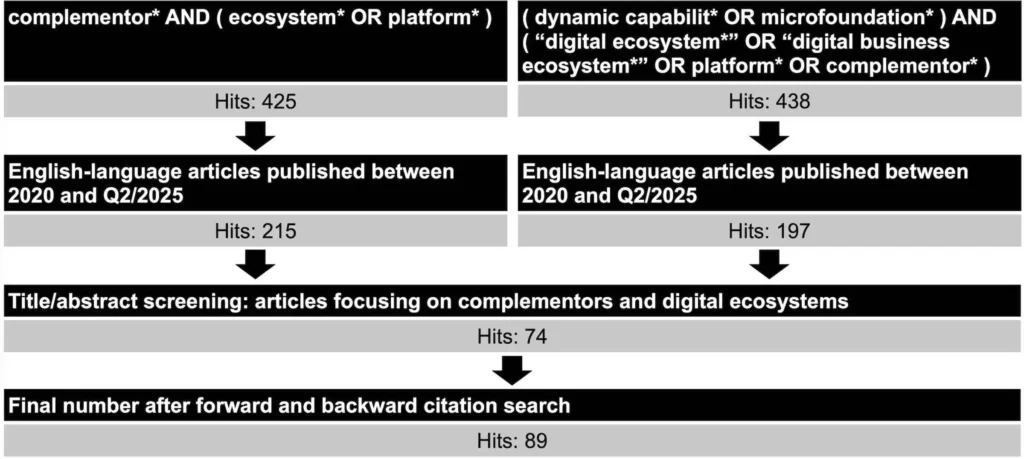
To do so, we conducted a systematic literature review following the method of vom Brocke et al. [8]. We employed two distinct search streams in the Scopus database: one capturing literature on complementors in digital ecosystems and a second focusing on DCs in digital ecosystems. The initial searches yielded 425 and 438 publications, respectively.
We subsequently limited the sample to English-language articles published between 2020 and mid-2025, resulting in 215 and 197 articles. After removing duplicates and excluding studies that did not explicitly address complementors in digital ecosystems based on their titles and abstracts, 74 articles remained. We further extended the sample through backward and forward citation searches, adding 15 articles, resulting in a final sample of 89 studies (Fig. 1).
Most studies in the final sample are empirical in nature (72). The majority of the reviewed literature focuses on digital software platform ecosystems (42), followed by physical-digital ecosystems (14), which combine digital platforms with tangible products or services, and digital marketplace ecosystems.
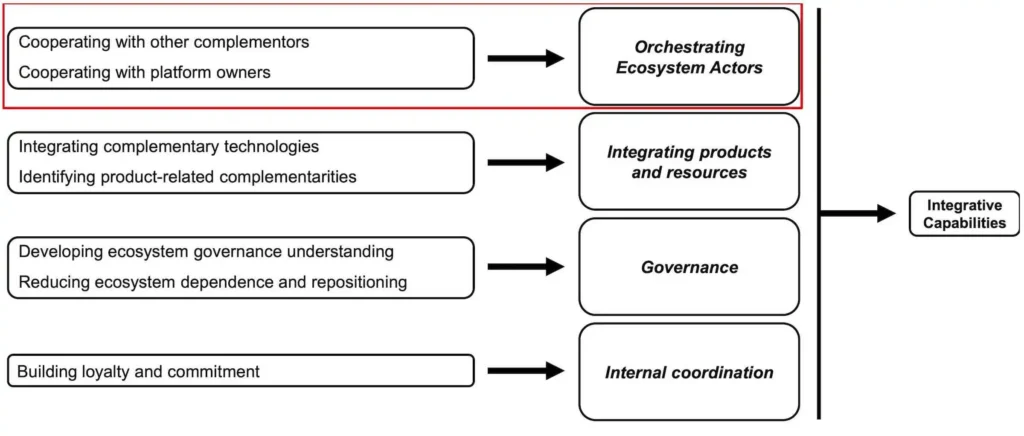
To conduct the qualitative analysis, we employed Gioia et al.’s method [9], identifying first-order concepts, second-order concepts, and aggregate dimensions. Following [6], we differentiated four microfoundations underlying integrative capabilities: orchestrating ecosystem actors, integrating products and resources, governance, and internal coordination. We treated these as second-order concepts under the aggregate dimension.
Through an iterative review of the literature, we then identified underlying first-order concepts from the perspective of complementors. In this study, we focus on the second-order concept orchestrating ecosystem actors and associate it with the two first-order concepts: cooperating with other complementors and cooperating with the platform owner (Fig. 2). Coding was iteratively conducted and refined by both authors using MAXQDA (version 24.9.1), thereby mitigating potential single-coder bias.
Cooperating with other complementors
Across the reviewed literature, 21 studies address cooperation among complementors, which is associated with access to novel resources, information exchange, and network externalities [10]. Such cooperation can take place spontaneously (and serendipitously), ranging from participation in hackathons, conferences and seminars to networking events organized by industry associations or universities [11, 12]. It may also take more structured forms, such as bottom-up, self-organized coalitions which can be mandated or facilitated by the platform owner (e.g., through dedicated events, partner managers), affecting complementor generativity and platform control [13].
Notably, the reviewed studies do not specify the degree of formalization underlying different forms of cooperation. Engaging in cooperation requires complementors to identify suitable partners within the ecosystem, supported by routines for monitoring competing complementors. In this regard, the evaluation of available competitive information, such as product features, user reviews, and prices, is often mentioned (e.g., [14]). A more intense routine is deliberate partnership scouting, which extends beyond monitoring and includes evaluation routines such as assessing technical compatibility and strategic alignment regarding value proposition and corporate philosophy [15]. Drawing on the information gathered, complementors are more likely to collaborate when their offerings are complementary and jointly extend the functional scope of their products [16].
The literature commonly focuses on the tension between cooperation and competition (coopetition; [17, 1]). Studies find that coopetition may be advantageous, accelerating innovation, e.g., in the case of software-developing complementors [18]. Complementors manage coopetition through routines, including balancing resource and knowledge sharing with the protection of critical assets [19, 20]. Furthermore, to share risks, complementors allocate investments and exposure to market uncertainty across coopetitive partners [21]. Finally, [12] show that firms in emergent and highly uncertain ecosystems strongly focus on non-routine elements of partnering activities rather than following standardized routines.
Cooperating with the platform owner
Given their central role, 27 studies examine the relationship between complementor firms and platform owners mostly from the perspective of the platform owner. Nevertheless, complementors also have incentives to engage in cooperation [10]. They may gain a competitive edge through endorsements [22, 23], direct investments [15], marketing support through exclusive deals and promotion [24], or mutual access to technologies and networks [25].
While the reviewed studies provide no insight into the degree of formalization, they identify recurring forms of cooperation with platform owners. Complementors use multiple channels to establish contact and communicate with them, ranging from online services such as help desks [26] to interaction via platform agents, including partners or sales managers, who serve as key boundary-crossing agents [15], and extending to premium support arrangements involving dedicated key account managers for selected complementors [12].
One routine for collaborating with platform owners involves developing complements with higher quality or network effects, as these are more likely to receive promotion and adoption support by the platform owner [24]. Another frequently mentioned routine is single-homing, which means committing exclusively to one ecosystem. Platform owners may endorse complementors in exchange for exclusivity by actively promoting their complements [23, 27], as exclusivity enhances a platform’s competitive position by denying rival platforms access to valuable complements [28]. However, research also discusses potential downsides of single-homing, including reduced performance due to foregone reach across multiple platforms [29] and costly interdependencies when ecosystems undergo architectural change [30].
Furthermore, cooperation with the platform owner is supported by routines aimed at strategic alignment and adaptation, as complementors are ‘platform followers’ who must comply with platform governance [10]. To this end, complementors ensure compliance with legal and regulatory requirements imposed by the platform (e.g., data protection, financial reporting; [31]) and continuously synchronize their offerings with the platform’s value proposition [15]. In addition, complementors can integrate ‘platform boundary resources’ (e.g., application programming interfaces and software development kits) originating from the platform owner [17].
Finally, studies also identify collaborative processes related to platform co-development. These include offering digital expertise and technological support to the platform owner [19], reporting bugs [31], and early involvement of complementors in the design and testing of platform boundary resources [32]. Coopetition between complementors and platform owners occurs when platform owners enter complementor markets by introducing ‘first-party complements’ [10, 33, 23]. For example, Amazon offers products that directly compete with those of complementors [34].
While the literature does not point to a single best practice for complementors managing coopetition, it identifies organizational strategies such as separating cooperative and competitive activities into distinct domains or teams (e.g., hotels collaborating with digital platforms on technical integration while competing in customer-facing activities; [35]). In addition, complementors may profit from positioning themselves as ‘bottleneck’ complementors within the value network, thus increasing their bargaining power [33].
Opportunities for complementors through cooperation
Drawing on Helfat & Raubitschek’s concept of integrative capabilities [6], the study analyzes platform orchestration from the complementor perspective. The reviewed literature suggests that effective orchestration hinges on cooperation both with other complementors and with the platform owner.
At the same time, the existing body of research remains fragmented. In particular, relatively little is known about the degree of formalization of such cooperations and a more systematic taxonomic differentiation of complementor and ecosystem types is still lacking. The literature predominantly focuses on B2C-oriented digital ecosystems, while orchestration dynamics in B2B contexts remain underexplored.
Regarding the examined routines, the literature highlights the importance of partnership sensing, such as identifying suitable partners through monitoring and evaluation. These enable complementors to initiate collaborative relationships, particularly in the presence of information asymmetries within (emerging) digital ecosystems [3]. At the same time, complementors need to actively manage coopetition by safeguarding critical resources and knowledge while sharing risks with selected partners. Finally, close alignment with platform governance, including compliance with rules and the integration of platform boundary resources, is essential for maintaining cooperative relationships and potentially securing preferential support from platform owners.
These findings also provide practical implications for complementors cooperating with other ecosystem actors. These involve establishing systematic partner-sensing routines to complement, especially in smaller companies, serendipitous or ad-hoc partnering driven by top management. Competitor analyses, ecosystem mapping, and active participation in industry and platform events enable the identification of suitable partners at an early stage. Focused co-creation, e.g., for B2B complementors serving the same customers, may provide further insight into partnering potentials. At the same time, this necessitates clear rules for resource and knowledge sharing to protect critical assets. In addition, complementors need to attract platform awareness, e.g., by engaging in dedicated communication channels (e.g., help desks, partner programs, and direct contact points) but also through public events. A raised profile helps to improve access to information, support, and co-development opportunities.
Finally, multi-homing may serve as a strategic hedge, carefully balancing trade-offs between market reach, dependency, and potential platform support as well as the costs associated with integrating platform boundary resources (e.g., APIs and SDKs). At the same time, multi-homing drives up the cost of partner-sensing, which may constitute a major roadblock for resource-constrained, smaller complementors. Given the complex nature of multiple ecosystems and power asymmetry via platform operators, self-organizations among complementors (e.g. through associations, norm-setting bodies, trade councils, etc.) also become highly relevant.
This is an original article. The German translation can be accessed via DOI: 10.30844/I4SD.26.4.3
Bibliography
[1] Zhang, Y.; Li, J.; Tong, T. W.: Platform governance matters: How platform gatekeeping affects knowledge sharing among complementors. In: Strategic Management Journal 43 (2022) 3, pp. 599-626.[2] Kapoor, R.: Ecosystems: Broadening the locus of value creation. In: Journal of Organization Design 7 (2018) 1, p. 12.
[3] Zabel, C.; Natzel, J.; O’Brien, D.: Fishing for complements: Partnership scouting routines of non-focal B2B firms in emerging-technology digital business ecosystems. In: S. Baumann (Ed.): Handbook on Digital Platforms and Business Ecosystems in Manufacturing. 2024, pp. 88-105.
[4] Teece, D. J.; Pisano, G.; Shuen, A.: Dynamic capabilities and strategic management. In: Strategic Management Journal 18 (1997) 7, pp. 509-533.
[5] Teece, D. J.: Profiting from innovation in the digital economy: Enabling technologies, standards, and licensing models in the wireless world. In: Research Policy 47 (2018) 8, pp. 1367-1387.
[6] Helfat, C. E.; Raubitschek, R. S.: Dynamic and integrative capabilities for profiting from innovation in digital platform-based ecosystems. In: Research Policy 47 (2018) 8, pp. 1391-1399.
[7] Priyono, A.; Hidayat, A.: Fostering innovation through learning from digital business ecosystem: A dynamic capability perspective. In: Journal of Open Innovation: Technology, Market, and Complexity 10 (2024) 1.
[8] vom Brocke, J.; Simons, A.; Niehaves, B.; Reimer, K.; Plattfaut, R.; Cleven, A.: Reconstructing the giant: On the importance of rigour in documenting the literature search process. In: ECIS 2009 Proceedings, pp. 2206-2217.
[9] Gioia, D. A.; Corley, K. G.; Hamilton, A. L.: Seeking Qualitative Rigor in Inductive Research: Notes on the Gioia Methodology. In: Organizational Research Methods 16 (2013) 1, pp. 15-31.
[10] Carst, A. E.; Hu, Y.: Complementors as ecosystem actors: A systematic review. In: Management Review Quarterly 74 (2024) 4, pp. 2579-2635.
[11] Fang, T. P.; Wu, A.; Clough, D. R.: Platform diffusion at temporary gatherings: Social coordination and ecosystem emergence. In: Strategic Management Journal 42 (2021) 2, pp. 233-272.
[12] Zabel, C.; O’Brien, D.; Natzel, J.: Sensing the Metaverse: The microfoundations of complementor firms’ dynamic sensing capabilities in emerging-technology ecosystems. In: Technological Forecasting and Social Change 192 (2023), p. 122562.
[13] Engert, M.; Hein, A.; Maruping, L. M.; Thatcher, J. B.; Krcmar, H.: Self-organization and governance in digital platform ecosystems: An information ecology approach. In: MIS Quarterly: Management Information Systems 49 (2025) 1, pp. 91-122.
[14] Liu, S.; Wang, J.; Hu, S.; Xia, J.: Imitate the Best or Imitate the Most? Complementors’ Product Development Strategies Impacted by Platform Features. In: IEEE Transactions on Engineering Management 71 (2024), pp. 11441-11453.
[15] Engert, M.; Evers, J.; Hein, A.; Krcmar, H.: Sustaining complementor engagement in digital platform ecosystems: Antecedents, behaviours and engagement trajectories. In: Information Systems Journal 33 (2023) 5, pp. 1151-1185.
[16] Pauli, T.; Marx, E.; Fielt, E.; Marheine, C.; Matzner, M.: Inhibitors and Enablers of Leverage in Digital Industrial Platform Ecosystems. In: Business and Information Systems Engineering (2025).
[17] Soh, F.; Grover, V.: Leveraging Platform Boundary Resources: The Role of Distributed Sensemaking. In: Journal of Management Information Systems 39 (2022) 2, pp. 366-394.
[18] He, Y.; Hu, M.; Lin, Y.: Effects of complementors’ perceived coopetition on fostering innovation: Evidence from Chinese software platforms. In: Industrial Marketing Management 117 (2024), pp. 66-78.
[19] Kamalaldin, A.; Sjödin, D.; Hullova, D.; Parida, V.: Configuring ecosystem strategies for digitally enabled process innovation: A framework for equipment suppliers in the process industries. In: Technovation (2021), p. 105.
[20] Maijanen, P.: Digital business ecosystems and dynamic capabilities. In: Baumann, S. (Ed.): Handbook on Digital Business Ecosystems. 2022.
[21] Cenamor, J.: Complementor competitive advantage: A framework for strategic decisions. In: Journal of Business Research 122 (2021), pp. 335-343.
[22] Kang, H.: Too much can be as bad as too little: Product update strategy for online digital platform complementors. In: Industrial and Corporate Change 31 (2022) 6, pp. 1494-1516.
[23] Rietveld, J.; Schilling, M. A.; Bellavitis, C.: Platform Strategy: Managing Ecosystem Value Through Selective Promotion of Complements. In: Organization Science 30 (2019) 6, pp. 1232-1251.
[24] Agarwal, S.; Miller, C. D.; Ganco, M.: Growing platforms within platforms: How platforms manage the adoption of complementor products in the presence of network effects? In: Strategic Management Journal 44 (2023) 8, pp. 1879-1910.
[25] Shim, D.: Interplay between Platform Providers and Complementors via Affordance, Autonomy, and Super-Modularity: The Empirical Investigation of the Korean Digital Industry. In: Journal of Theoretical and Applied Electronic Commerce Research 19 (2024) 2, pp. 975-992.
[26] Chi, M.; Huang, R.; Li, Y. J.; Wang, J.: The impact of cross-boundary knowledge management and platform control on sellers’ innovativeness and competitiveness. In: Technovation 141 (2025), p. 103171.
[27] Tavalaei, M. M.; Cennamo, C.: In search of complementarities within and across platform ecosystems: Complementors’ relative standing and performance in mobile apps ecosystems. In: Long Range Planning 54 (2021) 5, p. 101994.
[28] Carroni, E.; Madio, L.; Shekhar, S.: Superstar Exclusivity in Two-Sided Markets. In: Management Science 70 (2024) 2, pp. 991-1011.
[29] Castro, H. R.; Sant’Anna, D. A. L. M.: Playing against the platform: A research note on the impact of exclusivity under vertical competition in video game platforms. In: Technological Forecasting and Social Change (2023) 191, p. 122501.
[30] Agarwal, S.; Kapoor, R.: Value Creation Tradeoff in Business Ecosystems: Leveraging Complementarities While Managing Interdependencies. In: Organization Science 34 (2023) 3, pp. 1216-1242.
[31] Engert, M.; Evers, J.; Hein, A.; Krcmar, H.: The Engagement of Complementors and the Role of Platform Boundary Resources in e-Commerce Platform Ecosystems. In: Information Systems Frontiers 24 (2022) 6, pp. 2007-2025.
[32] Weiss, N.; Schreieck, M.; Wiesche, M.; Krcmar, H.: Lead complementor involvement in the design of platform boundary resources: A case study of BMW’s onboard apps. In: Information Systems Journal 33 (2023) 6, pp. 1279-1311.
[33] Pei, L.: Winner-takes-all or competitive coexistence? Research on the co-opetition relationships between platform owners and complementors. In: Chinese Management Studies 18 (2024) 6, pp. 1678-1707.
[34] Yoo, D. K.; Roh, J. J.; Cho, S.; Yang, M. M.: Coopetition in a platform ecosystem: From the complementors’ perspective. In: Electronic Commerce Research 24 (2024) 3, pp. 1509-1532.
[35] Bahar, V. S.; Nenonen, S.; Starr Jr, R. G.: Coopetition with platforms: Balancing the interplay of cooperation and competition in hospitality. In: Tourism Management 88 (2022), p. 104417.
Your downloads
Potentials: Globalization Profitability Strategy
You might also be interested in