Blockchain

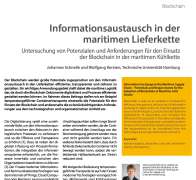
Information Exchange in the Maritime Supply Chain

Information Exchange in the Maritime Supply Chain

Johannes Schnelle ORCID Icon, Wolfgang Kersten ORCID Icon
Blockchain is seen as an enabler to increase the efficiency, transparency, and security of information exchange in supply chains. An important application area is maritime logistics, as blockchain facilitates the digitalization of documents and increases the efficiency of the processes. In this article, we elaborate on the example of temperature-controlled container transports the potential for adopting blockchain and the requirements to be considered from the technological and organizational environment.
Industrie 4.0 Management | Volume 38 | 2022 | Edition 6 | Pages 29-32 | DOI 10.30844/IM_22-6_29-32
Platform Economy Without a Platform

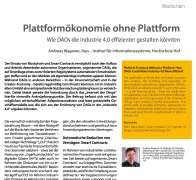
Platform Economy Without a Platform

How DAOs could make Industry 4.0 more efficient
Andreas Wagener
The application of blockchain and smart contracts also enables the building and operation of decentralized autonomous organizations (DAOs). While DAOs are already regularly in use in other areas – e. g. the financial sector − there has hardly been any application in an industrial environment, although, digitalisation and the upcoming of the "Internet of Things" have created a fruitful environment. This article looks at possible economic approaches to adaptation and explores potential business models that could result from the establishment of DAOs in Industry 4.0. (Only in German)
Industrie 4.0 Management | Volume 38 | 2022 | Edition 6 | Pages 51-53
Tool Management of the Future – A Practical Approach to the Use of Digital Twins

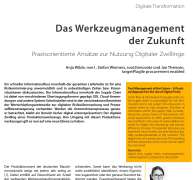
Tool Management of the Future - A Practical Approach to the Use of Digital Twins

Praxisorientierte Ansätze zur Nutzung Digitaler Zwillinge
Anja Wilde, Stefan Wiemers, Jan Theissen
A fast flow of information throughout the entire supply chain is unavoidable for risk minimization and is not subject of a discussion in volatile times or crisis situations. The flow of information within the supply chain is characterized by various forms of transmission: EDI, cloud applications or other system interfaces are manifold in the areas of value-added networks for digital risk monitoring and process efficiency increase. If corporate processes are examined more closely, one area remains digitally underrepresented at the moment: The digital twin of a production tool. The handling of these production tools must now be taken to a new level.
Industrie 4.0 Management | Volume 36 | 2020 | Edition 6 | Pages 39-42
Das HANSEBLOC-Projekt

Das HANSEBLOC-Projekt

Problemstellung und Lösungen
Thomas Twenhöven, Björn Engelmann, Julian Kakarott, Kevin Westphal, Moritz Petersen
Blockchain holds high potential for various applications. In the business context, one of its key features - the availability of data to various parties - is a liability as business secrets shouldn’t be exposed and GDPR compliance has to be ensured. In this paper, we discuss solutions for these privacy problems. Also, we present the HANSEBLOC project, a blockchain-powered platform for data exchange in logistics, and the chosen privacy solutions.
Industrie 4.0 Management | Volume 36 | 2020 | Edition 1 | Pages 45-48 | DOI 10.30844/I40M_20-1_S45-48
Decentralized IOTA-based Industry Marketplace

Decentralized IOTA-based Industry Marketplace

Industry marketplace based on IOTA, eCl@ss and I4.0 administrative shell
Alexander Belyaev, Christian Diedrich, Holger Köther, Alaettin Dogan
This article presents an IOTA Industry Marketplace. The industry marketplace is a manufacturer- and industry-neutral open-source platform, based on the specifications and guidelines of the platform Industry 4.0 and enables an uncomplicated integration of company information systems into the overall network. The industry marketplace combines distributed ledger technology, unchangeable audit trails, standardized, machine-readable language, an integrated distributed identity system and provides a trusted and secure infrastructure for data and value transfer.
Industrie 4.0 Management | Volume 36 | 2020 | Edition 1 | Pages 36-40 | DOI 10.30844/I40M_20-1_S36-40
Digitize Delivery Processes with 0G Network and Blockchains

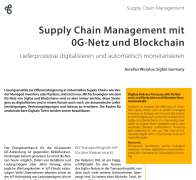
Digitize Delivery Processes with 0G Network and Blockchains

Digitize delivery processes and monetize them automatically
Aurelius Wosylus
Solutions to increase the efficiency of industrial supply chains, such as vendor managed inventory or Kanban, are not new. But thanks to technologies such as the 0G network from Sigfox and blockchains, it is becoming ever easier to digitize these strategies and to add automatic delivery confirmations, invoicing and collection in one go. The cost of immutable digital twins is becoming more and more affordable.
Industrie 4.0 Management | Volume 36 | 2020 | Edition 1 | Pages 53-56
Blockchains in the Context of Supply Chain Management

Blockchains in the Context of Supply Chain Management

A Critical Standpoint
Christian Straubert, Eric Sucky
Currently there are many optimistic expectations for the new and still little understood technology “blockchain”. This paper takes a critical stance and analyses the potential of blockchains in supply chain management (SCM). In the context of SCM, the application of blockchains promises transparency and traceability. It turns out that the expectations are not always met, because blockchains lose many of their positive characteristics when used in SCM. This is mainly due to the fact that both a digital level (information) and a physical level (goods) exist. In the original application area of blockchains - cryptocurrencies - only the digital level exists. In any case, blockchain technology (as well as every other technology) will not be able to solve the coordination problems within supply chain networks without the individual companies being willing to implement expensive IT interfaces and share their information.
Industrie 4.0 Management | Volume 36 | 2020 | Edition 1 | Pages 19-23
Impact of Blockchain Technology on the Role of the CFO in the Context of Industry 4.0

Impact of Blockchain Technology on the Role of the CFO in the Context of Industry 4.0

Philipp Sandner, Philipp Schulden
Due to the advancing digitalization of business sectors and increasing competitive pressures, industrial companies are forced to promote their own digital transformation to sustain on the market. Here, the literature regards the CFO as a key corporate function to induct digitization initiatives within organizations. The blockchain technology, due to its features of transparency, immutability and cryptography combined with its ability to coordinate data flows of e. g. the IoT or AI, constitutes a suitable instrument for the CFO to meet the requirements of the Industry 4.0. The results are improvements of business processes in regard to efficiency and automation, a relocation of the CFO’s strategic role, improvements of CFO-relevant KPIs through integrating machines into payment networks as well as the emergence of integrated business ecosystems facilitating new forms of inter-organizational collaboration.
Industrie 4.0 Management | Volume 36 | 2020 | Edition 1 | Pages 61-64
Business Models in the Context of Blockchain Technology

Business Models in the Context of Blockchain Technology

Teil 2
David Holtkemper, Jan Breidenbach
Blockchain technology attracted a great deal of attention with its first application Bitcoin. In addition to the multitude of practical solutions, initiatives and research efforts of the industry, the number of scientific publications on the topic of blockchain is comparatively low. Right now, there is a lack of universal standards and uniform terminology. One way of documenting blockchain technology could be a morphological box. In addition to the advantage of clarity, this type of information structuring offers further advantages that can be considered helpful in creating a comprehensive overview. In order to create such a morphological box, various features of the blockchain technology must be identified and described in detail. One of these features is the “business model”, for which the 4 different characteristics “infrastructure provider”, “platform provider”, “system integrator” and “application provider” have been identified.
Industrie 4.0 Management | Volume 36 | 2020 | Edition 1 | Pages 49-52
Challenges and Potentials of Blockchain Technology  Guidance for Manufacturing Companies

Challenges and Potentials of Blockchain Technology Guidance for Manufacturing Companies

Handlungsempfehlungen für produzierende Unternehmen
Günther Schuh ORCID Icon, Simon Ryschka, David Holtkemper, Simon Wieninger, Marcus Kampa
Blockchain technology (BCT) is one of the most promising technologies of the present that will be of even greater importance in the future, especially for manufacturing companies, in order to improve cross-company collaboration and make processes more transparent to the customer. However, BCT is not yet widely used as a trusted tool to ensure a clean and unadulterated flow of information. In addition to the potential, this paper discusses the challenges for the use of BCT and derives a solution concept based on the St. Gallen Management Model that shows potential BCT users possible application scenarios.
Industrie 4.0 Management | Volume 36 | 2020 | Edition 1 | Pages 7-10
1 2