Maturity Levels of Smart Knowledge Services |
Self-assessment and GAP analysis

| Journal | Industry 4.0 Science |
| Issue | Volume 40, 2024, Edition 4, Pages 50-56 |
| Bibliography | Share | Cite | Download |
Abstract
Keywords
Article
Until 2030, the shortage of trainees and skilled workers will continue worsening and increase the need for more efficient, effective training. As early as 2022, 49.7% of the companies surveyed stated that they would be directly affected by the shortage of skilled workers [1]. The increasing complexity of service and product-service systems can be seen as both a challenge and an opportunity.
Digitization and the associated developments are opening up new forms of on-the-job training [2]. The technologies required for orchestration are already available for use. The changing focus away from pure products towards the inclusion of services [3] and thus the orientation towards the needs of customers [4] is increasingly leading to product-service systems or, through the use of networked, digitalized and individualized solutions, to so-called smart product-service systems [5]. Digital technologies are already indispensable in the collection of data, procurement of information and its enrichment into usable knowledge.
This requires a rethink of how knowledge should be generated and transferred with the advent of Industry 4.0. Limitations based purely on human resources are no longer a given. The forms and possibilities of knowledge transfer are being expanded. In particular, the cost of individualized training, whether during the activity in real time or in advance, can be significantly reduced through the use of so-called smart services [2]. In this way, individualized forms of knowledge transfer can be used more efficiently and effectively, with greater reach and with minimal or no human resources.
New forms of knowledge transfer as an opportunity for the future
Smart services are understood as digitized, individualized services connected to an ecosystem [6]. The main goal is the ability to better meet customer needs proactively with the help of suitable technology and the intelligent use of digital data, even if those needs change over time [7]. This is particularly important in the context of widely varying requirements and environmental conditions [8]. Not only the shortage of skilled workers, but also digitization makes change within companies and among customers indispensable. Accordingly, the choice of suitable technologies for knowledge transfer in a professional context is important on a fundamental level [2].
Knowledge must first be created or processed. Bender and Fisch define information, obtained from data, as the preliminary stages of knowledge. Knowledge is gained through the process of transforming information. The smallest building block is data that can be linked to information [9].
Knowledge transfer is understood as the preparation of knowledge by a source (e.g. training center) and the corresponding successful transfer of new knowledge to a recipient (e.g. employee). The transfer can take place through various forms and technologies of knowledge transfer [10]. Smart services can play a decisive role in both the transfer and the generation of knowledge [2]. In this way, smart services can be used in the creation of data, its transformation into usable information and finally its enrichment into usable knowledge within the company.
In addition to the branch of knowledge creation or procurement, there’s great potential in knowledge transfer itself. The sensible networking of knowledge generation and appropriately prepared knowledge transfer offers a company various advantages. In addition to creating synergies and the associated efficiency and effectiveness, new paths can be taken. The integration of smart services enables new forms of knowledge transfer.
Smart services can therefore be seen as enablers for different forms of knowledge transfer. Forms of training are not only possible in advance, but also in real time, via remote or digital media during work [2]. Smart knowledge services, in combination with smart service, form a digitized and individualized form of knowledge transfer. Furthermore, intelligent systems can make the subsequent transfer of knowledge more effective and efficient as early as the data creation and collection stage.
Another aspect is employee acceptance, which isn’t necessarily a given, even in the case of high-performance systems [11]. The successful application or transfer of knowledge to the user is the most important interface and therefore requires special attention [12]. In the case of maintenance work, it has been shown that the competence and equipment of employees can be seen as key factors in reducing costs and increasing productivity [13].
The main driver of quality and reliability is appropriate training [14]. For this reason, choosing the appropriate methodology to influence the knowledge base of an organization is crucial.
Individualized and digitized knowledge transfer
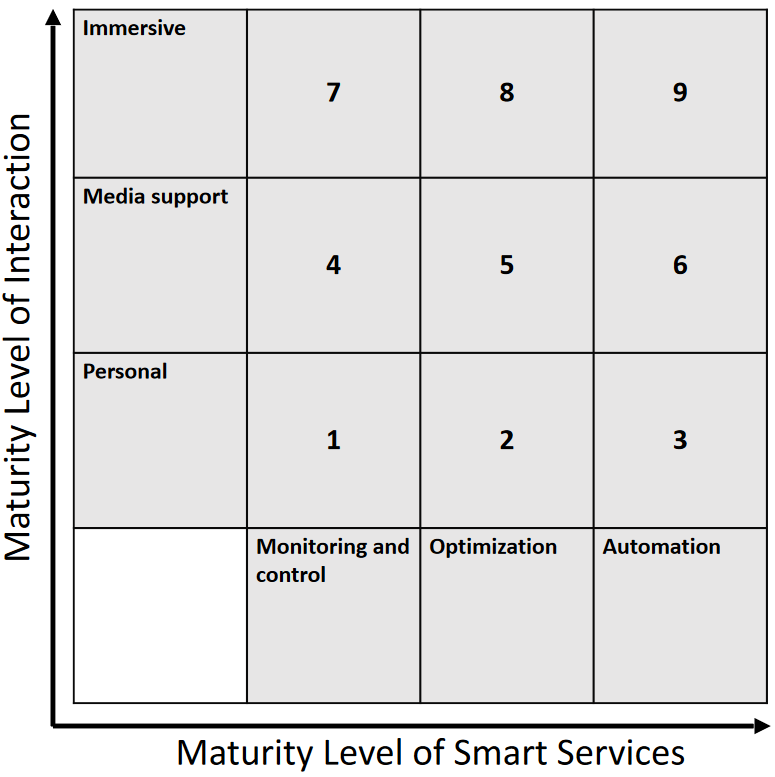
Smart knowledge services open up opportunities for standardized and individualized training, instructions, self-services and remote support. Knowledge transfer can be carried out using personnel, media support or immersive technologies. Smart Services can be used for the purposes of monitoring, control, optimization or automation [2, 7]. Figure 1 shows the so-called maturity levels of interaction and smart services. The maturity levels of interaction are divided into personal, media support and immersive. A strict separation is just as possible as a combination of different maturity levels. This essentially depends on the goals of the organization.

Monitoring and control represent the first maturity level of smart services, followed by the maturity levels of optimization and autonomy [15]. Technologies such as machine learning and AI are playing an increasingly important role, particularly in the areas of optimization and autonomy [1]. Proactive smart services are being put forward in the case of the last maturity level of smart services (autonomy) [15].
In the past, individualized training for thousands of employees, taking into account their position, individual experience and knowledge, seemed neither affordable nor feasible in terms of personnel. Larger companies in particular are faced with the challenge of processing and organizing their enormous data pool in a usable way.
With appropriate processing of the existing data pool and the use of suitable technologies, individualized training units could be generated and retrieved effectively and efficiently in the shortest possible time. For example, AI can be used to analyze knowledge transfer to process the individual learning progress of employees and make it available to training staff. In this way, personnel can be saved even in large groups without losing sight of the individual’s learning progress.
Advances in technology alone aren’t enough to realize this vision of customized smart training. In practice, companies need to create the basis for generating, storing, classifying and processing data. Once these prerequisites have been created, smart knowledge services could make such a vision possible.
Self-assessment for smart knowledge services
The combination of both maturity levels results in nine possible fields. Each field represents different maturity levels of smart knowledge services, as shown in Figure 2. In the case of maturity level 6, this means interaction through media and the use of autonomous smart services, as may be the case with online learning content. Level 9 represents the highest level of interaction and smart services maturity. This model enables an initial assessment and the possibility of making adjustments if necessary, depending on the objective of the source and recipient of the knowledge transfer. Ultimately, the knowledge transfer should be geared towards both the learning objectives of the recipient (e.g. employees) and the objectives of the source (e.g. management).
The use of immersive technologies, e.g. virtual reality (VR), augmented reality (AR) or mixed reality (MR), enables training or courses that could, for example, realistically simulate dangerous situations without posing any actual risks to users.
Chemical or reactor accidents, perhaps, could be carried out and tested realistically. Furthermore, training units can be carried out that would be unthinkable in normal production operations, as otherwise production would have to be shut down. With the inclusion of optimization or autonomy, new types of content that can be adapted to the needs and abilities of the users during training would be conceivable. The model of maturity levels of smart knowledge services offers the option of improving existing knowledge transfers or creating new smart knowledge services. The self-assessment should include in-house knowledge, the data integrity of the data pool and the needs and goals of employees and management as important aspects.
To this end, in-house competencies are compared with the requirements for the desired maturity level. Individual services or components of services can be assigned to the fields to create a mix of different maturity levels according to requirements.
This provides an overview of the current maturity level as well as strategic considerations, such as further developments or adjustments to user needs or changes in management objectives. Existing services can be examined with regard to requirements to ultimately select the right form and methodology of knowledge transfer. In this way, training can be improved in detail, but on-the-job training can also be integrated into everyday working life.
Due to the possibility of improving the efficiency and effectiveness of individual knowledge transfer in real time during work, smart knowledge services are increasingly moving into managers’ fields of interest. Augmented reality opens up the option of integration into everyday working life and is able to convey instructions more comprehensibly than conventional instructions [16]. Through the use of VR, AR, MR and AI, Smart knowledge services also offer the possibility of integrating playful aspects and thus further incentives such as reward incentives for users in the areas of training, instruction, self-service and remote support [2].
It’s possible to derive requirements, from the purchase of head-mounted displays (colloquially known as VR glasses) for participating in virtual realities to the creation of a dedicated virtual reality department. In this way, CAD data, for example, can be prepared and processed for later use in training situations as soon as it is created.
By taking a holistic view of internal aspects, deficits as well as strengths can be identified and specifically reduced or expanded. Training content and modules can be adapted to the needs and learning objectives. For example, a virtual environment is methodically ideal for explaining exploded views, but can’t yet realistically reproduce the haptic feedback when replacing a module. Virtual environments are ideal for collaborative work across locations or national borders.
Maturity Level 7 would be conceivable for the design of a smart knowledge service with the aim of conveying an exploded view. Maturity Level 8 should be the aim if optimization suggestions are already included. The “maintenance and repair” module could in turn be carried out on a hardware dummy due to the improved haptic feedback and supported by personnel or media (maturity levels 1-6). The selection of the appropriate maturity level therefore requires a holistic view in order to be able to identify the appropriate form of influence on the knowledge base.
Smart knowledge services: GAPs of the maturity levels
The defined fields differ from one another due to the respective maturity levels of interaction and smart services. Depending on the field and the knowledge transfer considered, there are different circumstances. A GAP analysis is used to better understand the respective hurdles between the individual maturity levels. In this way, the advantages and disadvantages of different maturity levels for the design of a specific smart knowledge service can be better understood.
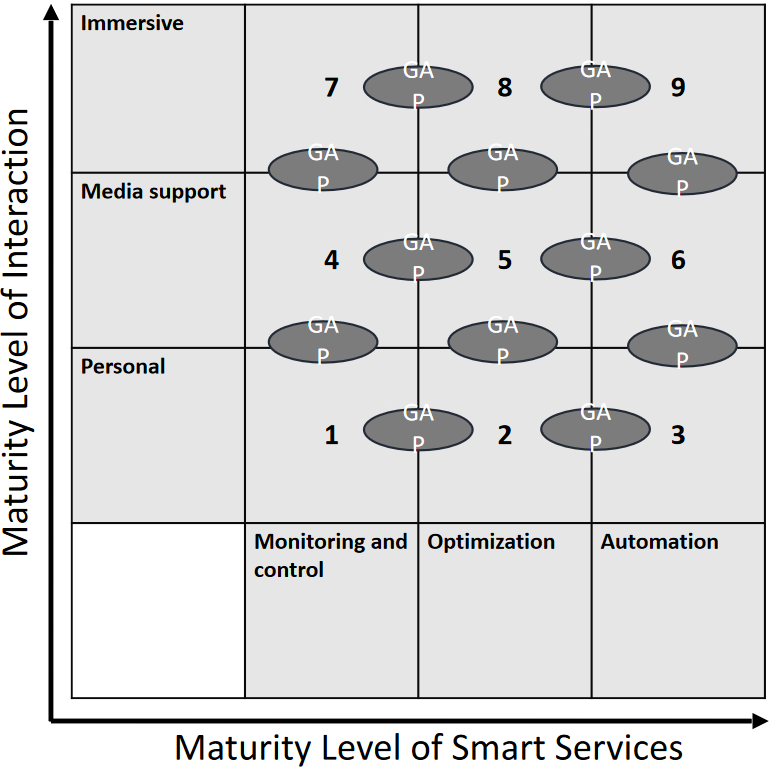
The hurdles, known as GAPs, are visualized in Figure 3 between the maturity level fields. If, for example, the suitable maturity level of the ideal knowledge transfer for a specific maintenance task is being determined, nine options are available. The size of the barrier to switching from media-supported to immersive instructions is highly dependent on the level of knowledge and acceptance of a service technician. Furthermore, the cost of immersive or media-assisted instructions for a one-off maintenance visit can be significantly higher than the support provided by a specialized service technician. However, the greater the number of deployments, the more positive the impact of media-supported or immersive content on the basic and marginal costs.
The same applies to the maturity level of smart services. In addition, the self-assessment and GAP analysis can be used for comparisons within the company and across the industry. Strengths and weaknesses of different approaches can be compared in this way. Beyond determining the current status in the company, potential for improvement can be identified and the size of the hurdles can be determined.
The future of smart knowledge services
Whereas employees previously made decisions based on intuition and experience [17], the appropriate design of smart knowledge services can support decisions with the help of suitable data pools [18]. A decentralized learning environment in real time, which used to be a utopian vision while work was being carried out, is now almost a reality. The tracking of work steps and therefore immediate feedback through the use of AR can shorten the duration of training, but also make errors during the execution of work transparent and communicate them to the user.
In the area of optimization, a course or training plan individually adapted to the needs and learning abilities of the user could be created and continuously improved. In this way, training personnel could be supported by trainees taking individual courses with media support in a blended learning format or interacting with colleagues across the globe in a corporate identity-adapted metaverse using VR cooperative training. Learning units could be integrated directly into the performance of activities, reducing training costs, improving productivity and reducing errors. The vision of individual, efficient and effective in-house learning on demand could become reality through the appropriate design and application of smart knowledge services.
Bibliography
[1] Peichl, A.; Sauer, S.; Wohlrabe, K.: Fachkräftemangel in Deutschland und Europa: Historie, Status quo und was getan werden muss. In: Leibniz Institute for Economic Research at the University of Munich 75 (10), pp. 1-70 (2022).[2] Husen, C. V. et al.: Knowledge on Demand by Smart Services. In: XXXIII International RESER Conference, pp. 213-233 (2023).
[3] Vargo, S. L.; Lusch, R. F.: Evolving to a New Dominant Logic for Marketing In: Journal of Marketing 68 (1), pp. 1-17 (2004).
[4] Tukker, A.; Tischner, U.: Product-Services as a Research Field: Past, Present and Future Reflections from a Decade of Research. In: Journal of Cleaner Production 14 (17), pp. 1552-1556 (2006).
[5] Zheng, P. et al: A Survey of Smart Product Service Systems: Key Aspects, Challenges and Future Perspectives. In: Advanced Engineering Informatics 42, pp. 1-19 (2019).
[6] Husen, C. V.; Abdel Razek, A. R.: Entwicklung von Smart Service-Leistungen mit Einsatz neuer Technologien. In: Künstliche Intelligenz im Dienstleistungsmanagement Band 1: Geschäftsmodelle – Serviceinnovationen – Implementierung. pp. 205-229 (2021).
[7] Graf-Drasch, V. et al.: A Contextualized Acceptance Model for Proactive Smart Services. In: Schmalenbach Journal of Business Research 74, pp. 345-387 (2022).
[8] Coetzer, A.; Perry, M.: Factors Influencing Employee Learning in Small Businesses In: Education + Training 50 (8/9), pp. 648-660 (2008).
[9] Bender, S.; Fish, A.: Transfer of Knowledge and the Retention of Expertise: The Continuing Need for Global Assignments In: Knowledge Management 4 (2), pp. 125-137 (2000).
[10] Liyanage, C. et al.: Knowledge Communication and Translation: A Knowledge Transfer Model. In: Journal of Knowledge Management 13 (3), pp. 118-131 (2009).
[11] Dam, H. K.; Tran, T.; Ghose, A.: Explainable Software Analytics In: Proceedings of the 40th International Conference on Software Engineering: New Ideas and Emerging Results, pp. 53-56 (2018).
[12] Cohen, W. M.; Levinthal, D. A.: Absorptive Capacity: A New Perspective on Learning and Innovation In: Administrative Science Quarterly 35 (1), pp. 128 (1990).
[13] Alsyouf, I.: The Role of Maintenance in Improving Companies’ Productivity and Profitability. In: International Journal of Production Economics 105, pp. 70-78 (2007).
[14] Wang, Q. H.; Li, J. R.: A Desktop VR Prototype for Industrial Training Applications In: Virtual Reality 7 (3-4), pp. 187-197 (2004).
[15] Gutsche, K.; Droll, C.: Enabling or Stressing? Smart Information Use Within Industrial Service Operation. In: Digital Human Modeling and Applications in Health, Safety, Ergonomics and Risk Management: Human Communication, Organization and Work. 11th International Conference, HCII 2020, Copenhagen (2020).
[16] Wanner, J. et al.: Verwendung binärer Datenwerte für eine KI-gestützte Instandhaltung 4.0. In: HMD Praxis der Wirtschaftsinformatik 56 (6), pp. 1268-1281 (2019).
[17] Zschech, P. et al.: Prognostic Model Development with Missing Labels. In: Business & Information Systems Engineering 61 (3) 3, pp. 327-343 (2019).
You might also be interested in