
Lean Empowerment in the Digital Ecosystem |
Translating cultural values into technical requirements

| Journal | Industry 4.0 Science |
| Issue | Volume 40, 2024, Edition 2, Pages 32-39 |
| Open Access | https://doi.org/10.30844/I4SE.24.2.32 |
| Bibliography | Share | Cite | Download |
Abstract
Keywords
Article
Designing digital and (cost-)efficient processes allows for the realization of potential throughout the entire value creation process of products, services and data-driven business models [1]. Sustainable success goes beyond pure process considerations and requires creative, satisfied employees, an approach to leadership grounded in partnership, and an appreciative, respectful culture of cooperation [2].
With the increasing need for global digital collaboration [3], the need arises for a digital understanding of culture.
A general question can be derived from this: How can cultural values be effectively implemented and lived out in a digital ecosystem? Digital interaction plays a role here, as does the translation of a digital understanding of values into technical requirements and their implementation as a functions in collaboration software. The question can be asked here: How can digital values be translated into technical requirements and implemented in software code?
In this study, the possibility of adapting a corporate culture based on physical presence into a culture that prioritized digital collaboration was examined.
The following section begins with an overview of the current academic situation in terms of collaboration in digital ecosystems and provides an introduction to lean empowerment as well as an explanation of the research approach taken. The findings and solutions are summarized in the section entitled “Living cultural values in the digital ecosystem”.
Collaboration in the digital ecosystem
Industrial value creation is increasingly characterized by a paradigm shift from product-centric demand to platform-based, data-driven business models [3]. The complexity of the services to be provided is constantly increasing, and value creation is also increasingly taking place in flexible, dynamic and global systems. The organization of collaboration ranges from traditional customer-supplier relationships to digitalized, collaborative networks [4, 5]. The vision of the networked economy is based on global, digital ecosystems [3], which comprise a “relationship structure of partners, competitors and customers around a specific product or service range” [6]. Cross-company teamwork is therefore becoming even more central.
With digital ecosystems, socio-technical systems of value creation are emerging beyond company boundaries [4]. In a socio-technical system, people, organizations and technologies are inextricably intertwined. The achievement of an overarching, common goal is at the forefront of the cooperation effort [7].
Collaboration is a form of cooperation that is designed to fulfill group goals and includes communication, coordination and cooperation between all participants [8]. Collaboration is always characterized by shared values, such as participation, personal responsibility or respect [2].
In addition to face-to-face collaboration, new work constellations are bringing digital collaboration to the fore. In this context, there is a need for adapted management and coordination concepts as well as a digital cultural understanding what corporate collaboration entails. Presence culture serves as a model, but cannot be reproduced in the digital world without further adaptations. Presence culture refers to a culture lived out in a physical location, whereas digital culture encompasses the conditions of working relationships in the digital space. Herget [9] attaches particular importance to the so-called generic cultural factors of belonging, appreciation and recognition, trust, personal growth and development as well as a sense of purpose in digital collaboration.
In the context of virtual collaboration, the associated digital collaboration tools are of interest in terms of technology. In the literature, tools for supporting groups with their work in overarching networks and organizations are summarized under the terms “group software” (also groupware or collaboration software) and “social software” [10, 11]. In digital ecosystems, well-known groupware solutions, such as Microsoft Teams, are also justified, as are individual software solutions for specific use cases.
The success factor for the operation of digital ecosystems lies in the handling of data across all three subsystems of the socio-technical system, whereby the common understanding of values also plays a decisive role. Creating transparency, living out the network concept and exhibiting an openness towards the exchange of data characterize the social subsystem. From an organizational perspective, it is important to enable access to data. Technical solutions create a secure, open exchange of data. In any case, working in digital ecosystems requires mutual trust so that all stakeholders can work towards common goals and make use of individual benefit options [3, 5, 6].
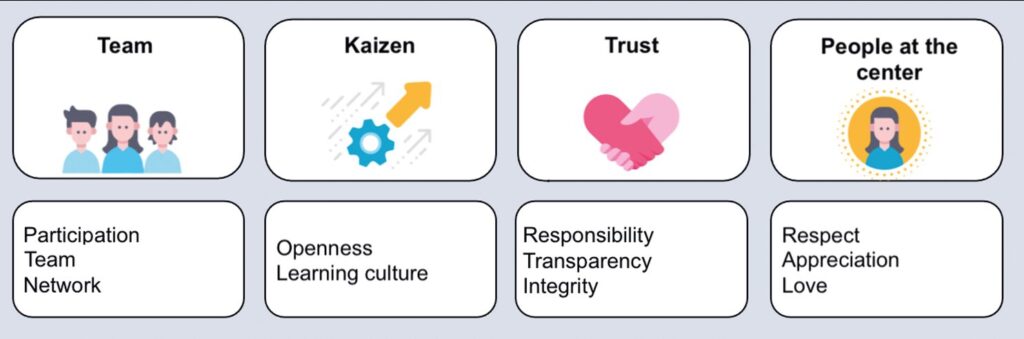
The values that characterize a culture of corporate cooperation can be assigned to four value units (Figure 1) [2].
The journey from presence-based to digital collaboration can proceed as follows: Initial focus revolves around working as an in-person team. The team has a strong understanding of teamwork in a working environment that is characterized by empowerment and an empowering leadership style. Personal interaction is based on a shared understanding of values and, in particular, on mutual appreciation. Tasks are solved by working together as a team and their resolution is therefore seen as the result of teamwork. The increasing complexity of the tasks to be performed makes it necessary to bring in other experts.
Digital, global collaboration develops with new colleagues and business partners in a digital ecosystem. Collaboration within the group will be supported by collaboration software, which needs to be developed to simplify specialist communication, the design of workflows and access to data, for example. The question arises as to how the previous cultural values of teamwork can be transferred to a digital culture. The idea of lean empowerment and the so-called “BERTAGNOLLI values” provide orientation when adapting management concepts and values to a digital ecosystem.
Lean Empowerment
Lean empowerment builds on the idea of lean leadership [12] and integrates the additional dimension of a lean culture alongside people and leadership. The idea of empowerment is based on Toyota’s culture and its incorporation of employee development and participation in order to achieve continuous process improvement. The corporate values of team and respect form the basis [2]. “Empowerment” thus forms the democratic or self-responsible level in the management theory. The previous stages are “management” according to Taylor and “leadership” according to Drucker [13].
In the course of intensive research into lean benchmark companies, the same cultural corporate values emerge again and again. There are eleven values that positively characterize the lean environment and enable lean empowerment: Participation, Ownership or Personal Responsibility, Respect, Transparency, Recognition or Appreciation, Community, Network, Openness, Learning Culture, Love and Integrity. In German, these are summarized under the acronym BERTAGNOLLI [2].
For this research, these values were clustered into four value units. The first unit combines the values of participation, community and network under the term “Team”. The Japanese term “Kaizen” combines openness and learning culture. Personal responsibility, transparency and integrity can be found under the heading “Trust”. Finally, the unit “People at the center” clusters respect, recognition and love (Figure 1).
Research approach
A qualitative explorative study based on a workshop concept was conducted with the aim of creating a space in which experts could discuss the research questions presented and, in particular, develop ideas and approaches to solutions [14].
The collection of ideas is based on the four value units of the lean empowerment approach.
The selection of participants was based on representatives from academic and corporate fields who have specialist expertise in the areas of lean, IT or engineering and are already working on innovative solutions in the digital context. Participants were recruited by direct approach. Representatives from the automotive and supplier industry, logistics services, mechanical engineering, the metal, packaging and electrical industries, software development, IT services, management consultancy, adult education and academia took part. The data collection took place over three digital workshop units held between September and October 2023 with a total of 26 experts participating.
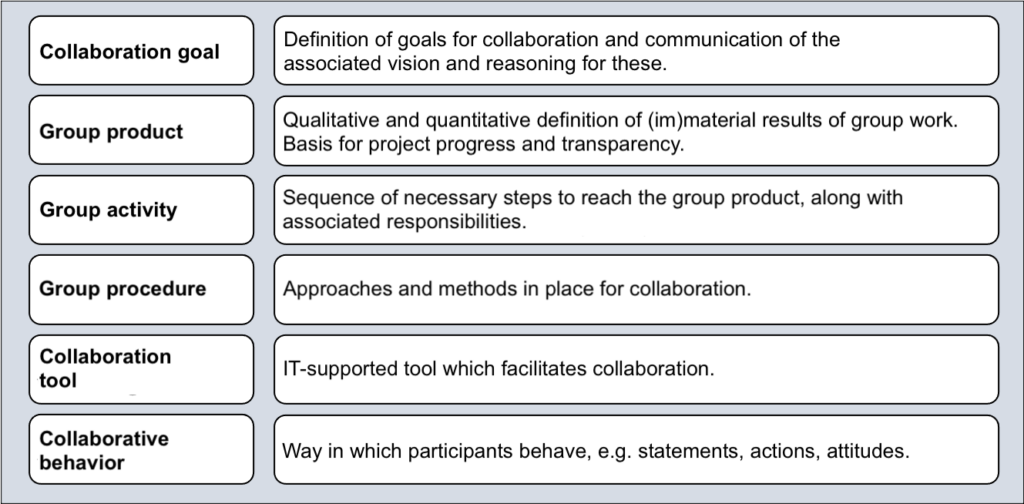
Once the data analysis was completed by categorizing the generated ideas, 552 usable data records were available. The categorization (Figure 2) is based on Leimeister’s six-level model [8]. An analysis and interpretation of the results led to the findings enumerated in the following section.
Living cultural values in the digital ecosystem
According to the objective of the study, the aim is to collect ideas for digital collaboration and, in particular, for the mapping of digital values onto software functions. The second objective is closely linked to the level of collaboration tools, which is the primary consideration of this section. Within the value units, as well as in the six-level model, the ideas are closely related to each other and cannot always be clearly categorized. Figure 3 provides an overview of the results presented below for each value cluster.
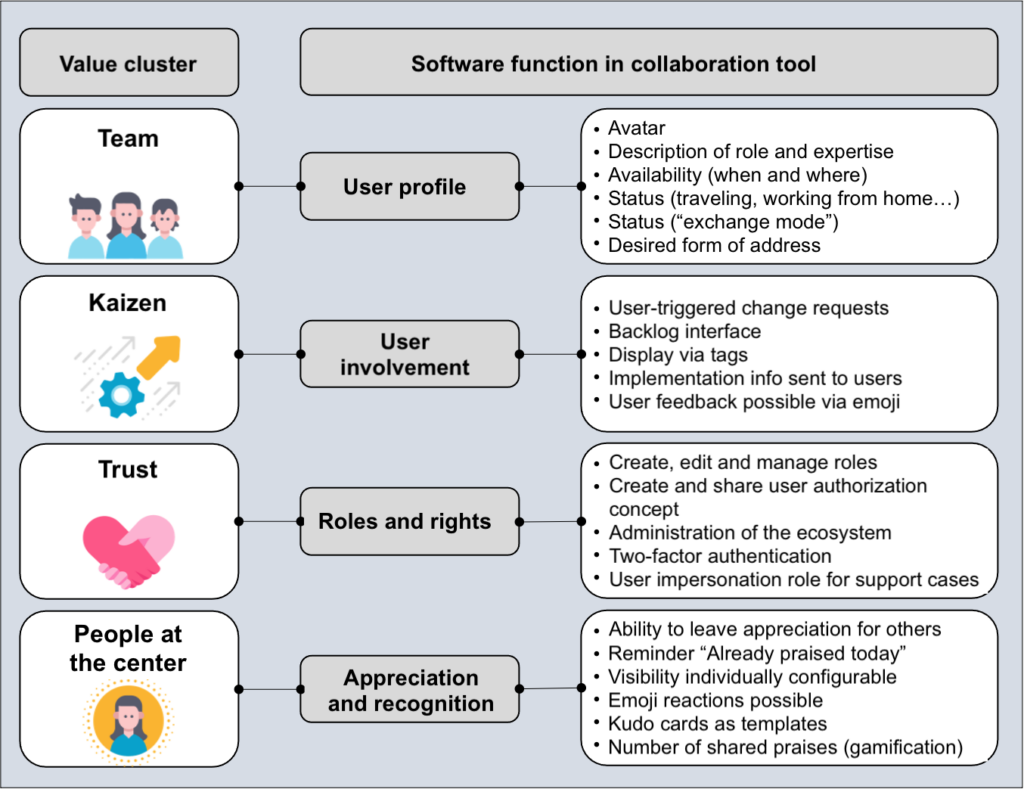
The “Team” concept is based on the values of participation, community and network, which, based on the ideas collected, can be translated into numerous functions, such as collaboration workflow, comment function, information transfer or polls on morale. The user profile of the individual team members can be seen as the basis. In addition to technical information, many details are anchored here that simplify collaboration (e.g. expert skills) or make it possible in the first place (e.g. availability). The profile offers the opportunity to give an anonymized avatar personality and to better understand the person behind it. If the “exchange mode” status is set, a user is available for digital “chance encounters”, which bear similarity to spontaneous meetings in the kitchenette or break room.
In the “Kaizen” value unit, the focus is on the learning culture. When collaboration is supported by collaboration tools, experts found it important to play a role in shaping and optimizing this. The resulting functions include offering users the opportunity to submit change requests. An interface to the software’s backlog allows changes to be tracked and the idea providers to be informed of their implementation. They can then use emojis or a comment function to react to the implementation and provide feedback.
“Trust” is based on personal responsibility, transparency and integrity. The experts see the greatest possible level transparency regarding data and information as a significant added value. Transparency creates sound background knowledge and lays the groundwork for independent-decision-making. Functionally, this requirement can be bundled into a role and authorization concept. This involves creating, editing and managing original roles.
Administration in the ecosystem must also be defined. The authorization concept specifies which rights (e.g. edit, view, make suggestions, delete) can be distributed. In the interests of transparency, the concept should be understandable and visible to everyone. Two-factor authentication ensures that no unauthorized person outside the ecosystem gains access. The impersonation role enables the administrator to log in as a specific user in support cases without having to know the password.
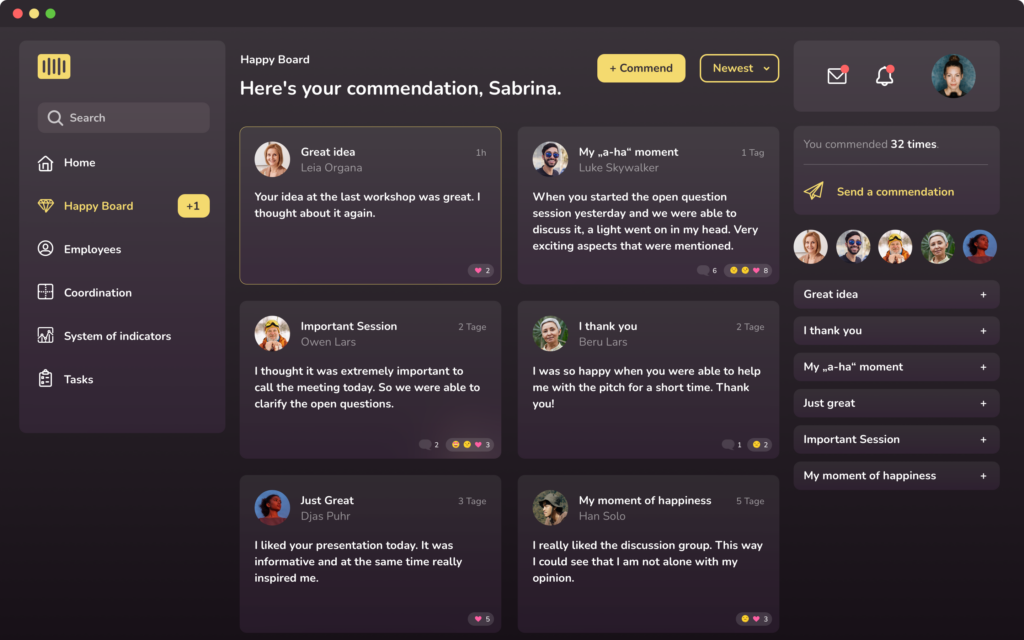
In the “People at the center” value cluster, ideas were developed that focus in particular on conveying praise and recognition in the context of digital collaboration. The ideas can be assigned to the collaboration behavior and tool level. In collaboration software, implementation of the user profile as a personal board is conceivable. Praise can be left on this board, to which the recipient of the praise can respond with emojis. At the same time, the recipient is reminded to actively praise others as well. “Kudo cards” are available for this purpose, which contain ready-made texts or can be filled with free text and pinned to another personal board.
Users can manage the visibility (personal, defined user group, public) of their personal board. The integration of such a function enables individual praise between employees, managers and partners. In addition to the functional illustration (Fig. 3), a user interface (Fig. 4) was created for this purpose, which visualizes the described functions on the user interface.
Software geared towards people
The brainstorming and evaluation of the workshops provided numerous starting points for answering the initial question of how cultural values can be effectively implemented and lived in a digital ecosystem. The BERTAGNOLLI values presented were met with the approval of all participating experts and their utility as an orientation for the discussion of the question was confirmed.
In particular, ideas that can be assigned at the level of collaboration tools are the starting point for answering the second question, which is dedicated to the implementation of digital values in software code. The examples presented show that values can be mapped in software code and thus a basis for the life of digital values can be laid. A key finding is that value-based functions in software do not necessarily have to be new functions. Rather, it reinforces the idea that people must be at the center of software design.
The innovation lies in the fact that specific functions are implemented with the intention of anchoring values and how the functions are combined for this purpose. A key success factor lies in the human-centered design of collaboration software so that users can easily use the software to share information or show reactions, for example, and thus enjoy using the application. By implementing digital values in collaboration software, the categories of the other levels, such as collaboration behavior or goal, are also addressed.
Further studies should investigate how ideas categorized at these levels can also be mapped using software functions. The potential of value-oriented collaboration software for its users should also be proven by means of a user study.
Bibliography
[1] Karch, S.; Lüder, A.; Listl, C.; Nowacki, N. S.; Hassan, K.; Werner, R.; Hohmann, T.; Müller, S.: Lean Engineering – Identifying waste in engineering chains. In: 56th CIRP Conference on Manufacturing Systems. Kapstadt 2023.[2] Bertagnolli, F.: Lean Empowerment – Die konsequente Fortsetzung von Lean Leadership. Stuttgart 2023.
[3] Plattform Industrie 4.0; BMWi (Hrsg): LeitBild 2030 für Industrie 4.0 – Digitale Ökosysteme global gestalten. URL: www.plattform-i40.de/IP/Redaktion/DE/Downloads/Publikation/Leitbild-2030-für-Industrie-4.0.pdf, Abrufdatum 24.10.2023.
[4] BMBF: Zukunft der Wertschöpfung – Forschung zu Produktion, Dienstleistung und Arbeit. URL: www.bmbf.de/SharedDocs/Publikationen/de/bmbf/5/31662_Zukunft_der_Wertschoepfung.html, Abrufdatum 24.10.2023.
[5] Lernende Systeme – Die Plattform für Künstliche Intelligenz (Hrsg): Von Daten zu Wertschöpfung – Potenziale von daten und KI-basierten Wertschöpfungsnetzwerken. URL: www.plattform-lernende-systeme.de/files/Downloads/Publikationen/PLS_Booklet_Datenoekosysteme.pdf, Abrufdatum 24.10.2023.
[6] Bühler, D.; Schneider, H.; Thiessen, T.: Plattformökonomie für den Mittelstand – von den Großen lernen, Vertrauen aufbauenden Einstieg wagen. In: Vernetzte Wertschöpfung – Plattformen, Wertschöpfungsnetzwerke und die Blockchain für Prozess- und Geschäftsmodellinnovationen. Mittelstand-Digital Magazin, Wissenschaft trifft Praxis 12 (2019), S. 5-12.
[7] Hirsch-Kreinsen, H.; ten Hompel, M.: Digitalisierung industrieller Arbeit: Entwicklungsperspektiven und Gestaltungsansätze. In: Vogel-Heuser, B.; Bauernhansl, T.; ten Hompel, M. (Hrsg): Handbuch Industrie 4.0. Berlin Heidelberg 2015.
[8] Leimeister, J. M.: Collaboration Engineering – IT-gestützte Zusammenarbeitsprozesse systematisch entwickeln und durchführen. Berlin Heidelberg 2014.
[9] Herget, J.: Digitale Unternehmenskultur – Strategien für die moderne Arbeitswelt. Wiesbaden 2021.
[10] George, J. F.: Groupware. In: Encyclopedia of Information Systems. Cambridge 2002.
[11] Siepermann, M.: Social Software. URL: wirtschaftslexikon.gabler.de/definition/social-software-53586, Abrufdatum 24.10.2023.
[12] Liker, J. K.; Trachilis, G.: Lean Leader auf allen Management-Ebenen entwickeln – Ein praktischer Leitfaden. Winnipeg 2014.
[13] Bertagnolli, F.: Lean Management, 2. Auflage. Heidelberg 2020.
[14] Niederberger, M.; Ortwin, R.: Das Gruppendelphi-Verfahren – Vom Konzept bis zur Anwendung. Wiesbaden 2018.
Your downloads
You might also be interested in