
MTM Analyses with AI and Rule-Based Algorithms |
An approach to interpreting textual process descriptions

| Journal | Industry 4.0 Science |
| Issue | Volume 42, 2026, Edition 5, Pages 62-69 |
| Open Access | https://doi.org/10.30844/I4SE.26.5.7 |
| Bibliography | Share | Cite | Download |
Abstract
Keywords
Article
MTM process language and artificial intelligence
The MTM process language (Methods-Time Measurement) is a proven and internationally established standard for the analysis and design of human work processes. Particularly in times of increasing global competition and digitalization, it serves as a key tool for industrial companies to systematically plan, evaluate, and optimize their processes [1].
Recent developments in the digital design of human work, such as human simulation (HS) [2], virtual reality (VR) [3, 4], and motion capture (MoCap) [5], have helped partially automate the creation of MTM analyses. However, these technologies are often technically complex and costly, resulting in a lack of widespread adoption, especially by smaller companies.
This is why there is growing interest in technologies that are simple and intuitive to use. Chief among these are large language models (LLMs), a branch of artificial intelligence (AI). These models can capture semantic relationships and contextual dependencies in natural-language texts, thereby unlocking new potential for interpreting and analyzing text-based process descriptions [6]. In industrial settings, LLMs are already used to evaluate technical documents, interpret process descriptions, and support planning and decision-making processes [7]. In human work design, they make it possible to translate textual process descriptions into MTM analyses.
At the same time, the use of AI raises questions surrounding reliability and traceability. Since AI systems often engage in complex and opaque decision-making processes, it can be difficult for users to know how results are derived [8]. This also makes quality, including compliance with formal requirements such as the MTM methodology, difficult to assess.
To address these challenges, this article presents a hybrid approach that combines LLMs with a deterministic, rule-based algorithm. The goal is to extract MTM-relevant information from textual process descriptions (e.g., work instructions) and to translate it into rule-compliant MTM analyses. This procedure ensures that the results are traceably derived from the input data and that compliance with the MTM methodology is guaranteed.
The focus of this article is on presenting the methodological approach. An empirical evaluation as well as tests and comparisons with reference analyses are currently carried out and are the subject of further work.
Work process analysis with MTM-UAS®
Various MTM process building block systems exist. Each has its own syntax and semantics to standardize description of work processes [1, 9].
MTM-UAS® is the most widely used MTM process building block system in industrial practice and is characterized by a comparatively low analysis effort while maintaining a high level of detail. The process building blocks used in MTM-UAS® are referred to as “basic operations”. They describe the components of human work, each of which has specific influencing factors. Depending on the nature of these influencing factors, each basic operation is assigned a basic time, more precisely, a manual time.
One example is the basic operation “handle tool,” which models the use of a tool (e.g., a cordless screwdriver). Relevant influencing factors here are the case of placing, which describes the control effort required when applying the tool, and the distance range, which represents the movement lengths during handling. The basic operations, their corresponding influencing factors, and the resulting basic times are shown on the MTM-UAS® data card [10].
To analyze a workflow, the sequence is broken down into individual process steps, which are then modeled using the appropriate MTM process building blocks. This results in a complete description from which the basic time for the workflow can be determined [1]. The detailed representation also makes it possible to identify optimization potential and to carry out targeted improvements and actual/target comparisons.
Connecting MTM and digital technologies with MTMmotion®
The systematic description of work processes via the MTM process language provides a suitable basis for connecting with digital technologies, for the planning and design of human work. Relevant technologies include HS, VR, and MoCap, which digitally capture or generate motion data [3–5].
To facilitate the coupling between these technologies and the MTM process language, the MTMmotion® service (MTMmotion®) was developed [11]. Its aim is to connect these two areas while ensuring the correct application of the MTM methodology. To this end, MTMmotion® provides a defined interface through which motion data, object data, body movements, and body postures are transmitted. Another key component of MTMmotion® is a deterministic translation algorithm.
It checks the transmitted data for content consistency and supplements missing information as needed using stored default values. The validated data are then converted, on a rule-based basis, into the corresponding MTM process building blocks, resulting in a traceable and rule-compliant MTM analysis [12].
Thanks to its modular architecture, MTMmotion® can be connected to a wide variety of digital tools while ensuring the correct application of the MTM process language [3–5].
Previous AI developments in the MTM context
Alongside digital technologies for capturing and processing human motions (HS, VR, MoCap), LLMs are increasingly coming into focus. These are based on the transformer architecture, which enables the semantic processing of natural language texts as well as the modeling of contextual dependencies [6]. LLMs are used, among other things, to derive structured information from unstructured text input, which is particularly relevant for knowledge-intensive industrial tasks such as planning, document analysis, and process interpretation [7, 13].
A first systematic contribution to the application of LLMs in the MTM context is provided by Ceylan et al., who investigate the extent to which MTM-UAS® analyses can be generated from textual work descriptions. The results show that, for scenarios that are described in detail and completely and with explicitly provided MTM rule knowledge, a high level of alignment with manually created MTM analyses is archived. At the same time, however, deficits arise with implicit work steps and nuanced rule applications [14].
This reveals a central weakness of LLM-based approaches: When information is incomplete or contexts unclear, not only does the quality of the results decline, but it often also remains unclear which assumptions the models make and which domain rules were actually applied. Particularly for rule-based methods such as MTM, it is therefore impossible to determine whether a result stems from a rule-compliant derivation or from statistical inference. This problem of a lack of transparency and explainability is further exacerbated by so-called automation bias, as users tend to increasingly adopt AI-generated results without verification [8, 15].
Combined translation of texts into MTM-UAS®
To leverage the interpretive capability of LLMs for natural-language texts while ensuring the rule-compliant application of the MTM process language, a hybrid approach was developed. It combines AI-based text interpretation with deterministic, rule-based algorithms and integrates MTMmotion® as the translation engine. The goal is to translate textually described into MTM-UAS® analyses in a traceable and rule-compliant manner.
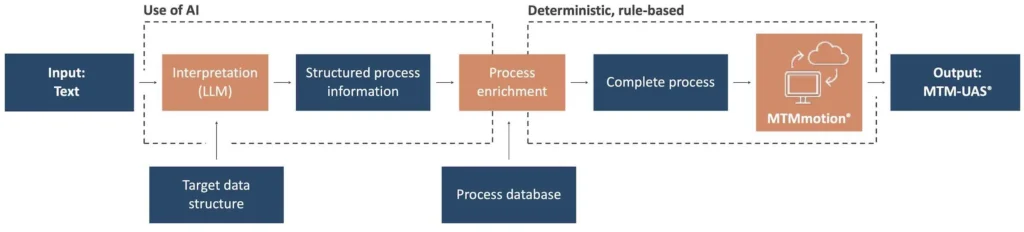
Figure 1 illustrates this process: First, the input text (such as a work description) is converted into structured data using an LLM. The structured information is then compared with a process database and adapted using a combination of AI and rule-based algorithms to generate a complete, valid process description. The resulting process description is translated via MTMmotion® into a rule compliant MTM-UAS® analysis . The following section provides an example of this process.
Input: text (work description)
The developed method is designed to automatically process various forms of text-based work descriptions. Informal process descriptions can be used in addition to formal work instructions. The method is fundamentally flexible and adaptable, allowing for the use of any text sources that contain relevant information about work processes. The example used is a short textual description of a typical manual work process, as frequently found in industrial practice:
“Walk 3 meters. Take a box (5 kg) from the shelf. Walk 4 meters and place the box on the workbench. Then take one wing screw from the box with each hand and insert each screw into a hole.”
Interpretation (LLM)
In the first processing step, the input text is analyzed by an LLM, namely the GPT-5.2 Chat language model, which is used for the semantic interpretation of natural-language process descriptions. The goal is to identify and extract relevant information for an MTM analysis, such as the objects handled and the actions performed, as well as their sequence and contextual information.
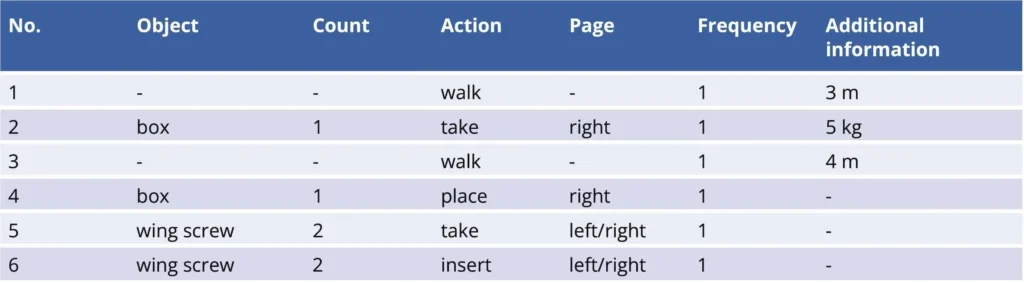
The interpretation is guided by specially developed prompts and a predefined target data structure (Fig. 2, table header), which maps the information required for an MTM analysis. The selection of the LLM and the prompt strategy was carried out exploratively, with a focus on high-quality results. A systematic evaluation of various models in terms of precision, stability, or computational effort is not the subject of this article. The prompts, data structures, and knowledge bases used are part of the system implementation and are not disclosed in full detail here.
Structured process information
The result of the LLM-based interpretation is a structured process description that consolidates the key information extracted from the text. Figure 2 depicts the result of this step for our example. It demonstrates the LLM’s ability to identify relevant objects and actions from the source text and assign additional attributes such as quantity, side, or frequency. The structure generated provides a suitable basis for subsequent processing.
Process enrichment
In the next step, the structured description is converted into a complete and valid process. To do this, objects and actions are matched against a domain-specific object and action catalog—the process database—and translated into a formally consistent sequence of sub-steps. The underlying knowledge base is derived from object and action catalogs for industrial assembly processes, which are continuously maintained and expanded.
Object & action recognition: The names of recognized objects and actions are matched against the process database comprising object and action types relevant to industrial assembly. The comparison is initially performed via string-based data matching, using similarity measures. If a suitable type cannot be identified in this way, supplementary semantic data matching is performed using LLM-based embeddings. This allows object and action descriptions to be unambiguously mapped even in cases of linguistic variation or vague formulation.
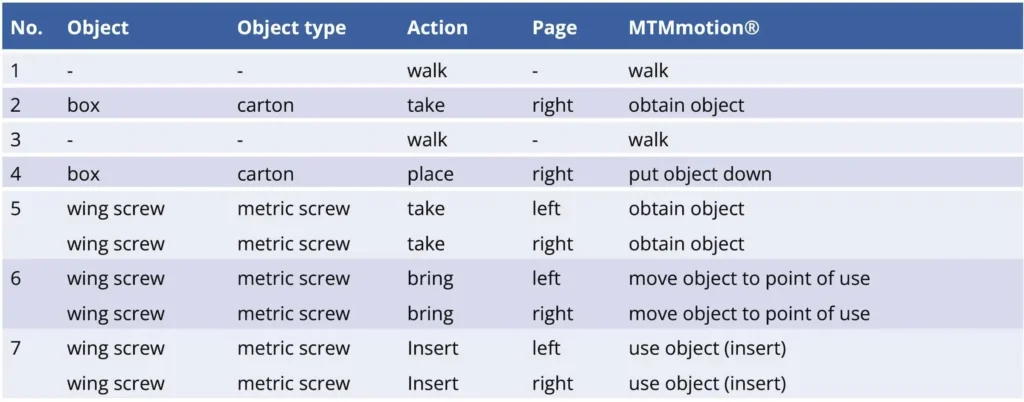
Process completion: Finally, the process is checked for completeness. If any sub-steps required for a rule-compliant mapping are missing, they are added. For example, if a cordless screwdriver is mentioned only in connection with the screwing operation itself, the steps “obtain the cordless screwdriver,” “move the cordless screwdriver to the point of use,” and “put down the cordless screwdriver” are automatically added. This results in a valid sequence that can be meaningfully converted into an MTM analysis using MTMmotion®.
Complete process
The process identified by the LLM (Fig. 2) has been refined into a more detailed process (Fig. 3). Thus, concrete object types are assigned to the objects identified in the text, for example the classification of the “wing screw” as a “metric screw.” In addition, the movements necessary for a complete description are added. For example, the steps “object to point of use” are inserted between picking up and screwing in the wing screw.
Translation into a valid MTM analysis using MTMmotion®
The complete process is then transferred to MTMmotion® in JSON format, where the rule-based translation of the interface data into a valid MTM analysis takes place. MTMmotion® supports various MTM process building block systems. This article describes the translation into MTM-UAS®.
MTMmotion® reads the transmitted process information and uses it to generate corresponding MTM-UAS® process building blocks. If information is missing from the file—e.g., distance traveled or an object’s dimensions or weight—the service falls back on transparent default values stored in the MTMmotion® object catalog [4, 8].
Output: MTM-UAS® analysis
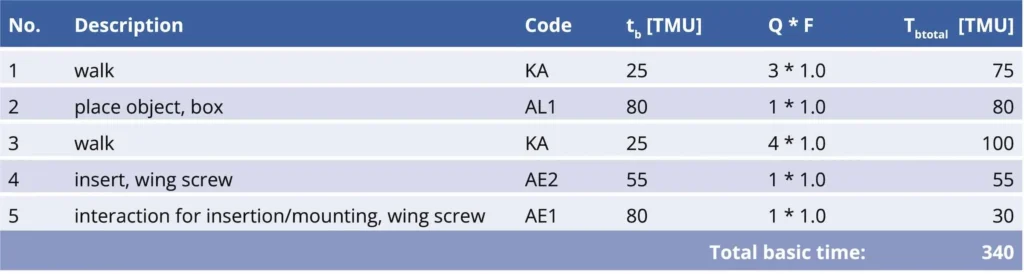
The result of this hybrid approach is a rule-compliant MTM-UAS® analysis derived entirely from text-based input data (Fig. 4).
In this example, a weight of 5 kg was specified for the box, but no dimensions were provided. Therefore, the standard dimensions of 600 × 400 × 400 mm stored in the object catalog were used, classifying the box as a bulky object in accordance with the MTM rule set. Since walking occurs both before picking up and after setting down the box, the residual distance rule means that distance range 1—and thus the MTM process building block AL1—is applied. The walking movements are accounted for as KA using distances of three and four meters respectively, as specified in the text.
No information on movement length is available for the screws. In this case, MTMmotion® applies a standardized movement length of 40 cm (distance range 2). Weight and dimensions are also taken from the object catalog. For simultaneous actions involving two screws, an additional basic interaction operation for the second screw with distance range 1 is added in accordance with MTM-UAS® rule set. Based on all of this, the example results in a rule-compliant MTM-UAS® analysis with a total basic time (tb total) of 340 TMU (approx. 12.2 seconds).
Evaluation of the method and further development activities
With the developed combined approach, an initial trial demonstrated that textual descriptions of work processes can be translated into rule-compliant MTM analyses that correspond to the described work process. This makes clear that the automated translation of process descriptions can be implemented in a rule-compliant and traceable manner, allowing industrial companies to efficiently analyze and optimize existing workflows.
However, the development and testing phases have also revealed numerous challenges and open questions. In particular, the LLM’s interpretation of the input text can lead to fluctuating output quality, which may result in varying process interpretations. In addition, not all relevant process data is always recognized, which can affect the reliability of the MTM analysis. Moreover, the process database with the catalog of objects and actions must be developed further.
In the future, the focus will be on extensive testing and comparison with manual MTM analyses to ensure quality and practical applicability. Furthermore, a systematic comparison with existing LLM-based approaches, like that of Ceylan et al., is useful for identifying differences in traceability, regulatory compliance, and result stability. It is also necessary to investigate at which points targeted human review of intermediate and final results is advisable to further enhance the traceability and correctness of the analyses.
From the perspective of the MTM ASSOCIATION e. V., the developed approach is to be understood as support for all those who wish to use a correct MTM analysis. The result is always an MTM simulation analysis that should be subjected to a final review and approval by qualified MTM practitioners to be converted into an MTM planning analysis.
Bibliography
[1] Bokranz, R.; Landau, K.: Handbuch Industrial Engineering: Produktivitätsmanagement mit MTM. Vol. 1. Stuttgart 2012. ISBN 978-3791028637.[2] Breznik, M.; Buchmeister, B.; Vujica Herzog, N.: Assembly line optimization using MTM time standards and simulation modeling. In: Applied Sciences 2023. DOI: https://doi.org/10.3390/app13106265
[3] Benter, M.; Neumann, M.; Kuhlang, P.: Ableitung von MTM-UAS®-Analysen unter Verwendung von Virtual Reality und MTMmotion®. In: Bundesanstalt für Arbeitsschutz und Arbeitsmedizin (ed.): Smarte Technologien und Augmented Reality in der Arbeitswelt. Dortmund 2023, pp. 39–45. DOI: https://doi.org/10.21934/baua:bericht20231027
[4] Benter, M.; Neumann, M.; Kuhlang, P.: Automated derivation of MTM analyses from VR data using MTMmotion®. In: Procedia Computer Science 277 (2026), pp. 30–39. DOI: https://doi.org/10.1016/j.procs.2026.02.044
[5] Pöttker, S.; Neumann, M.; Benter, M.; Eckart, C.; Wolf, U.; Kuhlang, K.; Lödding, L.: Ableitung von MTM-Analysen aus Motion-Capturing-Daten. In: Industry 4.0 Science 41 (2025) 5, pp. 112–119. DOI: https://doi.org/10.30844/I4SD.25.5.112
[6] Vaswani, A.; Shazeer, N.; Parmar, N.; Uszkoreit, J.; Jones, L.; Gomez, A. N.; Kaiser, Ł.; Polosukhin, I.: Attention is all you need. In: Proceedings of the 31st International Conference on Neural Information Processing Systems (NeurIPS), 2017. URL: https://arxiv.org/abs/1706.03762
[7] Li, Y.; Zhao, H.; Jiang, H.; Pan, Y.; Liu, Z. et al.: Large language models for manufacturing. In: arXiv 2024. DOI: https://doi.org/10.48550/arXiv.2410.21418
[8] Sajjadi Mohammadabadi, S. M.; Kara, B. C.; Eyupoglu, C.; Uzay, C.; Tosun, M. S.; Karakuş, O.: A survey of large language models. In: Electronics 14 (2025) 18, Art. 3580. DOI: https://doi.org/10.3390/electronics14183580
[9] Kuhlang, P.: Produktive und ergonomiegerechte Arbeit – Von Grundsätzlichem zur Prozesssprache MTM. In: Leistung und Entgelt. Joh. Heider, Düsseldorf 2018. URL: https://d-nb.info/1160721653
[10] MTM ASSOCIATION e. V.: Lehrgangsunterlage MTM-UAS®. Hamburg 2019.
[11] MTM ASSOCIATION e. V.: MTMmotion® – Webbasierter Service zur automatisierten Ableitung von MTM‑Analysen. URL: https://mtmmotion.mtm.org, accessed 02.04.2026.
[12] Benter, M.; Neumann, M.: Digitale Arbeitsgestaltung mit MTMmotion®. In: Gesellschaft für Arbeitswissenschaft e. V. (ed.): Proceedings of the 2023 Spring Congress “Nachhaltig Arbeiten und Lernen – Analyse und Gestaltung lernförderlicher und nachhaltiger Arbeitssysteme und Arbeits- und Lernprozesse”. Hanover 2023.
[13] Ohde, J. W.; Rost, L. M.; Overgaard, J. D.: The burden of reviewing LLM-generated content. In: NEJM AI 2 (2025) 2, Art. 8. DOI: https://doi.org/10.1056/aip2400979
[14] Ceylan, G.; Yapicioglu, H.; Benter, M.; Eckart, C.; Kuhlang, P.: On the Use of Large Language Models for Methods-Time Measurement. In: International Journal of Production Research (IJPR) (2025).
[15] Elbasheer, M.; Laili, Y.; Longo, F.: Natural language-driven production planning: integrating large language models with automatic simulation model generation. In: Journal of Intelligent Manufacturing (2025). DOI: https://doi.org/10.1007/s10845-025-02732-z
Your downloads
Potentials: Management
You might also be interested in