Work Design in the Use of Autonomous Systems |
Addressing the shortage of skilled workers

| Journal | Industry 4.0 Science |
| Issue | Volume 42, 2026, Edition 5, Pages 44-50 |
| Open Access | https://doi.org/10.30844/I4SE.26.5.5 |
| Bibliography | Share | Cite | Download |
Abstract
Keywords
Article
Germany’s labor force is declining as a result of demographic change. This is becoming increasingly evident as the baby boomer generation begins to retire. The resulting shortage of skilled workers is felt more acutely during economic booms whilst, conversely, economic downturns provide temporary alleviation. Figure 1 illustrates this trend.
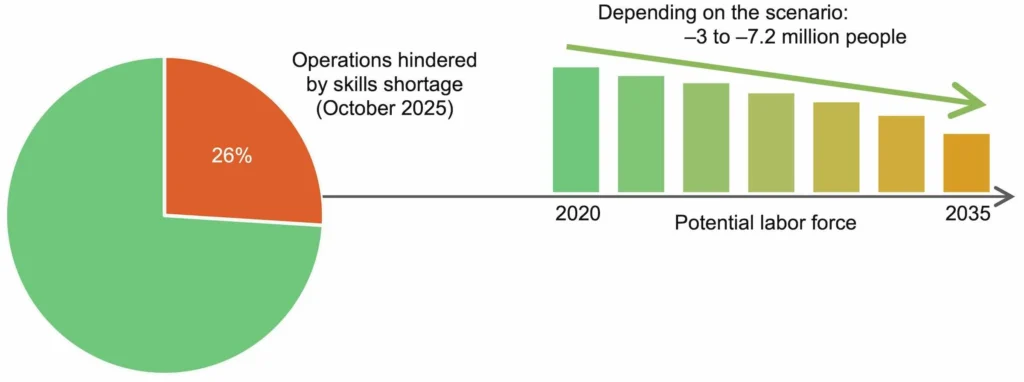
The metal and electrical industries have been hit particularly hard by the shortage. Between July 2021 and June 2022, approximately 110,000 skilled workers were lacking nationwide in this sector, including just under 57,000 in mechatronics, energy, and electrical trades [1]. In October 2025, approximately 26% of German companies reported that their business operations were constrained by a shortage of skilled workers [2].
Framework conditions for the deployment of autonomous systems
For a long time, policymakers and businesses focused on expanding the labor supply. This involved tapping into untapped labor capacity, extending working lives [3], recruiting foreign workers [4], and making employers more attractive [5]. Monetary and non-monetary incentives should also help increase the labor supply. However, measures to expand the labor supply are not sufficient to successfully offset the growing shortage of skilled workers and labor. This is also because they do not help increase productivity.
In addition to measures expanding supply, reducing labor demand is therefore becoming increasingly important. For example, business processes and workflows can be made more efficient using methods from industrial engineering and lean management [6]. Furthermore, digitalization and automation offer extensive opportunities for further developing processes [6]. Thanks to artificial intelligence (AI) and robotics, for instance, production can be maintained with fewer staff, counteracting the lack of experienced workers while also increasing productivity.
Furthermore, these approaches make it possible to relieve employees of repetitive or physically demanding tasks [7]. Flexible processes are key, as they enable companies not only to respond to changing market requirements but also to compensate temporary staffing shortages (such as absences due to illness). Autonomous systems can take on increasingly complex tasks, respond flexibly to disruptions [8], and collaborate with humans or other systems [9]. Examples range from driverless transport systems to collaborative robotics (cobots) and self-optimizing production systems.
Autonomous systems are complex; they are designed to act independently (without human control) and perform demanding tasks. Due to this complexity, their behavior cannot be programmed in advance for all possible situations, causing some unpredictability. Nevertheless, they are expected to function reliably and safely even with limited human supervision [10]. The design of autonomous systems requires a balanced interplay between autonomy and coordination. Other key challenges include investment costs, integration into existing production systems, employee acceptance, and compliance with safety and legal requirements [7, 11].
Applied work research addresses these challenges to promote productive work organization. The autoWert project (FKZ: 02J24B000) analyzes prerequisites for the successful deployment of autonomous systems as well as the risks involved. The focus is on technical, organizational, and personnel requirements for sustainable and profitable deployment. The project’s results provide companies with practical approaches to addressing current and future challenges, thereby helping to strengthen Germany as an industrial hub.
Methodological approach
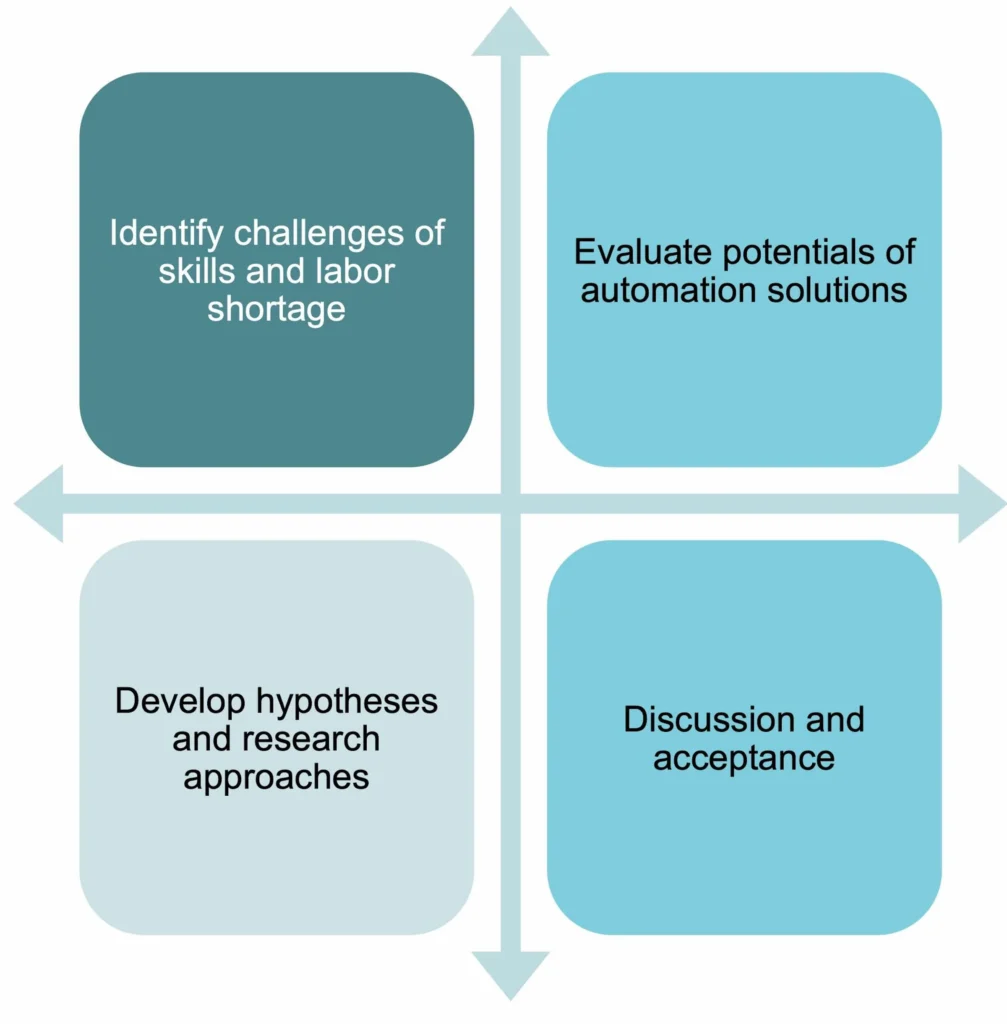
The project objectives were developed empirically, drawing on individual expertise related to the challenges posed by skilled labor shortage as well as the design and implementation of automation solutions. On this basis, key hypotheses and research approaches were derived and presented for discussion (Fig. 2) [12].
First, a structured approach was developed for gathering and analyzing subject expertise and semi-structured interviews were planned for data collection. To develop an interview guide, scientific studies and forecasts were researched and analyzed. This process took into account demographic and socioeconomic trends as well as economic growth rates, innovation trends, and the characteristics of autonomous systems.
The interview guide addressed key questions regarding the impacts of both the shortage of technical expertise and labor and the use of autonomous systems on organizational work systems.
Experts from industrial companies, associations, research institutions, and a network of project partners were selected for the interviews. The goal was to capture a broad and diverse range of perspectives. The semi-structured interviews were primarily conducted online and transcribed.
After ten of the fifteen planned interviews, an interim evaluation of the results was conducted. The aim was to validate initial findings and identify thematic priorities for the remaining interviews in order to specifically address existing knowledge gaps. To this end, the available interviews were systematically analyzed using qualitative content analysis [13] to identify key statements, recurring patterns, and relevant correlations.
The results were clustered by topic, documented, and validated in a workshop with eight engineers. The participating engineers come from various employer associations and thus work with a range of different companies. They therefore possess comprehensive knowledge of operational conditions as well as the implementation and use of digital and autonomous systems. During the workshop, the results across all thematic areas and clusters were systematically discussed to establish a shared understanding. This allowed the findings to be validated and additional perspectives to be integrated.
Why autonomous systems often fail in practice
The experts generally believe that autonomous systems have the potential to alleviate labor and skilled worker shortages in industry, but they still see a need for further development. Company representatives, academic experts in robotics and AI, and association staff point out that there are significant challenges involved in integrating these systems.
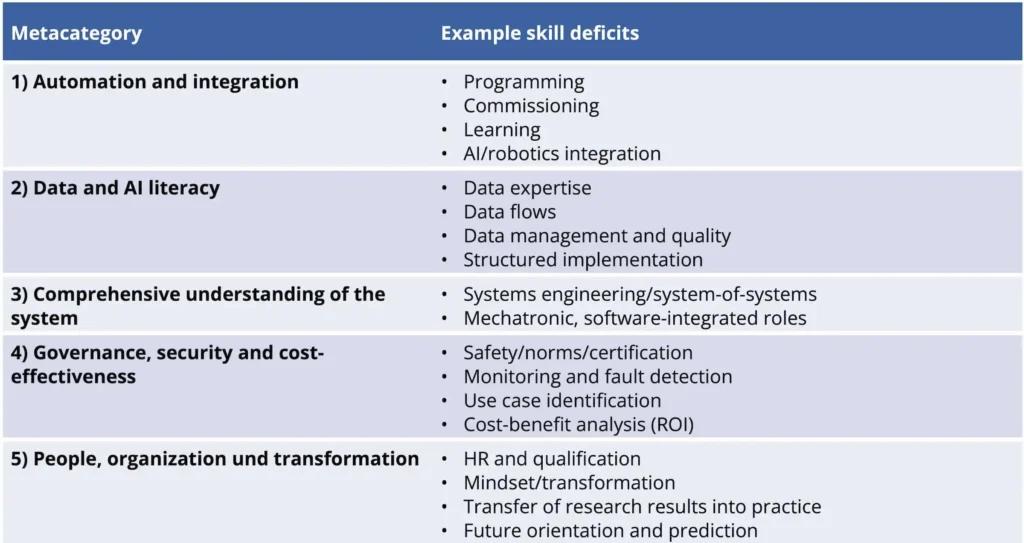
In nearly all expert interviews, it became clear that a lack of know-how regarding the integration of autonomous systems is a major obstacle to deploying these systems profitably. Companies face the challenge of selecting suitable systems, integrating them into existing processes, and operating them safely. The experts’ statements regarding current competency gaps in the industry were structured into five meta-categories, which are described below and summarized in Figure 3.
1) Automation and integration
Within companies, shortcomings in automation expertise are particularly evident at the foreman and team lead levels. While traditional manufacturing skills are present, advanced qualifications necessary for implementing automated processes and transitioning to a mechatronics- and software-oriented job profile are lacking. Employees with skills in mechanics, electronics, and software are in particularly high demand.
2) Data and AI literacy
According to experts, there is a lack of data literacy. The ability to collect and process machine-relevant data and to understand its significance for digital production must be fostered. In addition, there is often a lack of knowledge about how to ensure adequate data quality. This hinders the efficient use of AI and the further development of data-driven processes in the workplace.
3) Comprehensive understanding of the system
This meta-category addresses the need for holistic systems thinking, particularly in light of the increasing autonomy and interconnectivity of subsystems. Companies lack functions and specialists who can take a big-picture view and identify cross-system interdependencies. In addition, methods for fault diagnosis, monitoring, and training of autonomous systems are needed. The absence of these methods can lead to uncertainty and instability, especially in early stages of development.
4) Governance, security, and cost-effectiveness
There are shortcomings in assessment and decision-making capabilities, particularly in small and medium-sized enterprises. Often, there is an inability to make informed decisions regarding software investments, training initiatives, or the deployment of technical solutions such as cobots. When deploying autonomous systems, there is a lack of expertise for independently assessing safety requirements, conducting risk assessments, and ensuring compliance with standards.
This is especially true for dynamic environments involving collaborative robotics, where complex safety issues arise. To comply with safety requirements, cobots are sometimes fenced off, for example, and used for purposes other than their intended function—namely, to perform tasks on their own rather than collaboratively.
5) People, organization, and transformation
This meta-category concerns the holistic integration of autonomous systems into operations. A proactive strategy for identifying and addressing future training needs in a timely manner is currently lacking. In addition, a lack of understanding among the workforce regarding the potential of AI and robotics hinders the necessary willingness to embrace change. Finally, the rapid translation of research findings into commercially viable innovations remains a major challenge.
Recommendations for companies
To address the identified skills gaps sustainably, various measures were discussed in the expert interviews, and an competency-based approach was favored. This does not involve one-time training sessions. Rather, a learning-oriented implementation process is created based on real-world use cases and experimental environments for AI implementation within company operations.
To empower companies—and SMEs in particular—low-threshold access to proven solutions is essential. Numerous research initiatives, projects, digital centers, and AI competence centers are already addressing this need: Companies can systematically—and often free of charge—take advantage of these offerings to learn about best-practice examples from comparable or other industries (including cost-benefit metrics) and to try out AI through “hands-on” demonstrators.
Regional Competence Centers for Work Research (ReKodA) such as the WIRKsam Competence Center, which focus on the design of AI-supported work, offer interactive learning environments. These lower barriers to entry and highlight requirements for data quality, interfaces, and occupational safety based on best practices in real work environments at partner companies. In addition, their extensive networks provide access to development partners and innovative startups, who in turn can serve as an information pool.
Internal advocates—so-called AI scouts or AI enthusiasts—help promote and sustainably integrate AI within the company. In small steps, this approach can build capabilities combining technology adoption, secure implementation, and organizational change. This lays the foundation for the productive, compliant, and cost-effective deployment of autonomous systems.
This article was produced as part of the research and development project “autoWert—Identifying Design Potential of Autonomous Systems for Competitive and Sustainable Industrial Value Creation in Light of the Skilled Labor Shortage,” which is funded by the German Federal Ministry of Research, Technology, and Space (BMFTR) within “Future of Value Creation—Research on Production, Services and Work” program (funding number 02J24B000) and is managed by the Project Management Agency Karlsruhe (PTKA). The authors are responsible for the content of this publication.
Bibliography
[1] Malin, L.; Jansen, A.; Köppen, R.: Die Fachkräftesituation in Metall- und Elektroberufen. Studie 01/2023, Institut der deutschen Wirtschaft. Cologne 2023.[2] KfW-ifo-Fachkräftebarometer Oktober 2025. URL: https://www.kfw.de/PDF/Download-Center/Konzernthemen/Research/PDF-Dokumente-KfW-ifo-Fachkr%C3%A4ftebarometer/KfW-ifo-Fachkraeftebarometer_2025-10.pdf, accessed 15.04.2026.
[3] Czepek, J.; Gürtzgen, N.; Moczall, A.; Weber, E.: Halten rentenberechtigter Mitarbeiter in den Betrieben: Vor allem kürzere und flexiblere Arbeitszeiten kommen zum Einsatz. IAB-Kurzbericht 16/2017. Nuremberg 2017.
[4] Bundesinstitut für Berufsbildung (ed.): Datenreport zum Berufsbildungsbericht 2022. Informationen und Analysen zur Entwicklung der beruflichen Bildung. Bonn 2022.
[5] Fuest, C.; Jäger, S.: Höhere Löhne gegen den Fachkräftemangel? APuZ. In: Politik und Zeitgeschichte 74 (2024) 22–23, pp. 20–25.
[6] Lennings, F.; Eisele, O.; Terstegen, S.; Cost Reyes, C.; Conrad, R.: Den Fachkräftemangel als Chance begreifen und nutzen. Impulspapier des ifaa – Institut für angewandte Arbeitswissenschaft (2024). URL: https://www.arbeitswissenschaft.net/impuls-fachkraefte, accessed 15.04.2026.
[7] Forschungsbeirat der Plattform Industrie 4.0/acatech – Deutsche Akademie der Technikwissenschaften (ed.): Engineering autonom wandelbarer Industrie 4.0-Systeme. 2024. DOI: https://doi.org/10.48669/fb40_2024-2
[8] Forschungsbeirat der Plattform Industrie 4.0/acatech – Deutsche Akademie der Technikwissenschaften (ed.): Engineering autonom wandelbarer Industrie 4.0-Systeme. 2024. DOI: https://doi.org/10.48669/fb40_2024-2
[9] Dumitrescu, R.; Albers, A.; Riedel, O.; Stark, R.; Gausemeier, J. (ed.): Engineering in Deutschland – Status quo in Wirtschaft und Wissenschaft. In: Advanced Systems Engineering. Paderborn 2021.
[10] Adler, R.: Autonome Systeme. URL: https://www.bidt.digital/glossar/autonome-systeme, accessed 15.04.2026.
[11] Sino-German White Paper on Functional Safety for Industrie 4.0 and Intelligent Manufacturing. URL: https://www.bmwk.de/Redaktion/DE/Publikationen/Industrie/industrie-4-0-sino-german-white-paper-on-functional-safety-for-industry-4-0-and-intelligent-manufacturing.pdf?blob=publicationFile&v=1, accessed 15.04.2026.
[12] Adler, R.; Ottersböck, N.; Harlacher, M.; Jeske, T.; Humpert, L.: Autonome Systeme für die Zukunft der Wertschöpfung: Sicherheitstechnische Herausforderungen beim Einsatz autonomer Systeme zur Sicherung der Wertschöpfung bei Fachkräftemangel. In: Zeitschrift für wirtschaftlichen Fabrikbetrieb 120 (2025) 7–8, pp. 477–481.
[13] Mayring, P.: Qualitative Inhaltsanalyse. Grundlagen und Techniken, 13th edition. Weinheim 2022.
Your downloads
Potentials: Management Training
Solutions: Process Management
You might also be interested in