Training

Lifelong Learning

Lifelong Learning

New solutions for textile and clothing industry
Marcus Winkler, Guido Grau, Meike Tilebein ORCID Icon
Lifelong learning is an elementary part of the knowledge society and of high importance for industries and societies facing digitization (Industry 4.0). This comprises individual opportunities for the employees as well as competitive advantages for companies. Two concrete solutions for textile and clothing industry will be presented here: on the one hand a sector wide offer for vocational training and on the other hand an adaptable IT based learning method enabling learning in the workplace. Both solutions show cutting edge concepts, technologies and didactic.
Industrie 4.0 Management | Volume 32 | 2016 | Edition 5 | Pages 58-61
Successful and Educational

Successful and Educational

Skills for navigating system complexity through joint learning methods
Marlies Achenbach, Lena Schulte, Jochen Deuse ORCID Icon, Peter Buhr
In order to deal successfully with the increasing complexity of production systems, the deve-lopment of system and problem-solving competencies is increasingly important. This paper presents an innovative learning concept that combines “on-the-job” student training with company training: „Multi real - multi-perspective learning in a real production factory“. Especially the company’s role and benefits are described.
Industrie 4.0 Management | Volume 32 | 2016 | Edition 3 | Pages 11-14
The German Digitization Initiative “Industry 4.0”

The German Digitization Initiative “Industry 4.0”

It depends on the qualifications
Benjamin Kettner, Thomas Pietsch
As the digitization of production processes advances, it influences many areas. In addition to the intra corporate structures and inter enterprise supply chains, it even has an impact on social structures. The progress includes the whole range of changes from the digitization of production processes to their data-driven optimization using intelligent feedback processes. In the end it will result in the combination of the real world with the digital world. To build up this digitization of the value chains, the human relations departments, the forms of communication and cooperation as well as the process management have to change. But to be successful on the way of digitization, new skills are necessary. To obtain these skills, the forms and techniques of the qualification acquisition need to be adapted.
Industrie 4.0 Management | Volume 32 | 2016 | Edition 3 | Pages 47-50
Informal Learning in Industry 4.0

Informal Learning in Industry 4.0

Peter Dehnbostel
The renaissance of learning at the workplace is a result of the digitization of the world of work and related new working and organizational concepts. Vocational education and training, previously dominated by seminars and training courses, changes radically in favor of learning in the work process. Will the fourth industrial revolution enhance this development? Research and development are only at the beginning, yet first answers are emerging.
Industrie 4.0 Management | Volume 32 | 2016 | Edition 3 | Pages 23-26
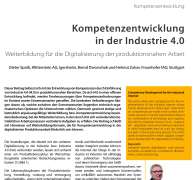
Competence Development for the Industrial Internet

Competence Development for the Industrial Internet

Weiterbildung für die Digitalisierung der produktionsnahen Arbeit
Dieter Spath, Bernd Dworschak, Helmut Zaiser
The article deals with competences for the implementation of the Industrial Internet whose further development is rather open. Statements on competences are made in the context of extreme scenarios. Concrete requirements depend on combinations of technology and organization which companies choose. So, an - supported - adaptable continuing training is important in which employees learn to carry out changing tasks in the actual work process. The article points to training forms which support competence development for digitalization of industry.
Industrie 4.0 Management | Volume 32 | 2016 | Edition 3 | Pages 51-54
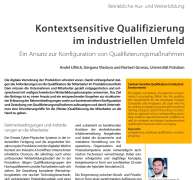
Context-Sensitive Qualification in Industrial Environments

Context-Sensitive Qualification in Industrial Environments

Ein Ansatz zur Konfiguration von Qualifizierungsmaßnahmen
André Ullrich ORCID Icon, Gergana Vladova, Norbert Gronau ORCID Icon
The digital cross-linking of production environments is proceeding. Within this, the qualification requirements for the employees increase. Companies and employees can cope with this by creating and applying customized vocational training concepts. Goal of this article is to introduce an approach and a corresponding procedure model to capture framework conditions as well to configure and design context-sensitive qualification measures within a company.
Industrie 4.0 Management | Volume 32 | 2016 | Edition 3 | Pages 15-18
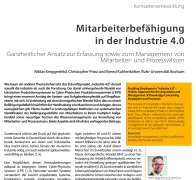
Enabling Employees in “Industry 4.0”

Enabling Employees in “Industry 4.0”

Holistic Approach for the Acquisition and Management of Knowledge Concerning Employees and Processes
Niklas Kreggenfeld, Christopher Prinz ORCID Icon, Bernd Kuhlenkötter ORCID Icon
The increase of complexity in the field of production due to “Industrie 4.0” causes also a rapid increase of the complexity of tasks on the shopfloor level. Thus, efficient methods for the systematic identification of the competence deficits of the employees as well as new forms of knowledge management for an adequate administration of knowledge have to be established.
Industrie 4.0 Management | Volume 32 | 2016 | Edition 3 | Pages 31-34
New Modes of Learning in Industrial Production

New Modes of Learning in Industrial Production

Personelle, technische und organisatorische Anforderungen an arbeitsplatzintegriertes Lernen mit digitalen Medien
Stefan Welling, Sebastian Freith, Carsten Ullrich, Glenn Schütze
Today’s in-house training faces the challenge an increasing demand for work expertise against the background of a continuing reduction of staff. This paper describes how companies can meet these challenges supported by a technology-enhanced approach. A central part of the solution is an intelligent-adaptive learning system that allows employees to create learning media while solving operational challenges and, at a later time to access these media, adapted to their individual needs. The article outlines the main human, technical and organizational requirements that an integration of such an adaptive digital learning and assistance system into a company faces.
Industrie 4.0 Management | Volume 32 | 2016 | Edition 3 | Pages 7-10
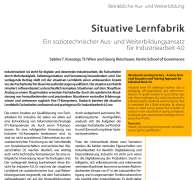
Situational Learning Factory

Situational Learning Factory

A socio-technical education and training approach for industrial work 4.0
Sabine T. Koeszegi, Georg Reischauer
Industrial work 4.0 challenges workers due to ambiguity, self-organization, and interconnec-tedness. To qualify workers to successfully cope with these challenges, this article introduces the software-based situational learning factory that is completed like a flight simulator. By playing these so called serious games that simulate situations on the shop floor of varying complexity, employees gain experiential knowledge and improve their IT-skills.
Industrie 4.0 Management | Volume 32 | 2016 | Edition 3 | Pages 27-30
Future-Oriented Trainings by PLUG+LEARN

Future-Oriented Trainings by PLUG+LEARN

Teaching and Learning with Reconfigurable Competence Modules
Manuela Krones, Jörg Strauch, Jens Schütze, Egon Müller
The technological and demographic change in the automotive industry leads to challenges for competence management. Increasing requirements with regard to professional and methodological competencies, combined with shortened innovation cycles, demand an increasing flexibility in employee trainings. The research project PLUG+LEARN aims at the development of reconfigurable solutions in competence development. Competencies along the automotive value chain are pooled in order to achieve a wide application of the results. This enables an effective cooperation between the actors of the PLUG+LEARN market place.
Industrie 4.0 Management | Volume 32 | 2016 | Edition 3 | Pages 35-38
1 9 10 11 20