Training

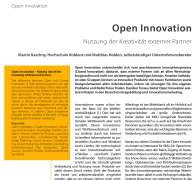
Open Innovation – Making Use of the Creativity of External Partners

Open Innovation - Making Use of the Creativity of External Partners

Martin Kaschny, Matthias Nolden
The difference between Open and Closed Innovation is that external partners can get actively involved in all stages of the value added process and are not limited to being mere idea generators. Whilst finding solutions for their own problems and needs, creative individuals or groups of individuals can play an active role in the development of innovative products featuring new functional and design elements. In addition, Open Innovation provides further benefits in the field of image building and innovation marketing.
Industrie 4.0 Management | Volume 32 | 2016 | Edition 1 | Pages 34-37
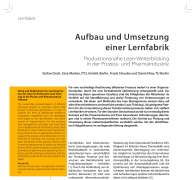
Setup and Deployment of a Learning Factory

Setup and Deployment of a Learning Factory

Close-to-production lean trainings in the process and pharmaceutical industry
Stefan Doch, Sara Merker, Frank Straube, Daniel Roy
The sustainable implementation of efficient processes requires a corporate culture that ensures continuous optimization. In order to achieve this level of operational excellence employees’ capabilities must be developed with regard to the identification and active pursuit of improvements. For this purpose, lean management principles and tools have to be implemented at all hierarchy levels (lean thinking). In many instances, learning factories have proved to be an appropriate platform to support this process of transformation. For the first time in Germany, this concept has now been transferred to the process industry with its special requirements by realizing a learning factory within a pharmaceutical company. The procedure of planning and deploying this industry-specific learning environment with the identified success factors are discussed in this paper.
Industrie Management | Volume 31 | 2015 | Edition 3 | Pages 26-30
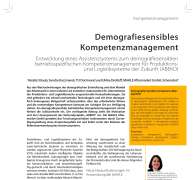
Demography-Sensitive Competence Management

Demography-Sensitive Competence Management

An assistance system for for production and logistics systems of the future (ABEKO)
Natalia Straub, Sandra Kaczmarek, Ulrike Drotleff
Demanding challenges arise through interactions of demographic development and change of modern working life in an industry 4.0., especially for enterprises of the production and logistics sector. While facing rapidly changing technologies and demographic homogenous personnel, they are requested to ensure that the required knowledge and the necessary competences are constantly recallable. A demographic-sensitive, operational competence management (ABEKO) plays a major role.
Industrie Management | Volume 31 | 2015 | Edition 3 | Pages 57-60
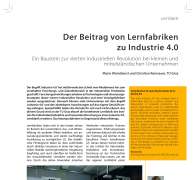
Contribution of Learning Factories to Industry 4.0

Contribution of Learning Factories to Industry 4.0

Ein Baustein zur vierten industriellen Revolution bei kleinen und mittelständischen Unternehmen
Mario Kleindienst, Christian Ramsauer
The term Industry 4.0 has changed from a fashionable issue to a serious research and future-topic in industrial production. Research organisations work on sophisticated technologies and concepts to implement this fourth industrial revolution, research grants are provided generously and model factories get decorated. However, many companies still cannot understand the term industry 4.0 and the related consequences on their own business. Especially small and medium sized enterprises have not understood the benefits. For that reason the currently existing learning factory at the institute of industrial management and innovation research at Graz University of Technology is enlarged to an industry 4.0 learning factory. The concept behind is the object of this article.
Industrie Management | Volume 31 | 2015 | Edition 3 | Pages 41-44
Industry 4.0 – Organization of Work in the Urban Factory of the Future

Industry 4.0 - Organization of Work in the Urban Factory of the Future

Arbeitsorganisatorische Aspekte zur Steigerung der Attraktivität urbaner Fabriken für Fachkräfte
Dominik T. Matt, Erwin Rauch
Die zukünftige Verstädterung führt zu einem Wachstum der urbanen Strukturen und gleichzeitig zu einer Konzentration von potenziellen Konsumenten von Gütern sowie von potenziellen Arbeitskräften der Fabriken von morgen. Dem Trend von Industrie 4.0 sowie einer Urbanisierung folgend sind daher auch die Fabriken mit ihren Arbeitsmodellen einem Wandel unterworfen. Mit dem Beginn der vierten industriellen Revolution spielt der Mensch als Produktionsfaktor weiterhin eine zentrale Rolle, allerdings ändert sich seine Rolle im Wertschöpfungsprozess. Dabei zeichnet sich immer stärker ein künftiger Mangel an qualifizierten Fachkräften ab. Der vorliegende Beitrag geht daher auf verschiedene arbeitsorganisatorische Ansätze zur Steigerung der Attraktivität urbaner Fabriken ein, welche zur Bewältigung des Fachkräftemangels einen Beitrag leisten sollen.
Industrie Management | Volume 31 | 2015 | Edition 3 | Pages 31-35
Knowledge and Competencies in a Digitalized Working Environment

Knowledge and Competencies in a Digitalized Working Environment

Herausforderungen und Unterstützungshilfen für kleine und mittlere Unternehmen
Theresa Myskovszky von Myrow, Gordon Lemme, Hendrieke Stiller, Oleg Cernavin
The increasing digitalization of the working environment has significantly influenced the dynamics of almost all sectors. It is responsible for fundamental changes of surrounding conditions and poses new challenges to organizations. New knowledge and new competencies have to be accumulated in ever shorter intervals. The directed selection, utilization and development of relevant knowledge and required competencies have to be planned and realized systematically. Within a research project, funded by the Federal Ministry for Labour and Social Affairs (BMAS), a self-assessment tool has been developed that is meant to support organizations in dealing with the critical success factors knowledge and competencies. The presentation of this tool is objective of the article at hand.
Industrie Management | Volume 31 | 2015 | Edition 3 | Pages 78-80
Knowledge Preservation by Using Digital Media in a Learning Factory

Knowledge Preservation by Using Digital Media in a Learning Factory

Ein neuer Ansatz zur Verringerung des Wissensverlusts hervorgerufen durch den demografischen Wandel
Dieter Kreimeier, Sebastian Freith, Carsten Ullrich
A closer look at the population pyramid shows the ongoing demographic change. The number of employees that are due to retire on account of their advanced age will increase significantly in the next years. Without further actions the knowledge and practical expertise of these experienced employees will no longer be available in the company. The preservation of the practical knowledge by the integration of digital media in an industrial production environment is subject of the article and is verified by the learning factory of the chair of production systems.
Industrie Management | Volume 31 | 2015 | Edition 3 | Pages 69-72
Multi-Dimensional Diversity in Logistics’ Education

Multi-Dimensional Diversity in Logistics’ Education

Ingrid Rügge, Aleksandra Himstedt
Researchers and decision-makers in global logistics are constantly communicating and co-operating across disciplinary and cultural borders. Therefore, doctoral candidates in logistics need to learn and practice skills to cope with multi-dimensional diversity in their working environment. We present a dynamically evolving structured doctoral training programme offered to early stage researchers who are affiliated with the International Graduate School for Dynamics in Logistics in the Research Cluster LogDynamics at the University of Bremen.
Industrie Management | Volume 31 | 2015 | Edition 2 | Pages 61-65
Intelligent Knowledge Services within Cyber-Physical Systems

Intelligent Knowledge Services within Cyber-Physical Systems

Soziotechnische Herausforderungen im Kontext von Industrie 4.0
Dieter Kreimeier, Niklas Kreggenfeld, Christopher Prinz ORCID Icon, Christoph Igel, Carsten Ullrich
As a result of continuously increasing economic constraints for the producing sector in Germany due to competitors from low-wage countries, production paradigms are changing substantially. This paradigm shift is characterized by rapidly advancing automation processes. Hence, highly complex Cyber-Physical Production Systems (CPPS) are developed and put into practice. In combination with decreasing numbers of staff and the resulting loss of knowledge, this leads to a deficit of competence required to handle the increasing complexity of CPPS. As a result, a need for innovative assistance systems arises for the support of the remaining employees. The given article describes the challenges and problems and drafts a potential technical solution as well as challenges concerning organization and staff.
Industrie Management | Volume 30 | 2014 | Edition 6 | Pages 25-29
IT-Supported Knowledge Management in Global Engineering

IT-Supported Knowledge Management in Global Engineering

Herausforderung Engineer-to-Order
Olga Willner, Stefan Weber, Alexander Eck, Paul Schönsleben
As a consequence of globalized markets product development and engineering functions increasingly work in globally distributed teams. To overcome challenges of global engineering processes, leading companies employ IT applications for storing knowledge centrally and accessing it locally. Typical IT applications however are not sufficient for engineer-to-order products, i.e. products that are engineered and built to the particular specifications of a customer. This paper explores on the example of a large elevator manufacturer how knowledge-intensive tasks can be coordinated and executed globally, efficiently combining the distinct capabilities of distributed engineering sites.
Industrie Management | Volume 30 | 2014 | Edition 4 | Pages 49-52
1 10 11 12 20