Sensors

Technology Selection for Automatic Identification

Technology Selection for Automatic Identification

A Systematic Approach to Select the Right Technology for the Automatic Identification of Workpieces and Products
Luise Weißflog, Philipp Wilsky, Tobias Markert, Ralph Riedel ORCID Icon
The automatic identification of workpieces is a compulsory step towards the Digital Twin and for a consistent life cycle file of products. Because different technologies exist, companies often face the challenge to find the right solution which meets their requirements. Especially the high level of prominence of some technologies lead to premature decisions without a profound selection process. This in turn might lead to sub-optimal solutions in the end. In order to support especially industrial companies in this process, a selection algorithm for Auto-ID technologies was developed as part of an industrial project at the department Factory Planning and Factory Management of TU Chemnitz. The selection process has been implemented in a Microsoft Excel-based tool.
Industrie 4.0 Management | Volume 35 | 2019 | Edition 5 | Pages 55-58
Digitalization Increases the Competitiveness of the Wind Industry

Digitalization Increases the Competitiveness of the Wind Industry

Horst Wildemann
The phase-out of nuclear energy decided by the politicians and the goal of significantly aligning the energy mix with renewable energies will give the industry great growth potential. Digitalization and the resulting technologies, such as sensors, robotics and assistance systems, artificial intelligence, virtual reality and augmented reality, are helping companies realise their potential. The study “Industrialization of the Wind Industry” by the Technical University of Munich has shown that digitalization will have a positive effect on the “Levelized Cost of Energy” (LCOE).
Industrie 4.0 Management | Volume 35 | 2019 | Edition 4 | Pages 63-65
Systematic Adoption of Industry 4.0 for SMEs

Systematic Adoption of Industry 4.0 for SMEs

Requirements, Methods and Application Example
Feras El Sakka, Timo Busert ORCID Icon, Alexander Fay ORCID Icon
In this contribution, a method for the implementation of Industry 4.0 projects in production and logistics for small and medium-sized enterprises (SME) is described. This method takes various boundary conditions of SMEs into consideration and has been applied in different projects with SMEs within the “Mittelstand 4.0-Kompetenzzentrum Hamburg” initiative. The method focuses on an integration of new technologies into existing systems and the connection of newly generated data with known information flows.
Industrie 4.0 Management | Volume 35 | 2019 | Edition 3 | Pages 25-29 | DOI 10.30844/I40M_19-3_S25-29
Measurement of the Filling Level of Trailers Used in Local Transport

Measurement of the Filling Level of Trailers Used in Local Transport

An overview of existing technologies and a practical test with ultrasonic sensors in automotive logistics
Till Becker, Thorben Funke, Joshua Coordes
In transport logistics the utilization of transports is often unknown. As a consequence it is not possible to use this information during the transport planning phase and it cannot be used for operational transport control. This report describes technologies which can measure the utilization of shipping spaces. Due to the lack of market-ready systems, a new system was developed that uses ultrasonic sensors to determine the transport utilization. The system was built on a trailer and was tested during live operation. It was shown that the system fulfills the given requirements and it is suggested to expand the tests.
Industrie 4.0 Management | Volume 34 | 2018 | Edition 5 | Pages 29-32 | DOI 10.30844/I40M18-5_29-32
Using RFID-Transponder for Cure Monitoring of Glass Fiber-Reinforced Plastics

Using RFID-Transponder for Cure Monitoring of Glass Fiber-Reinforced Plastics

RFID als ein neuer Ansatz zur Aushärtungsüberwachung von Komponenten aus glasfaserverstärktem Kunststoff
Marius Veigt, Elisabeth Hardi, Michael Koerdt, Gerd Ansorge, Karl-Heinz Wendisch, Stefan Krocyznski, Axel. S. Hermann, Michael Freitag ORCID Icon
The targeted curing of glass fiber-reinforced plastics (GFRP) is important to ensure the advantageous material properties. The use of RFID for curing monitoring is a completely new approach. This paper presents an experiment in which an RFID transponder has been integrated into GFRP and the Received Signal Strength Indicator (RSSI) has been measured during the curing process. The result shows that the RSSI can be used as an indicator for curing GFRP. The advantages of RFID technology compared to conventional methods for cure monitoring are the wireless application as well as the benefit, which an integrated RFID transponder generates in the further product life.
Industrie 4.0 Management | Volume 34 | 2018 | Edition 4 | Pages 7-10
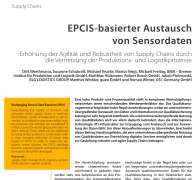
Exchanging Sensor Data Based on EPCIS

Exchanging Sensor Data Based on EPCIS

Erhöhung der Agilität und Robustheit von Supply Chains durch die Vernetzung der Produktions- und Logistikprozesse
Dirk Werthmann, Susanne Schukraft, Michael Teucke, Marius Veigt, Michael Freitag ORCID Icon, Matthias Hülsmann, Jakub Piotrowski, Matthes Winkler, Roman Winter
Guaranteeing the quality of products and processes within supply chains is essential. Nevertheless, quality management is still restricted to production processes while logistics processes are normally not considered. IT infrastructures for exchanging quality data are often missing. Those needs can be addressed by using sensor systems in combination with a cross company exchange of sensor data based on EPCIS. In order to realise this approach, sensor systems, the EPCIS standard, decision support systems and business models need to be further developed.
Industrie 4.0 Management | Volume 33 | 2017 | Edition 2 | Pages 20-24
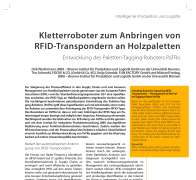
Climbing Robot for Attaching RFID Transponders

Climbing Robot for Attaching RFID Transponders

Development of the Pallet-Tagging-Robot PaTRo
Dirk Werthmann, Tim Schmohl, Kolja Schmidt, Michael Freitag ORCID Icon
Based on the specification of the European Pallet Association (EPAL) and GS1 the Pallet-Tagging-Robot (PaTRo) was developed. Special about the patented robot is that it can climb pallet stacks without additional equipment and can attach two RFID transponders to each pallet. During the whole process for tagging each pallet of the stack PaTRo is just supported by the stack. That is why PaTRo is very flexible and mobile for being moved to the location where the tagging should take place. For realizing the described features the construction of the robot is based on lightweight design.
Industrie 4.0 Management | Volume 32 | 2016 | Edition 2 | Pages 19-24
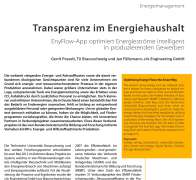
Optimizing Energy Flows the Smart Way

Optimizing Energy Flows the Smart Way

EnyFlow-App optimiert Energieströme intelligent in produzierenden Gewerben
Gerrit Posselt, Jan Füllemann
The world’s rising energy and raw material costs are a reason for many companies to reduce energy and resource waste in their own production. Based on this plan, the Federal Ministry of Education and Research (BMBF) initiated in 2009 the project EnHiPro. Until May, 2012 the Technische Universität Braunschweig and three other research partners developed a system to make the energy demand of machines tangible by utilizing smart metering strategies. For the analysis and visualization of the energy flows, the c4c Engineering company was brought into the team in order to engineer the EnyFlow app that makes the energy flows and states of machines transparent on an tablet PC.
Industrie 4.0 Management | Volume 32 | 2016 | Edition 1 | Pages 55-57
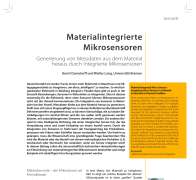
Material Integrated Micro Sensors

Material Integrated Micro Sensors

Integrating micro sensors in a material to describe its physical condition
Gerrit Dumstorff, Walter Lang
Since several years, there is a strong trend in integrating electronics in machines and everyday items to make them “intelligent”. For example, electronics are integrated in clothes. In addition, sensors are integrated in materials too. This is also necessary for the electronics because without sensors microprocessors cannot communicate with the environment. Integrating sensors in materials has the advantage of getting measurement quantities out of the material. The scientific community has to answer a fundamental question: How does the integrated sensor change the macroscopic behavior (e.g. thermal or mechanical) of the material or of the component? This article focuses on the scientific and technical challenges for developing material integrated sensors. Various examples are provided through which future scientific goals can be focused upon.
Industrie Management | Volume 31 | 2015 | Edition 1 | Pages 33-36
On the Way to Industry 4.0

On the Way to Industry 4.0

Christian Gorldt, Alexander Pflaum
The development of information and communication technologies (ICT) is progressing rapidly and is seen in today‘s economic action as a key driver of innovation. Future industrial production is characterized by a high degree of customization of products and a strong production flexibility. The rapid development of the Internet has contributed especially in recent years in the private life of merging the real with the virtual world and will get stronger in the future of industrial sector. This paradigm shift is referred to as Industry 4.0. This paper gives an overview of the Industry 4.0 and represents the potential of the transformation process.
Industrie Management | Volume 30 | 2014 | Edition 1 | Pages 15-18
1 2 3 4 7