Autor: Sander Lass

Decentralized Tact Time Control in Assembly

Decentralized Tact Time Control in Assembly

Simplifying robust control of assembly lines via the I4.0 box
Sander Lass, Tim Körppen
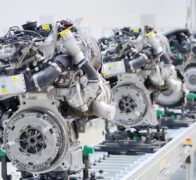
In theory, decentralized control approaches in the manufacturing context offer several advantages over monolithic centralized systems where all functions are combined into one or into several authorities. However, practical implementation requires adaptation of the general concept of decentralization to fit individual and specific use cases, especially with regard to their sensible scope. One such use case is the assembly of high-variation products. This article shows the appropriate combination of centralized and decentralized approaches can be leveraged to achieve better planning and increased throughput in manufacturing. With flexible cycle control for work stations and suitable assistance at the assembly workstation, the previous shop-floor oriented organization style can be transformed into a series-like manufacturing process. This is done using a multi-layered infrastructure that follows the Industry 4.0 paradigm of decentralized information processing through autonomous ...
Industry 4.0 Science | Volume 39 | 2023 | Edition 1 | Pages 34-40 | DOI 10.30844/I4SE.23.1.34
Industry 4.0 Despite Legacy Systems

Industry 4.0 Despite Legacy Systems

Integration of Existing Plants into CyberPhysical Production Systems
Sander Lass
Cyber-physical systems (CPS) have shaped the discussion about Industrie 4.0 for some time. For ensuring the competitiveness of producing enterprises the vision for the future figures out cyber-physical production systems (CPPS) as a core component of a modern factory. Adaptability and coping with complexity are (among others) potentials of this new generation of production management. The succesful transformation of this theoretical construct into the practical implementation can only take place with regard to the conditions characterizing the context of a factory. The subject of this contribution is a concept that takes up the brown field character and describes a solution for CPS-extension of existing (legacy) systems.
Industrie 4.0 Management | Volume 33 | 2017 | Edition 6 | Pages 15-19
Efficient Simulation in Production Management

Efficient Simulation in Production Management

Schnelle und belastbare Analyse von Fertigungsprozessen
Sander Lass, Hanna Theuer ORCID Icon, Norbert Gronau ORCID Icon
In the research project LUPO a hybrid simulation laboratory is build up. This combines the advantages of the computer simulation with those of a model factory. For the systematic recording, mapping and analysis of various production processes a procedure model has been created that responds to the special requirements (quick, flexible, effortless determination of informative results) of the project. A library of production objects facilitates the reutilisa tion of existing machines and hereby a reduction of simulation effort.
Industrie Management | Volume 27 | 2011 | Edition 3 | Pages 13-15
Hybrid Simulator – A New Production Management Approach

Hybrid Simulator - A New Production Management Approach

Neuer Ansatz für das Produktionsmanagement
Sander Lass, Corinna Fohrholz, Hanna Theuer ORCID Icon
In a world of steady change, manufacturing companies face major challenges. They have to react quickly to an increasing competition and more and more individual customer requests. New technologies and organisational structures like RFID or decentralised and real-time based production control can deal with this issue successfully. The specific realization of selection and analysis of each production process of the company often approves to be difficult and cost intensive. Previous simulation approaches are frequently combined with high efforts in order to state credible propositions regarding suitability and economic efficiency. The present paper shows a new opportunity towards managing these disadvantages. Additionally, the advantages are combined with computer-based simulations of the model factory. A fast and flexible illustration of the analysed production processes is achieved.
Industrie Management | Volume 27 | 2011 | Edition 1 | Pages 13-16