Autor: Dirk Werthmann

Interactive Logistics Planning and Control for the Turnover of Vehicles

Interactive Logistics Planning and Control for the Turnover of Vehicles

Lösungsansatz für die Steigerung der Effizienz und Flexibilität der Logistikabwicklung auf See- und Binnenhäfen
Susanne Schukraft, Stephan Oelker, Dirk Werthmann, Michael Freitag ORCID Icon, Michael Görges, Emrah Gencer, Artur Malek
Logistic processes at seaports and inland terminals play an important role for finished vehicle logistics. High flexibility and reactivity are required to cope with frequent deviations from original operational planning. This paper describes a concept for developing tools and systems to optimize planning and control processes. This includes a simulation backed planning system and a control system for order allocation using mobile devices and their GPS as well as sensor data.
Industrie 4.0 Management | Volume 33 | 2017 | Edition 6 | Pages 11-14
Approaches to Improve Finished Vehicle Logistics

Approaches to Improve Finished Vehicle Logistics

Survey Based Identification of Challenges at the Interfaces between Car Manufacturers and Logistics Service Providers
Dirk Werthmann, Aljoscha Warns, Michael Freitag ORCID Icon
Finished vehicle logistics is of particular importance for the automotive industry, because it is the link between manufacturer and customers. If problems occur during the distribution of a car, it becomes visible to the customer, unless the problems can be solved during the following processes. Process interfaces between companies are frequently causing issues. That is why a survey was executed in order to identify those issues at the interfaces between car manufacturers and logistics service providers.
Industrie 4.0 Management | Volume 33 | 2017 | Edition 4 | Pages 61-65
Exchanging Sensor Data Based on EPCIS

Exchanging Sensor Data Based on EPCIS

Erhöhung der Agilität und Robustheit von Supply Chains durch die Vernetzung der Produktions- und Logistikprozesse
Dirk Werthmann, Susanne Schukraft, Michael Teucke, Marius Veigt, Michael Freitag ORCID Icon, Matthias Hülsmann, Jakub Piotrowski, Matthes Winkler, Roman Winter
Guaranteeing the quality of products and processes within supply chains is essential. Nevertheless, quality management is still restricted to production processes while logistics processes are normally not considered. IT infrastructures for exchanging quality data are often missing. Those needs can be addressed by using sensor systems in combination with a cross company exchange of sensor data based on EPCIS. In order to realise this approach, sensor systems, the EPCIS standard, decision support systems and business models need to be further developed.
Industrie 4.0 Management | Volume 33 | 2017 | Edition 2 | Pages 20-24
Climbing Robot for Attaching RFID Transponders

Climbing Robot for Attaching RFID Transponders

Development of the Pallet-Tagging-Robot PaTRo
Dirk Werthmann, Tim Schmohl, Kolja Schmidt, Michael Freitag ORCID Icon
Based on the specification of the European Pallet Association (EPAL) and GS1 the Pallet-Tagging-Robot (PaTRo) was developed. Special about the patented robot is that it can climb pallet stacks without additional equipment and can attach two RFID transponders to each pallet. During the whole process for tagging each pallet of the stack PaTRo is just supported by the stack. That is why PaTRo is very flexible and mobile for being moved to the location where the tagging should take place. For realizing the described features the construction of the robot is based on lightweight design.
Industrie 4.0 Management | Volume 32 | 2016 | Edition 2 | Pages 19-24
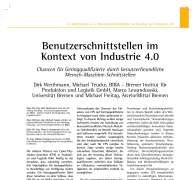
Human Machine Interfaces in the Context of Industrie 4.0

Human Machine Interfaces in the Context of Industrie 4.0

Chancen für Geringqualifizierte durch benutzerfreundliche Mensch-Maschine-Schnittstellen
Dirk Werthmann, Michael Teucke, Marco Lewandowski, Michael Freitag ORCID Icon
The number of cyber-physical systems (CPS) in industrial environments is growing based on the effort of projects like Industrie 4.0. CPS offer the potential to improve processes in modern value networks. By improving processes, especially jobs with no demand for qualified workers can be dispensed. Another effect are jobs being standardised, that they become very monotonous for the workers. For providing satisfying jobs especially for low qualified workers in future working environments some opportunities CPS offer were presented. First opportunities consumer devices offer were presented, second concepts for user-friendly human machine interfaces were illustrated.
Industrie Management | Volume 30 | 2014 | Edition 4 | Pages 39-44
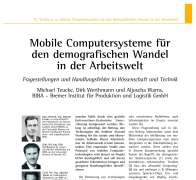
Supporting Aging Workers in Production and Logistics

Supporting Aging Workers in Production and Logistics

A method involving mobile computing systems
Michael Teucke, Dirk Werthmann, Aljoscha Warns
Aging employees in modern working environments require compensation of their decreasing fitness and cognitive abilities. Ambient Assisted Working (AAW) based on modern information technology can offer potentials to cope with the upcoming demographic change. The project EUNA aims at figuring out the potential contribution of wearable computing components to enable social and economic participation of aging employees. Focus of the project is on production oriented branches and logistics oriented service providers. The project activities include an empirical investigation of AAW to establish the status quo and future development of the topic within production and logistics as well as identifying new application areas.
Industrie Management | Volume 30 | 2014 | Edition 3 | Pages 47-51
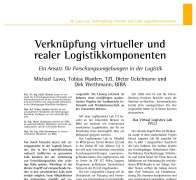
Matching Virtual and Real Supply Chain Objects

Matching Virtual and Real Supply Chain Objects

An Approach to Match Research Environments in Logistics
Michael Lawo, Tobias Warden, Dieter Uckelmann ORCID Icon, Dirk Werthmann
To evaluate research approaches in logistics, tests are indispensable. For enhanced research in logistics worldwide well established labs could take a major role to shorten development cycles. However, often remote access to necessary resources in the different labs is not possible. In this context a new opportunity for a technology driven access to supply chain labs could be established to increase the availability and user friendliness as well as the utilization rate of existing infrastructures. In the present article the remote access through a web based interface is introduced. The system has been developed within a two year student project in collaboration with the computer science and production engineering department at the University of Bremen.
Industrie Management | Volume 28 | 2012 | Edition 1 | Pages 45-48
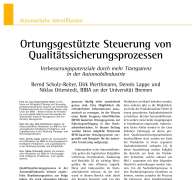
Location-Based Controlling of Rework Processes

Location-Based Controlling of Rework Processes

Verbesserungspotenziale durch mehr Transparenz in der Automobilindustrie
Bernd Scholz-Reiter ORCID Icon, Dirk Werthmann, Dennis Lappe, Niklas Otterstedt
Quality assurances in the automotive industry pose additional processing times which are highly fluctuating and difficult to calculate. Within the rework processes the registration of vehicle positions is done manually. As a result the available information is not continuous and sufficient for an efficient control of these processes. Radio frequency identification (RFID) based positioning systems are one possibility to track the vehicles in the rework process automatically and to provide the required information. This paper presents the potential of a RFID-based positioning system in the rework area as well as examples for technical realization.
Industrie Management | Volume 28 | 2012 | Edition 1 | Pages 22-26
Special Load Carrier Management in the Automotive Industry

Special Load Carrier Management in the Automotive Industry

Betrachtung der Wirtschaftlichkeit und Energieeffizienz von RFID-Anwendungen bei einem Logistikdienstleister
Bernd Scholz-Reiter ORCID Icon, Dennis Lappe, Dirk Werthmann
During the last decades, automotive manufacturers have outsourced many processes. Hence, complex networks consisting of automotive manufacturers, suppliers and logistics service providers have grown in the automotive industry. The resulting transports of components in these networks often require special load carriers. Consequently, companies nowadays face the challenge to handle a growing number of load carriers. For improving the load carrier management a higher transparency is required regarding the load carriers in the whole network. Transparency can be assured by the application of radio frequency identification technology. However, especially logistics service providers have to invest in this technology, which can be implemented in different ways. In this paper, some application possibilities are described and analyzed regarding economic and energy efficiency.
Industrie Management | Volume 27 | 2011 | Edition 6 | Pages 77-81
An Approach for a Further Development of a Wearable Computing System

An Approach for a Further Development of a Wearable Computing System

Bernd Scholz-Reiter ORCID Icon, Dennis Lappe, Dirk Werthmann, Carmen Ruthenbeck
Wearable computing systems allow the support of workers in ongoing processes of automotive logistics. In a previous research project a wearable computing system, which is called easyTracing System, was developed. To this date, the easyTracing System is not technically mature because of the following reasons: First of all, the system was just tested in a laboratory. Hence, field tests are necessary, for example respective robustness. Besides, for supporting workers an efficient method for process controlling has to be developed. Both to make the technology of the easyTracing System workable and to develop an efficient method for process controlling are objects of research. This paper presents an approach for both development projects with the characteristic of a simultaneous processing.
Industrie Management | Volume 27 | 2011 | Edition 1 | Pages 17-20