Autor: Dieter Uckelmann

Increasing Resilience in Logistics with IT

Increasing Resilience in Logistics with IT

Investigating supply chain risk management information systems
Alexander Baur, Jasmin Hauser, Dieter Uckelmann ORCID Icon
The blockage of the Suez Canal in 2021, caused by the accident involving the container ship Ever Given, clearly illustrates the need to design global supply chains in such a way that they can respond quickly to disruptions. In a volatile, uncertain, complex, and ambiguous (VUCA) environment, conventional logistics processes that focus on efficiency, and supply chain management methods in particular, are increasingly reaching their limits. Resilience, achieved through a combination of robustness and agility, is essential to ensure responsiveness. This article analyzes how risk management information systems (RMIS) can increase resilience. The analysis covers data availability, data transparency, modeling and simulation of risk scenarios, and the development of appropriate emergency action plans. Despite existing challenges in designing IT infrastructure, the measures mentioned have the potential to increase resilience in logistics.
Industry 4.0 Science | Volume 41 | Edition 4 | Pages 36-42
Training in the Industrial Metaverse

Training in the Industrial Metaverse

Buzzword or opportunity?
Leon Schellhammer ORCID Icon, Lucas Waag, Mert Cumert, Dieter Uckelmann ORCID Icon
Metaverse-based training programs offer a realistic and risk-free learning environment that is particularly valuable in industrial contexts, e.g. in immersive training and the simulation of workflows. Challenges remain in the areas of data protection, technological acceptance and integration into existing systems. Using a carefully crafted questionnaire, four expert interviews were conducted to investigate whether the metaverse can innovate training programs effectively and lastingly. Its standardized format yields comparable, reliable data while allowing for an accurate evaluation of the results.
Industry 4.0 Science | Volume 41 | 2025 | Edition 2 | Pages 102-108
Energy Efficiency Through Intelligent Electricity Data Acquisition

Energy Efficiency Through Intelligent Electricity Data Acquisition

Wireless retrofit solution based on IoT technologies and open-source software for existing industrial buildings
Sergej Kreber, Kevin Kutzner, Dieter Uckelmann ORCID Icon
Facility managers for industrial properties are faced with the challenge of optimizing the energy efficiency of their facilities in the face of ever-increasing energy demand and rising energy costs. Digital processes that enable the comprehensive monitoring, analysis and control of energy demand offer an effective way to reduce costs, increase energy efficiency and make optimal use of resources. Based on IoT technologies and open-source software, a cost-effective, wireless and flexible retrofit solution for real-time energy data collection has been developed.
Industry 4.0 Science | Volume 40 | Edition 2 | Pages 87-93
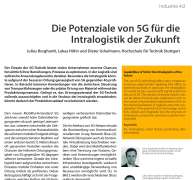
Capabilities of 5G for the Intralogistics of the Future

Capabilities of 5G for the Intralogistics of the Future

Julius Burghardt, Lukas Höhn, Dieter Uckelmann ORCID Icon
The use of 5G technology o ers many companies enormous opportunities regarding their efforts to optimize processes. In particular, the intralogistics of a smart factory could bene t signi cantly from the use of 5G. The position of diverse mobile units can be determined precisely. Applications such as the control of Automated Guided Vehicles (AGV ) or the precise localization of material come into consideration. If the potential of 5G technology can be fully utilized and integrated into the structure of intralogistics, production processes could be revolutionized.
Industrie 4.0 Management | Volume 38 | 2022 | Edition 3 | Pages 57-60 | DOI 10.30844/IM_22-3_57-60
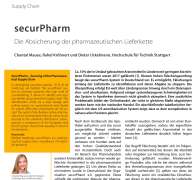
SecurPharm – Securing of the Pharmaceutical Supply Chain

SecurPharm - Securing of the Pharmaceutical Supply Chain

Chantal Mause, Rahel Kröhnert, Dieter Uckelmann ORCID Icon
In developing countries approx. 10 % of all medicines are falsified. The securPharm system in Germany prevents this high level of counterfeiting. It allows to identify and stop counterfeit drugs along the supply chain. The identification works via a data storage and polling system on supranational level. Based on system difficulties, pharmacies do not accept the system fully. Besides online pharmacies are an issue because they are not as much secured as the stationary distributors. Subsequently a comparison of the European and the US system shows their equality in most of the elements.
Industrie 4.0 Management | Volume 37 | 2021 | Edition 2 | Pages 44-47 | DOI 10.30844/I40M_21-2_S44-47
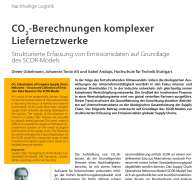
CO₂ Calculations of Complex Supply Chain Networks

CO₂ Calculations of Complex Supply Chain Networks

Structured collection of emission data based on the SCOR model
Dieter Uckelmann ORCID Icon, Johannes Tonio Alt, Isabel Andujo
As a result of the progressively climate change, the environmental impact of corporate activities is becoming the focus of internal and external shareholders. At the same time more complex supply chain networks are being developed in the industry. The majority of the processes involved in a supply chain network are executed by globally spread partners. This trend makes it difficult to quantify the impact of individual corporate-level activities on the overall ecological performance of the supply chain. The following document evaluates the scope of application on the SCOR model for a structured range of data emissions from global supply chains, based on a detailed literature research.
Industrie 4.0 Management | Volume 35 | 2019 | Edition 6 | Pages 16-20 | DOI 10.30844/I40M_19-6_S12-16
Green Warehouses – A Guideline From Planning to Construction

Green Warehouses - A Guideline From Planning to Construction

von der Planung bis zum Bau
Ronja Ege, Maximilian Kornmann, Clemens Stöver, Dieter Uckelmann ORCID Icon
As transportation is accountable for around 87 % of total logistics emissions globally, scientific focus in the past laid on the moving elements of the supply chain and not the stop points in between, namely the warehouses. However, responsible for 13 % of emissions, logistics real estate should not be neglected. Thus, based on an extensive literature research, the article summarizes the current state of science in green logistics buildings. By discussing certain aspects of supply chain strategy development, location planning and warehouse construction, possibilities aiming to minimize the ecological lifecycle footprint are elaborated.
Industrie 4.0 Management | Volume 35 | 2019 | Edition 6 | Pages 51-54 | DOI 10.30844/I40M_19-6_S51-54
Environmental Aspects of Vendor Managed Inventory

Environmental Aspects of Vendor Managed Inventory

Gökhan Cenk ORCID Icon, Emre Kayadelen, Philipp Kürner, Marius Schultenkämper, Dieter Uckelmann ORCID Icon
The economic and environmental impacts of globalization are forcing companies to form their supply chain more efficient. Vendor Managed Inventory (VMI) is a widely used concept that is primarily implemented because of its cost savings. Based on a comprehensive survey in the logistics industry in Germany, this study provides sustainable and ecological recommendations for companies planning or already working daily with VMI.
Industrie 4.0 Management | Volume 34 | 2018 | Edition 6 | Pages 56-60 | DOI 10.30844/I40M_18-6_56-60
Social Networks in Logistics and Industry 4.0

Social Networks in Logistics and Industry 4.0

The Usage of Social Networks for Communication Enhances Production and Logistics
Anuschka Huber, Helen Mödinger, Dieter Uckelmann ORCID Icon
Fast-pacing technologies force companies to improve their flexibility. Fluctuating demand and volatile markets require high reactivity. Due to Industry 4.0 and globalization, communication in companies is becoming increasingly important. Social networks can be used to improve the efficiency of in-house communication and create a connection to partners and customers. This paper discusses how social networks can support corporate communication internally as well as externally, with a focus on logistics and production. In this context, practical examples are shown and a self-developed model is presented.
Industrie 4.0 Management | Volume 34 | 2018 | Edition 5 | Pages 51-54 | DOI 10.30844/I40M18-5_51-54
SupplyOn – Data Interchange within Networks in the Supplying Industry

SupplyOn - Data Interchange within Networks in the Supplying Industry

Netzwerk für den elektronischen Datenaustausch in der Zulieferindustrie
Dietlind Ruoff, Patricia Srsa, Dieter Uckelmann ORCID Icon
In the last years, e-business and networking between companies has become an increasingly important aspect. Simultaneously with e-business, electronic data interchange has evolved and supported network formation. According to the large number of supplier platforms, like SupplyOn, the traditional 1:1 EDI communication between manufacturer and supplier is no longer the only way of interaction. The present article describes this development detailed and deals with different possibilities of data interchange just as the comparison to classical EDI.
Industrie 4.0 Management | Volume 34 | 2018 | Edition 5 | Pages 25-28 | DOI 10.30844/I40M18-5_25-28
1 2