Autor: Marius Veigt

Planning Assistance in Production and Logistics

Planning Assistance in Production and Logistics

Supervised learning for predicting process steps in the planning of logistics processes
Marius Veigt, Lennart M. Steinbacher, Michael Freitag ORCID Icon
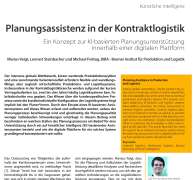
The competitive pressure in the contract logistics industry is intense. Logistics providers must respond to tenders quickly and with convincing concepts. This article presents initial approaches to how logistics process planning in tender management can be supported using supervised learning methods. Under the premise that similar processes from past projects can be transferred and adapted to a project to be planned, an AI-based assistance system suggests appropriate process steps and MTM (Methods-Time Measurement) codes during planning. This procedure can accelerate process planning and lead to an increased quality of logistics processes to be planned. (Only in German)
Industrie 4.0 Management | Volume 39 | 2023 | Edition 1 | Pages 9-13
Planning Assistance in Production and Logistics

Planning Assistance in Production and Logistics

A concept for AI-based planning support within a digital platform
Marius Veigt, Lennart Steinbacher, Michael Freitag ORCID Icon
Intense global competition, shorter product life cycles and an increasing number of variants require flexible and adaptable, but at the same time economical production and logistics systems. This requires constant replanning of factories and logistics systems. Value-adding processes are being outsourced to contract logistics providers. Contract logistics planners must respond to tenders as quickly as possible and develop a proposal with an initial planning concept and a cost estimation. Despite standardization efforts in planning, the knowledge is often only implicit at the planners. This article describes the need for support by an AI-based assistance system during the planning process and how a digital platform for such an assistance system should look like.
Industrie 4.0 Management | Volume 37 | 2021 | Edition 5 | Pages 11-15
Automated Wire Rope Inspection

Automated Wire Rope Inspection

Sensorintegration in die Überprüfung von Drahtseilen und Entwicklung einer intelligenten Auswerteeinheit
Markus Trapp, Benjamin Staar ORCID Icon, Marius Veigt, Stephan Oelker, Michael Freitag ORCID Icon
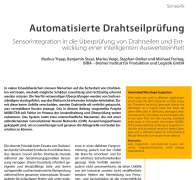
Wire ropes are used in different applications and human life often depend on their integrity. Therefore, technical personnel checks the tightropes on a regular basis but there are some difficulties in detecting damaged areas. Consequently, wire ropes are exchanged rather too early than too late causing avoidable extra costs. In this paper, the project MOBISTAR is presented that combines a magneto-inductive and an optical sensor to detect damages and a software based on Convolutional Neural Networks to evaluate those defects.
Industrie 4.0 Management | Volume 34 | 2018 | Edition 4 | Pages 29-32
Using RFID-Transponder for Cure Monitoring of Glass Fiber-Reinforced Plastics

Using RFID-Transponder for Cure Monitoring of Glass Fiber-Reinforced Plastics

RFID als ein neuer Ansatz zur Aushärtungsüberwachung von Komponenten aus glasfaserverstärktem Kunststoff
Marius Veigt, Elisabeth Hardi, Michael Koerdt, Gerd Ansorge, Karl-Heinz Wendisch, Stefan Krocyznski, Axel. S. Hermann, Michael Freitag ORCID Icon
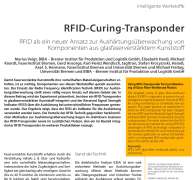
The targeted curing of glass fiber-reinforced plastics (GFRP) is important to ensure the advantageous material properties. The use of RFID for curing monitoring is a completely new approach. This paper presents an experiment in which an RFID transponder has been integrated into GFRP and the Received Signal Strength Indicator (RSSI) has been measured during the curing process. The result shows that the RSSI can be used as an indicator for curing GFRP. The advantages of RFID technology compared to conventional methods for cure monitoring are the wireless application as well as the benefit, which an integrated RFID transponder generates in the further product life.
Industrie 4.0 Management | Volume 34 | 2018 | Edition 4 | Pages 7-10
Exchanging Sensor Data Based on EPCIS

Exchanging Sensor Data Based on EPCIS

Erhöhung der Agilität und Robustheit von Supply Chains durch die Vernetzung der Produktions- und Logistikprozesse
Dirk Werthmann, Susanne Schukraft, Michael Teucke, Marius Veigt, Michael Freitag ORCID Icon, Matthias Hülsmann, Jakub Piotrowski, Matthes Winkler, Roman Winter
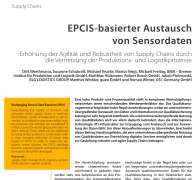
Guaranteeing the quality of products and processes within supply chains is essential. Nevertheless, quality management is still restricted to production processes while logistics processes are normally not considered. IT infrastructures for exchanging quality data are often missing. Those needs can be addressed by using sensor systems in combination with a cross company exchange of sensor data based on EPCIS. In order to realise this approach, sensor systems, the EPCIS standard, decision support systems and business models need to be further developed.
Industrie 4.0 Management | Volume 33 | 2017 | Edition 2 | Pages 20-24
Development of a Cyber-Physical Logistics System

Development of a Cyber-Physical Logistics System

Marius Veigt, Dennis Lappe, Karl Hribernik, Bernd Scholz-Reiter ORCID Icon
Along with increasing complexity and dynamics the importance of cyber-physical systems in production and logistics also increases. Hence, the BIBA - Bremer Institut für Produktion und Logistik GmbH at the University of Bremen considers the application of cyber-physical systems in logistics. This paper presents the approach for the development of a cyber-physical logistics system. To start we describe the fundamental terms cyber-physical system and cyber-physical production system. Following these definitions we explain the term cyber-physical logistics system. Afterwards we describe the course of action; in particular necessary steps within the development of a cyber-physical logistics system are explained. In detail we present the procedure consisting of requirements analysis, conception and simulation-based evaluation.
Industrie Management | Volume 29 | 2013 | Edition 1 | Pages 15-18