Autor: Bernd Scholz-Reiter

“Data Generated by Cyber-Physical Systems Will Play a Decisive Role”

"Data Generated by Cyber-Physical Systems Will Play a Decisive Role"

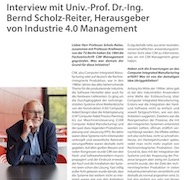
Interview with Prof. Bernd Scholz-Reiter, former editor of Industrie 4.0 Management
Bernd Scholz-Reiter ORCID Icon, Bernd Scholz-Reiter ORCID Icon
Professor Bernd Scholz-Reiter studied industrial engineering at the Technical University of Berlin. After several positions in Germany and abroad, he accepted the call to the University of Bremen in 2000, where he initially held the professorship of Planning and Control of Production Systems in the Department of Production Engineering. From 2002 to 2012, he also headed the Bremen Institute for Production and Logistics (BIBA). From 2012 to 2022, Bernd Scholz-Reiter was rector of the University of Bremen.
Industrie 4.0 Management | Volume 38 | Edition 6 | Pages 6-8
Interlinking Central Production Planning with Autonomous Production Control

Interlinking Central Production Planning with Autonomous Production Control

Beurteilung der logistischen Zielerreichung und Planeinhaltung beim Einsatz autonomer Steuerungsmethoden
Susanne Schukraft, Sebastian Grundstein ORCID Icon, Michael Freitag ORCID Icon, Bernd Scholz-Reiter ORCID Icon
The integration of autonomous control methods into central PPC-systems enables a high logistics target achievement despite occurring dynamic influences. Thereby, the integration requires coupling strategies to specify the harmonisation of autonomous control and central planning methods. The logistics target achievement and the adherence to given planning parameters depend on the specific strategy and the related level of autonomy. This paper introduces a target system which enables the evaluation of coupling strategies considering both logistics target achievement and the adherence to given planning para-meters. Thereby, producing companies are enabled to consider both aspects for the selection of suitable planning and control methods.
Industrie Management | Volume 31 | 2015 | Edition 2 | Pages 23-27
3D Object Recognition of Universal Logistic Goods

3D Object Recognition of Universal Logistic Goods

Flexible Automatisierung basierend auf 3D-Bildverarbeitung
Hendrik Thamer, Bernd Scholz-Reiter ORCID Icon
Progress in the areas of 3D sensor systems and artificial intelligence provides new opportunities for the development of flexible robotic systems that are applicable in scenarios without predefined and constant environmental conditions or standardized processes. An example from the field of logistics is the automatic unloading of containers. The development of a suitable robotic system on the one hand requires applicable gripping technologies, on the other hand it requires a reliable object recognition method in order to recognize and localize differently shaped logistic goods within a packaging scenario. This paper presents an object recognition method for logistic goods from three different shape classes using point clouds acquired by a laser scanner. The method is evaluated with real packaging scenarios.
Industrie Management | Volume 30 | 2014 | Edition 6 | Pages 35-38
Capacity Control Based on Reconfigurable Machine Tools

Capacity Control Based on Reconfigurable Machine Tools

Durchlaufzeitharmonisierung in der Werkstattfertigung durch den Einsatz rekonfigurierbarer Werkzeugmaschinen
Dennis Lappe, Christian Toonen, Bernd Scholz-Reiter ORCID Icon
Nowadays, a well-designed capacity supply is essential for a company’s competitiveness. In this situation, a flexible and efficient capacity control is among the most important measures. In this paper, we presented the potential of reconfigurable machine tools. Based on this, we described the concept of the throughput time harmonizing capacity control. Moreover, we evaluated the theoretical potential of this capacity control approach in a simulation experiment. In further steps, we will analyze the total potential in different simulation studies.
Industrie Management | Volume 30 | 2014 | Edition 5 | Pages 17-22
Detection of Critical Disruptions in Supply Chains

Detection of Critical Disruptions in Supply Chains

Jens Hartmann, Magdalena Metzger, Bernd Scholz-Reiter ORCID Icon
Nowadays, the production of many goods takes place in distributed facilities within supply chains. The production planning of single facilities is based on due dates for delivery of raw materials or intermediate products that were agreed with supply chain partners. Thus, for an efficient overall system it is of major importance that these due dates are fulfilled. However, production systems are usually subjected to disruptions that put the execution of a given schedule at risk. This paper presents a method for the signal-based detection of faults in production systems. In addition to the fault detection, a heuristic method is employed that mitigates the disruptions and leads to a reliable production.
Industrie Management | Volume 29 | 2013 | Edition 6 | Pages 26-30
Autonomously Controlled Route Planning for Rental Articles

Autonomously Controlled Route Planning for Rental Articles

Florian Harjes, Bernd Scholz-Reiter ORCID Icon
In general, rental articles circulate in closed logistic systems, where the order parameters determine the material flow. As the planning horizon often comprises several subsequent orders at different locations, the corresponding transport and route planning is a complex task. Additionally, dynamic effects, such as thefts, damages, rush orders as well as new orders or order changes complicate the proceeding. This paper introduces the concept of an autonomously controlled route planning for rental articles that bases on the Distributed Logistics Routing Protocol (DLRP). At this, an example from the field of event logistics illustrates the concept.
Industrie Management | Volume 29 | 2013 | Edition 6 | Pages 44-48
Information Transparency in Event Logistics

Information Transparency in Event Logistics

Florian Harjes, Bernd Scholz-Reiter ORCID Icon
The disposition and control of orders in the field of event logistics constitutes a complex and dynamic challenge. Changing venues, temporal restrictions as well as order changes and high customer demands require a flexible planning of the related logistic processes. Methods from the field of autonomous control offer a promising approach to cope with these problems. This contribution deals with the design of a special module for the information acquisition within the related logistic processes, as the provision of actual planning data is an indispensable prerequisite for the application of autonomous control.
Industrie Management | Volume 29 | 2013 | Edition 5 | Pages 39-42
Registering Simulated Point Cloud of Complex Micro Structures

Registering Simulated Point Cloud of Complex Micro Structures

3D Sensorsimulation zur Projektierung von Bildverarbeitungslösungen
Daniel Weimer, Hendrik Thamer, Bernd Scholz-Reiter ORCID Icon
The major components of a machine vision system are image acquisition and image processing. The complexity of image acquisition is based on the huge number of degrees of freedom. This article introduced an extension of a sensor simulation tool which enables a user to simulate the current sensor positions and field of views. The results are registered point clouds from different sensor positions merged to a final object point cloud. Now it is possible to evaluate image processing techniques based on the simulated 3D data, without explicit results from the real sensor behaviour. The benefits of the tool were demonstrated in a real micro cold forming scenario. Future work focuses on additional sensor noise models. Adding these models results in a more realistic sensor simulation framework.
Industrie Management | Volume 29 | 2013 | Edition 2 | Pages 49-52
A Method to Design Process Chains in Micro Manufacturing

A Method to Design Process Chains in Micro Manufacturing

Bernd Scholz-Reiter ORCID Icon, Daniel Rippel
In the field of micro manufacturing, a highly precise adjustment of relevant process parameters is of major importance. The continuing miniaturization of work pieces and machines leads to very small tolerances. The occurrence of so called size-effects interferes with a direct application of knowledge and experiences from macro manufacturing. Moreover, the high specialization of manufacturing technologies and processes in micro manufacturing requires a careful review of each process’s suitability with respect to the involved materials and components. This article presents a method that supports process designers with structured procedures and notations, to model and evaluate technological as well as logistic dependencies along the process chain. Thereby, it supports the selection and configuration of suitable processes for a given process chain.
Industrie Management | Volume 29 | 2013 | Edition 2 | Pages 15.19
Development of a Cyber-Physical Logistics System

Development of a Cyber-Physical Logistics System

Marius Veigt, Dennis Lappe, Karl Hribernik, Bernd Scholz-Reiter ORCID Icon
Along with increasing complexity and dynamics the importance of cyber-physical systems in production and logistics also increases. Hence, the BIBA - Bremer Institut für Produktion und Logistik GmbH at the University of Bremen considers the application of cyber-physical systems in logistics. This paper presents the approach for the development of a cyber-physical logistics system. To start we describe the fundamental terms cyber-physical system and cyber-physical production system. Following these definitions we explain the term cyber-physical logistics system. Afterwards we describe the course of action; in particular necessary steps within the development of a cyber-physical logistics system are explained. In detail we present the procedure consisting of requirements analysis, conception and simulation-based evaluation.
Industrie Management | Volume 29 | 2013 | Edition 1 | Pages 15-18
1 2 9