change management

JOCAT (Job Change Acceptance Toolbox)

JOCAT (Job Change Acceptance Toolbox)

A change management approach for implementing AI systems ethically and sustainably
Sophie Berretta ORCID Icon, Pauline Nolte, Annette Kluge ORCID Icon, Skrolan Kopka
AI systems challenge conventional change management due to their dynamic, opaque, and ethically sensitive nature. This article applies insights from established change models to AI-specific challenges, illustrated by a real-world use case. The resulting propositions are substantiated by six expert interviews, which integrate practical perspectives. Together, they inform the development of the Job Change Acceptance Toolbox (JOCAT), a modular, practice-oriented resource designed to support the implementation of human-centered, ethical, and sustainable AI-related change processes.
Industry 4.0 Science | Volume 42 | Edition 1 | Pages 80-91 | DOI 10.30844/I4SE.26.1.74
Increased Productivity in Engineer-to-Order Production

Increased Productivity in Engineer-to-Order Production

Digital assistance between design and production in shipbuilding
Jan Sender, David Jericho ORCID Icon, Konrad Jagusch
In engineer-to-order production systems, design and production processes are often carried out simultaneously to achieve shorter throughput times. Shipbuilding frequently adopts this approach. In practice, whilst this may lead to time savings, it can also result in efficiency losses. This article analyzes the causes of these inefficiencies and, as a counteractive measure, develops digital assistance systems for integration in the shipbuilding process chain. Digital assistance systems are based on a digital shadow of the shipbuilding process.
Industry 4.0 Science | Volume 41 | 2025 | Edition 5 | Pages 78-85 | DOI 10.30844/I4SE.25.5.76
Design Thinking

Design Thinking

A practical approach
Benjamin März, Nick Ackerhans
Originally developed in the software industry, a method inspired by the mindset of designers has proven to be a broadly applicable approach to solving complex problems. Design thinking holds the potential to contribute positively to social and economic change. A look at its development offers valuable insights for a deeper understanding.
Industry 4.0 Science | Volume 41 | 2025 | Edition 4 | Pages 68-75
Pathways to Responsible Use of AI at Work

Pathways to Responsible Use of AI at Work

An organizational change perspective
Valentin Langholf ORCID Icon, Uta Wilkens ORCID Icon, Daniel Lupp ORCID Icon, Niklas Obermann ORCID Icon
The integration of AI in Industry 4.0 is steadily increasing. Applications include both single-purpose and generative AI systems in operation practices as well as training approaches. In addition to the technical challenges posed by these systems, organizations need to assess, plan and support the organizational changes associated with technology integration.
Industry 4.0 Science | Volume 40 | 2024 | Edition 5 | Pages 58-66 | DOI 10.30844/I4SE.24.5.58
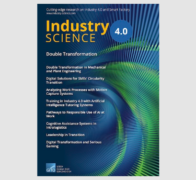
I4S 5/2024: Double Transformation

I4S 5/2024: Double Transformation

Integrating digital and ecological change in the world of work
Change is necessary for companies to maintain their competitive edge—both digital and ecological change. But while external support is at hand, the drive for change must come from companies themselves. In this issue of Industry 4.0 Science, experts of the Academic Society for Work and Industrial Organization discuss how the real-world application of innovative technologies lead to resource-efficient manufacturing.
The Key to Successful Digitalization

The Key to Successful Digitalization

Development, implementation and benefits of digital twins in Industry 4.0
Andreas Bayha ORCID Icon, Sönke Knoch ORCID Icon, Dirk Schöttke ORCID Icon
The success of technologies depends not only on their innovative strength and acceptance, but also on their management. Decision-makers evaluate factors like technical framework conditions and organizational requirements, with the demand for flexibility adding to the complexity. Industry 4.0 addresses this with networking, transparency and decentralized decisions. Digital twins, which can be implemented with open source software, play a key role.
Industry 4.0 Science | Volume 40 | Edition 4 | Pages 42-49
Digital Transformation Coaching

Digital Transformation Coaching

Employee development as a supplement to change management in transformation processes
Michael Bauer, Eric Grosse ORCID Icon
Digital transformation processes have a high tendency for delay, exceeding costs, and failure. This poses a significant risk in competitive global markets and shifting business models of entire industries. Successful companies have a different approach to new technologies than more traditional incumbents. Including the workforce in the transformation via change leadership in a digital transformation coaching process can reduce fear and resistance and can lead to a paradigm shift of approaching the digital transformation itself: as an agility driven, infinite game with high potential gain.
Industry 4.0 Science | Volume 40 | 2024 | Edition 3 | Pages 33-40
Transformation in the Automotive Industry

Transformation in the Automotive Industry

Overcoming employee-related challenges with effective leadership
Stefan Süß ORCID Icon, Ingo Klingenberg ORCID Icon, Maximilian Kellerer, Phillip Nguyen
Transformative forces present companies with enormous challenges. At the same time, new forms of collaboration and new roles and responsibilities are emerging. Due to the risks associated with change, many employees hold on to old habits and work processes, which can slow down positive developments. The challenge for managers is to recognize this resistance, prevent it and turn it into acceptance or even proactive support.
Industry 4.0 Science | Volume 40 | Edition 3 | Pages 21-26
Artificial Intelligence and Future of Work

Artificial Intelligence and Future of Work

Changes and Possible Approaches
Andreas Heindl, Alexander Mihatsch
Artificial intelligence (AI) is already an important part of business models and processes of many companies. In the future, AI systems will pro- foundly change our working environment. AI systems can develop completely new potential for companies in a wide variety of sectors and domains - especially in industry. Existing busi- ness models can be optimized along the value chain by optimizing production flows and processes or avoiding production downtimes with predictive maintenance. At the same time, AI systems can enable completely new business models and thus radically change existing mar- ket structures through new players. The AI economy of tomorrow will be more individual, more precise and more sustainable: Competitive value creation without AI will not be possible in many areas of industry.
Industrie 4.0 Management | Volume 38 | 2022 | Edition 4 | Pages 10-14
Respond to the Changing Work World with Resilience

Respond to the Changing Work World with Resilience

Operational Measures for Organizational Development
Anika Peschl, Sascha Stowasser
In times of digital transformation, it is important to counteract the associated challenges in the work world. This requires resilience and flexibility on the part of employees. Resilience has a positive effect on the health and performance of individuals. Therefore, organizations should support their employees in developing a positive attitude towards the unknown and increasing complexity, aspects that are often associated with new technologies. In this article, two exemplary corporate actions for organizational development aiming to strengthen the resilience of employees are explained.
Industrie 4.0 Management | Volume 36 | 2020 | Edition 3 | Pages 33-36
1 2 3