Transformation in the Automotive Industry |
Overcoming employee-related challenges with effective leadership

| Journal | Industry 4.0 Science |
| Issue | Volume 40, Edition 3, Pages 21-26 |
| Bibliography | Share | Cite | Download |
Abstract
Keywords
Article
The automotive industry is the most important industrial sector in Germany, both in terms of its contribution to value creation and in terms of job creation [1]. Due to developments such as the future ban on the registration of new combustion vehicles or the growing customer demand for a greater variety of variants, the industry is being forced to undergo considerable structural change. For the German automotive industry, which is accustomed to success and focuses on incremental optimization of its products and production processes, this has long proven to be particularly difficult and has led to a sluggish transformation process that threatens the long-term success of the industry [2].
In addition to the changes in the product range precipitated by increasing focus on electromobility, the transformation affects production processes, which need to be optimized through increased digitalization and automation. However, the resulting changes have far-reaching consequences for the employees in the affected companies. In addition to numerous opportunities – such as stress reduction through the use of smart assistance systems – the transformation is also associated with a number of challenges that can reduce employees’ productivity, job satisfaction and motivation. Good leadership is crucial to adequately prepare employees for the demands of the transformation and allay their fears.
However, the transformation itself places considerable demands on leaders in order to successfully overcome the employee-related challenges. The aim of this article is therefore to provide an overview of possible leadership styles that can be adopted for the change process based on a presentation of the challenges in transformation processes using the Full Range Leadership Model (FRLM) and to critically discuss their application.
Employee-related challenges during the transformation process
In the course of automated and intelligent production within the Industry 4.0 framework and the relocation of labor-intensive processes to low-wage countries, the threat of job losses in particular is being addressed in academic and mass media discussions. The postulate of a factory without people, which long prevailed in the automotive industry, is increasingly seen as unrealistic. Nevertheless, it is becoming apparent that the reduction in the number of components associated with electrification and the lower personnel requirements resulting from (partial) automation could amount to a potential reduction in the number of employees of up to 45% by 2050 [3]. Such forecasts result in uncertainties and fears that can reduce employees’ acceptance of the transformation.
Work will change fundamentally for employees. Changing product ranges and new production processes are associated with changing qualification requirements, which are reflected in the need for further training and retraining, among other things [4]. The increasing use of digital technologies in production and the associated increase in human-machine interfaces require a higher level of technological competencies and skills. For example, the implementation of an intelligent production system requires knowledge of its programming and operation.
At the same time, the changed work organization leads to new forms of collaboration as well as changed roles, responsibilities and social interactions that require employees to be highly adaptable. However, this can lead to a feeling of being overwhelmed, so that the changes are rejected. In addition to insufficient acceptance of the change and a decrease in job satisfaction and motivation, the challenges of transformation can be associated with increased stress for employees, endangering their health in the long term and leading to increased incapacity to work and reduced productivity.
Due to the perceived risks or a fundamental lack of openness to change, employees may want to hold on to old habits and work processes and can thus slow down the changes, e.g. in the form of reduced work performance, active resistance or skepticism. The challenge for leaders is to recognize this resistance, prevent it and turn it into acceptance or even proactive support.
Leading employees successfully through the transformation
Leadership is of crucial importance for the success of transformation processes. It can be understood as a “goal-oriented, reciprocal influence on the behavior of employees who are to be motivated to pursue the company’s goals” [5].
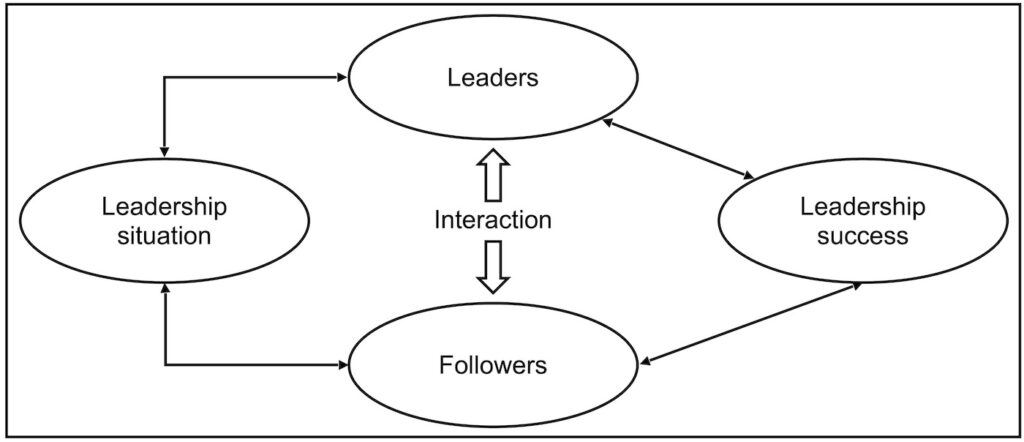
In addition to the leader, leadership includes followers, who interact with each other in a leadership-driven situation and, as a result, exhibit a certain behavior that determines leadership success, which in turn has repercussions on the leadership interaction between the leader and followers.
Leadership is therefore a dynamic process. Figure 1 shows a schematic representation of this understanding.
In order to ensure that leaders support the transformation process, leaders have three key starting points: Firstly, leadership in change processes must communicate a clear vision for the future and motivate employees to both internalize this vision and actively participate in its implementation. Secondly, leaders must create a supportive environment in which employees can develop their potential and tackle the challenges that the change brings about with a high degree of commitment. Thirdly, leaders play a central role in identifying relevant skills gaps, providing targeted training and promoting a learning environment that supports the continuous development and adaptation of employees [6].
In practice-oriented literature, situation-specific behaviors are often discussed without addressing the more stable, cross-situational behaviors of leaders that are shaped by their basic attitude, the so-called leadership styles. These are understood to be action patterns that transcend time, which characterize leadership situations and thus influence leadership success. In order to ensure a comprehensive understanding of the complex dynamics and challenges that affect the practice of leadership, it is necessary to consider the advantages and disadvantages of different leadership styles, and to do so without neglecting the influence of situational and context-specific factors in the transformation process [7].
Leadership styles and their suitability for facing transformation challenges
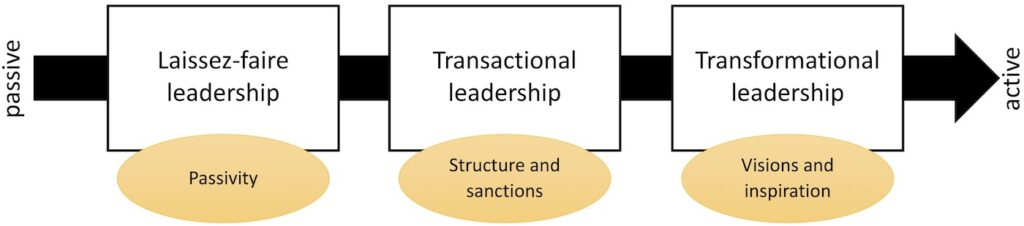
The Full Range Leadership Model (FRLM) is a popular academic approach that considers leadership styles as a function of situational factors. This presents three leadership styles, which exist on a continuum from passive to active leadership:
- The laissez-faire style, which is defined by passivity and the avoidance of leadership tasks.
- Transactional leadership, which is based on the creation of structures as well as clear incentives and sanctions for (non-)performance.
- Transformational leadership, which is characterized by inspiring visions, intellectual stimulation, individual support and idealized influence to motivate employees and promote positive change. Figure 2 illustrates the FRLM described.
Figure 3 provides a short summary of the leadership styles considered.
Transformational leadership is considered to be extremely effective in initiating and promoting change processes. This results from its focus on inspiring visions, intellectual stimulation, individual support and idealized influence. These aspects open up a particularly high potential for success in successfully shaping key steps in the change process, such as adapting the corporate culture or creating a shared vision of change [8].

In view of the radical changes taking place in the automotive industry as outlined above, the transformational leadership style is particularly suitable for winning employees over for the transformation. For example, fears of job losses can be reduced through transparent communication and by conveying a sense of community. In addition, this leadership style can increase acceptance of the transformation and boost employee motivation and job satisfaction. For example, communicating a vision of (partially) automated production processes and demonstrating the associated benefits from the employees’ perspective can better motivate them to participate in training programs.
Despite these advantages, it should be noted that transformational leadership is not suitable for every context. In practice, it has been shown that it can lead to impatience and conflict-avoidant tendencies among leaders, especially if there is a lack of rapid success with regard to the change [9]. The application of transformational leadership can be particularly challenging in rigid structures and in teams that require the leader to be heavily involved in operational matters. Against the background of the inertial forces identified in the automotive industry, the concern arises that this leadership style may harbor a high potential to cause frustration for leaders.
In addition, transformational leadership takes a relatively long time to have a positive impact. In the automotive industry, which is characterized by rapid technological developments and market changes, quick adjustments are often necessary. The transactional leadership style, which relies on clear structures and rewards for high performance, is more suitable for this. For example, early participation in further training or the use of new technological possibilities, such as the use of intelligent assistance systems, can be encouraged through incentives [10].
In addition, transactional leadership is particularly suitable for situations with a high potential for error and high time urgency [11]. Here, the development of clear structures and expectations can provide orientation in a way that relieves the burden on employees. Transactional leadership can therefore have a positive effect, particularly in central and difficult phases of the transformation process.
It has also been shown that transactional leadership has a high potential for promoting innovative idea generation and employee motivation, particularly at the shop floor level [12]. Production employees may have a higher affinity for clear targets and incentives, while the instruments of transformational leadership are more difficult to implement. Overall, however, transactional leadership is less suitable for creating a willingness to change and allaying fears, as it does not communicate why certain change measures make sense and therefore does not create a vision [13].
It therefore reaches its limits when it comes to disruptive changes in particular, such as the paradigm shift in the automotive industry, especially as the rigid rules of exchange associated with knowledge-intensive activities leave little room for creativity and innovation. In addition, transactional leadership neglects the involvement of employees in decision-making processes. However, such involvement could increase identification with the results, foster the intrinsic motivation and skills of employees and allow the company to benefit from the knowledge generated and the diversity of perspectives [14].
In transformational leadership, the involvement of employees in decision-making processes depends on the leader. In laissez-faire leadership, responsibility for work processes and decisions is transferred to followers. Employees then have a particularly high degree of independence and decision-making power, resulting in autonomy that fosters creativity, motivation, and job satisfaction in highly competent teams. However, transformation processes usually require leaders to provide direction and structure and to be a clear role model for employees. In addition, the laissez-faire leadership style ignores possible skepticism or frustration in connection with change processes, which can lead to employees remaining in habitual patterns of behavior and increase the potential for conflict and stress, ultimately making change more difficult [10].
Adequate and flexible use of leadership styles
The current challenges in the automotive industry require a balanced application of different leadership styles. The transformational style is particularly suitable in the initial phase of transformation and in departments such as Research and Development in order to reduce fears and promote acceptance through inspiring visions and individual support. The transactional style, on the other hand, is suitable at shop floor level and during critical phases to ensure clear structures and rewards. The laissez-faire style can be used with top performers, whereby care must be taken to ensure that leadership and structure are not neglected.
By flexibly adapting their leadership style to the challenge at hand, leaders can maximize the effectiveness of their leadership. However, it should be emphasized that this requires special reflection and adaptation skills on the part of the leader in order to correctly assess situations and (re)act appropriately. Leadership training can help to develop these skills, which can enable leaders to successfully navigate the challenges of the automotive industry.
This article was written as part of the project “Transformation of the Automotive Industry in the Bergisch Region” (TrAIBeR), which is funded by the German Federal Ministry of Economic Affairs and Climate Action (BMWK) under the grant number 16TNW0024B.
Bibliography
[1] Van Suntum, U.: Die volkswirtschaftliche Bedeutung von Automobilindustrie und Mobilität. In: Wolfgang Maus (ed.): Zukünftige Kraftstoffe. Energiewende des Transports als ein weltweites Klimaziel. Heidelberg 2019.[2] Haas, T.: Die Mobilitätswende als Auslöser einer tief greifenden Transformation des “Modell Deutschland”? In: Politische Vierteljahreszeitschrift 62 (2020) 1, pp. 149-170.
[3] Hartmann, S.; Harter, C. et al.: Automobile Wertschöpfung 2030/2050. Study commissioned by the Federal Ministry for Economic Affairs and Energy – Final Report. URL: www.bmwk.de/Redaktion/DE/Downloads/Studien/automobile-wertschoepfung-2030-2050-kurzfassung.pdf?__blob=publicationFile&v=10, Accessed 30.11.2023
[4] Meil, P.: Inside looking out: Digital transformation in the German automobile sector and its effects on the value chain. In: Jan Drahokoupil (ed.): The challenge of digital transformation in the automotive industry. Jobs, upgrading and the prospects for development. Brussels 2020.
[5] Scherm, E.; Süß, S.: Personalmanagement, 3rd edition. Munich 2016.
[6] Al Harbi, J.A.; Alarifi, S.; Mosbah, S.: Transformation leadership and creativity. Effects of employees psychological empowerment and intrinsic motivation. In: Personnel Review 48 (2019) 5, pp. 1082-1099.
[7] Herold, D. M.; Fedor, D. B. et al.: The effects of transformational and change leadership on employees’ commitment to a change: A multilevel study. In: Journal of Applied Psychology, 93 (2008) 2, pp. 346-357.
[8] Faupel, S; Süß, S.: The Effect of Transformational Leadership on Employees During Organizational Change – An Empirical Analysis. In: Journal of Change Management 19 (2019) 3, pp. 145-166.
[9] Vinger, G.; Cilliers, F.: Effective Transformational Leadership Behaviors For Managing Change In: SA Journal of Human Resource Management 4 (2006) 2, pp. 1-9.
[10] Potosky, S.; Azan, W.: Leadership behaviors and human agency in the valley of despair: A meta-framework for organizational change implementation In: Human Resource Management Review 33 (2023) 1, 100927.
[11] Sethibe, T.; Steyn, R.: The Impact of Leadership Styles and the Components of Leadership Styles on Innovative Behavior. In: International Journal of Innovation Management, 21 (2017) 2, 1750015.
[12] Deichmann, D.; Stam, D.: Leveraging transformational and transactional leadership to cultivate the generation of organization-focused ideas. In: The Leadership Quarterly 26 (2015) 2, pp. 204-219.
[13] Mescheder, B.; Sallach, C.: Change Management. In: Wettbewerbsvorteile durch Wissen. Heidelberg 2012, pp. 39-59
[14] Wang, Q.; Hou, H.; Li, Z.: Participative Leadership: A Literature Review and Prospects for Future Research. In: Frontiers in Psychology 13 (2022), 924357.
You might also be interested in