Automation

Energy Efficiency Through Intelligent Electricity Data Acquisition

Energy Efficiency Through Intelligent Electricity Data Acquisition

Wireless retrofit solution based on IoT technologies and open-source software for existing industrial buildings
Sergej Kreber, Kevin Kutzner, Dieter Uckelmann ORCID Icon
Facility managers for industrial properties are faced with the challenge of optimizing the energy efficiency of their facilities in the face of ever-increasing energy demand and rising energy costs. Digital processes that enable the comprehensive monitoring, analysis and control of energy demand offer an effective way to reduce costs, increase energy efficiency and make optimal use of resources. Based on IoT technologies and open-source software, a cost-effective, wireless and flexible retrofit solution for real-time energy data collection has been developed.
Industry 4.0 Science | Volume 40 | Edition 2 | Pages 87-93
Motion-Mining Compared to Traditional Lean Tools

Motion-Mining Compared to Traditional Lean Tools

Sensor-supported analysis of manual processes in manufacturing and logistics
Hendrik Appelhans, Christopher Borgmann, Carsten Feldmann
Motion-Mining® is a technology that uses motion sensors and pattern recognition to enable automated process mapping and analysis of manual work. This article evaluates the advantages and limitations of its use in manufacturing and logistics processes. To this end, Motion-Mining® is compared with traditional lean management tools used to analyze manual activities. Experiences derived from four use cases provide decision support for selecting the appropriate method for a specific use case.
Industry 4.0 Science | Volume 40 | Edition 2 | Pages 24-31
The Compressed Enterprise-Control System Integration and the Era of Industry 4.0

The Compressed Enterprise-Control System Integration and the Era of Industry 4.0

How the digital control twin is changing operational applications and the integration of IT systems in a company
Wilmjakob Herlyn ORCID Icon
The Enterprise-Control System Integration of the operational applications is described in IEC-62264 and also referred to as the automation pyramid. This integration model is built on the MRP-II model developed in the 1980s. This model was groundbreaking for its time and still forms the basis of operational IT systems today. According to this concept, operational applications are run through hierarchically-sequentially (waterfall principle), which results in disadvantages such as: many interfaces, time delays, data loss, inconsistencies, etc. This sequential model neither meets the current requirements nor the informational and technical possibilities of Industry 4.0. It can be replaced by the concept of the digital control twin, which has corresponding effects on the automation pyramid.
Industrie 4.0 Management | Volume 39 | 2023 | Edition 5 | Pages 42-47
Automated Detection of Fragile Production Behavior

Automated Detection of Fragile Production Behavior

Simple early detection of deterministic-chaotic behavior in highly available production systems
Martin Manns ORCID Icon, Denny Höhnen
Routing flexibility enables a robust, resilient design of production. However, in highly available, decentralized controlled production systems with cyclic material flow, it can reduce efficiency due to undesired deterministic-chaotic behavior. An automated method for measuring such behavior is presented. It is tested with a double conveyor belt laboratory system. An embedded system simplifies data acquisition. Results indicate that the method is usable for manual and automatic production systems. It has the potential to recognize modeling deficiencies in Industry 4.0 control with IEC 61499. (Only in German)
Industrie 4.0 Management | Volume 39 | 2023 | Edition 5 | Pages 17-21
Robot-Based Assembly Automation in Mid-Sized Companies

Robot-Based Assembly Automation in Mid-Sized Companies

Obstacles, drivers and implications
Aaron Zinßer, Fabian Diefenbach ORCID Icon, Arik Lämmle ORCID Icon
Production automation is well established in large companies for high volume products. But robot-based assembly automation in mid-sized companies is still in its infancy. This study uses results from 19 expert interviews and a survey to identify obstacles to and drivers of automation in this field. Among the obstacles is the low flexibility of the robotic systems. One driver for automation is the increasing shortage of skilled workers. Based on the empirical findings, the study proposes options to increase the use of automation.
Industrie 4.0 Management | Volume 39 | 2023 | Edition 4 | Pages 21-24 | DOI 10.30844/IM_23-4_21-24
Focus on Employees

Focus on Employees

Clear rules and processes as the basis for independent ordering of indirect requirements
Michael Petri
eProcurement systems enable employees to handle the purchase of C-parts and indirect requirements independently with a minimum of work. This article explains how this can free up space for the strategically decisive procurement of A and B parts. The basic idea is to outsource the operative procurement activity to those who have the demand - so-called demand carriers. Decisive for the success of this approach is the right mix of individual freedom and sufficient control. Here, eProcurement solutions offer various levers that the purchasing department can configure according to the respective company situation. (Only in German)
Industrie 4.0 Management | Volume 39 | 2023 | Edition 3 | Pages 60-61
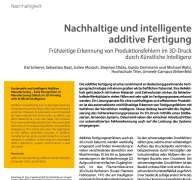
Sustainable and Intelligent Additive Manufacturing

Sustainable and Intelligent Additive Manufacturing

Early Recognition of Manufacturing Defects in 3D-Printing with Artificial Intelligence
Kai Scherer ORCID Icon, Sebastian Bast ORCID Icon, Julien Murach, Stephan Didas, Guido Dartmann, Michael Wahl
Additive manufacturing is an increasingly important manufacturing technology with huge economical potential. However, its popularity is accompanied by high material and time losses, as defects are often detected at a very late stage. One solution for a more sustainable production is the automated detection of manufacturing defects using artificial intelligence. This article describes the digitization of the defect detection process in additive manufacturing using a system based on a neural network. In addition to the steps for automated defect detection, system performance is also discussed.
Industrie 4.0 Management | Volume 39 | 2023 | Edition 2 | Pages 56-59
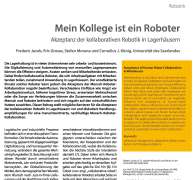
My Colleague Is a Robot

My Colleague Is a Robot

Acceptance of collaborative robotics in warehouses
Frederic Jacob, Eric Grosse ORCID Icon, Stefan Morana, Cornelius J. König
Warehousing is a very labor- and cost-intensive task in many companies. Digitization and automation of manual warehouse processes can increase efficiency, reduce costs and relieve employees. Collaborative robots that share work tasks with employees are increasingly used in warehouses. However, the pure techno-centric use of such robots can negatively influence the acceptance of human-robot collaboration. Various influences such as fear of job loss, higher cognitive stress, expected extra effort, or concerns about injuries can hinder human-robot collaboration and negatively impact economic benefits. This paper presents possible barriers to the acceptance of collaborative robotics in warehouses and discusses recommended actions for human-centered, sustainable human-robot collaboration.
Industrie 4.0 Management | Volume 39 | 2023 | Edition 1 | Pages 23-26
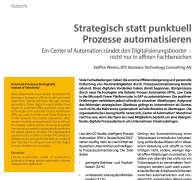
Automate Processes Strategically Instead of Selectively

Automate Processes Strategically Instead of Selectively

How and why a Center of Automation ignites the digitization booster—not only in related fields
Steffen Weiers
Many departments have already recognized the enormous increase in efficiency and personnel relief from routine activities through process automation. These digital thought leaders have begun to automate office processes using new technologies such as Robotic Process Automation (RPA), low code in the Microsoft Power Platform or in SAP. However, the positive experiences often remain in individual departments. Due to the lack of a strategic superstructure, companies as a whole have not yet succeeded in systematically transferring the added values to all areas. The organizational solution for this is called a "Center of Automation". Sometimes it is enough for the team to consist of two members to bring an overarching, digital process mindset into a company. (Only in German)
Industrie 4.0 Management | Volume 39 | 2023 | Edition 1 | Pages 58-62
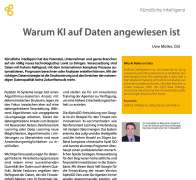
Why AI Relies on Data

Why AI Relies on Data

Uwe Müller
Artificial intelligence has the potential to bring companies and entire industries to a completely new technological level. The prerequisite is data with a high degree of maturity, with which companies can automate complex processes, calculate forecasts or create analyses. With the right data strategy, structuring and achieving the necessary data quality are no longer dreams of the future.
Industrie 4.0 Management | Volume 39 | 2023 | Edition 1 | Pages 63-66
1 2 3 4 7