-
×
 Manage Industry 4.0 - A Practice-Oriented Approach
1 × 29,00 €
Manage Industry 4.0 - A Practice-Oriented Approach
1 × 29,00 € -
×
 Planning Assistance in Production and Logistics
1 × 29,00 €
Planning Assistance in Production and Logistics
1 × 29,00 € -
×

 Real-time Reactions for Automated Guided Vehicles (AGV)
1 × 29,00 €
Real-time Reactions for Automated Guided Vehicles (AGV)
1 × 29,00 €

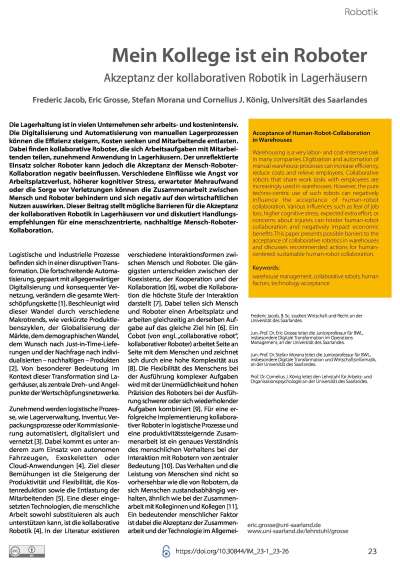
My Colleague Is a Robot |
Acceptance of collaborative robotics in warehouses

| Journal | Industrie 4.0 Management |
| Issue | Volume 39, 2023, Edition 1, Pages 23-26 |
| Bibliography | Share | Cite | Download |
Abstract
Warehousing is a very labor- and cost-intensive task in many companies. Digitization and automation of manual warehouse processes can increase efficiency, reduce costs and relieve employees. Collaborative robots that share work tasks with employees are increasingly used in warehouses. However, the pure techno-centric use of such robots can negatively influence the acceptance of human-robot collaboration. Various influences such as fear of job loss, higher cognitive stress, expected extra effort, or concerns about injuries can hinder human-robot collaboration and negatively impact economic benefits. This paper presents possible barriers to the acceptance of collaborative robotics in warehouses and discusses recommended actions for human-centered, sustainable human-robot collaboration.
Bibliography
[1] Winkelhaus, S.; Grosse, E. H. (2020) Logistics 4.0: a systematic review towards a new logistics system. In: International Journal of Production Research 58 (2020) 1, S. 18-43.[2] Maderna, R.; Poggiali, M. u. a.: An online scheduling algorithm for human-robot collaborative kitting. In: IEEE International Conference on Robotics and Automation (IC- RA). 2020.
[3] Winkelhaus, S.; Grosse, E. H. u. a.: Towards a conceptualization of Order Picking 4.0. In: Computers & Industrial Engineering 159 (2021), 107511.
[4] Firescu, V.; Gaşpar, M.-L. u. a.: Collaboration Between Humans and Robots in Organizations: A Macroergonomic, Emotional, and Spiritual Approach [Brief Research Report]. In: Frontiers in Psychology 13 (2020), 855768.
[5] Scherf, J.: Was ist Logistik 4.0? Alles zum Thema Digitalisierung & Lo- gistik. URL: www.mm-logistik.vogel.de/was-ist-logistik-40-alles-zum-thema-digitalisierung-logistik-a-692722, Abrufdatum 02.04.2022.
[6] Hentout, A.; Aouache, M. u. a.: Human–robot interaction in industrial collaborative robotics: a literature review of the decade 2008–2017. In: Advanced Robotics 33 (2019) 15-16, S. 764-799.
[7] Aaltonen, I.; Salmi, T. u. a.: Refining levels of collaboration to support the design and evaluation of human-robot interaction in the manufacturing industry. In: Procedia CIRP 72 (2018), S. 93-98.
[8] Berx, N.; Decré, W. u. a.: Identification and classification of risk factors for human-robot collaboration from a system-wide perspective. In: Computers & Industrial Engineering 163 (2022), 107827.
[9] Andronas, D.; Apostolopoulos, G. u. a.: Multi-modal interfaces for natural Human-Robot Interaction. In: Procedia Manufacturing 54 (2021), S. 197-202.
[10] Donohue, K. L.; Özer, Ö. u. a.: Behvioral Operations: Past, Present, and Future. In: SSRN Electronic Journal (2019).
[11] Pasparakis, A.; de Vries, J. u. a.: In Control or under Control? Human-Robot Collaboration in Warehouse Order Picking. In: SSRN Electronic Journal (2021).
[12] Neumann, W. P.; Winkelhaus, S. u. a.: Industry 4.0 and the human factor – A systems framework and analysis methodology for successful development. In: International Journal of Production Economics 233 (2021), 107992.
[13] Spurk, A.; Grosse, E. u. a.: Drohnen in der Intralogistik: Chancen und Barrieren. In: Zeitschrift für wirtschaftlichen Fabrikbetrieb 117 (2022) 7-8, S. 503-507.
[14] Lambrechts, W.; Klaver, J. S. u. a.: Human Factors Influencing the Implementation of Cobots in High Volume Distribution Centres. In: Logistics 5 (2021) 2.
[15] Hendrick, H. W.: Human Factors in Organizational Design and Management. In: Hancock, P. A. (Hrsg.): Advances in Psychology 47. North-Holland 1987.
[16] Alaiad, A.; Zhou, L.: The determinants of home healthcare robots adoption: An empirical investigation. In: International Journal of Medical Informatics 83 (2014) 11, S. 825-840.
[17] Venkatesh, V.; Morris, M. G. u. a.: User Acceptance of Information Technology: Toward a Unified View. In: MIS Quarterly 27 (2003) 3, S. 425-478.
[18] Baumgartner, M.; Kopp, T. u. a.:. Analysing Factory Workers’Acceptance of Collaborative Robots: A Web-Based Tool for Company Representatives. In: Electronics 11 (2022) 1, 145.
[19] Fukushima, Y.; Asai, Y. u. a.: DigiMobot: Digital Twin for Human-Robot Collaboration in Indoor Environments. IEEE Intelligent Vehicles Symposium (IV). 2021.
[20] Chadalavada, R. T.; Andreasson, H. u. a.: Bi-directional navigation intent communication using spatial augmented reality and eye-tracking glasses for improved safety in human–robot interaction. In: Robotics and Computer-Integrated Manufacturing 61 (2020), 101830.
[21] Hata, A.; Inam, R. u. a.: AI-based Safety Analysis for Collaborative Mobile Robots. In: 24th IEEE International Conference on Emerging Technologies and Factory Automation (ETFA). 2019.
[22] Ivsic, B.; Sipus, Z. u. a.: Analysis of Safe Ultrawideband Human-Robot Communication in Automated Collaborative Warehouse. In: 14th European Conference on Antennas and Propagation (EuCAP). 2020.
[23] Vitolo, F.; Rega, A. u. a.: Mobile Robots and Cobots Integration: A Preliminary Design of a Mechatronic Interface by Using MBSE Approach. In: Applied Sciences 12 (2022) 1, 419.
[24] Khalid, A.; Kirisci, P u. a.: Security framework for industrial collaborative robotic cyber-physical systems. In: Computers in Industry 97 (2018), S. 132-145.
[25] Lorson, F.; Fügener, A. u. a.: New team mates in the warehouse: Human interactions with automated and robotized systems. In: IISE Transactions (2022), S. 1-18.
[26] Niu, Y.; Schulte, F. u. a.: Human Aspects in Collaborative Order Picking – Letting Robotic Agents Learn About Human Discomfort. In: Procedia Computer Science 180 (2021), S. 877-886.
[27] Jost, J.; Kirks, T. u. a.: Safe Human-Robot-Interaction in Highly Flexible Warehouses using Augmented Reality and Heterogenous Fleet Management System. In: IEEE International Conference on Intelligence and Safety for Robotics (ISR). 2018.
[28] Petković, T.; Puljiz, D. u. a.: Human intention estimation based on hidden Markov model motion validation for safe flexible robotized warehouses. In: Robotics and Computer-Integrated Manufacturing 57 (2019), S. 182-196.
[29] Szafir, D.; Mutlu, B. u. a.: Designing planning and control interfaces to support user collaboration with flying robots. In: The International Journal of Robotics Research 36 (2017) 5-7, S. 514-542.
[30] Fruggiero, F.; Lambiase, A. u. a.: Cognitive Human Modeling in Collaborative Robotics. In: Procedia Manufacturing, 51 (2021), S. 584- 591.
[31] Breque, M.; De Nul, L u. a.: Industry 5.0 : towards a sustainable, human-centric and resilient European industry. Publications Office. 2021.
Your downloads
You might also be interested in