Artificial Intelligence in ERP Systems |
Development potential and benchmarking

| Journal | Industry 4.0 Science |
| Issue | Volume 39, 2023, Edition 1, Pages 100-105 |
| Open Access | https://doi.org/10.30844/I4SE.23.1.100 |
| Bibliography | Share | Cite | Download |
Abstract
Keywords
Article
AI maturity model: Making progress measurable
ERP systems must master the task of integrating all business areas and providing them with helpful functions, which means that the requirements for AI-supported functions can differ. It is also important to consider whether complete automation or autonomization is actually desired for the respective application [1].
Discussion of this topic gave rise to the development of an AI-ERP maturity model, which not only evaluates AI functions based on their characteristics, but also considers which level of AI use offers practical added value for the company and its customers.
In order to be able to meaningfully evaluate an ERP system, the first step is to break it down into smaller items for examination. “Depending on the name of the provider, these can be ‘modules’, ‘functions’ or, for example, ‘tasks’, which are all then evaluated according to their level of maturity,” explains Dr.-Ing. Marcus Grum.
As can be seen in Figure 1, an analysis of the ERP system is conducted based on three core elements. The first core element of an ERP system under investigation is based on an analysis of the degree of functionality of various AI functions, including their technical possibilities, data and functional maturity.
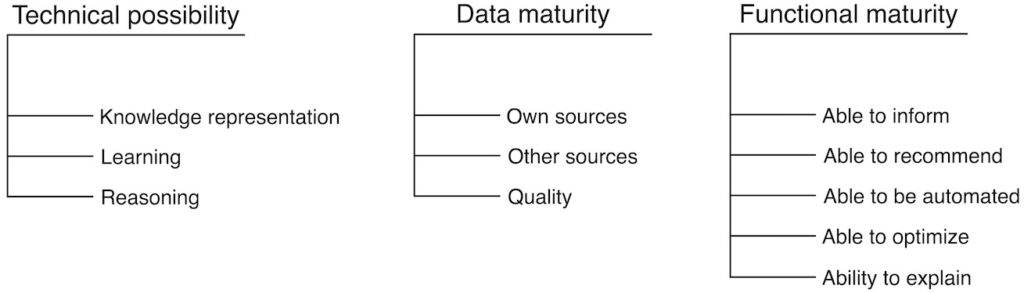
In the technical possibility dimension, analysis focuses on mapping the AI knowledge representation, which amounts to sets of rules, ontologies, neural knowledge representations, learning algorithms and algorithms for inference that generate new knowledge.
Analysis of data maturity assesses the extent to which AI access to data from a company’s own ERP system is sensibly restricted, along with the quality of the data available to an AI.
Analysis of functional maturity weighs up the various levels of complexity an AI possesses. For example, it records the extent to which the AI is able to intelligently identify, generate or provide information. It is also important to evaluate to what extent the AI can then carry out processes and actions autonomously and whether it learns from previous interference processes. Finally, explainability is also assessed [1]. “It is particularly important for human users to be presented with the insights produced by the AI in a comprehensible way, so that these can be used at key points in the process,” explains Dr.-Ing. Grum in an interview. The ability to explain the AI ERP system is therefore included in the ERP evaluation.
The second core element assesses the extent to which the evaluation criterion under consideration is relevant for the ERP system, the software manufacturer and their end users.

“If we consider the possible benefits of an AI criterion for an ERP system, we can derive the hypothetical benefits and compare them from the customer’s perspective,” says Dr.-Ing. Grum in an interview. However, there may be a difference between hypothetical benefit and the real benefit, or the the upper limit beyond which greater AI incorporation does not lead to further benefit in practice.
This difference between the two is called “empty potential”, and is best avoided. “We call the difference between the degree of fulfillment and the real benefit the ‘real potential’ – the focus of an ERP provider should therefore be on achieving the real potential,” explains Dr.-Ing. Grum. To use the AI maturity model from the customer’s perspective, the main focus must be placed on the specific customer benefit that is derived from an evaluation criterion. Figure 2 visualizes this as an example.
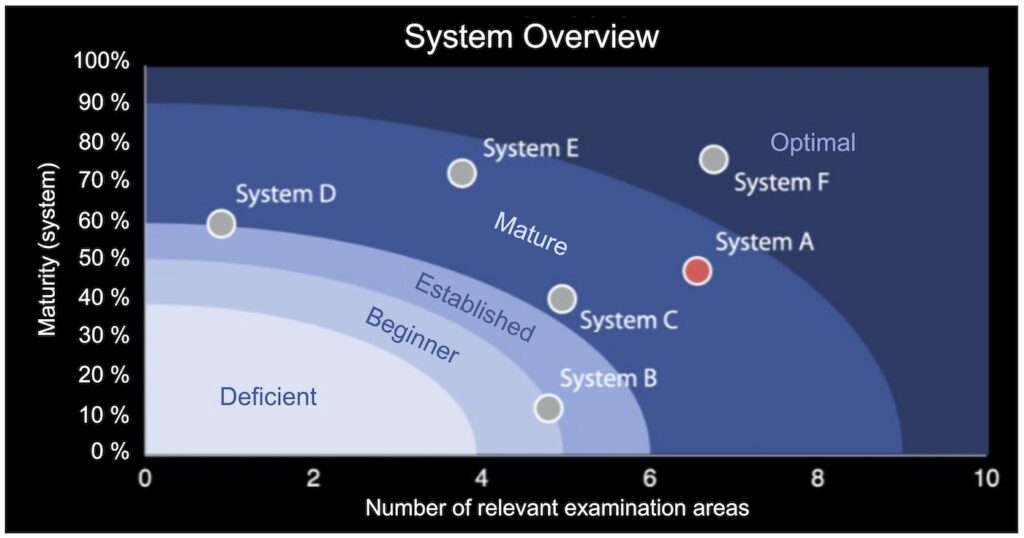
The third core element is the maturity levels themselves. By aggregating selected evaluation criteria, an overarching value is created, which is then contextualized in five maturity levels (see Fig. 3).

For example, deficient describes an ERP function that does not make use of any AI functions, even though it has been determined that real benefit would be derived from their incorporation. Established ERP functions, however, can already exploit a large part of the real benefit.
Mature ERP functions can exploit a fair amount of the real potential. There is only a small upward shift to reach the highest level, that of optimal AI functions. To visualize the level of maturity, the “AI Indicator” tool developed by Dr.-Ing. Grum was used.
AI indicator: Building a tool
To determine and display the AI maturity level, the AI Indicator tool uses 35 well-defined criteria to determine the AI indicator for an examination object and the area assigned to it. Further detail is provided by different views of a system and also by a comparison with other systems on the market.
If one’s own system is to be presented in comparison to the competition, it is classified as shown in Figure 4. Here the level of maturity of the system is juxtaposed against the number of modules examined. “This makes it possible to see whether an ERP system is AI-specialized and contains only a few modules with a very high level of AI maturity or whether the system has a large number of modules that are supported by AI, even if these do not fully utilize the potential,” explains Dr.-Ing. Grum.
Such an ERP system could be described as AI-diversified. If focus of the examination should lie on one’s own system, the tool can display the individual objects to be examined, e.g. material requirements planning, ordering process or warehouse optimization, thereby providing a basic view of the individual modules. This can be consulted as a basis for evaluating the ERP system.
By assigning a module to the ERP areas, it is also possible to see the level of AI maturity present in the individual company areas, e.g. material/warehouse/shipping. In total, an analysis can be conducted for ten ERP areas.
AI indicators in practice: Critical analysis by APplus
The goal of a demonstration of the AI indicator using Asseco’s ERP system APplus as an example is to initially assess the company’s internal development of the application from the company’s perspective and then to derive the next development stages of the ERP system. The analysis areas of the AI indicator were divided into three areas: overall, category-specific and area-specific. In addition to further analyses [1], a selection is highlighted below.
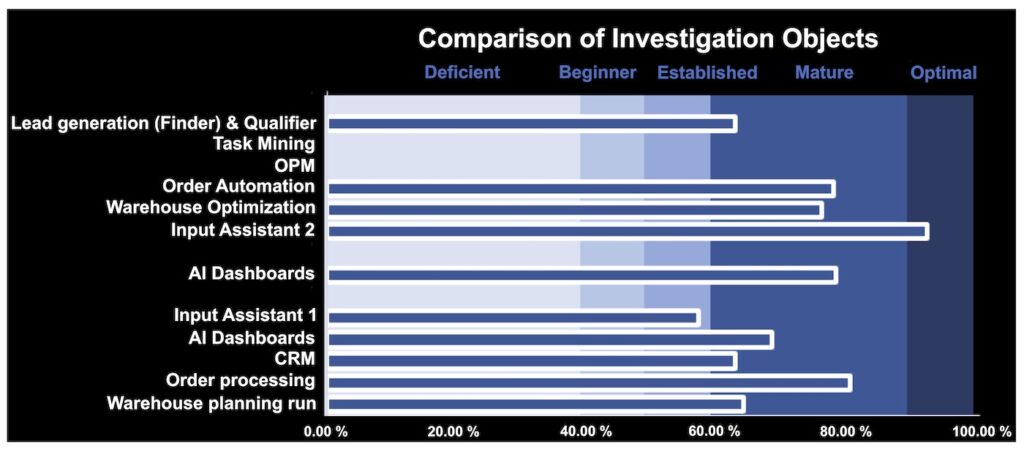
As part of the overall analysis, all modules under consideration were first assessed. This enables a view of the individual maturity level of the smallest objects to be considered in the analysis – the modules. The majority of the twelve modules selected by Asseco for analysis were categorized as mature. However, Input Assistant 2, which exhibits an optimal level of AI integration, was able to achieve the optimal level of maturity.
Therefore, further development of Asseco’s Input Assistant 2 does not offer much potential, as it is already very close to achieving its full potential. Since the other modules are already at a high AI indicator level, two strategies can be derived. Either the selected modules are perfected, which helps providers in particular to take a pioneering role in a specific industry, or a fuller fulfillment of outstanding potential is pursued in alternative modules. The latter is particularly attractive for providers who serve a variety of industries and want to achieve a high standard across all areas.
As part of the ERP category-specific analyses, module evaluations were divided into the identified ERP categories. All ERP areas, including UI/UX/Information, master data, materials/warehouse/shipping, sales/CRM and purchasing exhibited a high level of AI maturity [1]. For our example provider, this means that no outliers or critical anomalies were present in the analyzed modules. This means that specialization could now take place on individual modules for which an optimal level of AI integration is sought. “There are a total of six further analyzes which have already shown promising development potential for Asseco.
For example, Figure 5 shows the evaluation of the modules submitted by APplus, which range between the levels ‘established’ and ‘optimal’. If you look at the overall assessment of APplus on the market, you can currently see an AI-ERP maturity level on the border between ‘established’ and ‘mature’. This is currently a remarkable achievement and, on the one hand, enables an ERP system provider to take a strategic competitive positioning on the market.
On the other hand, it enables a potential ERP end user to compare the ERP system under consideration with other products from other system providers on the market that are open to this comparison. If there is further interest along these lines, our consultants at CER would be happy to address this in consultation sessions with a view to further developing specific analyses,” offers Dr.-Ing. Grum.
AI certification via CER
Despite increasing integration of AI functions by ERP providers, progress in the implementation of AI in the respective applications still appears to be slow, especially in Germany. Regardless of individual reasons for this, when considering the potential of AI, the AI maturity level in the product strategy should be considered in order to be able to set rational and clearly defined goals for the development of ERP systems.
For this reason, the CER, located at the University of Potsdam, offers companies the opportunity to receive a neutral evaluation of their ERP system from an independent authority. The assessment can be designated as an AI-ERP certification, making it possible to create a market overview in which the best systems can be identified based on the AI maturity level.
On the one hand, this enables a possible ERP end user to objectively compare the systems available on the market. This also lets innovative ERP manufacturers appear in an attractive light and represents a real competitive advantage. “We are happy to talk to interested parties and determine the placement of the respective ERP system in the developed AI landscape,” concludes Dr.-Ing. Grum.
Bibliography
[1] Grum, M.; Körppen, T.; Lauppe, H.; Korjahn, N.; Gronau, N.: Entwicklung eines KI-ERP-Indikators – Evaluation der Potenzialerschließung von Künstlicher Intelligenz in Enterprise-Resource-Planning-Systemen (2022).Your downloads
Potentials: Innovation Services
You might also be interested in