Adaptability

Wirtschaftliche Resilienz durch Subventionen?

Wirtschaftliche Resilienz durch Subventionen?

Anmerkungen aus ökonomischer Perspektive
Manuel Rupprecht
The world economy is under tension. For years now, globalization has been faltering, moving sideways at best. Recent developments have caused additional distortions. There is now a strong desire for independence. In many places, subsidies are supposed to pave the way for this. In some areas, a veritable competition has broken out in this regard. Even if this is understandable from a political point of view, from an economic perspective the disadvantages of such a competition outweigh the benefits.
Industrie 4.0 Management | Volume 39 | 2023 | Edition 4 | Pages 16-20 | DOI 10.30844/IM_23-4_16-20
The Power of People in Pandemic Times

The Power of People in Pandemic Times

Driving Supply Chain Resilience through Corporate Culture
Nils-Ole Hohenstein
The assertion “Our people are what set us apart from our rivals” is a common statement made by nearly every company, highlighting the significance of their people as the most valuable asset. Similarly, a corporate culture emphasizing risk awareness and learning from experiences has played a key role in shaping supply chain resilience (SCRES) amidst competitive dynamics in response to the COVID-19 pandemic. Employee engagement, communication, and collaboration, as dimensions of SC risk awareness, determine the effectiveness of firms’ cultures in handling large-scale disruptions with robustness and agility. Additionally, the COVID-19 crisis has had a positive impact on firms’ learning orientation. The crucial necessity of digital supply chain (SC) transformation to enhance SCRES under pandemic conditions has further reinforced the need for dynamic adaptation and reconfiguration of firms’ culture and employee skillsets through digital upskilling.
Industrie 4.0 Management | Volume 39 | 2023 | Edition 4 | Pages 25-30 | DOI 10.30844/IM_23-4_25-30
Digital Transformation for SMEs

Digital Transformation for SMEs

Developing a roadmap for Industry 4.0 visions in small and medium-sized enterprises
Robin Sutherland ORCID Icon, Nicolas Wittine ORCID Icon, Deike Gliem ORCID Icon, Sigrid Wenzel ORCID Icon
Small and medium-sized enterprises still face the challenge of shaping their digital transformation. Maturity models offer a way to capture the situation within a company and support the formation of an Industry 4.0 vision. This paper presents a methodology that companies can use to develop a roadmap for shaping digital transformation by enabling the transfer of this vision into concrete decision-making steps.
Industrie 4.0 Management | Volume 39 | 2023 | Edition 4 | Pages 59-62 | DOI 10.30844/IM_23-4_59-62
Pragmatism for Resilient Logistics Networks

Pragmatism for Resilient Logistics Networks

Pragmatism on the road to resilient logistics networks
Michael Schröder
As a result of disruptions in the supply chain, enhancing resilience has become imperative. Upon reevaluating risks associated with the supply side, it is necessary to shift our perspective on inventory management. Drawing from proven and practical solutions, we should focus on implementing swift measures to bolster stock levels and transition from single sourcing to multiple sourcing. Furthermore, embracing digitization will significantly enhance the efficiency of the supply chain as well as the identification of faults. (Only in German)
Industrie 4.0 Management | Volume 39 | 2023 | Edition 4 | Pages 63-66
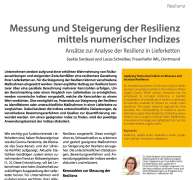
Applying Numerical Indices to Measure and Increase Resilience

Applying Numerical Indices to Measure and Increase Resilience

Approaches to analyzing resilience in supply chains
Saskia Sardesai ORCID Icon, Lucas Schreiber
An increased awareness of risks and rising incidents prompt companies to enhance the resilience of their supply chains. While various measures can be employed to increase resilience, a parallel consideration of a multitude of metrics is necessary to explicitly evaluate its impact on supply chain resilience. The paper presents approaches that facilitate the comparability of resilience across alternative supply chain designs by combining various metrics into a single numerical index. Additionally, innovative technologies are highlighted that can help to create resilient supply chains.
Industrie 4.0 Management | Volume 39 | 2023 | Edition 4 | Pages 45-49 | DOI 10.30844/IM_23-4_45-49
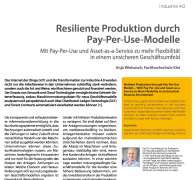
Resilient Production through Pay-Per-Use Models

Resilient Production through Pay-Per-Use Models

More flexibility in an uncertain business environment with Pay-Per-Use and Asset-as-a-Service
Anja Wiebusch
Corona crisis, supply chain problems and global crises lead to growing uncertainties in the business environment of machine manufacturers and their customers. Usage-based business models offer flexible solutions to make business models more resilient and able to cope with future challenges. (Only in German)
Industrie 4.0 Management | Volume 39 | 2023 | Edition 4 | Pages 55-58
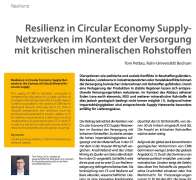
Resilience in Circular Economy Supply Networks in the Context of Critical Mineral Resource Supply

Resilience in Circular Economy Supply Networks in the Context of Critical Mineral Resource Supply

Tom Pettau
The supply of CRM to domestic companies is threatened by disruptions (e. g. trade conflicts or shortages). Relocating production to stable regions is often not possible in the context of CRM due to geological reasons. One way out is CE. From a network perspective, the resilience must be improved and expanded to include viability. In CE for resilience improvement, a distinction must be made between ex-post and ex-ante CE. Ex-post CE is used as a reaction to a disruption and ex-ante CE reduces the probability of a disruption occurring.
Industrie 4.0 Management | Volume 39 | 2023 | Edition 4 | Pages 10-15
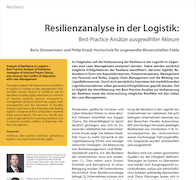
Analysis of Resilience in Logistics

Analysis of Resilience in Logistics

Best-practice approaches of selected players
Boris Zimmermann, Philipp Knauf
The paper analyzes the improvement of resilience in logistics in contrast to lean management. First, possible success factors of resilience will be identified, including agility, redundancy in the form of capacity reserves, process transparency, management of personnel and risk, supply chain management and the formation of liquidity reserves. Eight face-to-face interviews with leading logistics companies will be conducted to examine these success factors. The aim is to identify best practice approaches for improving resilience and to examine possible conflicts of objectives with lean management.
Industrie 4.0 Management | Volume 39 | 2023 | Edition 4 | Pages 50-54 | DOI 10.30844/IM_23-4_50-54
Focus on Employees

Focus on Employees

Clear rules and processes as the basis for independent ordering of indirect requirements
Michael Petri
eProcurement systems enable employees to handle the purchase of C-parts and indirect requirements independently with a minimum of work. This article explains how this can free up space for the strategically decisive procurement of A and B parts. The basic idea is to outsource the operative procurement activity to those who have the demand - so-called demand carriers. Decisive for the success of this approach is the right mix of individual freedom and sufficient control. Here, eProcurement solutions offer various levers that the purchasing department can configure according to the respective company situation. (Only in German)
Industrie 4.0 Management | Volume 39 | 2023 | Edition 3 | Pages 60-61
Climate Neutrality and Digitization

Climate Neutrality and Digitization

A maturity-based approach to identifying measures in production
Stefan Seyfried ORCID Icon, Lukas Martin, Matthias Weigold
Climate neutrality and digitisation are two future-relevant and interlinked topics that are gaining in importance for manufacturing companies. However, especially for small and medium-sized enterprises (SMEs), it is often difficult to get an overview of the concepts and practical measures in these fields. This article presents a maturity model that offers companies practical assistance in combining the goals of climate neutrality and digitisation and in identifying suitable (digitisation) measures for the company to support the transformation towards climate-neutral production. (Only in German)
Industrie 4.0 Management | Volume 39 | 2023 | Edition 2 | Pages 51-55
1 4 5 6 21