
Digital Transformation for SMEs |
Developing a roadmap for Industry 4.0 visions in small and medium-sized enterprises

| Journal | Industrie 4.0 Management |
| Issue | Volume 39, 2023, Edition 4, Pages 59-62 |
| Open Access | https://doi.org/10.30844/IM_23-4_59-62 |
| Bibliography | Share | Cite | Download |
Abstract
Keywords
Article
Even twelve years after the ideas for Industry 4.0 were first presented [1], many small and medium-sized enterprises (SMEs) continue to face challenges in shaping the process of transformation [2]. The introduction of the new technologies, methods, tools and concepts [3] associated with digital transformation is often met with reluctance [4], increases the fear of poor decision-making and inhibits the transformation process, especially in SMEs, due to a lack of sufficient financial resources and know-how [5].
According to a study by the German KfW, only 33% of SMEs surveyed had carried out a digitalization project in 2021 [5]. To support digital transformation efforts in SMEs, a variety of guidelines and maturity models can be used (see [6] for an overview). These models can differ significantly in their structure, scope, level of detail and intended audience. Maturity models can utilize (self-)assessments to determine the current state and show a development path to a target state [7].
Such models are comprised of subject areas (dimensions) and subordinate aspects (indicators) [8]. The indicators are assigned specific features that must be met to achieve a certain level of maturity. These features are defined by a Likert scale, with ascending levels of maturity.
Development paths can then be derived from the assessed current state, whereby the limits of a maturity model are reached. For SMEs to be able to leverage the insights gained from the maturity model to define and design concrete digitalization projects, a supplementary methodological support tool is necessary.
Roadmaps are commonly used at this stage of development as they provide a comprehensive overview of development steps over a strategic period [9]. This implies that SMEs can translate long-term Industry 4.0 visions into realizable projects without getting mired in misguided transformation processes. To support SMEs in developing a roadmap for shaping digital transformation, a holistic methodology has been developed.
Methodology: Developing an Industry 4.0 Roadmap as a Team
By using this methodology, Industry 4.0 visions are systematically translated into a roadmap. This enables SMEs to develop their own digitalization strategy and strengthen their long-term competitiveness in the market. The methodology process is explained below and is illustrated in Figure 1.
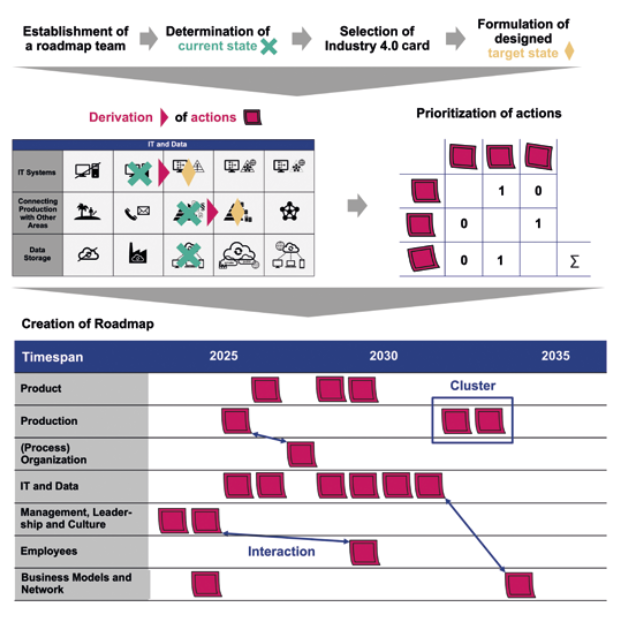
The initial step of the process is to establish a roadmap team. Defining responsibilities for the roadmap and assessing the need for external support for facilitation or consultation is important at this stage. The roadmap team should cover all relevant functional and occupational domains, with a particular emphasis on the Industry 4.0 vision. Additionally, it is crucial to communicate the outcomes company-wide to ensure transparency and gain acceptance from management and beyond [9]. The following stage is to determine the current state of affairs, meaning the company’s individual situation concerning the upcoming digital transformation.
The company’s current level of digitalization is assessed employing an SME-specific maturity model developed in [6], which facilitates creation of a holistic perspective.
This maturity model spans seven dimensions (“product”, “production”, “(process) organization”, “IT and data”, “management, leadership and culture”, “employees”, “business model and network”), and includes a total of 29 indicators. These indicators are compared with one another across five maturity levels (0 = beginner to 4 = excellent). To determine company-specific maturity levels using this maturity model, these indicator assessments are made through a guided interview lasting several hours (approx. 100 questions) [6].
The developed SME maturity model facilitates the assessment of a company’s current state and the formulation of specific Industry 4.0 visions. Supporting the formulation of Industry 4.0 visions, so-called “Industry 4.0 cards” present practical examples of possible visions (e.g. for the use of Augmented Reality and Virtual Reality solutions; see Fig. 2). These fabricated Industry 4.0 cards can be customized or expanded to suit a company’s individual needs. Moreover, individual cards can be created using this schematic.
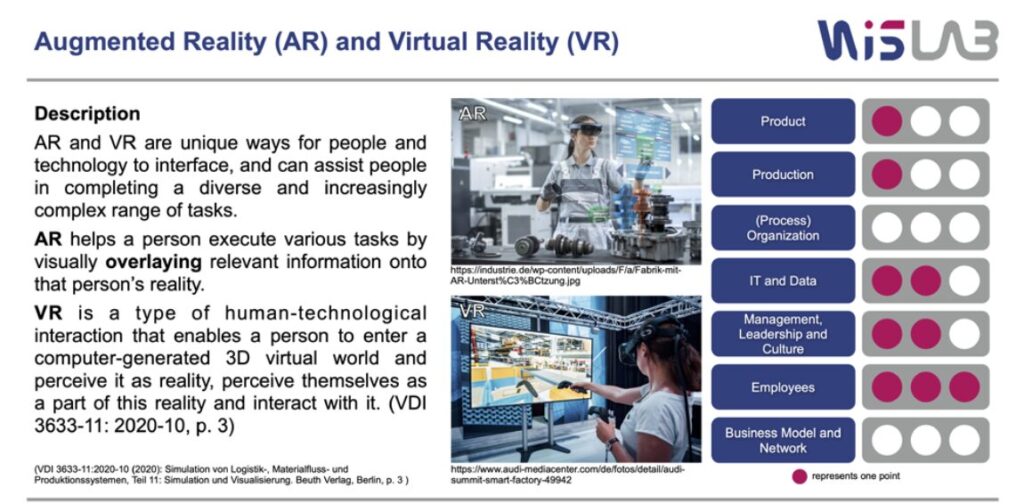
These Industry 4.0 cards create a common understanding within the roadmap team and provide a basis for further methodological processes. Each Industry 4.0 card contains a description of the Industry 4.0 vision in question and assigns points (on a scale from 1 to 3) to reflect the connection assessed between the Industry 4.0 vision and the various dimensions of the maturity model. This is done for each of the seven dimensions based on the ratio of relevant to total indicators within the dimension.
An indicator is deemed relevant if it has received 1 or more points based on its implementation of the vision. To ensure comparability of results, even with differing numbers of indicators per dimension, the Industry 4.0 cards are normalized to 3 points. This is achieved by multiplying the ratio and the maximum scale value and then rounding up to the nearest whole point. This establishes a specific link between the Industry 4.0 vision and the dimensions outlined in the maturity model.
To map the target state, the Industry 4.0 card is transferred into the maturity model by selecting the necessary maturity levels for the indicators deemed relevant. Concrete actions must then be identified through a delta analysis comparing the previously outlined Industry 4.0 vision (target state) and the company’s current level of digitalization (current state).
The descriptions of the individual maturity levels of an indicator provide objective support to derive explicit actions (e.g. “Centralize master data” or “Develop training concepts”) , that are necessary to achieve the respective maturity level. These actions are subsequently incorporated into later stages of the roadmap. They are documented e.g. on sticky notes and added to a table (prioritization matrix), where they are no longer grouped by dimension. This enables the identification of dependencies and interactions between the individual actions, which can be systematically arranged in the roadmap.
Actions are entered into rows and columns in the prioritization matrix, and then compared in pairs (see pair comparison in [11]). If an action in a row must be completed to enable an adjoining action in the column to be completed, a 1 is entered. If there is no connection between the two, a 0 is entered. All pairs are compared using this method, from which a preliminary prioritization can be derived based on the totals for each row.
The prioritization matrix is fundamental in roadmap creation, which comprises a timeline and the maturity model’s seven dimensions (See “Creation of roadmap” section in Fig. 1). The individual actions are added to the roadmap according to their dimension, beginning with the highest followed by its subordinate actions (those assigned a 1 in the prioritization matrix), which are then discussed and transferred over.
This is followed by the action with the second highest priority and its dependent actions. The order of actions that have already been placed may change as necessary. This procedure is repeated until all actions are entered and their order no longer requires changes. Possible constraints can then be discussed, important goals and significant interactions highlighted, and thematically linked or cross-dimensional clusters can be formed. Finally, the roadmap team must reach a consensus on a qualitative time horizon.
To prevent the developed roadmap from being an end in and of itself, explicit follow-up activities must be formulated, project planning must be initiated and the results of the roadmap must be converted into a corporate vision. The project planning phase can be oriented around common project management techniques [11].
Evaluation via a practice-oriented workshop
The methodology was tested via a full-day workshop. An Industry 4.0 vision was developed and transformed into a practical roadmap for a realistic use case in a fictional company. The fictitious company in question produces 250,000 hole punchers per year, generates a turnover of 3.9 million euros, has 42 employees, and possesses a hierarchical structure.
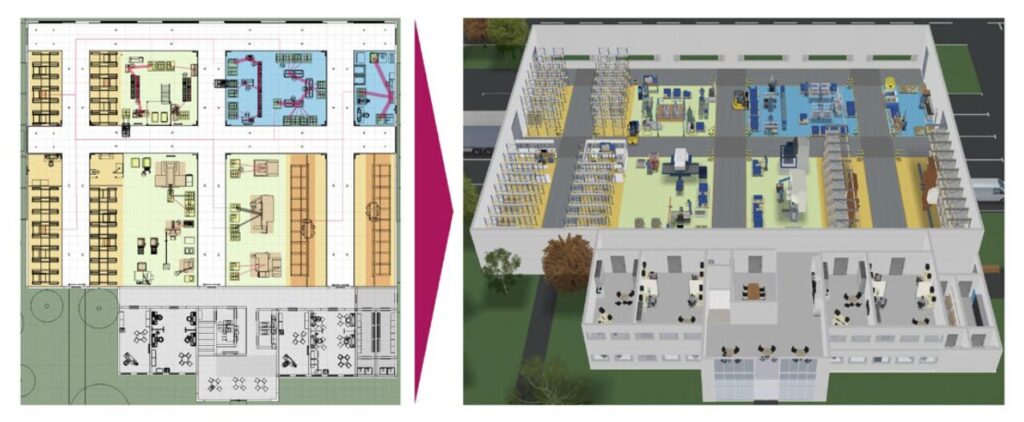
To assist workshop participants in the implementation of different Industry 4.0 cards, detailed information about the company is necessary in addition to the general information provided. This includes a bill of materials from which the necessary production steps can be derived. The resulting factory layout has been modeled in both 2D and 3D (see Fig. 3) and contains production quantities, cycle rates, and logistical processes. Additionally, a value stream map illustrates the flow of materials and information.
Based on this example and the level of digitalization present, the methodology outlined previously was carried out in small groups. Each group selected a different Industry 4.0 card and entered a corresponding target state into the maturity model. The subsequent actions derived from the delta analysis were compared and prioritized using the prioritization matrix. These actions were then transferred into a roadmap, and significant interactions and a time horizon were determined.
The methodology was evaluated by eight industry participants (including management, production, IT and digitalization managers) during a workshop [10]. An anonymous questionnaire was used to collect data, with respondents rating each statement on a five-point Likert scale. The scale scores from “Disagree” (1) to “Agree” (5). Particularly, the structure of the workshop (score: 4.6), the development of the fictional company (score: 4.5) and the methodology for roadmap creation (score: 4.4) received positive ratings. Furthermore, all participants confirmed the workshop’s usefulness (score: 4.5) and expressed their intention to employ the methodology in the future (score: 4.1).
Actively shaping digital transformation
In summary, the methodology is adaptable to a company’s respective level of digitalization, while Industry 4.0 cards offer practical implementation options. Systematically utilizing the methodology identifies actions that can be prioritized and converted into a roadmap using a maturity model. The practical implementation of the roadmap starts by defining follow-up activities. The developed methodology is assumed to be generally valid and is fundamentally usable independently from the specific use case. Nevertheless, additional testing is required to investigate the general validity and transferability regarding specific company contexts.
However, the ongoing process of digitalization necessitates changes to job roles, potentially resulting in subsequent changes to staff’s competence profiles. These changes must be considered when planning and designing Industry 4.0 visions to prevent delays or inaccurate planning. Therefore, it is crucial to identify both current and future competencies and incorporate them into the planning process. Furthermore, suitable competence profiles for future roles must be determined using appropriate methods. This applies both to the manufacturing roles for which this planning is occurring and to the roles within the planning department.
The workshop, developed as an independent further training opportunity, is intended for employees who aim to promote digitalization within their company in the medium term or are directly or indirectly affected by the digital transformation.
The research project – SME Knowledge Transfer Laboratory “Digital Factory” – (KMU-Wissenstransferlabor “Digitale Fabrik“) with a duration of three years (01/2020 – 12/2022) is funded by the European Regional Development Fund (ERDF – or EFRE in German) 2014 to 2020 (IWB-ERDF Programme Hesse) and by the State of Hesse.
Bibliography
[1] Kagermann, H.; Lukas, W.-D.; Wahlster, W.: Industrie 4.0: Mit dem Internet der Dinge auf dem Weg zur 4. industriellen Revolution. URL: bit.ly/3lyHpPd, Abrufdatum 23.06.2023.[2] BMWi: Erschließen der Potenziale der Anwendung von „Industrie 4.0“ im Mittelstand. URL: http://bit.ly/3jUDkV6, Abrufdatum 23.06.2023.
[3] WGP: WGP-Standpunkt Industrie 4.0. URL: bit.ly/3lxUic8, Abrufdatum 23.06.2023.
[4] Von Wascinski, L.; Weiß, M.; Tilebein, M.: Industrie 4.0 für die Textil- und Bekleidungsindustrie. In: Matt, D. T. (Hrsg): KMU 4.0 – Digitale Transformation in kleinen und mittelständischen Unternehmen. Berlin 2018.
[5] KfW Research: KfW-Digitalisierungsbericht Mittelstand 2021: Corona-Pandemie löst Digitalisierungsschub aus, die Digitalisierung wird aber nicht zu einem Selbstläufer. URL: bit.ly/3Sd0jaF, Abrufdatum 23.06.2023.
[6] Wittine, N.; Sutherland, R.; Wenzel, S.; Amaral Bicalho, A. L.: Analysing the state of digitisation in SME – A survey based on an SME-specific maturity model. In: Herberger, D.; Hübner, M. (Hrsg): Proceedings of the 2nd Conference of Production Systems and Logistics (CPSL 2021). Hannover 2021.
[7] Altuntas, M.; Uhl, P.: Grundlagen der Entwicklung von Reifegradmodellen. In: Altuntas, M.; Uhl, P. (Hrsg): Industrielle Exzellenz in der Versicherungswirtschaft. Wiesbaden 2016.
[8] Akkasoglu, G.: Methodik zur Konzeption und Applikation anwendungsspezifischer Reifegradmodelle unter Berücksichtigung der Informationsunsicherheit. Nürnberg 2014.
[9] Isenmann, R.: Technologie-Roadmapping für kleine und mittlere Unternehmen – Vom Konzept des T-Plans zum Leitfaden für KMU. In: Möhrle, M. G.; Isenmann, R. (Hrsg): Technologie-Roadmapping. Berlin Heidelberg 2017.
[10] Wenzel, S.; Gliem, D.; Jessen, U.; Stolipin, J.; Sutherland, R.; Wittine, N.: Abschlussergebnisbericht KMU-Wissenstransferlabor „Digitale Fabrik“. Kassel 2023.
[11] Drews, G.; Hillebrand, N.: Lexikon der Projektmanagement-Methoden, 2. Auflage. Freiburg 2010.
Your downloads
Potentials: Management
You might also be interested in