Classification of Digital Supply Chain Management Platforms |
Review of existing classification approaches from a circular economy perspective

| Journal | Industry 4.0 Science |
| Issue | Volume 42, 2026, Edition 4, Pages 62-70 |
| Open Access | https://doi.org/10.30844/I4SE.26.4.7 |
| Bibliography | Share | Cite | Download |
Abstract
Keywords
Article
The classification of digital platforms is a necessary prerequisite for a structured academic examination of the effects of such platforms on the dynamics of cross-organizational value creation systems. From a supply chain management perspective, research on industrial digital platforms is still in its infancy [4, 5]. Current typological publications focus on platforms that make supply chains more agile and resilient [4, 7, 13]. The topic of sustainability in general—and the transformation of traditional “take-make-waste” supply chains into circular structures [16] in particular—which is currently relevant to both academia and practice, has not yet been addressed in the context of supply chain management.
Against this backdrop, this article examines the extent to which existing classifications of digital platforms for supply chain management must be further developed to account for circular economy platforms [1, 14]. Digital platforms are becoming increasingly important in the context of circular supply chains. Ultimately, these platforms support the implementation of the 9 R strategies [15] of the circular economy (CE) and help to realize the corresponding goals, principles, and potential benefits. The R strategies are illustrated in Figure 1 below, briefly explained, and placed within the overall CE context.
The potential benefits are diverse. They range from reducing the demand for primary raw materials and extending product life cycles to reducing waste through rigorous implementation of the CE principle.
![Figure 1: Circular economy strategies [2, 3, 9, 15, 17].](https://industry-science.com/wp-content/uploads/2026/07/Botsch_I4S-26-4_Figure-1-1024x580.webp)
The second chapter addresses the scientific methodology. Subsequently, in the third chapter, existing classifications are identified and synthesized in a section on the state of the art. The fourth chapter summarizes and discusses the key findings of the study. The fifth chapter, in turn, describes the study’s contributions to science and management, highlights its main limitations and proposes further research questions.
Scientific methodology
A qualitative methodology employing abductive reasoning was chosen to answer the research question [8]. Based on an initial internet search, double-sided and multi-sided circular economy platforms with a focus on business-to-business applications were identified, briefly characterized in terms of their contribution to value creation, and roughly clustered according to similarity. Representative examples were selected from the individual clusters and examined in greater detail with regard to their business models.
A comparatively simple business model conceptualization based on Gassmann et al. [6] was used; this approach is well-established in the scientific literature due to its flexible application. Based on these more detailed descriptions, it was then possible to classify the platforms by type and to verify the consistency of existing typologies from business administration literature on supply chain management.
Classifications of digital platforms in supply chain management literature
Goertler [8] provides an initial typology of digital platforms from the perspective of supply chain management. He distinguishes between data-oriented platforms, matching platforms, and Supply Chain as a Service (SCaaS) platforms. Mante et al. [12] build upon this typology and expand the categories to include supply chain control towers, which are currently being developed and deployed by product manufacturers, consulting firms, and logistics service providers. Mante et al. [12] do not refer to SCaaS platforms but to service platforms more generally. This article is based on the classification by Mante et al. [12] (Fig. 2).
![Figure 2: Types of digital platforms in supply chain management (based on Mante et al. [12]).](https://industry-science.com/wp-content/uploads/2026/07/Botsch_I4S-26-4_Figure-2-1024x522.webp)
CE platforms from a business model perspective
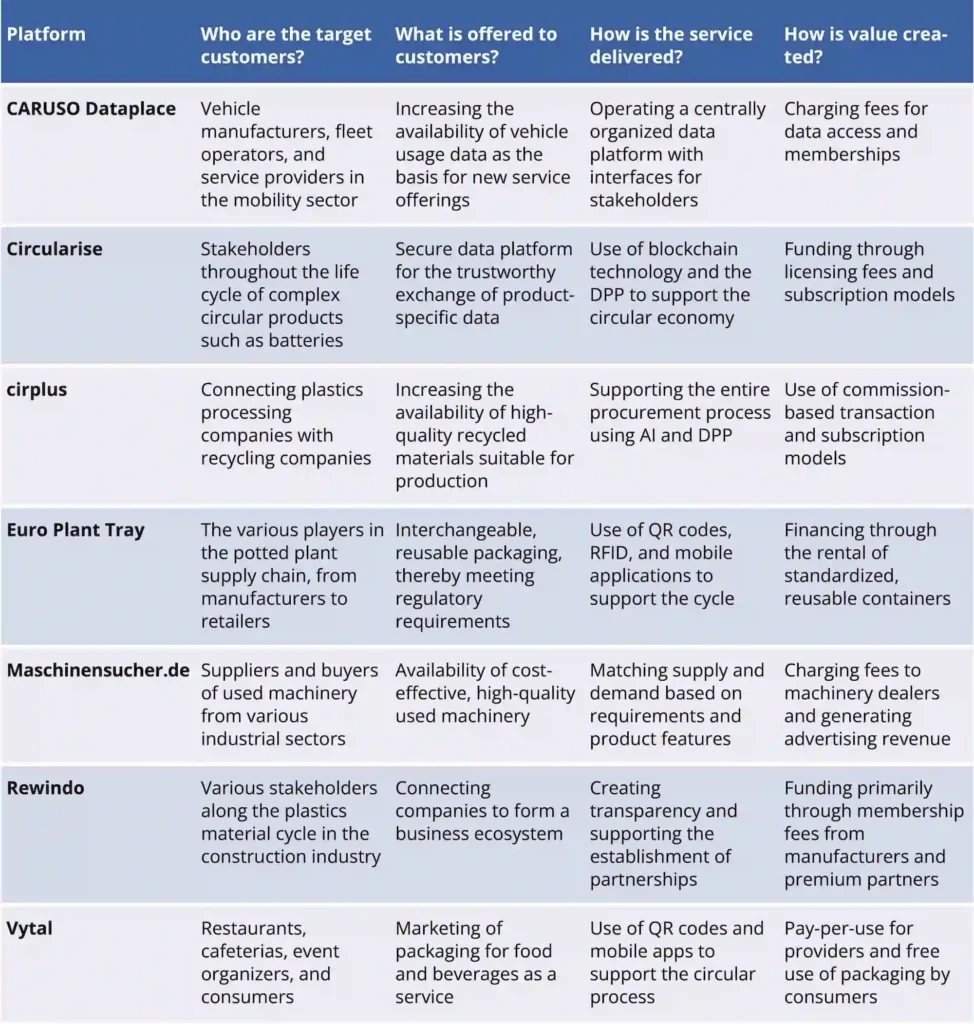
In the following, seven selected circular economy platforms are described according to their business models, target customers, and services. The different business models are summarized in Figure 3.
Classification of CE platforms in a theoretical context
The first platform, CARUSO Dataplace, is a neutral marketplace for mobility data that provides cross-manufacturer access to vehicle-generated data. It connects data providers such as automakers, fleet operators, and telematics service providers with service providers in the mobility, insurance, and maintenance and repair sectors. Vehicle owners must consent to the use of their data and access is then provided via standardized APIs. The revenue model is based primarily on data subscriptions, API integration fees, and basic marketplace services.
The platform supports various life-cycle-oriented R strategies, including REUSE (R3), REPAIR (R4), REFURBISH (R5), REMANUFACTURE (R6), and REPURPOSE (R7), by enabling data-driven services that extend the vehicle’s life cycle. Within the spectrum of digital platform types, CARUSO Dataplace is classified as a data-oriented platform. Its key contribution lies in providing high-quality, granular vehicle usage data as a foundation for data-driven services that benefit various stakeholders throughout the vehicle life cycle.
Circularise, on the other hand, offers blockchain-based solutions for secure transparency and traceability in industrial supply chains. The platform connects material suppliers, manufacturers, and recyclers through digital product passports that enable the controlled exchange of verified product and material information without disclosing sensitive business data. The data can then be selectively used throughout the value chain for compliance, sustainability, and circular economy purposes. Circularise can be integrated into existing ERP systems; its revenue structure is based on software licenses, integration services, and data-related service fees.
Trusted material data supports the following life-cycle-oriented R strategies: REUSE (R3), REPAIR (R4), REFURBISH (R5), REMANUFACTURE (R6), REPURPOSE (R7), and RECYCLE (R8). Circularise is classified as a data-oriented platform. It implements the digital product passport based on blockchain technology, thereby laying the foundation for data-driven services throughout the entire product lifecycle and for the design of industrial circular systems.
cirplus is a two-sided marketplace for recycled plastics that digitally connects recycling companies and plastics processing businesses. The platform provides standardized material and quality data, enables the comparison of technical requirements, and supports digital transaction processing, while physical delivery takes place directly between the recycler and the buyer. The revenue model is primarily transaction-based.
By reducing search and transaction costs and increasing market transparency, cirplus contributes to the scalable procurement of recycled materials. It thus primarily addresses the RECYCLING (R8) strategy by returning waste material to the plastics cycle and facilitating its reuse. In terms of platform typology, cirplus is classified as a matching platform that extends traditional supply chain management functions to include a circular perspective.
If cirplus offers new methods of recycling, Euro Plant Tray provides one specific method of reuse. Euro Plant Tray is a European cooperative that operates a standardized reusable container system for potted plants. It connects growers, wholesalers, and retailers through reusable plant containers that replace single-use plastic packaging in plant transportation. The containers are rented out, cleaned upon return, and put back into circulation; tracking, logistics, and washing services are integrated. The revenue model is based on rental and service fees.
The system reduces plastic waste and supports compliance with future regulatory requirements for reusable transport packaging along the entire value chain in line with the R-strategy REUSE (R3). Euro Plant Tray can be classified as a service platform for reusable container management. The value-added processes surrounding containers for potted plants are supported by digital technologies. QR codes and RFID systems, among other technologies, are used for container identification.
Maschinensucher.de is a digital platform that connects sellers of used machinery with industrial buyers. It provides performance, search, and contact functions, while contract conclusion and transactions take place outside the platform. The revenue structure is based not on sales commissions, but on dealer subscriptions, premium listings, and advertising services designed to increase reach and visibility.
The focus is on “second-life” strategies such as REUSE (R3) and REFURBISHMENT (R5), which aim to extend the service life of various types of machinery. Maschinensucher.de can be classified as a matching platform. It functions as a procurement platform in the sense of traditional supply chain management solutions, but with a focus on brokering production equipment rather than procuring supplier parts.
Rewindo’s focus is not on machinery but on PVC building components such as windows, doors, and roller shutters. It is a multisectoral recycling and sustainability platform, which connects manufacturers, construction and demolition companies, and recycling facilities to coordinate the collection, processing, and reuse of PVC waste within closed-loop material cycles. The platform particularly strengthens the construction and profile industries by increasing the proportion of recycled material, reducing PVC waste, and supporting compliance with regulatory requirements. Value creation stems primarily from industry collaboration, increased recycling rates, and improved environmental metrics, rather than from direct profit.
Rewindo implements the R Strategy RECYCLING (R8) by systematically returning PVC building components to the material cycle. In terms of classification, Rewindo is fundamentally categorized as a service platform.
Finally, Vytal is a digital platform for reusable packaging in the food delivery and takeout sector. It combines standardized reusable containers with software-based tracking to replace single-use packaging. Restaurants serve food in Vytal containers; consumers use them temporarily and then return them to the circulation via participating drop-off points. The platform coordinates the entire container circulation process, including cleaning, through partner companies. The revenue model is based on usage- or transaction-based fees per packaging cycle.
The system is enabled via digital means, for example QR codes for packaging identification. In this way, Vytal extends the service life of the containers used in accordance with the R-strategy REUSE (R3). In the context of supply chain management, Vytal falls into the category of reusable container systems. However, the innovation lies in the software-based, systemic integration into food service establishments, combined with low-barrier consumer participation. It transforms the traditional reusable system into a user-centered service platform.
Discussion of the results: Classification of platforms by type
The following table presents the key findings from the previous subsection. In addition to the classification of the individual platforms into the platform types from the framework model, it also shows the respective R strategies supported by each platform.
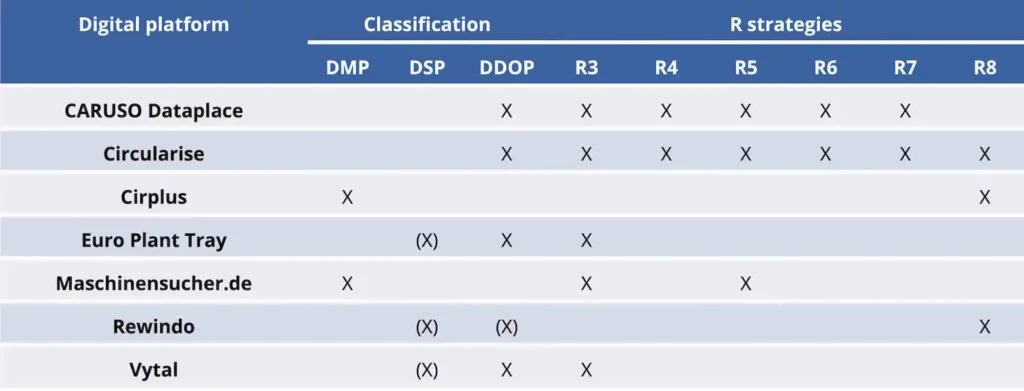
Classifying the platforms cirplus and Maschinensucher.de as matching platforms is relatively straightforward. Both are undoubtedly two-sided platforms where suppliers and consumers of materials, products, or services are connected with one another using digital technologies—including artificial intelligence in the case of cirplus.
The digital platforms CARUSO Dataplace and Circularise are similarly easy to classify. They are both digital, data-driven platforms, despite the fact that CARUSO Dataplace has a centralized and Circularise a decentralized architecture. Both platforms can serve as a foundation for the design and implementation of services and service systems aimed at establishing, operating, and further developing circular value creation systems.
Classifying the remaining platforms is somewhat more challenging. Rewindo provides data-driven support to manufacturers of windows, doors, and blinds by helping them establish an economically viable ecosystem for the reuse of plastic materials through a direct search function and documents material flows for later statistical analysis.
Other data-driven services that support the circular value creation process itself are not mentioned in the public sources evaluated for this article. However, the establishment of the ecosystem represents a prerequisite for the implementation of such services. Therefore, the platform was cautiously classified as a service platform, with the potential to gradually evolve into an SCaaS platform. Digital, data-oriented platforms act as enablers in this context.
Although Vytal and Euro Plant Tray use relatively simple technologies such as QR codes and RFID for container identification, they are IoT-based container management systems. From a supply chain management perspective, such systems are nothing new. In both cases, the container management service already in place can be supplemented with additional data-driven services. Here, too, there is potential to further develop the currently available solution into service platforms and integrate them into existing SCaaS solutions, such as those offered by companies like Accenture. At present, these two platforms still function as digital, data-oriented platforms.
Outlook: Platform types in the circular economy
This article asks to what extent the classification of digital platforms developed by Görtler and Mante et al. in the context of supply chain management [8, 12] must be further refined with regard to the circular economy. To this end, a number of selected platforms are analyzed in terms of their business models and classified according to the types described in the supply chain management literature.
A key finding from a scientific perspective is that the typology developed by Görtler and Mante et al. [8, 12] remains valid in a circular economy context. Some platforms could be unambiguously classified as digital matching platforms or digital data-oriented platforms. Others exhibit characteristics of both service platforms and digital data-oriented platforms. Since the academic literature on supply chain management platforms notes that digital data-oriented platforms also serve as enablers for the implementation of service platforms [12], this does not in any way limit the scientific contribution of this study.
For management, the results imply that this typology can continue to be used when implementing circular economy initiatives or transforming traditional supply chains into circular systems. Additionally, the evaluation allows for conclusions to be drawn regarding the relevance of individual platforms for the implementation of specific R strategies. For example, the results show that digital, data-oriented platforms are key enablers for the implementation of the circular economy.
This study is not without limitations. For one thing, only a limited number of platforms were analyzed. The selection of these platforms was relatively pragmatic. To ensure that the findings are generalizable, additional platforms must be identified and examined using a suitable search methodology. Furthermore, the analyses of the selected platforms are based exclusively on publicly available information. To increase the robustness of the results, additional sources should be tapped as part of a methodological triangulation. Conducting expert interviews, for example, would be a suitable approach.
Additionally, preliminary work from supply chain management was taken into account during the typology development. In recent years, additional typology approaches have been developed within the academic circular economy community [10, 11, 14]. Against this backdrop, it remains to be examined to what extent the different typology variants can be consistently consolidated.
Further research questions can be formulated on the basis of this article. First, digital service platforms and digital data-driven platforms must be distinguished from one another even more clearly. It must be clarified under which conditions the terms digital service platform or digital data-driven platform should be used. Additionally, the question arises as to whether the implementation of a single service already justifies the use of the term “service platform” or whether the prerequisite for this is the existence of multiple, complementary services. This article was unable to establish a concrete connection between supply chain management or supply chain control towers, on the one hand, and digital circular economy platforms, on the other, which is thus a task for future research.
In light of the general trend toward more sustainable supply chains, the environmental impact of different platform types should be examined more closely in the future. By mapping R strategies to platforms and platform types, this paper already provides initial insights.
The results presented in this article were developed in the course of research projects funded by the BMFTR as part of the “Dynamics of Digital Value Creation Systems (DynaVer)” funding line within the “Future of Value Creation” program.
The original German version of this article can be accessed via DOI: 10.30844/I4SD.26.4.7
Bibliography
[1] Blackburn, O.; Ritala, P.; Keränen, J.: Digital platforms for the circular economy: Exploring meta-organizational orchestration mechanisms. In: Organization & Environment 36 (2023) 2, pp. 253–281.[2] Bocken, N. M. P.; de Pauw, I.; Bakker, C.; van der Grinten, B.: Product design and business model strategies for a circular economy. In: Journal of Industrial and Production Engineering 33 (2016) 5, pp. 308–320.
[3] Bühler, L.: Smart Circular Economy in produzierenden Unternehmen: Wie digitale Technologien und Daten die Umsetzung einer Circular Economy ermöglichen. In: Pflaum, A. (ed.): Schriftenreihe Supply Chain Management und Digitalisierung. Vol. 4. Fraunhofer Verlag 2025.
[4] Chan, H. K.; Cheng, Y.; Shi, Y.; Sheng, J.: Guest editorial: Platform-enabled supply chain and logistics excellence: research challenges and opportunities. In: International Journal of Physical Distribution & Logistics Management 55 (2025) 6, pp. 569–581.
[5] Cusumano, M. A.; Gawer, A.; Yoffie, D. B.: The Business of Platforms: Strategy in the Age of Digital Competition, Innovation, and Power. New York 2019.
[6] Gassmann, O.; Frankenberger, K.; Choudury, M.: Geschäftsmodelle entwickeln: 55 innovative Konzepte mit dem St. Galler business model navigator“. Berlin 2020.
[7] Gu, X.; Chan, H. K.; Thadani, D. R.; Chan, F. K. S.; Peng, Y.: The role of digital techniques in organizational resilience and performance of logistics firms in response to disruptive events: flooding as an example. In: International Journal of Production Economics 266 (2023), 109033.
[8] Goertler, T.: A typification of digital platforms from a supply chain management perspective. In: International Journal of Physical Distribution & Logistics Management 55 (2025) 6, pp. 678–699.
[9] Kirchherr, J.; Reike, D.; Hekkert, M.: Conceptualizing the circular economy: An analysis of 114 definitions. In: Resources, Conservation and Recycling 127 (2017), pp. 221–232.
[10] Körppen, T.; Ullrich, A.; Böttcher, T. P.; Krcmar, H.: How digital platforms can foster a circular economy. In: Proceedings of the Pacific Asia Conference on Information Systems (PACIS 2024).
[11] Konietzko, J.; Bocken, N.; Hultink, E. J.: Online platforms and the circular economy. In: N. Bocken, N.; Short, S. (eds.): Innovation for sustainability: Business transformations toward a better world. Cham 2019.
[12] Mante, E.; Görtler, T.; Marcel, P.; Pflaum, A.: Digitale Wertschöpfung: Beiträge digitaler Plattformen zu Resilienz und Nachhaltigkeit. In: Handbuch Dynamik von Wertschöpfungssystemen. Cham 2026.
[13] Papert, M.; Hamper, A.; Hoßbach-Zimmermann, N.; Schuster, T.; Bühler, L.; Pflaum, A.: Towards a data-driven circular and embedded supply chain: Considerations from an ICT perspective. In: Proceedings of the 57th Hawaii International Conference on System Sciences (HICSS 57): January 3–6, 2024, Honolulu, HI, USA.
[14] Petrik, D.; Hiller, S.; Morar, D.: Digital platforms for the circular economy: Empirical development of a taxonomy and archetypes. In: Electronic Markets 35 (2025) 60.
[15] Potting, J.; Hekkert, M.; Worrell, E.; Hanemaaijer, A. (2017). Circular economy: Measuring innovation in the product chain – Policy report. PBL Netherlands Environmental Assessment Agency.
[16] Stevens, G. C.; Johnson, M.: Integrating the Supply Chain … 25 years on. In: International Journal of Physical Distribution & Logistics Management 46 (2016) 1, pp. 19–42.
[17] Zeiss, R.: Circular Economy in the Digital Age – How Information Systems Can Advance Sustainable Consumption and Production. Dissertation. 2021.
Your downloads
You might also be interested in