Supply Chain Management

I4S 4/2025: Smart Logistics

I4S 4/2025: Smart Logistics

Sustainable, resilient processes along the entire value chain
Logistics is entering a new era. Climate change and geopolitical uncertainties are shifting the focus to resilience and sustainability. The concept of smart logistics is gaining importance. But what exactly makes logistics smart, and how can it help us organize our societies and the economy? Approaches such as predictive analytics, demand analysis, and machine learning show why smart logistics is more than just a technological trend.
Increasing Resilience in Logistics with IT

Increasing Resilience in Logistics with IT

Investigating supply chain risk management information systems
Alexander Baur, Jasmin Hauser, Dieter Uckelmann ORCID Icon
The blockage of the Suez Canal in 2021, caused by the accident involving the container ship Ever Given, clearly illustrates the need to design global supply chains in such a way that they can respond quickly to disruptions. In a volatile, uncertain, complex, and ambiguous (VUCA) environment, conventional logistics processes that focus on efficiency, and supply chain management methods in particular, are increasingly reaching their limits. Resilience, achieved through a combination of robustness and agility, is essential to ensure responsiveness. This article analyzes how risk management information systems (RMIS) can increase resilience. The analysis covers data availability, data transparency, modeling and simulation of risk scenarios, and the development of appropriate emergency action plans. Despite existing challenges in designing IT infrastructure, the measures mentioned have the potential to increase resilience in logistics.
Industry 4.0 Science | Volume 41 | Edition 4 | Pages 36-42
Requirements Analysis for Predictive Analytics in SCM

Requirements Analysis for Predictive Analytics in SCM

Decision support for research and practice
Iris Hausladen ORCID Icon, ABM Ali Hasanat
Predictive analytics opens up opportunities to improve decision-making in manifold areas, including in supply chain management (SCM). Yet, the complete realization of its potential requires the identification of the corresponding needs upfront. This paper provides a structured concept that guides through the complex and interdisciplinary endeavor of requirements analysis for predictive analytics in SCM. Due to the generic nature of this approach, it can be applied for any use case and be adapted or enhanced in case of need.
Industry 4.0 Science | Volume 41 | Edition 4 | Pages 86-92
Intelligent Load Carrier Management

Intelligent Load Carrier Management

AI-supported monitoring and reduction of losses in logistics
Dominik Augenstein, Lea Basler
Load carriers are essential for transporting manufactured parts in manufacturing companies. Despite their ‘simplicity’, they are usually expensive to purchase as they are manufactured expressly to fit purpose. While tracking methods such as GPS tracking can be used to prevent the loss of load carriers, this is associated with monitoring costs and presents challenges with regard to data protection as soon as the work performance of intralogistics employees is monitored. Assigning load carriers to designated clusters and monitoring these clusters provides an effective solution—without drawing conclusions about employee performance. Furthermore, artificial intelligence can optimize this approach whilst also deterring the theft of load carriers.
Industry 4.0 Science | Volume 41 | 2025 | Edition 2 | Pages 78-84
GAIA-X Maturity Model 

GAIA-X Maturity Model 

Assessing the future viability of cross-company 
data exchange
Maximilian Weiden, Jokim Janßen
In order to cope with growing customer requirements and the associated increase in complexity, companies are opening up their value chains, reducing their vertical integration and increasingly entering into collaborations. Cross-company data exchange along the supply chain is thus becoming a key component for competitiveness and the realization of customer-specific solutions. For this reason, the European Union has launched the GAIA-X project, which aims to create the next generation of data infrastructure for Europe and its companies. The GAIA-X maturity model offers an approach for classifying companies into different development stages and provides concrete requirements for further development along a predefined development path towards becoming a fully-fledged participant in the federated GAIA-X data infrastructure.
Industry 4.0 Science | Volume 40 | 2024 | Edition 3 | Pages 14-20
“Data Generated by Cyber-Physical Systems Will Play a Decisive Role”

"Data Generated by Cyber-Physical Systems Will Play a Decisive Role"

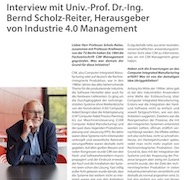
Interview with Prof. Bernd Scholz-Reiter, former editor of Industrie 4.0 Management
Bernd Scholz-Reiter ORCID Icon, Bernd Scholz-Reiter ORCID Icon
Professor Bernd Scholz-Reiter studied industrial engineering at the Technical University of Berlin. After several positions in Germany and abroad, he accepted the call to the University of Bremen in 2000, where he initially held the professorship of Planning and Control of Production Systems in the Department of Production Engineering. From 2002 to 2012, he also headed the Bremen Institute for Production and Logistics (BIBA). From 2012 to 2022, Bernd Scholz-Reiter was rector of the University of Bremen.
Industrie 4.0 Management | Volume 38 | Edition 6 | Pages 6-8
Circular supply chain management for the wind energy industry – Conceptional ideas towards more circularity

Circular supply chain management for the wind energy industry – Conceptional ideas towards more circularity

Supply chains have to be designed and managed to handle complexity and uncertainties. Recent events (e.g. Covid-19) have shown how fragile supply chains can be when assumptions for the design and management of supply chains are challenged. In addition, governments are striving for systemic changes towards more sustainability (e.g. European Green Deal). To meet the resulting requirements, the concept of circular economy and with it, circular supply chain management (CSCM) are gaining attention as they could contribute to building a sustainable and resilient system. The German wind energy industry, with its long track record, is a suitable application for further research on CSCM, as the industry operates predominantly in a linear system and relies on finite materials. Despite, research on CSCM for the wind energy industry is still rare. The aim of the paper is therefore to present conceptional ideas that enable an efficient design of a circular wind energy industry in Germany. Aspects ...
Industry 4.0 Science | 2022 | | DOI 10.30844/WGAB_2022_4
Digitization in Supply Chain Management −Decision Support for the Selection of Suitable Technologies

Digitization in Supply Chain Management −Decision Support for the Selection of Suitable Technologies

Entscheidungsunterstützung bei der Auswahl geeigneter Technologien
Sascha Düerkop, Jakob Grubmüller, Michael Huth
The trend toward digitization o ers considerable potential; this is particularly true in supply chain management (SCM). However, not every technology is suitable for every company and its processes. This article presents a structured approach that supports companies in the selection process. The approach consists of several phases: Starting with the identi cation of business goals and ending with the selection of those technologies that seem most promising. Its applicability was tested in a research project at a logistics service provider. It is easily transferable to a concrete decision-making situation.
Industrie 4.0 Management | Volume 38 | 2022 | Edition 3 | Pages 31-34
Key Factors for Successful Supply Chain Management

Key Factors for Successful Supply Chain Management

Sebastian Trojahn, Vanessa Klementzki
Today's business world is characterized by ever-increasing complexity in nearly every dimension. Supply chains can no longer be understood in a linear fashion, but form networks across numerous supply chain participants. Globalization and crises are straining existing structures, calling into question previously set priorities and measures, and demanding new solutions. How must supply chains be structured in this constantly changing environment in order to be successful? This article highlights fields of action for successful supply chain management.
Industrie 4.0 Management | Volume 38 | 2022 | Edition 3 | Pages 48-52 | DOI 10.30844/I40M_22-3_48-52
Machine Learning in Supply Chain Management

Machine Learning in Supply Chain Management

An overview of existing approaches based on the SCOR model
Benjamin Seifert, Theo Lutz ORCID Icon
With increasing availability of data, the use of machine learning to optimize supply chains becomes attractive, as the accuracy of data analysis can be increased and simultaneously the effort can be reduced. Based on the SCOR model, exemplary approaches are described as a guidance and suitable machine learning methods are presented.
Industrie 4.0 Management | Volume 37 | 2021 | Edition 2 | Pages 49-51
1 2 6