Industrial Platforms for the Analysis of Decision Dynamics |
An agent-based modeling approach

| Journal | Industry 4.0 Science |
| Issue | Volume 42, 2026, Edition 4, Pages 30-40 |
| Open Access | https://doi.org/10.30844/I4SE.26.4.4 |
| Bibliography | Share | Cite | Download |
Abstract
Keywords
Article
Industrial platforms as orchestrators of value creation systems
The transition from pipeline-based models to interconnected ecosystems is fundamentally transforming value creation [1] [2]. Traditional value chains follow a clear linear logic in which goods and services pass through a predefined sequence of stages before reaching the market [3]. Digital platforms disrupt this linearity by enabling dynamic value creation systems. Within such ecosystems, value is co-created through collaboration among interconnected actors who interact with one another [4].
In industrial contexts, a platform is not merely regarded as a technological system or an intermediary for conducting transactions. Rather, it defines the conditions for collaboration among companies as well as for value generation within the ecosystem. By connecting diverse participants, platforms generate reciprocal relationships that foster both competition and innovation. In doing so, ecosystems address complementarities among actors through data-driven exchange and a modular architectural structure [5].
Existing explanatory models cannot fully capture the complexity and multifaceted nature of platform-based value creation systems [6] as they mainly refer to linear, self-contained systems. The use of appropriate simulation approaches supports the analysis of platforms within industrial value creation systems. Examining the platform phenomenon and its effects, simulation research has to adhere to specific methodological requirements to accurately illustrate the complex interaction structures and the resulting dynamics.
Here, agent-based simulation is particularly well-suited for analyzing an individual platform and its interaction with the surrounding ecosystem. This simulation approach enables the modeling of individual behavior patterns and decision-making logic, particularly those of heterogeneous actors [7]. The wide variety of definitions and perspectives on the different forms of platforms requires a clear operationalization of relevant actors and their interaction structures [8]. Leveraging agent-based simulation facilitates the development of an analytical and evaluative framework, rendering emergent dynamics observable.
Research methodology
To guide the implementation of the simulation model, this research project follows Design Science Research Methodology (DSRM) as outlined by Peffers et al. [9]. The process begins with the problem identification phase, in which the characteristics of industrial platforms, environmental influences on platform mechanisms, and changes in the value creation network are defined. Based on these findings, the objective definition phase derives the requirements for the simulation environment. This process essentially involves a conceptual foundation for a future simulation artifact.
These requirements are incorporated into the design and development phase, during which a modeling concept for the simulator is developed. Platform mechanisms and the various interaction structures are converted into a simulation-ready representation suitable for technical implementation. Findings from the modeling process, together with the collected data, are continuously incorporated into the development cycle, enabling a step-by-step refinement of both the simulation models and the resulting platform dynamics.
Overall, this research project focuses on the analysis of a single platform and the interactions between multiple platforms, resulting in two distinct phases within the DSRM framework. The micro-level perspective focuses on interactions among actors within the platform ecosystem, while the macro-level perspective focuses on the market environment, considering the effects of rules governing the platform economy. By integrating both perspectives within a single simulation tool, a foundation for an integrated analytical instrument is established, designed to derive evidence-based recommendations for action and to generate scientific insights.
This allows both perspectives to be combined and utilized within the simulation depending on the specific research question. The actual interactions and the extent of platform-induced changes can thus be examined through different research questions.
Development of a database to characterize industrial platforms in agent-based simulations
A prerequisite for modeling industrial platforms is the development of a database that maps variables, defines agent parameters, and captures temporal dynamics required to predict development dynamics. Compared with consumer-oriented platforms, digital platforms in industrial and business-to-business (B2B) contexts remain considerably less explored. This is due to the complexity of industrial environments, which has thus far limited scientific analysis.
Because of the industry-specific characteristics, the constellations of actors, and the transaction characteristics in the B2B context, insights from the B2C sector are not directly transferable to industrial settings. Existing descriptive approaches focus primarily on technological aspects while largely overlooking the role of platforms as markets, ecosystems, or socio-technical environments in which actors interact [10]. To understand the core mechanisms of industrial platforms, previous research has been examined, placing particular at the complexity of actor constellations as well as governance and value creation mechanisms.
To this end, three systematic literature reviews were conducted to derive simulation-oriented requirements, establish a consistent definition of industrial platforms and identify their phase-specific mechanisms of action (Figure 1).
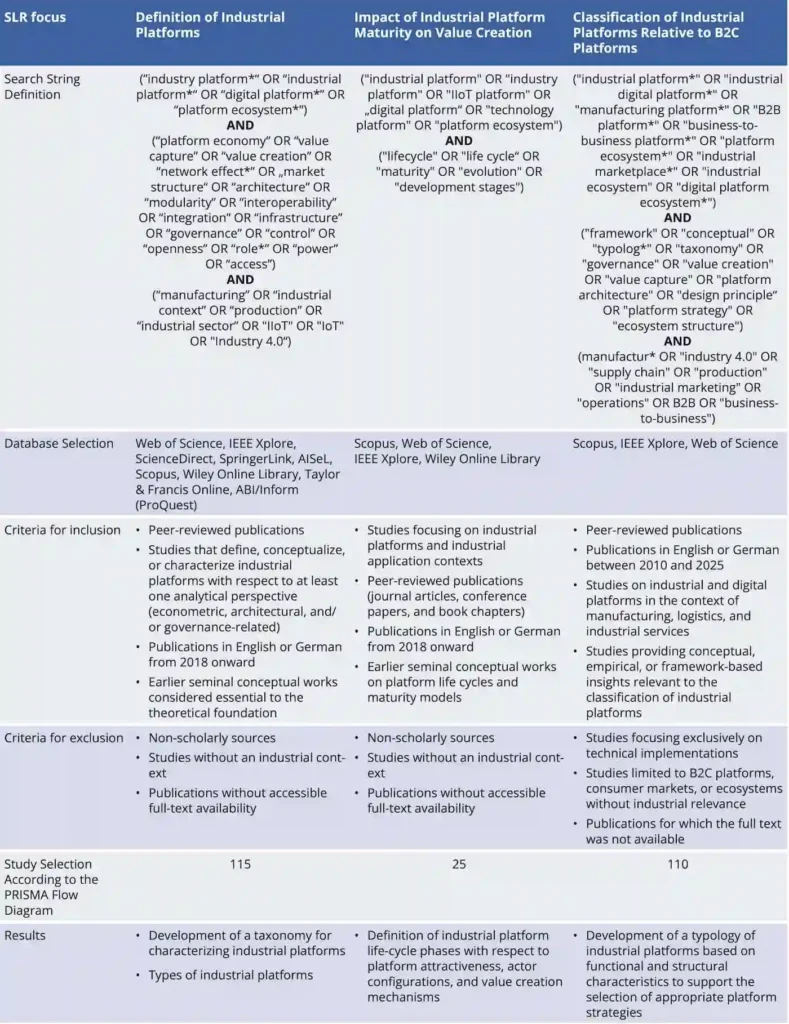
Identifying the characteristics of industrial platforms provides the foundation for modeling individual agents and their behavioral patterns. These characteristics influence the agents’ decision parameters and available courses of action. Different platform configurations also play an important role in the differentiated parameterization of agents. In addition, the adaptability of agents is demonstrated by referring to the life cycle phases of industrial platforms. As platforms mature, their influence on the value creation network changes, requiring the characteristics and idealized patterns of industrial platforms to be defined in varying degrees.
To quantify the contribution to value creation within the platform ecosystem, the results were assigned to three platform types. The classification distinguishes between “type-specific” and “non-type-specific” characteristics. Results that occur independently of a specific platform type are considered “non-type-specific”. In contrast, at least two platform mechanisms may operate simultaneously, as the functionality of a platform often relies on multiple mechanisms that shape the its purpose. Based on this classification, the following cross-cutting platform types were defined:
- Coordination platforms: Organize the behavior of ecosystem actors through rules, roles, and coordination mechanisms
- Exchange platforms: Focus on value creation between at least two types of actors by matching compatible participants and enabling value generation through interaction
- Enablement platforms: Provide technological incentives for the integration of external actors or complementors and the development of proprietary functionalities
Requirement Identification
As part of the requirements analysis, the platform characteristics (Figure 2) and application scenarios (Figure 4) identified in the literature are extracted in the context of the relevant domains of agent behavior and platform development [11] [12].
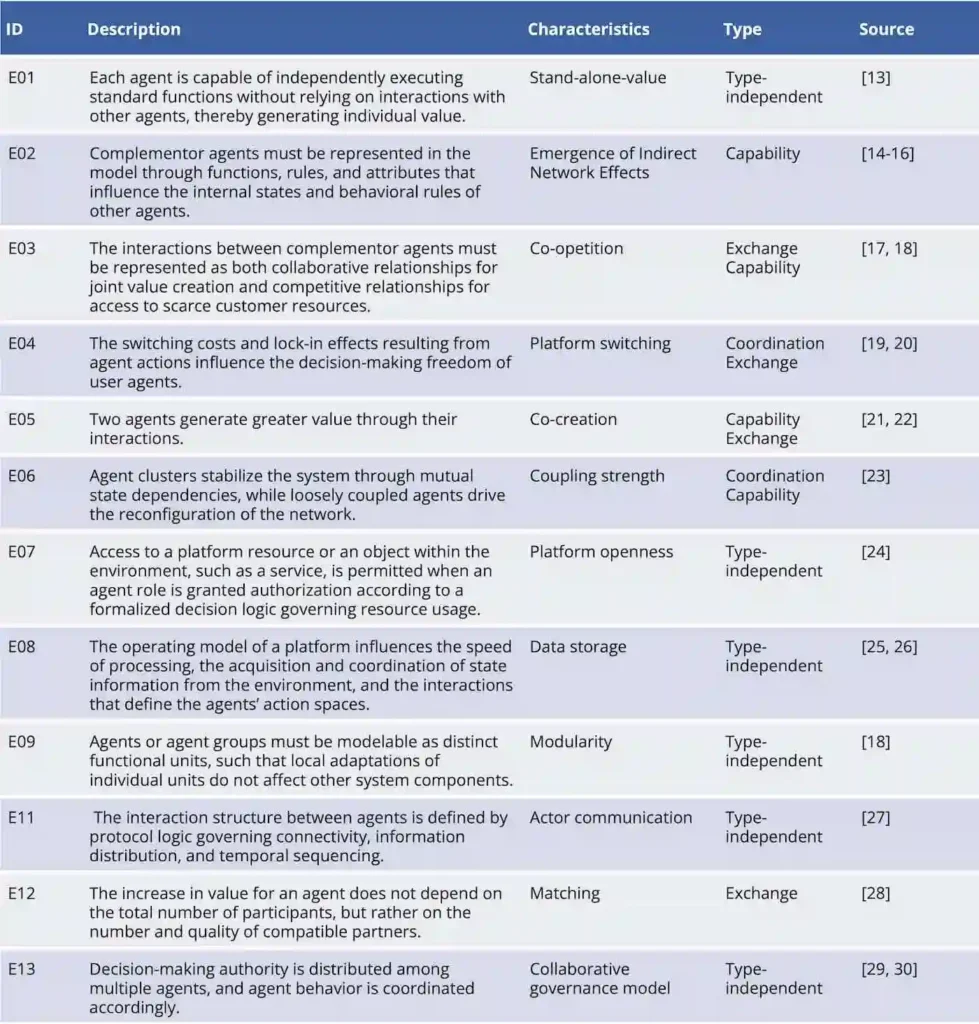
Based on these platform characteristics, the modeling requirements (Figure 3) for agent-based simulation are derived. The scenario-based assumptions serve as representative use cases that are intended to be implemented in the simulation and provide the framework for defining the modeling requirements.
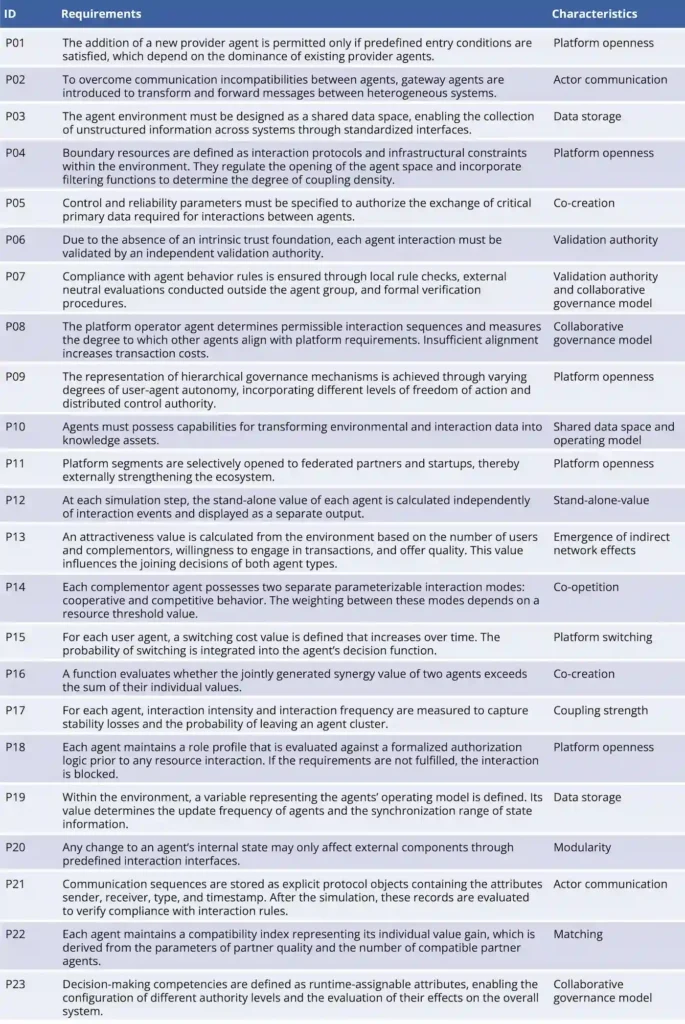
The relationship between agents influences both system behavior and platform value. The activities of one group of agents affect the utility of other groups, thereby generating network effects. The agents’ resources must be transformed into value-creating interactions that produce quantifiable benefits in the form of network effects. Each interaction between agents should generate a measurable contribution to platform value based on the resources deployed, which can be attributed to the respective revenue model and network effect parameters. In particular, complementor agents shape the states of other agents in terms of behavioral rules and attributes. Thus, they act as indirect drivers of innovation and service quality [31].
The platform infrastructure provides the structural framework within which agents make decisions. Thus, the scope of action is regarded as a defined potential for action. Depending on the configuration of the platform infrastructure, the scope of action may either be limited or expanded. Access logic and boundary resources determine both information availability and opportunities for interaction [32] [33]. In addition, the platform’s operating model influences data processing capabilities and consequently, the agents’ responsiveness. Overall, the platform architecture determines the entry conditions and the intensity of value-creation relationships.
Furthermore, no intrinsic basis of trust should develop between the agents when exchanging business-critical data. Since agents pursue different objectives, tensions regarding data access arise [34]. On the one hand, the agents rely on data access to create data-driven services and to support strategic decision-making that strengthens their competitive position. On the other hand, they seek to control data access to protect themselves from competing agents. Governance mechanisms with varying degrees of control define the interaction logic and the scope of agents’ decision-making autonomy. These mechanisms regulate the extent of resource utilization and interaction relationships. In particular, the aim is to identify a balance between central control by the platform operator and the autonomous actions of complementor agents [35].
Within the platform ecosystem, data is not processed in isolation by a single agent, but rather within a networked processing workflow. Raw data is consolidated to support the agents’ decision-making through semantic and process-oriented linkages [36]. These serve as the foundation for developing intelligent platform functionalities that complementors can develop and offer as value-added services.
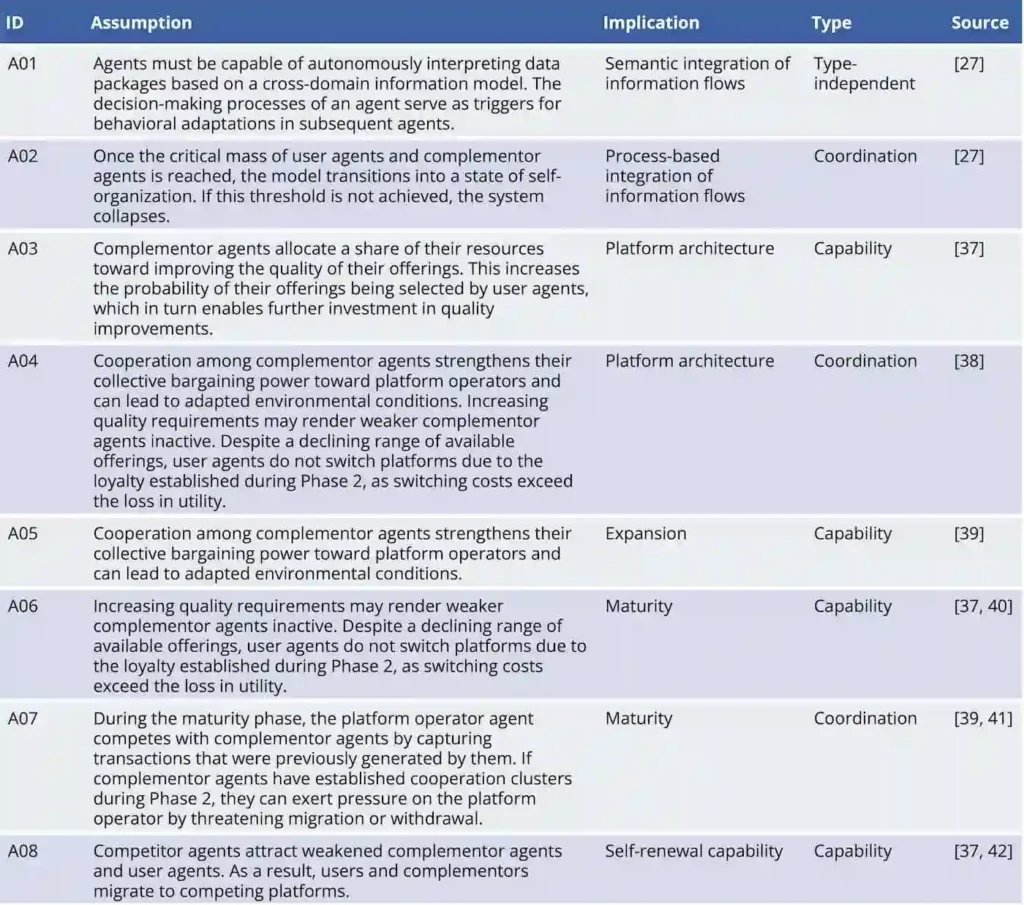
The evolution of industrial platforms highlights the shifting conditions for success across its various phases. Power dynamics and incentive structures influence the willingness to cooperate and exchange data [43]. As the platform matures, accessibility for external actors may be increased, depending on market share and competitive position [44]. In doing so, the agents aim to focus on the benefits for their market position and control over resources. They evaluate whether the risk of disclosing critical data is lower than the potential added value. A simulation of these phase-specific developments allows for an analysis of insights regarding platform stability.
From platform requirements to agent-based simulation architecture
By defining the system requirements, platform characteristics are translated into concrete modeling specifications for the agent-based simulation. The conceptual specification determines the objectives and scope of the simulation, enabling the representation of the platform’s influence on the value-creation network, its evolution over time, and its characteristics within an executable simulation model [45]. In this process, system boundaries and modeling assumptions are specified to provide an abstract representation of the real-world system. This allows both the platform itself and the effects of its mechanisms within the ecosystem to be operationalized. Here, the data foundation for the semantic representation of the simulation elements is translated into functional requirements.
At the agent level, all actors are represented together with their behavioral attributes and available resources. Each agent is assigned a set of state variables for its individual scope of action. This assignment may vary depending on the platform type. The interactions and behaviors of the agents drive economic mechanisms, such as cross-functional network effects or lock-in effects. Their impact should be illustrated in a qualitatively measurable manner to ensure transparency and traceability. A temporal dimension is added through the representation of the lifecycle phases of industrial platforms, which globally governs the agents’ behavioral rules.
The results are presented as a deliberately preliminary conceptual architecture that structures the modeling space and serves as the foundation for subsequent implementation, parameterization, and validation. Overall, the unique nature of industrial platforms demonstrates that agent-based modeling is one of the few approaches capable of capturing their complex socio-technical dynamics. Industrial platforms comprise decentralized networks of interacting actors in which platform mechanisms emerge through bottom-up interactions rather than centralized control. As a result, the system cannot be described as static at any given point in time. Instead, the simulation enables the analysis of alternative scenarios and their effects on the evolution of the overall system.
The original German version of this article can be accessed via DOI: 10.30844/I4SD.26.4.4
Bibliography
[1] Gawer, A.; Cusumano, M. A.: Industry platforms and ecosystem innovation. In: Journal of Product Innovation Management (2014) 3. DOI: https://doi.org/10.1111/jpim.12105[2] Jacobides, M. G.; Cennamo, C.; Gawer, A.: Towards a theory of ecosystems”. In: Strategic Management Journal (2018) 8. DOI: https://doi.org/10.1002/smj.2904
[3] Gronau, N.: Enterprise Resource Planning. Berlin 2025.
[4] Kapoor, R.: Ecosystems: Broadening the locus of value creation. In: Journal of Organization Design (2018) 1. DOI: https://doi.org/10.1186/s41469-018-0035-4.
[5] Hein, A.; Schreieck, M.; Riasanow, T. et al.: Digital platform ecosystems. In: Electronic Markets (2019) 1. DOI: https://doi.org/10.1007/s12525-019-00377-4.
[6] Von Engelhardt, S.; Wangler, L.; Wischmann, S.: Eigenschaften und Erfolgsfaktoren digitaler Plattformen. Berlin 2017.
[7] Andrae, S.; Pobuda, P.: Agentenbasierte Modellierung: Eine interdisziplinäre Einführung. Wiesbaden 2021.
[8] Rojahn, M.; Gronau, N.: Digital Platform Concepts for Manufacturing Companies – A Review. Int. Conf. Future Internet of Things and Cloud (FiCloud-10) (2023).
[9] Peffers, K.; Tuunanen T.; Rothenberger, M. A. et al.: A design science research methodology for information systems research. In: Journal of Management Information Systems (2007) 3.
[10] Meyer, O.; Stock, D.: Standardisierung für Industrie 4.0. Berlin 2023.
[11] Santos, J. L.; Martins, L. E. G.; Mollér, J. S.: Requirements extraction from model-based systems engineering: A systematic literature review. In: Journal of Systems and Software (2025) 1.
[12] Pohl, K.; Rupp, C.: Basiswissen Requirements Engineering. Heidelberg, 2021.
[13] Anderson, E. G.; Lopez, J.; Parker, G. G.: Leveraging value creation to drive the growth of B2B platforms. In: Production and Operations Management (2022) 12.
[14] Ritala, P.; Jovanovic, M.: Platformizers, Orchestrators, and Guardians: Three Types of B2B Platform Business Models. Cham 2024.
[15] Grabher, G.: The Disruption Delusion: Machines, Networks, and the Platformization of Industrial Production. In: Sociologica (2025) 1.
[16] Schüler, F.; Petrik, D.: Measuring network effects of digital industrial platforms: towards a balanced platform performance management. In: Information Systems and e-Business Management (2023) 4.
[17] Hasler, D.; Krumay, B.; Schallmo, D.: Characteristics of Digital Platforms from a B2B Perspective – A Systematic Literature Review. Pacific Asia Conference on Information Systems (PACIS) (2022).
[18] Ahmed, T.; Kowalkowski, C.: The new industry playbook: digital service innovation in multi-platform ecosystems. In: Journal of Enterprise Information Management (2025) 5.
[19] Dyck, M.V.; Lüttgens, D.; Piller, F. et al.: Positioning Strategies in Emerging Industrial Ecosystems for Industry 4.0. Hawaii International Conference on System Sciences (HICSS-54) (2021).
[20] Petrik, D.; Springer, V.; Strobel, G. et al.: The Price is Right: Exploring Pricing of Digital Industrial Platforms. In: Information Systems Management (2024) 2.
[21] Hodapp, D.; Hawlitschek, F.; Kramer, D.: Value Co-Creation in Nascent Platform Ecosystems: A Delphi Study in the Context of the Internet of Things. International Conference on Information Systems (ICIS-40) (2019).
[22] Weber, M.; Hein, A.; Weking, J.; Krcmar, H.: Orchestration logics for artificial intelligence platforms: From raw data to industry-specific applications. In: Information Systems Journal (2025) 3.
[23] Christou, I. T.; Kefalakis, N.; Soldatos, J. K. et al.: End-to-end industrial IoT platform for Quality 4.0 applications. In: Computers in Industry (2022).
[24] Eichholz, J.; Baumeister, M.; Kreyenborg, A.; Hefft, D. et al.: Categorizing Challenges And Potentials Of Digital Industrial Platforms. Conference on Production Systems and Logistics (CPSL-4) (2023).
[25] Gerz, F.; Basturk, T. R.; Kirchhoff, J. et al: A Comparative Study and a New Industrial Platform for Decentralized Anomaly Detection Using Machine Learning Algorithms. International Joint Conference on Neural Networks (IJCNN-31) (2022).
[26] Arnold, L.; Jöhnk, J.; Vogt, F. et al.: IIoT platforms’ architectural features – a taxonomy and five prevalent archetypes. In: Electronic Markets (2022) 2.
[27] Alexopoulos, K.; Sipsas, K.; Xanthakis, E. et al.: An industrial Internet of things based platform for context-aware information services in manufacturing. In: International Journal of Computer Integrated Manufacturing (2018) 11.
[28] Suuronen, S.; Ukko, J.; Eskola, R.; Semken, R. S. et al.: A systematic literature review for digital business ecosystems in the manufacturing industry: Prerequisites, challenges, and benefits. In: CIRP Journal of Manufacturing Science and Technology (2022) 2.
[29] Arnold L.; Hukal, P.; Link, M.: Consortium Governance and Market Entry of Digital B2B Platforms: The Case of ADAMOS. In: Information Systems Journal (2025) 4.
[30] Springer, V.; Randhawa, K.; Jovanović, M. et al.: Platform design and governance in industrial markets: Charting the meta-organizational logic. In: Research Policy (2025) 6.
[31] Petrik, D.; Springer, V.; Strobel, G. et al.: The price is right: Exploring pricing of digital industrial platforms. In: Information Systems Management (2024) 2.
[32] De Reuver, M.; Sørensen, C.; Basole, R. C.: The digital platform: A research agenda. In: Journal of Information Technology (2018) 2.
[33] Abed Alghani, K.; Kohtamäki, M.; Kraus, S.: Mapping the landscape: Unveiling the structural dynamics of industry platforms. In: European Journal of Innovation Management (2024) 9.
[34] Hasler, D.; Krumay, B.; Schallmo, D.: Characteristics of digital platforms from a B2B perspective – A systematic literature review. Pacific Asia Conference on Information Systems (PACIS-26) (2022).
[35] Eichholz, J.; Baumeister, M.; Kreyenborg, A. et al.: Categorizing challenges and potentials of digital industrial platforms. In: Proceedings of the 4th Conference on Production Systems and Logistics, Hannover 2023.
[36] Alexopoulos, K.; Sipsas, K.; Xanthakis, E. et al.: An industrial Internet of Things based platform for context-aware information services in manufacturing. In: International Journal of Computer Integrated Manufacturing (2018) 11.
[37] Gawer, A.: Digital platforms’ boundaries: The interplay of firm scope, platform sides, and digital interfaces. In: Long Range Planning (2021) 5.
[38] Teece, D. J.: Dynamic Capabilities and (Digital) Platform Lifecycles. Bingley 2017.
[39] Huber, T. L.; Kude, T.; Dibbern, J.: Governance practices in platform ecosystems: Navigating tensions between cocreated value and governance costs. In: Information Systems Research (2017) 3.
[40] Tsai, C.L.; Ahn, J. M.; Mortara, L.: Managing Platform-based Ecosystems in B2B Markets –Outbound Open Innovation Perspective. In: International Journal of Technology Management (2022) 3-4.
[41] Ceccagnoli, M.; Forman, C.; Huang, P. et al.: Cocreation of value in a platform ecosystem: The case of enterprise software. In: MIS Quarterly (2012) 1.
[42] Parker, G. G.; Van Alstyne, M. W.; Choudary, S. P.: Platform Revolution: How Networked Markets Are Transforming the Economy and How to Make Them Work for You. New York 2016.
[43] Cusumano, M.: Technology strategy and management: The evolution of platform thinking. In: Communications of the ACM (2010) 1.
[44] Rojahn, M.; Gronau, N.: Openness Indicators for the Evaluation of Digital Platforms between the Launch and Maturity Phase. Hawaii Int. Conf. System Sciences (HICSS-57) (2024).
[45] Rabe, M.; Spieckermann, S.; Wenzel, S.: Verifikation und Validierung für die Simulation in Produktion und Logistik: Vorgehensmodelle und Techniken. Berlin 2008.
Your downloads
You might also be interested in