
Platform Adoption as a Dynamic Capability |
How SMEs overcome barriers to adoption of B2B collaboration platforms

| Journal | Industry 4.0 Science |
| Issue | Volume 42, 2026, Edition 4, Pages 42-48 |
| Open Access | https://doi.org/10.30844/I4SE.26.4.5 |
| Bibliography | Share | Cite | Download |
Abstract
Keywords
Article
The platform paradox: High potential, low adoption
The digital transformation of industrial value creation is increasingly taking place via platform ecosystems. Companies collaborate through digital infrastructures of Industry 4.0 platforms such as ADAMOS [1], industry hubs, or data-driven networks. These platforms promise SMEs access to complementary expertise, accelerated innovation cycles, and thus the opportunity to compensate structural resource weaknesses.
Nevertheless, a paradox emerges: While large companies orchestrate their own platform ecosystems, many SMEs remain hesitant despite strategically relevant advantages [2]. Why, then, do SMEs hesitate to adopt these platforms, and which barriers prevent their adoption? The existing literature focuses primarily on adoption motives, whilst a systematic, theoretically grounded analysis of the barriers is lacking. This paper fills this gap by conceptualizing adoption barriers as deficits in specific organizational capabilities, using the dynamic capabilities approach [3] to develop a practice-oriented framework.
Dynamic capabilities as the key to SME platform participation
SMEs differ from large companies in terms of resources, specific path dependencies (informal structures, relational practices), IP sensitivity (protection of core competencies), and governance experience (multi-stakeholder coordination) [2]. Collaboration and innovation platforms, as digital ecosystems — in contrast to transaction platforms — aim at cooperative value creation: co-product development, shared data use, and coordinated innovation processes [4]. They enable SMEs to overcome their inherent competitive disadvantages relative to large corporations (resource scarcity) and startups (path dependencies) through access to external knowledge, risk sharing, and new business models [5].
The concept of Dynamic Capabilities (DC), established by Teece [3], refers to an organization’s ability to adapt to changing environments. It comprises three dimensions: Sensing(identifying opportunities), Seizing(capitalizing on opportunities), and Reconfiguring(adapting the organization). This approach enables a conceptual classification of the aforementioned adoption barriers in SMEs by characterizing platform adoption not as a one-time technological decision, but as a profound organizational adaptation effort [6].
Methodological approach
This article is based on a systematic literature review following the PRISMA 2020 guidelines [7] (Fig. 1). The 45 identified articles were qualitatively analyzed using the ATLAS.ti software [8] and deductively assigned to the three capability dimensions. In addition to explicit references to DC, implicit conceptual references were also considered.
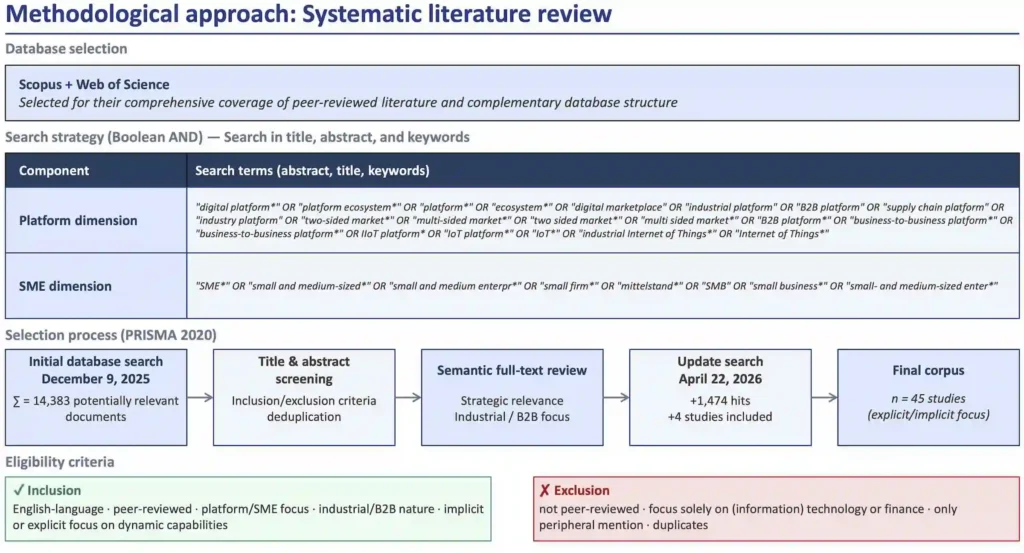
The following analysis is based on a focused synthesis of relevant literature. Key articles for the theoretical and empirical classification of the identified barriers are cited as examples.
The threefold barrier to SME platform adoption
Sensing: Blind spots hinder ecosystem awareness
In the B2B collaboration context, there is little transparency regarding platform ecosystems. SMEs frequently do not know which platforms exist or how participation can be organized in practice [9]. While large companies have in many cases established systematic ecosystem monitoring [2], SMEs frequently lack structured scanning routines. In addition, the operational involvement of senior management can limit the scope for strategic technology monitoring [10]. Cognitive path dependencies further reduce the perception of external innovation opportunities in favor of established internal development models [11, 12].
Seizing: Fear of knowledge drain
Even when SMEs are aware of collaboration platforms, they often do not adopt them. Innovation platforms require the disclosure of technical information, production data, and collaborative development processes. SMEs fear that this knowledge may be absorbed by competitors or more powerful platform partners [12].
Furthermore, many platforms are orchestrated by large companies that define standards and control access conditions. This creates uncertainties for SMEs regarding bargaining power, data usage, and the distribution of value [2, 4]. At the same time, integration into platform ecosystems increases organizational complexity through data management and the expansion of expertise and processes [2]. The often difficult-to-quantify benefits and returns of platform-based collaboration further increase uncertainty about the actual value created its fair distribution [2].
Reconfiguring: Organizational inertia hinders adaptation
Platform participation requires far-reaching organizational adjustments. Innovation processes in SMEs are often internally oriented [13], while external cooperation is predominantly bilateral and project-based. This “closed innovation” logic is difficult to reconcile with open platform practices [14].
Platform ecosystems also create interdependencies: standards, development processes, and innovation cycles are increasingly coordinated on a network basis. Autonomy-oriented SMEs, in particular, may perceive this as a loss of control [12]. At the same time, they often lack the human and financial capital [15] needed to build expertise in data management, multi-stakeholder collaboration, and platform governance, or to internalize complementary expertise [9, 16]. In particular, the subjectively high perception of adoption barriers can amplify their reciprocal effects [2].
Capability building as a path to platform readiness
Sensing: Institutionalizing ecosystem scanning
SMEs can establish regular “ecosystem reviews”: structured analyses of relevant Industry 4.0 platforms or innovation hubs, institutionalized as a top management responsibility. Mittelstand-Digital centers offer free consulting and best-practice workshops for this purpose, while industry consortia serve as intermediaries. Limited pilot projects without full system integration enable learning by doing with reduced risk.
Seizing: Selective and strategic participation
SMEs can selectively open up specific areas of innovation for collaboration (e.g., digital services), while keeping the development of core products in-house. This “modular participation strategy” reduces IP risks. Before participating, clear sharing boundaries should be defined and IP assessments conducted. At the same time, governance skills can be practiced in such a “sandbox”-setting: understanding platform terms of service, negotiating data usage rights. Additionally, SMEs can join cooperative models to pool bargaining power and reduce individual risks [1, 17]. Reliable participation can strengthen a firm’s reputation within the platform ecosystem and partly mitigate power asymmetries through reciprocity [18].
Reconfiguring: Ambidexterity between closed and open innovation
Platforms expand internal capabilities rather than replacing them. Open innovation therefore enables access to complementary knowledge and accelerated problem-solving [19]. Successful platform participation requires hybrid innovation models that combine the protection of core competencies with external collaboration [5, 20]. Training in data management, collaboration skills, IP management, and partner management can support the development of absorptive capacity [21]. In addition, an “ecosystem manager” can coordinate across R&D, IT, legal, and executive management in an interdisciplinary role.
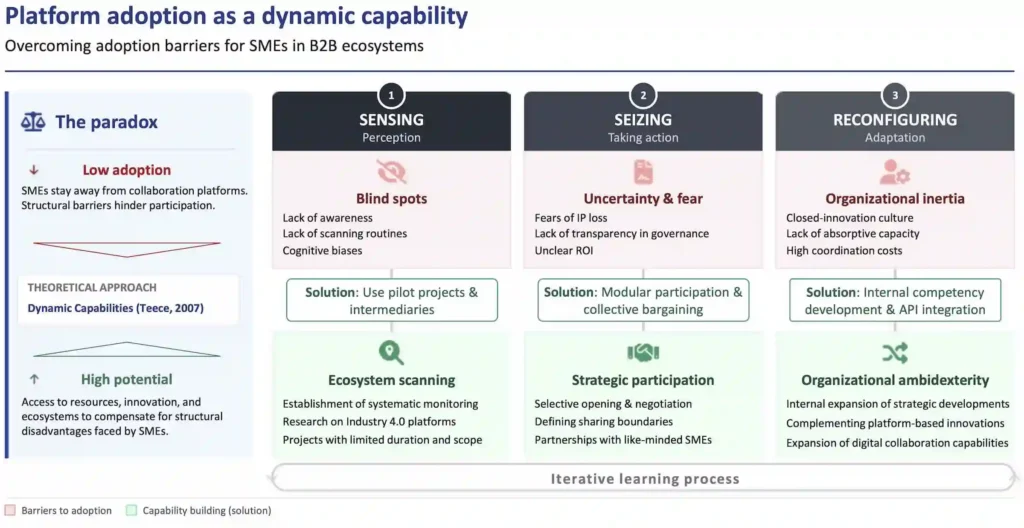
Based on the identified barriers, a capability-based framework can be derived (Fig. 2). Capability building is an iterative learning process: Sensing is refined through seizing experiences, while Seizing is facilitated by successful Reconfiguring measures.
Platform operators, in turn, should establish SME-friendly governance (modular participation options, transparent IP regulations). Policymakers can provide additional support through digitalization vouchers, awareness campaigns, and intermediaries [22].
From barriers to capabilities: Platform adoption as a learnable competency
Based on a systematic literature review, this article examines why SMEs often refrain from adopting digital collaboration platforms despite their substantial advantages. The analysis reveals consistent barriers across all DC dimensions. It turns out that SMEs do not adopt collaboration platforms because they are constrained in three ways: they fail to recognize ecosystem opportunities (Sensing), are reluctant to participate (Seizing), and struggle with organizational adaptation (Reconfiguring).
These barriers reflect deficits in dynamic capabilities and can therefore, in principle, be developed. By focusing on adoption barriers, this paper contributes to DC research. The capability-building framework provides SMEs a structured roadmap for strategic participation in platform ecosystems: establish ecosystem scanning, launch selective pilot participation, and implement hybrid innovation models. As a conceptual paper, this analysis is based on a synthesis of existing literature — empirical validation is still pending. Future research should shift the focus more explicitly and in a generalizable manner to adoption barriers in order to develop and evaluate effective interventions.
This article was produced as part of the “PLATIN-STRAT-KMU” project, which is funded by the German Federal Ministry of Research, Technology, and Space under grant number 02J24A120.
The original German version of this article can be accessed via DOI: 10.30844/I4SD.26.4.5
Bibliography
[1] Arnold, L.; Hukal, P.; Link, M.: Consortium Governance and Market Entry of Digital B2B Platforms: The Case of ADAMOS. In: Information Systems Journal 35 (2025) 4, pp. 1235–1256. DOI: https://doi.org/10.1111/isj.12580.[2] Marzi, G.; Marrucci, A.; Vianelli, D.; Ciappei, C.: B2B Digital Platform Adoption by SMEs and Large Firms: Pathways and Pitfalls. In: Industrial Marketing Management 114 (2023), pp. 80–93. DOI: https://doi.org/10.1016/j.indmarman.2023.08.002.
[3] Teece, D. J.: Explicating dynamic capabilities: the nature and microfoundations of sustainable enterprise performance. In: Strategic Management Journal 28 (2007) 13, pp. 1319–1350. DOI: https://doi.org/10.1002/smj.640.
[4] Schreieck, M.; Wiesche, M.; Krcmar, H.: Governing innovation platforms in multi-business organizations. In: European Journal of Information Systems 32 (2023) 4, pp. 695–716. DOI: https://doi.org/10.1080/0960085X.2022.2041371.
[5] Asadullah, A.; Faik, I.; Kankanhalli, A.: Can Digital Platforms Help SMEs Develop Organizational Capabilities? A Qualitative Field Study. ICIS 2020 Proceedings (2020) 12. URL: https://aisel.aisnet.org/icis2020/sharing_economy/sharing_economy/12, accessed June 11, 2026.
[6] Warner, K. S. R.; Wäger, M.: Building dynamic capabilities for digital transformation: An ongoing process of strategic renewal. In: Long Range Planning 52 (2019) 3, pp. 326–349. DOI: https://doi.org/10.1016/j.lrp.2018.12.001.
[7] Page, M. J.; McKenzie, J. E.; Bossuyt, P. M.; Boutron, I.; Hoffmann, T. C. et al.: The PRISMA 2020 statement: an updated guideline for reporting systematic reviews. In: BMJ 372 (2021), n71. DOI: https://doi.org/10.1136/bmj.n71.
[8] Mayring, P.: Qualitative Inhaltsanalyse. In: Flick, U.; Kardoff, E. von; Keupp, H.; Rosenstiel, L. von; Wolff, S. (eds.): Handbuch qualitative Forschung: Grundlagen, Konzepte, Methoden und Anwendungen. Munich 1991, pp. 209–213. URL: https://nbn-resolving.org/urn:nbn:de:0168-ssoar-37278, accessed 11.06.2026.
[9] Hansen, A. K.; Christiansen, L.; Lassen, A. H.: “Technology Isn’t Enough for Industry 4.0: On SMEs and Hindrances to Digital Transformation.” In: International Journal of Production Research 63 (2025) 18, pp. 6585–6605. DOI: https://doi.org/10.1080/00207543.2024.2305800.
[10] Hafeez, S.; Shahzad, K.; De Silva, M.: Enhancing digital transformation in SMEs: The dynamic capabilities of innovation intermediaries within ecosystems. In: Long Range Planning 58 (2025) 3, 102525. DOI: https://doi.org/10.1016/j.lrp.2025.102525.
[11] Marzi, G.; Fakhar Manesh, M.; Caputo, A.; Pellegrini, M. M.; Vlačić, B.: Do or do not. Cognitive configurations affecting open innovation adoption in SMEs. In: Technovation 119 (2023), 102585. DOI: https://doi.org/10.1016/j.technovation.2022.102585.
[12] Huo, H.; Ioniță, D.; Onișor, L.-F.; Stancu, A.: Digital Empowerment: How Small B2B Companies Remodel the Value Chain Through Digital Platforms. In: Journal of Business-to-Business Marketing 31 (2024) 4, pp. 385–403. DOI: https://doi.org/10.1080/1051712X.2024.2354708.
[13] Spithoven, A.; Vanhaverbeke, W.; Roijakkers, N.: Open innovation practices in SMEs and large enterprises. In: Small Business Economics 41 (2013) 3, pp. 537–562. DOI: https://doi.org/10.1007/s11187-012-9453-9.
[14] Van de Vrande, V.; Jong, J. P. J. de; Vanhaverbeke, W.; Rochemont, M. de: Open innovation in SMEs: Trends, motives, and management challenges. In: Technovation 29 (2009) 6–7, pp. 423–437. DOI: https://doi.org/10.1016/j.technovation.2008.10.001.
[15] Heider, A.; Hülsbeck, M.; Schlenk-Barnsdorf, L. von: The role of family firm-specific resources in innovation: an integrative literature review and framework. In: Management Review Quarterly 72 (2022) 2, pp. 483–530. DOI: https://doi.org/10.1007/s11301-021-00256-3.
[16] Jiang, H.; Yang, J.; Gai, J.: How digital platform capability affects the innovation performance of SMEs—Evidence from China. In: Technology in Society 72 (2023), 102187. DOI: https://doi.org/10.1016/j.techsoc.2022.102187.
[17] Renna, P.: Negotiation policies and coalition tools in an e-marketplace environment. In: Computers & Industrial Engineering 59 (2010) 4, pp. 619–629. DOI: https://doi.org/10.1016/j.cie.2010.07.007.
[18] Jacobides, M. G.; Cennamo, C.; Gawer, A.: “Towards a theory of ecosystems.” In: Strategic Management Journal 39 (2018) 8, pp. 2255–2276. DOI: https://doi.org/10.1002/smj.2904.
[19] Xie, X.; Wang, H.: How can open innovation ecosystem modes drive product innovation? An fsQCA analysis. In: Journal of Business Research 108 (2020), pp. 29–41. DOI: https://doi.org/10.1016/j.jbusres.2019.10.011.
[20] Hao, Y.; Shamsuzzoha, A.; Helo, P.: An enterprise system virtual factories platform for a collaborative business environment. In: 2014 IEEE International Conference on Industrial Engineering and Engineering Management. Selangor 2014, pp. 1476–1480. DOI: https://doi.org/10.1109/IEEM.2014.7058884.
[21] Jun, W.; Nasir, M. H.; Yousaf, Z.; Khattak, A.; Yasir, M. et al.: Innovation performance in the digital economy: Do digital platform capability, improvisation capability, and organizational readiness really matter? In: European Journal of Innovation Management 25 (2022) 5, pp. 1309–1327. DOI: https://doi.org/10.1108/EJIM-10-2020-0422.
[22] Xie, X.; Han, Y.; Anderson, A.; Ribeiro-Navarrete, S.: Digital platforms and SMEs’ business model innovation: Exploring the mediating mechanisms of capability reconfiguration. In: International Journal of Information Management 65 (2022), 102513. DOI: https://doi.org/10.1016/j.ijinfomgt.2022.102513.
Your downloads
Potentials: Services
You might also be interested in