Increasing Supply Chain Resilience with Reverse Logistics |
Hypotheses for a value model

| Journal | Industry 4.0 Science |
| Issue | Volume 41, 2025, Edition 1, Pages 34-40 |
| Bibliography | Share | Cite | Download |
Abstract
Keywords
Article
The circular economy is an umbrella term for a broad range of sustainability initiatives put into place by manufacturing companies [1]. For example, the bearing, seal and lubricant manufacturer SKF reduces emissions and resource consumption throughout the product’s life cycle by using recycled steel and reprocessing old bearings and lubricating oils in production or in service [2].
Another example, from the adhesives industry, demonstrates how suppliers are also developing solutions to facilitate their customers’ circular economy: Removable adhesive bonds help to reduce waste, allowing for the recycling of raw materials and for repairs and upgrades. These case studies provide an insight into some of the many ways in which focusing on the circular economy can create benefits for companies.
Circular economy models are based on several building blocks, one of which is reverse logistics. Following the broad definitions of the Reverse Logistics Executive Council and other sources, this is a deproduction process for planning, implementing and controlling the material flow from the point of consumption back to the point of material creation with the aim of recovering recyclable materials or facilitating clean disposal [3]. This is not just limited to recycling, because material cycles are also closed and natural resources conserved by extending the product’s life cycle and reusing, repairing and refurbishing old products [4].
Sustainability and uncertainty pressure companies to act
Current trends in EU market regulation are increasing the pressure on established production companies to consider reverse logistics. These trends are reflected in the ESG guidelines for reducing resource consumption and emissions as well as requirements for the reparability of products and the avoidance of scrapping [5]. Although implementing these requirements presents companies with considerable challenges, the acceptance of such measures can be increased if additional associated potentials can be identified, quantified and addressed in a targeted manner.
Current research points to a connection between reverse logistics and resilience [6-9]. Supply chain resilience refers to the ability to anticipate and react flexibly to a variety of recurring supply chain shocks. In the global business world, characterized by uncertainty and crises, resilience is a significant competitive factor. It reduces the probability of occurrence and the impact of such shock-like crises and enables a rapid return to the old or an improved operating state in the aftermath. However, despite the pressure to act, the complexity of the concept makes it almost as difficult to build resilience as it is to increase sustainability [10, 11].
The aim of this article is to show how reverse logistics can affect the resilience of supply chains. Directed at decision-makers in companies, a hypothesis-based value model illustrates the quantifiable benefits.
A need for research on the quantifiable impact of resilience measures
This study benefits from the fact that several research fields and modern management concepts deal extensively with the development and strategic anchoring of sustainability and resilience [12]. The concept of reverse logistics as a building block of green supply chain management and its effects on cost, time, quality, innovation and flexibility are also generally well-researched [3], as well as approaches for the systematic development of resilience-enhancing measures and their sustainable safeguarding [11]. Nevertheless, there are gaps in research when it comes to a concrete and comprehensive understanding of the quantifiable impact of individual resilience measures. Research is particularly lacking at the points of intersection between resilience and sustainability [10, 12].
This research project, which includes an assessment of the benefits of sustainability measures as part of corporate strategy, gathers expertise on associated challenges and solutions [13]. The adaptation of the approach to focus on reverse logistics as a sustainability and resilience measure results in a hypothesis-based classification of the relationship between reverse logistics and various principles of resilience as well as a downstream collection of value drivers for these principles. The empirical basis for assessing the correlations and determining the value drivers is formed by statements from 16 semi-structured expert interviews conducted by the authors on the topics of sustainability as a corporate purpose [13] and supply chain resilience [11].
Hypotheses for the model – Supply chain resilience with reverse logistics
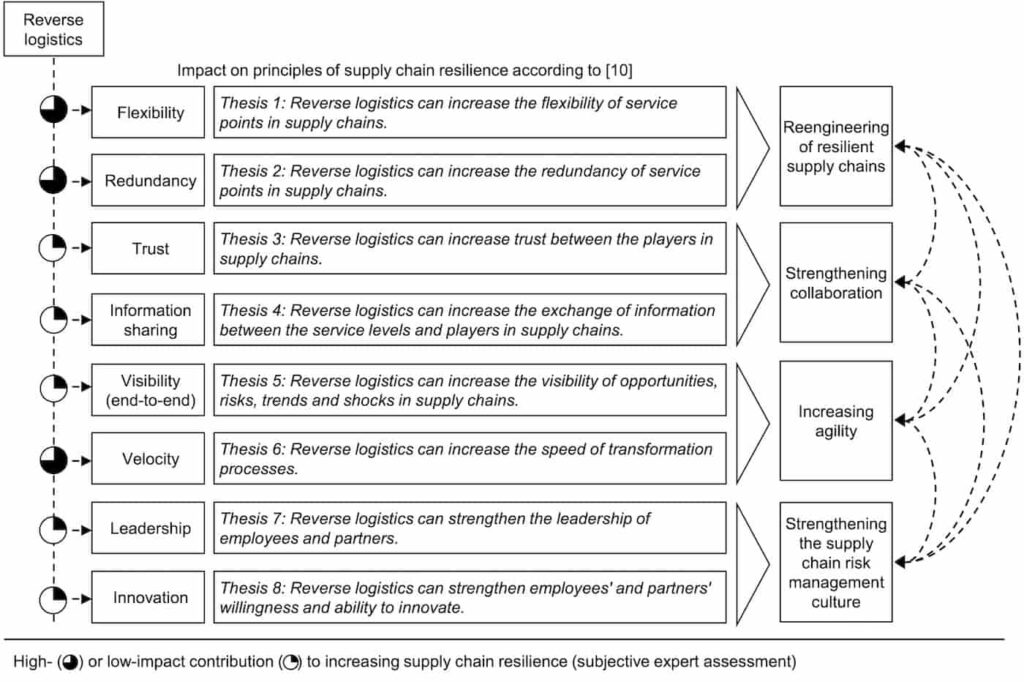
The structure of the model is based on an enhanced model by Kamalahmadi and Parast for structuring supply chain resilience. This model divides resilience into four fields of action: supply chain reengineering, collaboration, agility and supply chain risk management culture, as well as the associated principles of flexibility, redundancy, trust, information sharing, visibility, velocity, leadership and innovation. The model aims to structure resilience and its associated research and present it holistically. The principles of the model are interdependent, which in turn is an object for the research [10].
As part of the hypothesis generation process, the contribution of reverse logistics to the resilience principles was analyzed and discussed with experts (Figure 1). The experts provided a subjective assessment as to whether reverse logistics make a major or only a minor contribution to strengthening the principle compared with other resilience measures. After evaluating the interviews, the most frequent assessment was taken as the result.
The analysis shows that, according to the experts, reverse logistics can make a major contribution to increasing flexibility, redundancy and velocity of action in supply chains. The other sub-principles were recognized by the experts as relevant and should therefore not be discarded. However, the impact on these was assessed as minor and indirect, as it is difficult to prove and the influence of other factors on the principles may dominate.
Increasing flexibility and redundancy
Building resilience requires the reconfiguration of supply chains into networks of redundant, flexible service points [10, 11]. One reason for the potentially high contribution of reverse logistics to flexibility and redundancy is that the return of products or the reprocessing of recycled materials can introduce new sources of supply for raw materials.
The resulting redundancies in procurement can be activated with contingency plans in the event of a crisis, for example if unreliable standard suppliers fail [11]. According to experts, companies can also benefit from: increased flexibility based on low-cost stocks of recycled components; differentiation potential in the product range with regard to the quality of the material used; or the ability to rework cost-effectively and on demand in flexible and reversible production processes.
Strengthening trust and information sharing
Resilience and efficiency have increased in reconfigured supply chains due to a high degree of collaboration. The willingness to respond collaboratively to disruptions across organizations is associated with the resilience principles of trust and information sharing [7, 10]. Sustainable action has a positive effect on the success of collaboration in supply chains [13], as focusing on a common goal and sharing common values creates synergies [1]. Reverse logistics, as a sustainability measure, can thus help to unify.
In addition, the sustainable use of resources can create security benefits that function as an indicator of resilience [14] and increase trust across organizations. With the reversal of the material flow, reverse logistics also require a reversal of the upstream or accompanying information flow. This backward-looking exchange of information can improve the joint optimization and synchronization of processes as well as the ability to forecast the robustness of the supply chain against volatilities and shocks [10, 14].
Increasing visibility and velocity
The resilience-related ability to return quickly and better from crises is linked to the field of agility. It is based on the principles of visibility and velocity and aggregates various change capabilities [10, 11]. Reverse logistics can increase end-to-end visibility in the supply chain through an improved exchange of information. Structured information packages are exchanged, for example, about order situations, processing problems and impending crises. This provides supply chain players with the relevant information before, during and after a disruption [10].
Early reactions to anticipated changes in transparent supply chains are an indicator for velocity of action. Velocity also benefits from flexible and adaptable structures that promote rapid change. Examples include the option of reducing stocks of end products and intermediate products as well as synergies with external partners that can reduce investment requirements [11, 14].
Strengthening leadership and innovation
For the development of resilience to be needs-based and efficient, the right conclusions must be drawn in companies. The field of risk management culture, which is based on leadership and innovation performance, is of great importance for the introduction of the right resilience measures. Sustainability-oriented strategies in corporate management can have a meaningful and motivating influence on employees’ willingness to perform and change [9, 13].
Reverse logistics can provide a basis for implementing such strategies. This can help employees to independently anticipate and react to risks along the supply chain or actively support innovation activities within the company [10]. On this point, some experts emphasize the potential innovation-promoting effect of the circular economy, especially for new service and business models as well as for sustainable supply chain structures.
Value model for determining benefits for companies
The model provides an overview of possible dimensions of supply chain resilience that can be strengthened through reverse logistics. From an economic point of view, implementation should be made dependent on whether the benefits that can be determined justify the expected costs of the measure [3]. The model summarizes the potential of the principles strengthened by reverse logistics in the three resilience phases of normal operation, crisis and return from crisis. Determining the potential for crisis phases is particularly opportune due to uncertainties at the time of occurrence. Figure 2 shows an excerpt of the relevant variables for resilience-related benefit values derived from this research work.
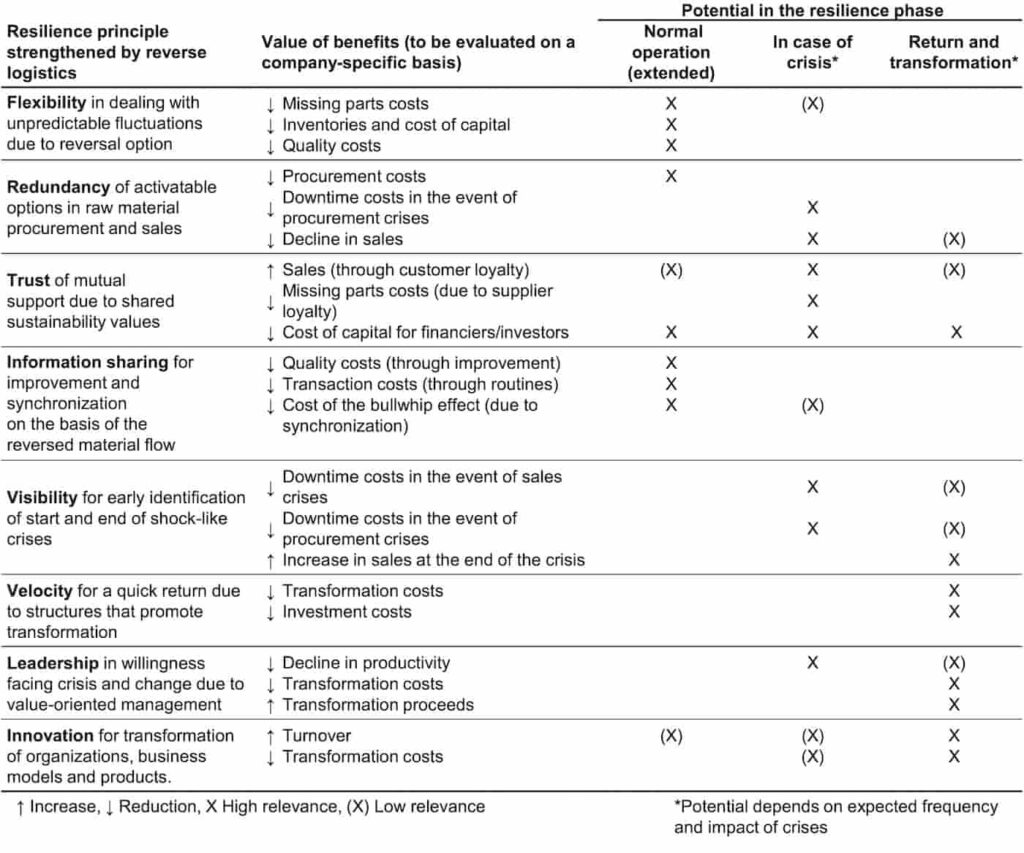
The benefit of increased flexibility in the supply chain is reflected in a more efficient normal state, which reduces recurring missing parts, inventory and capital costs as well as quality costs by avoiding scrapping. Underlying redundancies in procurement and the product range can also reduce procurement costs and mitigate the consequences of crises such as production downtime and declining sales.
The trust fostered between suppliers, customers and investors is particularly valuable in the event of a crisis. It not only enables better purchasing conditions but also extends suppliers’ ability to deliver and reduces the capital costs of crisis financing. At times of normal operation, the sharing of information required for collaboration helps to reduce costs associated with quality, transaction and the bullwhip effect. By synchronizing the supply chain, inventories, order postponements and missing parts can be minimized and efficiency increased.
The main benefit of increased visibility can be found in the early detection of sales or procurement crises, allowing their effects to be reduced in a targeted manner. Visibility about the resolution of crises also enables a rapid increase in sales in the return phase. Velocity, supported by structures and partnerships that promote transformation, plays a key role in this and helps to reduce transformation and investment costs.
Strengthened leadership in the management of employees and partners can be a decisive success factor in the event of a crisis. Its benefits can be seen in the reduction of productivity decline and the level of transformation costs and revenues when returning to an improved state. Innovation also plays a central role in increasing sales and reducing costs during the transformation of organizations, business models and products in the return phase.
Companies should quantitatively determine the benefits, especially for the principles of flexibility, redundancy and velocity, which can potentially be influenced strongly by reverse logistics. The value model does not consider resilience-independent sales potential through higher pricing capability, differentiation, portfolio expansion, new business models or greater vertical integration, as well as sustainability-related benefits such as the reduction of energy costs or CO2 emissions. These potentials can have a complementary effect.
The expenses associated with the benefits depicted in the value model can be one-off or ongoing. According to experts, one-off expenses include transaction costs and investments in setting up new and redundant supply chain structures as well as in product and process development. Ongoing costs include management and operating costs for reverse logistics structures. Opportunity costs for alternative supply chain structures and business models, for example due to lost economies of scale, can supplement the cost calculation.
The value model can serve as the basis for a quantified cost-benefit calculation but has limitations. Firstly, the model does not claim to be comprehensive and not all parameters are relevant for all companies. Secondly, as mentioned above, there may be other benefits that are independent of resilience. Thirdly, resilience can also be increased by other measures that are not entirely additive to reverse logistics. The model should be tested, validated and improved in further research. As an open concept, the current draft provides a basis for discussion within companies and between research and practice.
An orientation framework for potential benefits
This article describes the structure of a hypothesis-based value model for quantifying the benefits of reverse logistics in various dimensions of supply chain resilience. Due to the complexity of the concepts and dependencies, the values must always be determined and discussed on a company-specific basis. The model serves as an orientation framework of potential benefits for the purpose of strategic management and can be evaluated alongside the associated expense in the context of cost-benefit analyses. Implementation should be in line with the company’s overarching sustainability strategy [13]. Considering the practical relevance, empirical validation of the model and its potential is an important starting point for further research.
This article was written as a follow-up to the “Return on Purpose” project, which was funded by the Federal Ministry for Economic Affairs and Climate Protection under the reference IGF 22338 N, as well as an accompanying doctoral project in the field of flexibility-oriented vertical integration.
Bibliography
[1] Opferkuch, K.; Caeiro, S.; Salomone R.; Ramos T.: Circular economy disclosure in corporate sustainability reports: The case of European companies in sustainability rankings. In: Sustainable Production and Consumption 32 (2002), pp. 436-456.[2] SKF: Life with less friction: Annual Report 2023. URL: investors.skf.com/sites/skf-ir/files/pr/202403039498-1.pdf, accessed 06.01.2025.
[3] Sarkis J.: Green Supply Chain Management, 1st edition. New York 2014.
[4] Yamaguchi, S.: Securing reverse supply chains for a resource efficient and circular economy. In: OECD Trade and Environment Working Papers 02 (2022).
[5] European Commission: Kommission begrüßt politische Einigung über neue Verbraucherrechte für einfache und günstige Reparaturen. Brussels 2024.
[6] Bag S.; Gupta S.; Foropon C.: Examining the role of dynamic remanufacturing capability on supply chain resilience in circular economy. In: Management Decision 57 (2019) 4, pp. 863-885.
[7] Saffari H.; Abbasi M.; Gheidar-Kheljani J.: A robust, sustainable, resilient, and responsive model for forward/reverse logistics network design with a new approach based on horizontal collaboration. In: Environ Dev Sustain (2023), pp. 1-44.
[8] Govindan K.; Soleimani H.; Kannan D.: Reverse logistics and closed-loop supply chain: A comprehensive review to explore the future. In: European Journal of Operational Research 240 (2015) 3, pp. 603-626.
[9] Negri M.; Cagno E.; Colicchia C.; Sarkis J.: Integrating sustainability and resilience in the supply chain: A systematic literature review and a research agenda. In: Business Strategy and the Environment 30 (2021) 7, pp. 2858-2886.
[10] Kamalahmadi M.; Parast M.: A review of the literature on the principles of enterprise and supply chain resilience: Major findings and directions for future research. In: International Journal of Production Economics 171 (2016) 1, pp. 116-133.
[11] Wenig C.; Amann A.; Wölflick M.: Resilienz in globalen Produktionsnetzwerken: Ein theoretischer Orientierungsrahmen für die Integration und nachhaltige Sicherung. In: Zeitschrift für wirtschaftlichen Fabrikbetrieb 119 (2024) 5, pp. 171-175.
[12] Florez Jiménez M.; Muñoz Villamizar A.; Lleo A.: Exploring the Relationship between Sustainability, Resilience, and Purpose in the Context of Corporations: A Comprehensive Literature Review. In: SSRN Electronic Journal (2021).
[13] Hamann J.; Ettner J.; Heymann S.: Corporate Purpose als Leitlinie zur Realisierung der UN-Nachhaltigkeitsziele. In: Industry 4.0 Science 40 (2024) 1, pp. 37-43.
[14] Singh C.; Soni G.; Badhotiya G.: Performance indicators for supply chain resilience: review and conceptual framework. In: Journal of Industrial Engineering International 15 (2019) 1, pp. 105-117.
Potentials: Globalization
Solutions: Logistics Logistics Technology
You might also be interested in