
Enabler for the Digital Twin |
Requirements for Technical Documentation 4.0

| Journal | Industry 4.0 Science |
| Issue | Volume 41, 2025, Edition 4, Pages 76-85 |
| Bibliography | Share | Cite | Download |
Abstract
Keywords
Article
The implementation of digital twins in industry is progressing steadily [1]. For machines and plants, it is essential that the digital twin reflects their real-time state, including hierarchical component structures [2]. This requirement is challenging to achieve due to the heterogeneous corporate landscape in mechanical and plant engineering [3]. The growing complexity of cyber-physical systems (CPS) and production systems (CPPS) further results in an extensive network of suppliers and integrators involved in system development.
Creating documentation is correspondingly challenging, as it must account for a wide variety of system components and numerous participants. Although legal guidelines, norms, and standards exist [4], companies are largely free to structure their documentation within this framework. However, this historically evolved heterogeneity of technical machine and plant documentation contradicts the goal of interoperability in the context of Industry 4.0 [5]. Due to the growing number of software components, digital services and applications increasingly depend on valid plant and data structures [6]. Inconsistent technical documentation (TD) therefore poses a challenge for ensuring seamless integration, data consistency, and interoperability across systems.
Dynamic technical documentation as a key requirement in Industry 4.0
The situation described above requires a fundamental rethinking of the creation, provision, and maintenance of technical documentation (TD) and its role in production systems. Traditionally, documentation was created once and then delivered to the customer [7]. However, with the increasing dynamism of production in the context of Industry 4.0, this approach is changing. Machines and systems are continuously adapted to meet the requirements of increasingly diverse and complex product portfolios, often undergoing design modifications.
The networking of production enables a wide range of services such as predictive maintenance and spare parts management. In this context, up-to-date TD is not only useful for digital twins but also essential for plant operators to maintain compliance throughout the entire life cycle. Against this backdrop, a paradigm shift from static to dynamic TD is necessary.
This article analyzes existing standards and proposes a holistic documentation framework designed to meet the requirements of Industry 4.0. The aim of the article is to present a concept, discuss its potential applications, and encourage active participation and interdisciplinary exchange.
Technical documentation in transition
There are ongoing standardization activities related to TD. These activities are outlined and categorized below, distinguishing between guidelines and implementations.
What rules must be observed?
In the EU, the requirement to create TD primarily stems from the provisions of the Product Liability Act and, in mechanical and plant engineering, from the Machinery Directive, which will be replaced by the Machinery Directive 2027 [4]. This regulation serves as the basis for all TD-related activities. It also defines the framework for the declaration of conformity. The revised version explicitly permits the transfer of TD in digital form. An overview of the documents required under this regulation, along their classification throughout the product life cycle, can be found in VDI 4500 Sheet 1:2006 [8].
This is accompanied by an overview of the harmonized standards applicable within the scope of this regulation [9]. The Machinery Regulation specifies the elements of technical documentation and the specific information that must be included. In addition, harmonized standards define further requirements for specific areas of application. Although the application of harmonized standards during development is voluntary, they serve as an important reference for the current state of the art.
The mandatory risk assessment and associated risk reduction measures are defined in DIN EN ISO 12100:2012 [10], which serves as the fundamental safety standard among the harmonized standards. More specific requirements are provided by safety standards and machine safety standards. DIN EN IEC/IEEE 82079-1:2021 specifies detailed content requirements for preparing operating instructions, which are considered the most important document for plant operators [11]. A 2015 comprehensive summary of standards and guidelines for TD can be found in [12].
What approaches already exist for technical documentation?
In addition to legal requirements and the resulting necessary information objects, several specific technical implementations, solutions, and procedures exist that influence TD and its structuring. At data level, the markup language XML is commonly used for content structuring [13, 14, 15]. XML enables the separation of content from layout, facilitating content reuse and publication of TD across different media formats. Some TD structuring standards are based on XML, such as the metadata model defined in VDI 2770 Sheet 1:2020 [16].
Similarly, the Darwin Information Typing Architecture (DITA) provides an XML Document Type Definition (DTD) and defines document design principles [17]. DITA’s primary goal is to achieve content reusability across three dimensions: content design, and process. This is done by referencing the respective information modules. DITA focuses on the creation and delivery phases of the technical documentation lifecycle.
The Multimedia Machine Information System (mumasy) is another XML-based schema for TD, standardized and maintained by the VDMA [18]. However, its current version, which dates back to 2006, does not reflect the technical advancements of the last 20 years, including the emergence of Industry 4.0.
XML-based data exchange formats such as AutomationML [7] and HTML [13] are also used in technical plant documentation, offering similar properties to XML.
The Intelligent Information Request and Delivery Standard (iiRDS) is another standard for structuring TD [19]. The aim is to create an ontology-based standard for the exchange of usage information and compatibility with VDI 2770. The iiRDS standard emphasizes the structured extraction and definition of metadata.
Another standardization initiative for describing factories and plants is the Equipment Behavior Catalog (EBC) [20], which focuses on describing plant behavior but also incorporates their properties.
In recent years, the Asset Administration Shell (AAS) has gained increasing importance as a digital twin (DT) standard, formalized in IEC 63278 [21]. The Industrial Digital Twin Association (IDTA) is advancing AAS content specifications through the development and publication of submodel templates (SMTs) [22]. The SMT most relevant to TD is “IDTA 02004—Handover Documentation” [23], which adapts the VDI 2770 metadata model an AAS-compliant representation and focuses on the plant handover phase.
A further relevant SMT, “IDTA 02003—Generic Frame for Technical Data for Industrial Equipment in Manufacturing,” targets basic technical data of a plant or component without direct reference to specific technical documents [24]. However, this data, such as the “ManufacturerName,”, can be referenced in the respective technical documents, ensuring a single source of truth within equipment documentation while maintaining modularity and separation between structure and content.
Other relevant SMTs include “IDTA 02006—Digital Nameplate for Industrial Equipment” and “IDTA 02011—Hierarchical Structures enabling Bills of Material” [25, 26]. The latter provides a standardized structure for modeling a plant or even an entire production system. A common characteristic of all SMTs is that they describe structures for individual information points but do not link them to corresponding documents or describe the structure of the documents themselves. One advantage of AAS is its widespread use and integration into various data ecosystem projects [27].
Interoperable TD requires not only uniform guidelines and structures but also consistent terminology. The two central standards in this context are ECLASS and IEC CDD (Common Data Dictionary) [28, 29]. A reference to the respective dictionary and the entry therein ensures that data can be clearly identified.
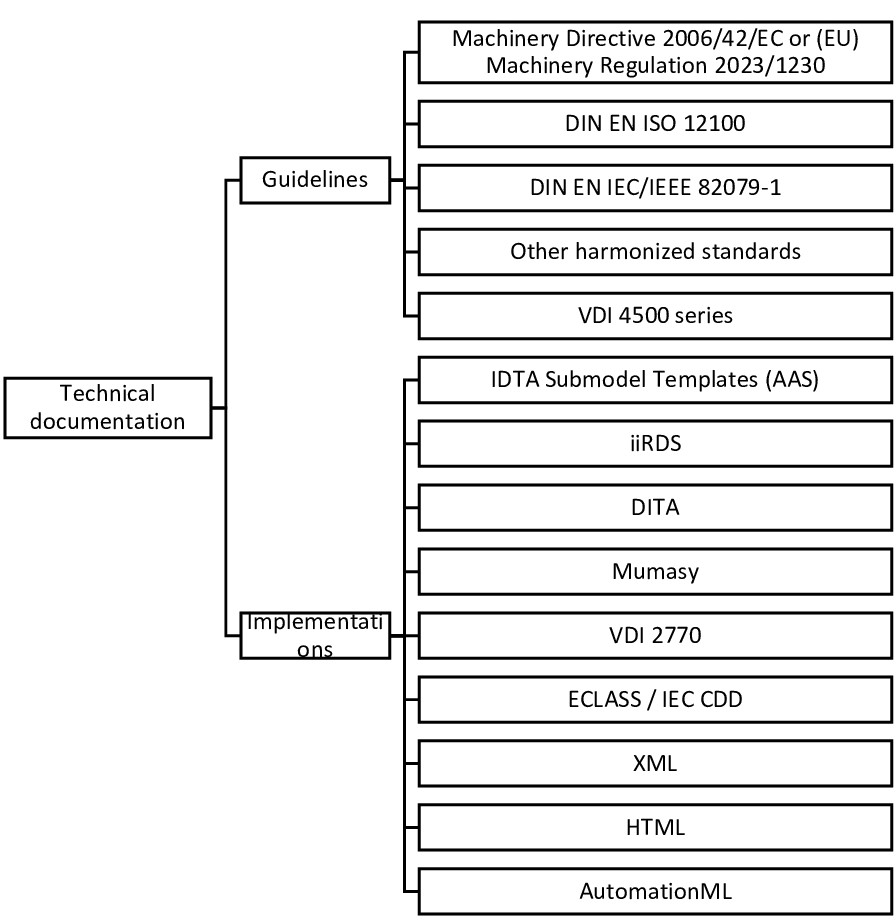
Despite significant ongoing activities in TD, no single standard has yet emerged as dominant. The application of mumasy, for example, remains complex [30], a challenge also evident in linking activities described in [31, 32].
Most standards address specific problems and thus represent isolated solutions. A holistic approach to technical documentation is still missing.
Figure 1 provides an overview of key guidelines and implementations.
While not exhaustive, the figure highlights the central standards, regulations and implementations that are currently shaping the field.
Presentation of the documentation concept
What requirements must technical documentation 4.0 fulfill?
Technical documentation (TD) must meet several requirements in the context of Industry 4.0. These mandatory criteria were derived from the core characteristics of digital twins and TD during a workshop conducted prior to the underlying research project.
Despite the heterogeneous nature of information landscape, TD must provide complete coverage at both the component and system levels to guarantee comprehensive system describability. Furthermore, to support interoperability, TD content for each CPS component must remain consistent across manufacturers. From a regulatory perspective, TD must ensure conformity and guarantee it throughout the entire life cycle.
Another key requirement for TD is its applicability in the creation and maintenance of information. Only when data can be integrated into the editorial process at the time of its creation can a transparent and redundancy-free process be ensured. The increasing networking of production also emphasizes the need to leverage generated data profitably. Accordingly, TD must support the use of data for service functions such as predictive maintenance. Finally, once a DT has been defined, bidirectional data exchange must start automatically, making automation an essential aspect of TD processes. Data collection and processing, as well as the creation and updating of TD, must rely on automated workflows.
After evaluating the literature and expert consultations, it can be concluded that the requirements described are only partially met. The guidelines and standards primarily address completeness, uniformity, and conformity by providing the legal framework and defining the information required for TD. For example, the Machinery Directive only partially fulfills the requirement of completeness, as it refers to harmonized standards. The structuring standards presented take a step toward applicability and automatability.
XML and AutomationML can be used to describe information that is not defined itself, which means that completeness and conformity are not a priority. The dictionaries of ECLASS and IEC CDD are characterized by their high degree of uniformity and automation. AAS already meets many requirements, particularly through the ongoing standardization of its structures and interfaces. However, in the current SMTs, documents are still regarded as static elements, resulting in information redundancy relative to the referenced asset data.
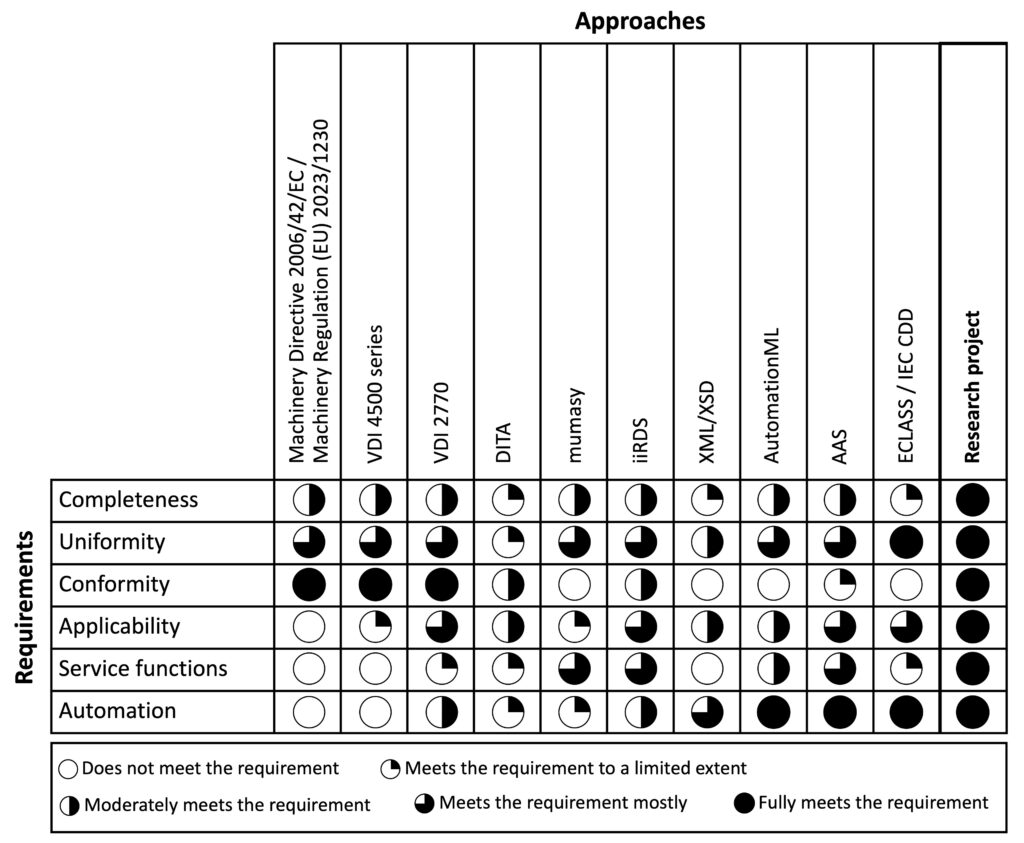
Figure 2 shows a qualitative assessment of how the approaches discussed meet the requirements using Harvey Balls. This highlights the need for a universal documentation scheme capable of adequately fulfilling these requirements.
Unlike the approaches presented, such a scheme would be designed for broad applicability, including adoption by SMEs.
The proposed schema is to be developed in coordination with industry partners, for example, as an XML Schema Definition (XSD) or as a SMT within the AAS.
This approach leverages synergies with existing activities and enables dynamic and redundancy-free documentation creation based on information contained in digital images.
How is a holistic documentation scheme created in the context of Industry 4.0?
To meet the outlined requirements for TD 4.0, a systematic development approach was initiated as part of this article. The process began by identifying key gaps in existing norms and standards. Building on this, an interview study was conducted to capture practical framework conditions within companies. This allows for systematic documentation of company-specific requirements and the current state of TD practices. These findings form the basis for the methodological development of a comprehensive documentation scheme.
In the subsequent project phases, common content management systems (CMS) will be analyzed, and their capabilities evaluated against the requirements of Industry 4.0. In the context of TD creation, CMS offer significant advantages over conventional word processing systems, among other things due to the possibility of modular information structure and are preferred within the framework of TD 4.0.
Using industry-specific use cases, a complete semantic data model is created as the basis of the documentation scheme. The necessary information objects, their properties and relationships, and their assignment to TD are presented. At this point, interfaces for data exchange between authoring systems and CMS are specified across the entire life cycle. This ensures traceability of information and establishes a single source of truth for both the DT and TD.
Finally, the documentation schema can be developed using the designed data model, whereby plant and document structures are derived from the requirements and the data model. The schema determines how individual information objects are assigned to specific information objects and links them accordingly.
The documentation schema will then be technically designed, aligned with standardization processes. The aim is to produce user-oriented guidelines that simplify TD creation and management for SMEs. A practical demonstration is provided through the integration of the schema into a CMS, which then generates TD according to the defined model based on data from authoring systems.
The final validation of the schema is based on industry use cases to confirm its practical suitability. Scenarios across various life cycle phases are considered, such as plant design and configuration during the operating phase. The procedure is illustrated in Figure 3.

The resulting documentation scheme specifies and manages the information and documents required throughout the entire life cycle of a CPS. In the target state, information is generated within authoring systems and is centrally stored or referenced within the digital twin. The CMS uses this information to generate TD, which can be published in a user-friendly format. Bidirectionality is ensured by synchronizing changes to the physical system, such as maintenance measures or plant reconfigurations with both the TD and the DT, keeping all documentation consistently up to date.
The documentation schema extracts and aligns information from the digital twin with the current physical configuration of the plant. Figure 4 illustrates the digital twin for TD, based on [33]. Within digital twin architecture, TD is located at the application level, where it supports further services.
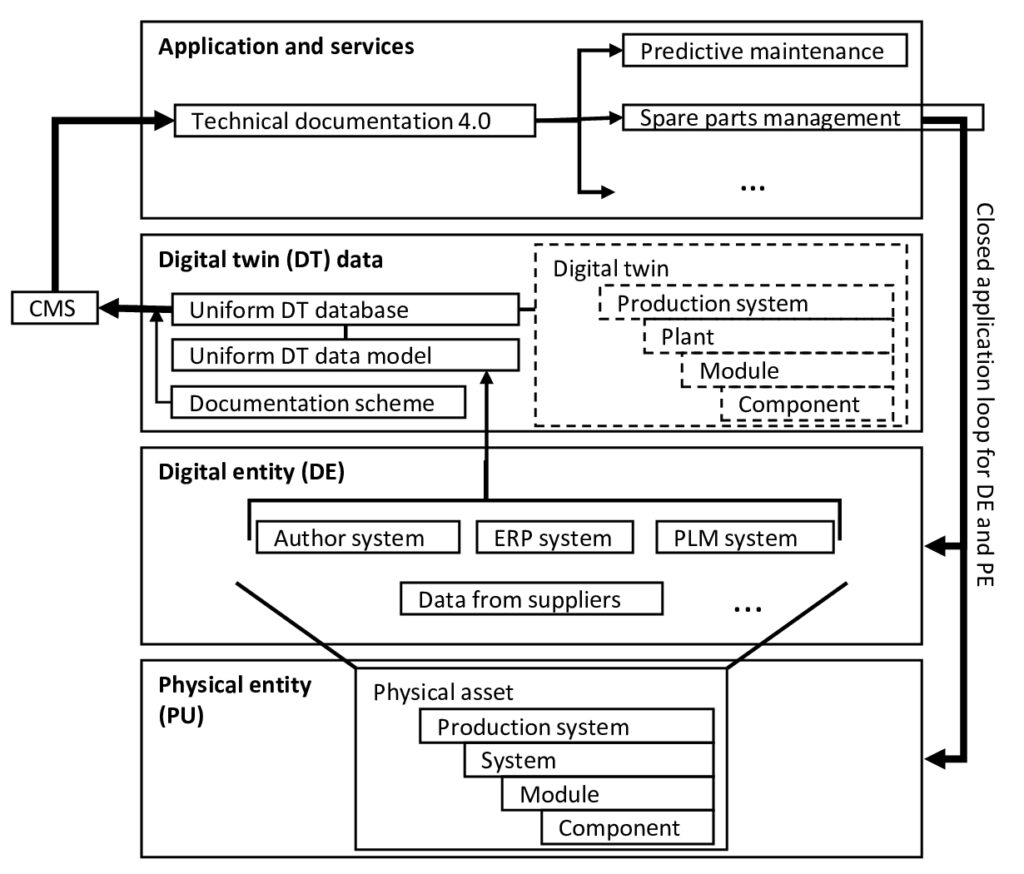
At the same time, information flows back to both the digital and physical entities, where the data flows back into the digital twin.
The proposed documentation schema is located at the data level of the digital twin. It defines the required data and structures needed for TD generation within the CMS.
TD 4.0 is thus subject to a holistic view and is linked to the digital twin.
Unlike existing approaches, , such as the static documents of the “Handover Documentation” submodel template (SMT), this concept focuses on storing and managing information directly within the DT rather than maintaining separate, static document instances.
The documentation scheme is designed to offer added value throughout the entire life cycle. By enforcing a uniform structure for TD across all manufacturers, it supports system integrators in creating the overall plant documentation. Suppliers also benefit, as a standardized approach strengthens their position with potential customers.
In the event of changes during the commissioning phase, which are often poorly documented today, the scheme supports targeted knowledge retention by reducing complexity and automating workflows. During the operating phase, uniform documentation provides maintenance personnel with improved clarity, as all system components are documented consistently. During plant reconfiguration, components can be replaced and automatically integrated into the structure of the digital twin and TD.
These life cycle scenarios demonstrate the advantages of a standardized documentation scheme over individual documentation solutions. Furthermore, structured data management can also support AI applications.
Summary and outlook
Due to the lack of consistency and general applicability of existing structuring standards for TD, there is a clear need for a universal documentation scheme covering the entire life cycle in today’s interoperable world. This need is being addressed in the “UniDoku” project in cooperation with industry partners. The IGF funding framework offers ongoing opportunities for industry partners to participate and contribute use cases, ensuring that the research outcomes remain practical and applicable.
To develop a comprehensive concept, a detailed catalog of industry requirements must be compiled. For this reason, interested companies in mechanical and plant engineering, as well as service providers specializing in technical documentation, are invited to submit expressions of interest via the provided contact details.
The next project phase will focus on working with partners to develop industrial use cases that will provide essential input for the data model. This is a crucial milestone in advancing towards TD 4.0. The automated transfer of existing TD—e.g., PDF operating instructions—into the schema and to facilitate knowledge extraction from it is planned for a follow-up project.
The “UniDoku” project (funding code “01IF23157N”) is funded by the German Federal Ministry for Economic Affairs and Climate Action as part of the “Industrial Collective Research (IGF)” program based on a resolution of the German Bundestag on behalf of BVL e.V.
Bibliography
[1] Wiez, M. and Gorenflos Lopez, J.: Digitale Zwillinge werden in der Industrie zum Standard. 2023. URL: https://www.bitkom.org/Presse/Presseinformation/Digitale-Zwillinge-Industrie-Standard, accessed 25.03.2025.[2] Lin, W. D. and Low, M. Y. H.: Design and Development of a Digital Twin Dashboards System Under Cyber-physical Digital Twin Environment. In: 2021 IEEE International Conference on Industrial Engineering and Engineering Management (IEEM) (2021), pp. 1716–1720. DOI: 10.1109/IEEM50564.2021.9672870.
[3] Hammerstingl, V.: Steigerung der Rekonfigurationsfähigkeit von Montageanlagen durch Cyber-Physische Feldgeräte. Munich 2019.
[4] Verordnung (EU) 2023/1230 des europäischen Parlaments und des Rates vom 14. Juni 2023 über Maschinen und zur Aufhebung der Richtlinie 2006/42/EG des Europäischen Parlaments und des Rates und der Richtlinie 73/361/EWG des Rates.
[5] Siepmann, D. and Graef, N.:Industrie 4.0 – Grundlagen und Gesamtzusammenhang. In: Roth, A. (ed.): Industrie 4.0 – Grundlagen und Gesamtzusammenhang. , Heidelberg 2016, pp. 17–82. DOI: 10.1007/978-3-662-48505-7_2.
[6] All for One Group SE: Digitaler Zwilling. URL: https://www.all-for-one.com/de/themen-impulse/iot-machine-learning/digitaler-zwilling/, accessed on May 6, 2025.
[7] Barthelmey, A.: Digitaler Zwilling für durchgängige Datenbereitstellung und -nutzung im Lebenszyklus wandlungsfähiger Produktionssysteme. Herzogenrath 2021.
[8] VDI 4500 Sheet 1: 2006-06 Technische Dokumentation – Begriffsdefinition und rechtliche Grundlagen.
[9] Mitteilung der Kommission im Rahmen der Durchführung der Richtlinie 2006/42/EG des Europäischen Parlaments und des Rates über Maschinen und zur Änderung der Richtlinie 95/16/EG.
[10] DIN EN ISO 12100: 2011-03 Sicherheit von Maschinen – Allgemeine Gestaltungsleitsätze – Risikobeurteilung und Risikominderung.
[11] Muranko, B. and Drechsler, R.: Technical Documentation of Software and Hardware in Embedded Systems. In: 2006 IFIP International Conference on Very Large Scale Integration (2006), pp. 261–266. DOI: 10.1109/VLSISOC.2006.313244.
[12] Schlagowski, H.: Technische Dokumentation im Maschinen- und Anlagenbau. Anforderungen. Berlin, Vienna, Zurich 2015.
[13] Caponi, A; Di Iorio, A; Vitali, F; Alberti, P; Scatá, M.: Exploiting patterns and templates for technical documentation. In: Proceedings of the ACM Symposium on Document Engineering 2018 (2018). New York, NY, USA, pp. 1–9. DOI: 10.1145/3209280.3209537.
[14] Brun, C; Dymetman, M; Lux, V.: Document structure and multilingual authoring. In: Proceedings of the first international conference on Natural language generation – INLG ’00 (2000). Morristown, NJ, USA, p. 24. DOI: 10.3115/1118253.1118258.
[15] Quint, V. and Vatton, I.: Structured templates for authoring semantically rich documents. In: Proceedings of the 2007 international workshop on Semantically aware document processing and indexing (2007). New York, NY, USA, pp. 41–48. DOI: 10.1145/1283880.1283889.
[16] VDI 2770 Blatt 1: 2020-04 Betrieb verfahrenstechnischer Anlagen – Mindestanforderungen an digitale Herstellerinformationen für die Prozessindustrie – Grundlagen.
[17] Priestley, M.: DITA XML. In: Proceedings of the 19th annual international conference on Computer documentation (2001). New York, NY, USA, pp. 152–156. DOI: 10.1145/501516.501547.
[18] VDMA 66320:2006-09 Beschreibung eines Schemas für Technische Dokumentation im Maschinenbau (mumasy).
[19] Robers, R. and Fritz, M.: White paper 2/2022 – From Manual to “Information on Demand” with iiRDS. 2022. URL: https://www.iirds.org/fileadmin/downloads/documents/Whitepaper_2-2022_iiRDS.pdf, accessed 09.05.2025.
[20] Wöstmann, R; Möhle, R; Krappe, H; Deuse, J.: Comprehensive equipment behavior description in production lifecycle using digital twin concepts and ISO standards of Equipment Behavior Catalogues. In: IFAC-PapersOnLine 58 (2024) 19, pp. 223–228. DOI: 10.1016/j.ifacol.2024.09.172.
[21] DIN EN IEC 62378-1*VDE 0810-781: 2024-09 Verwaltungsschale für industrielle Anwendungen – Teil 1: Struktur der Verwaltungsschale.
[22] IDTA: AAS Submodel Templates. 2025. URL: https://industrialdigitaltwin.org/content-hub/teilmodelle, accessed 02.05.2025.
[23] IDTA 02004-1-2-1-0 Handover Documentation. 2023. URL: https://industrialdigitaltwin.org/wp-content/uploads/2023/03/IDTA-02004-1-2_Submodel_Handover-Documentation.pdf, accessed 23.04.2025.
[24] IDTA 02003 Generic Frame for Technical Data for Industrial Equipment in Manufacturing. 2025. URL: https://industrialdigitaltwin.org/en/wp- content/uploads/sites/2/2025/03/IDTA-02003_Generic-Frame-for-Technical-Data.pdf, accessed 23.04.2025.
[25] IDTA 02006-3-0 Digital Nameplate for Industrial Equipment. 2024. URL: https://industrialdigitaltwin.org/wp-content/uploads/2024/11/IDTA-02006-3-0_Submodel_Digital-Nameplate.pdf, accessed 23.04.2025.
[26] IDTA 02011-1-1 Hierarchical Structures enabling Bills of Material. 2024. URL: https://industrialdigitaltwin.org/en/wp-content/uploads/sites/2/2024/06/IDTA-02011-1-1_Submodel_HierarchicalStructuresEnablingBoM.pdf, accessed 23.04.2025.
[27] Platform Industry 4.0: “Manufacturing-X” funding program. URL: https://www.bmwk.de/Redaktion/DE/Dossier/manufacturing-x.html, accessed 06.05.2025.
[28] ECLASS e.V.: ECLASS. 2025. URL: https://eclass.eu/, accessed 02.05.2025.
[29] DIN EN 61360-1: 2018-07 07 Genormte Datenelementtypen mit Klassifikationsschema für elektrische Betriebsmittel – Teil 1: Definitionen – Regeln und Methoden
[30] Steinhauer, H.:Dokumentation in der Realität des Anlagenbaus . Winterthur 2011.
[31] Gesellschaft für Technische Kommunikation – tekom Deutschland e.V.: Generate iiRDS Packages from DITA. 2024. URL: https://www.iirds.org/tools/dita-plugin, accessed 06.05.2025.
[32] IDTA 020063-1-0 Intelligent Information for Use. 2025. URL: https://industrialdigitaltwin.org/en/wp-content/uploads/sites/2/2025/03/IDTA-02063-1-0_Submodel__IntelligentInformationForUse.pdf, accessed 23.04.2025 .
[33] Wöstmann, R; Borggräfe, T; Janßen, S; Kimberger, J; Ould, S; et al.: Data-driven recipe optimization based on unified digital twins and shared prediction models. In: Proceedings of the 34th European Modeling & Simulation Symposium (EMSS 2022) (2022), pp. 1–11. DOI: 10.46354/i3m.2022.emss.006.
You might also be interested in