Off-Peak Delivery: An Opportunity for Climate-Friendly Urban Logistics

JournalIndustrie 4.0 Management
Issue Volume 38, 2022, Edition 1, Pages 48-52
Bibliography Share Cite Download

Abstract

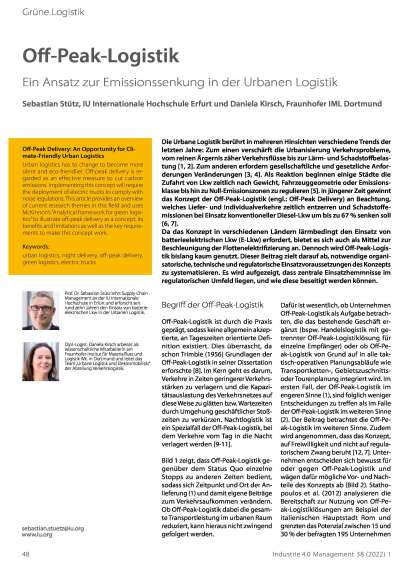
Urban logistics has to change to become more silent and eco-friendlier. Off-peak delivery is regarded as an effective measure to cut carbon emissions. Implementing this concept will require the deployment of electric trucks to comply with noise regulations. This article provides an overview of current research themes in this field and uses McKinnon’s “Analytical framework for green logistics”to illustrate off-peak delivery as a concept, its benefits and limitations as well as the key requirements to make this concept work.

Keywords

Access limited

You are currently not logged in / not yet registered.

In order to download the desired file(s), you must be logged in and have an appropriate inclusive subscription. Alternatively, you can also obtain access by paying a one-off fee.

Subscription included Purchase
without 29,00 €
Digital 27,55 €
Expert 26,10 €
Professional 0,00 €

Download for one time 29,00 €

All prices include 7% VAT

After purchasing access rights, you will automatically be redirected back to this page.


You might also be interested in

Serious Gaming and the Energy Transition

Serious Gaming and the Energy Transition

Collaborative knowledge generation and interactive understanding of complex interrelationships
Janine Gondolf ORCID Icon, Gert Mehlmann, Jörn Hartung, Bernd Schweinshaut, Anne Bauer
Conveying the complexity and multifaceted nature of the energy transition to a broad audience is a challenge. This article demonstrates how interactive serious games on a multitouch table can help make connections tangible and comprehensible. The games and the table were used in various conversational contexts. These are presented here in three case vignettes based on participant observation of the different applications, as well as situated and shared reflection. The vignettes demonstrate how interaction can trigger epistemic processes, enable shifts in perspective, and foster collective thinking, all of which are necessary for shaping the future of society as a whole.
Industry 4.0 Science | Volume 42 | 2026 | Edition 2 | Pages 62-69
Industrial Transformation via a Machining Learning Factory

Industrial Transformation via a Machining Learning Factory

A learning module to foster competencies for a sustainability-driven transformation
Oskay Ozen ORCID Icon, Victoria Breidling ORCID Icon, Stefan Seyfried ORCID Icon, Matthias Weigold
Sustainability-enhancing transformation processes are necessary in all sectors if we are to remain within planetary boundaries. This also applies to the industrial sector as a significant emitter of greenhouse gases. Employees need new competencies to master this complex task of industrial transformation. These range from CO2 equivalents accounting to the development and evaluation of transformation scenarios, including technical measures. The learning module developed here addresses these competency requirements and uses the example of the ETA factory to show how a competency-oriented learning module for industrial transformation can be structured. It essentially comprises four phases: data collection and CO2 equivalents accounting, cause analysis, development of measures and evaluation of measures.
Industry 4.0 Science | Volume 42 | Edition 2 | Pages 38-47 | DOI 10.30844/I4SE.26.2.38
Experiencing Digital Twins in Production and Logistics

Experiencing Digital Twins in Production and Logistics

The fischertechnik® Learning Factory 4.0 as a development platform for possible expansion stages
Deike Gliem ORCID Icon, Sigrid Wenzel ORCID Icon, Jan Schickram, Tareq Albeesh
The fischertechnik® Learning Factory 4.0 has proven to be a suitable experimental environment for testing digital twins. Depending on the targeted maturity stage, the functions of a digital twin range from status monitoring and forecasting to the operational control of production and logistics systems. To systematically classify these functions, this article presents a maturity model that serves as a framework for the development of a digital twin. Building on this, selected use cases are implemented in a test and development environment based on a system architecture with multi-layered logic structure. These initial implementations serve to highlight application purposes, relevant methods, and typical challenges and potentials in the transfer to real factory environments.
Industry 4.0 Science | Volume 42 | Edition 2 | Pages 30-37 | DOI 10.30844/I4SE.26.2.30
Has the Time Come for an Energy Revolution in Intralogistics?

Has the Time Come for an Energy Revolution in Intralogistics?

The current status of hydrogen fuel cell-powered MHE
Gustav Bösehans, Joseph W. Dörmann
Hydrogen fuel cells promise to be a sustainable alternative to fossil fuel or battery-electric material handling equipment (MHE) in various production or warehouse contexts. Short refuelling times, an absence of carbon emissions, and constant power input put fuel cell-powered MHE at an advantage in high-intensity work environments. However, various barriers to the adoption of fuel cells remain, including considerations surrounding cost and efficiency.
Industry 4.0 Science | Volume 41 | 2025 | Edition 6 | Pages 74-80
Loam Construction and Wooden Shelving

Loam Construction and Wooden Shelving

A contribution to sustainability in warehouse logistics
Viviano De Giacomo ORCID Icon, Nathalie Fritsch ORCID Icon, Jakob Kennert ORCID Icon, Dieter Uckelmann ORCID Icon
This study examines the contribution of natural building materials, in particular loam and wood, to the sustainable development of logistics infrastructure, assessing ecological, economic, and technical dimensions across the entire life cycle. Potentials, restrictions, and supportive framework conditions are identified based on literature analyses and expert interviews. Wood proves to be technically mature and ecologically advantageous, especially in high rack construction, while loam offers high potential for energy- and resource-efficient construction. The study concludes with recommendations for research, policy, and practice to establish circular construction methods in logistics.
Industry 4.0 Science | Volume 41 | Edition 6 | Pages 82-89
Electric Trucks in Intermodal Terminal Pre- and Post-Carriage

Electric Trucks in Intermodal Terminal Pre- and Post-Carriage

Impact on terminal processes in combined road-rail freight transport
Ralf Elbert, Samira Ghaneian Sebdani ORCID Icon
Electric trucks (e-trucks) play an important role in reducing CO₂ emissions especially on short distances in pre and post-carriage in combined road-rail freight transport (CT). Using the example of a CT terminal, this article highlights the logistical and energy challenges involved in using e-trucks to establish suitable charging infrastructures and ensuring a reliable power supply.
Industry 4.0 Science | Volume 41 | Edition 6 | Pages 70-77