Sustainable Recycling of EV Traction Batteries

JournalIndustrie 4.0 Management
Issue Volume 38, 2022, Edition 1, Pages 12-16
Open Accesshttps://doi.org/10.30844/I40M_22-1_12-16
Bibliography Share Cite Download

Abstract

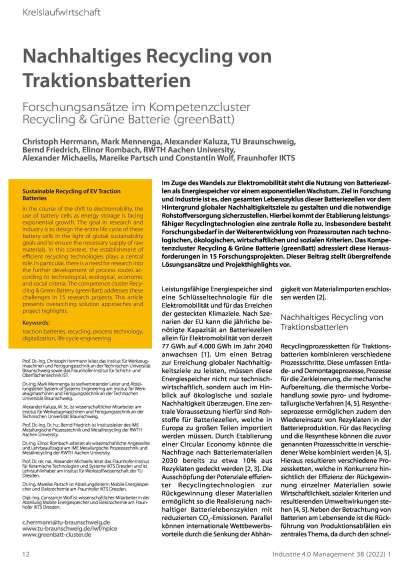
In the course of the shift to electromobility, the use of battery cells as energy storage is facing exponential growth. The goal in research and industry is to design the entire life cycle of these battery cells in the light of global sustainability goals and to ensure the necessary supply of raw materials. In this context, the establishment of efficient recycling technologies plays a central role. In particular, there is a need for research into the further development of process routes according to technological, ecological, economic and social criteria. The competence cluster Recycling & Green Battery (greenBatt) addresses these challenges in 15 research projects. This article presents overarching solution approaches and project highlights.

Keywords


Bibliography

[1] Tsiropoulos, I.; Tarvydas, D.; Lebede- va, N.: Lithium-ion batteries for mobility and stationary storage applications Scenarios for costs and market growth for costs and market growth. European Commission 2018.
[2] acatech/Circular Economy Initiative Deutschland/SYSTEMIQ (Hrsg.): Ressourcenschonende Batteriekreisläufe – Mit Circular Economy die Elektromobilität antreiben. 2020.
[3] Buchert, M.; Dolega, P.; Degreif, S.: Gigafactories für Lithium-Ionen-Zellen – Rohstoffbedarfe für die globale Elektromobilität bis 2050, Darmstadt 2019.
[4] VDMA e.V.: Recycling von Lithium-Ionen Batterien. URL: www.vdma.org/viewer/-/v2article/render/31877343, Abrufdatum 21.09.2021.
[5] Friedrich, B.; Schwich, L.: New Science Based Concepts for Increased Efficiency in Battery Recycling. In: Editorial: Metals 11 (2021) 4, S. 533. DOI: https://doi.org/10.3390/met11040533.
[6] Kushnir, D.: Lithium Ion Battery Recycling Technology 2015: Current State and Future Prospects. Environmental Systems Analysis. Chalmers University, Göteborg, Sweden. ESA REPORT # 2015:18, (2015).
[7] Serna-Guerrero, R. u. a.: A Critical Review of Lithium-Ion Battery Recycling Processes from a Circular Economy Perspective. Batteries 5 (4), S.68. DOI: 10.3390/batteries5040068, 2019.
[8] Elwert, T.; Frank, J.: Auf dem Weg zu einem geschlossenen Stoffkreislauf für Lithium-Ionen-Batterien. Recycling und Sekundärrohstoffe (13), S. 524-530, Thomé-Kozmiensky Verlag GmbH, ISBN 978-3-944310- 51-0.
[9] Schwich, L. u. a.: Early-Stage Recovery of Lithium from Tailored Thermal Conditioned Black Mass Part I: Mobilizing Lithium via Supercritical CO2-Carbonation. Metals 11 (2) S.177. DOI: 10.3390/ met11020177, 2021.
[10] Slabon, A. u. a.: Sustainable Li-Ion Batteries: Chemistry and Recycling. Adv. Energy Mater. 11 (43), S.

2003456. DOI: 10.1002/aenm.202003456, 2021.
[11] Deutsche Rohstoffagentur: Batterierohstoffe für die Elektromobilität. DERA Themenheft: 26 S. ISSN: 2193-5319. Berlin 2021.
[12] Cerdas, F.; Thiede, S.; Herrmann, C.: Integrated Computational Life Cycle Engineering – Application to the case of electric vehicles, In: CIRP Annals – Manufacturing Technology, Elsevier B.V. Amsterdam 2018.

Your downloads


You might also be interested in

Data-Driven Supplier Selection in Industry 4.0

Data-Driven Supplier Selection in Industry 4.0

Towards an industrial platform for selection and configuration
Purushothaman Ganesh ORCID Icon, Baris E. Albayrak ORCID Icon, Jörg Franke ORCID Icon, Till Sindel ORCID Icon, Jens Fürst, Sebastian Lang ORCID Icon
Industrial supply chains must repeatedly reconfigure sourcing strategies in response to disruptions, yet supplier capability information remains heterogeneous and difficult to operationalize. Existing research addresses supplier selection, simulation, and interoperability standards separately, treating discovery, evaluation, and optimization as disconnected steps requiring manual data transformation. This paper presents a framework for a data-driven industrial platform integrating three components: Asset Administration Shell-based supplier profiles structured by an Actor-Service ontology for semantic discovery, automatic discrete-event simulation model generation from layout data for performance evaluation, and KPI-driven configuration using optimization algorithms. The main contributions are an end-to-end interoperable workflow, a two-tier supplier profile concept separating semantic descriptions from simulation parameters, and a standardized KPI interface maintaining consistency ...
Industry 4.0 Science | Volume 42 | 2026 | Edition 4 | Pages 50-61 | DOI 10.30844/I4SE.26.4.6
Open Source as Enabler for Smart Data Ecosystems

Open Source as Enabler for Smart Data Ecosystems

How collaboration shapes sovereignty and interoperability across industrial applications
Anna Maria Schleimer ORCID Icon, Julia Pampus ORCID Icon
From automotive supply chains to smart factories, data ecosystems promise seamless collaboration across company boundaries. But how can industries build the necessary infrastructure without creating new dependencies? This article explores how open-source software can serve as a foundation and impactful tool for sovereign, interoperable technologies and standards. Yet, open-source software is not a silver bullet; rather, it poses challenges for digital sovereignty in burgeoning data ecosystems.
Industry 4.0 Science | Volume 42 | 2026 | Edition 4 | Pages 6-13 | DOI 10.30844/I4SE.26.4.1
From Private Law to Private Ordering

From Private Law to Private Ordering

Rule-making through industrial digital platforms
Pia C. Romeike, Frederik Bär
Industrial digital platforms are considered the driving force behind digital value creation, yet legally they largely operate in a gray area. This article examines what defines industrial digital platforms and what legal framework applies to them. Existing platform regulations apply only to a limited extent to industrial digital platforms, which is why these platforms often establish their own legal framework through their terms and conditions. The article also explores the implications of European regulation, power asymmetries, and the opportunities and limitations of private regulation.
Industry 4.0 Science | Volume 42 | 2026 | Edition 4 | Pages 98-105 | DOI 10.30844/I4SD.26.4.11
Enabling Digital Trust in Green Hydrogen Markets

Enabling Digital Trust in Green Hydrogen Markets

Trust-Building Information Systems and Mechanisms
Johanna Voß, Jens Pöppelbuß ORCID Icon
Building a global hydrogen economy requires more than technology and investment; it requires trust. As information systems (IS) increasingly mediate collaboration among unfamiliar, distributed actors, the question of how trust can be deliberately built becomes critical. This study systematically maps how IS enable different types of trust and reveals how these mechanisms can support trusting collaboration in emerging hydrogen value chains.
Industry 4.0 Science | Volume 42 | 2026 | Edition 4 | Pages 82-90 | DOI 10.30844/I4SE.26.4.9
Classification of Digital Supply Chain Management Platforms

Classification of Digital Supply Chain Management Platforms

Review of existing classification approaches from a circular economy perspective
Sophia Botsch ORCID Icon, Eva Mante ORCID Icon, Marcel Papert ORCID Icon, Alexander Pflaum ORCID Icon
Assessing the impact of digital industrial platforms on the dynamics and resilience of supply chains requires clear classification of such platforms. This article examines the extent to which a current classification proposal from the field of supply chain management must be further developed in the context of digital platforms for implementing the circular economy (CE). The authors conclude that a fundamental revision is not necessary, as the digital CE platforms under consideration fit well into the existing classification system. However, new research questions arise regarding the distinction between digital service platforms and digital data-oriented platforms, as well as the link between the circular economy and supply chain management—particularly in connection with supply chain control towers, which are becoming increasingly established in supply chain management practice.
Industry 4.0 Science | Volume 42 | 2026 | Edition 4 | Pages 62-70 | DOI 10.30844/I4SE.26.4.7
Industry 4.0—Progress and Digitalization in Limbo

Industry 4.0—Progress and Digitalization in Limbo

Status of sustainable transformation and digitalization in production engineering
Christian Donhauser ORCID Icon, Daniel Riepl
Digitalization projects help users represent complex processes more simply and efficiently. However, there are many obstacles to implementation. Reluctance to implement these projects is palpable. This affects, among others, employers and employees, who may fall behind economically by waiting or avoiding change. These observations can be traced back to an overarching research question: What barriers and systemic challenges hinder sustainable transformation within the context of Industry 4.0, particularly when considering human labor in production engineering? What questions are the affected stakeholders asking? The primary goal of this long-term research project is to define these questions decisively and in detail in order to develop a conceptual foundation that integrates research, teaching, and technological development and thus combines the potential of digital technologies with the experiential and practical knowledge of production workers.
Industry 4.0 Science | Volume 42 | 2026 | Edition 3 | Pages 56-60