Modular Learning Factories for Industry 4.0 |
Acquisition of a target-oriented acton competence to accelerate industrial implementation

| Journal | Industry 4.0 Science |
| Issue | Volume 40, 2024, Edition 4, Pages 24-30 |
| Open Access | https://doi.org/10.30844/I4SE.24.4.24 |
| Bibliography | Share | Cite | Download |
Abstract
Keywords
Article
Industry plays an important role in the German economy and is regularly exposed to major changes due to technological and social change. Companies and employees must constantly adapt, especially as the speed of change increases constantly (e.g. BANI) and the framework conditions are becoming more stringent (e.g. demographic change) [1]. With globalization, maintaining competitiveness is only possible through continuous productivity increases and targeted specialization [2].
Companies hope that I4.0 will give them a tangible competitive advantage through the use of digital technologies (e.g. in production). To do this, they need suitable specialist staff. This is becoming increasingly difficult to find, Therefore, German universities and colleges are starting to offer an increasing number of specialized courses on the topic.
Comprehensive studies also show the need to adapt training occupations, some of which have already been implemented (e.g. partial revision of M+E occupations in 2018) [3]. Nevertheless, formal education in particular is finding it increasingly difficult to keep pace with operational requirements. Especially in the manufacturing industry, I4.0 is leading to a currently unpredictable demand for further adapted content and more highly skilled workers. In the course of the digital transformation, the world of work and its requirements will change so continuously, rapidly and fundamentally that skills profiles are already in demand on the industry side for which there are no suitable vocational and academic training courses [4, 5] at present.
In particular, there is a lack of practical I4.0 application skills that prepare young professionals for the implementation of the digital transformation in industry [6, 7].
However, the majority of the workforce is not made up of career starters, but rather professionals who are being financed by companies with a record high level of expenditure on further training. Nevertheless, around half of the training costs for digitization today remain without measurable effect. More promising are individually tailored learning opportunities for industrial companies and their target groups as well as a focus on teaching effective skills for the implementation of I4.0 [8, 9].
Challenging status quo within the industry
Although many industrial companies have been working on the implementation of I4.0 for over 10 years, one of the main reasons for failure is still the lack of actionable skills for the beneficial implementation of digital transformation. The majority of industrial companies (87%) say that the implementation of digital technologies plays a decisive role in their competitiveness, but they aren’t in a position to implement digital technologies in a benefit-oriented manner.
They see the biggest hurdle as the lack of skilled workers and thus a lack of application knowledge, which leads to increased implementation costs in the company if there’s a lack of training in advance [10, 11]. Due to the growing global shortage of skilled workers, the chance for industrial companies to obtain the desired I4.0 skills through new hires is decreasing. Targeted in-company training for the digital transformation is therefore considered a promising way to counteract the initial situation in the short and long term.

It’s therefore hardly surprising that companies are spending exponentially more on training. However, the results of these efforts have so far been sobering. For example, companies are currently still in the status of I4.0 pilot projects and not in the process of comprehensive implementation. At the same time, companies are still in the discovery phase with regard to the skills employees need for I4.0. On the one hand, companies are unaware of their status quo with regard to existing digitalization skills (due to a lack of statistics in personnel databases). On the other hand, there’s a lack of clarity regarding the job profiles and learning needs of employees with regard to I4.0.
Furthermore, companies lack suitable further training opportunities, which is why the knowledge gap in terms of digitization is constantly widening and the necessary know-how development isn’t progressing [12]. Nowadays, digital innovations are generally created by younger people, with the necessary domain and process knowledge coming predominantly from experienced employees. The latter is becoming increasingly critical as a result of demographic change, as experience often isn’t documented or documented insufficiently [13].
In summary, there’s a considerable knowledge and qualification gap with regard to the digital transformation that hasn’t yet been specifically identified.
Learning needs in international comparison
Whether digitalization, climate change or the COVID-19 pandemic, the enormous current and future challenges demand new skills from employees. There are already several studies on vocational and academic training that call for adapted curriculums with new technological and digital content (e.g. digital processes, data analysis, digital problem solving) [4].
In addition to technological knowledge, transformative and key digital skills seem to play a central role for successful digital transformation within industry in the future, although the necessary application skills in particular can’t yet be described in more detail. According to experts, the latter can only be identified on a company-specific basis. A current recommendation for industrial training is therefore a two-stage approach: an initial and continuous assessment of skill requirements followed by the identification and implementation of targeted further training measures in a second stage. However, the specific skill requirements of companies with regard to the benefit-oriented digital transformation are currently unknown [8, 14].
The industrial skills requirements were therefore examined in more detail as part of a study on the learning needs of various international manufacturing companies. In the period from November 2022 to March 2024, 250 employees from 25 internationally distributed locations of various industrial companies were surveyed on their current skills and learning needs for a successful digital transformation to I4.0. An online questionnaire was set up to identify the industrial learning needs and classify them according to their depth of knowledge. Various hierarchical levels were selected in order to capture the effects of the digital transformation on qualification requirements across the board. The employees surveyed were divided into three different target groups:
- decision-makers & managers (78)
- IT responsibles & digitalization experts in the factories (150)
- direct shopfloor employees (22)
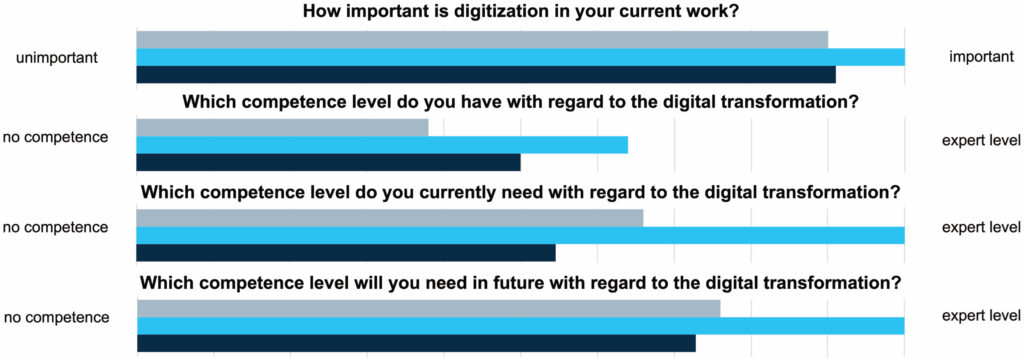
The target groups examined were asked to assess their current level of competence with regard to the subject areas investigated and, in a second step, to indicate the level of competence required today and in the future. For this purpose, as shown in Figure 1, various competence levels were defined in advance using the scale shown.
According to [15], there’s a significant difference between knowledge, application and action competence. The latter has a considerable influence on the result through transfer knowledge and determines whether digital transformation plans and projects are successful or fail during implementation.
At the “onboarding level”, employees can describe the change in the course of I4.0. With the “basic level”, they know the connections and background in detail. The “advanced level” allows the knowledge to be transferred to the application. Only at the “expert level” do they achieve sustainable transfer performance and targeted problem solving. Figure 2 shows the mean values of the study results of various target groups with regard to their digital transformation skills.
All target groups rate the importance of digitalization in today’s work as very high. In terms of I4.0 skills, managers rated themselves lowest (slightly below basic level). Shopfloor employees rated their skills slightly higher and only IT experts placed themselves in the advanced level, but not in the expert level. However, they already need to be at the latter level to successfully master their tasks. For the future, all target groups would like to see a higher level of application expertise for the beneficial implementation of I4.0.
The study also asked about the learning barriers and needs for I4.0. The five most common learning barriers for I4.0 were lack of time (35%), lack of learning support (29%), lack of desire (24%), lack of offers (22%) and lack of on-site learning environments (16%). With regard to learning environments, the target groups call for practical training on hand, e.g. in a learning factory (64%), instead of digital or hybrid training (36%). Experts (79%) and shopfloor employees (64%) have the greatest need for a physical learning environment: managers prefer flexible hybrid learning opportunities (55%) alongside a learning factory (45%).
The motivational factors of the various target groups are striking. The majority of shopfloor employees (64%) are only interested in digitalization training if they relate to their current task and this is evident in the training. In addition to enabling them to carry out their work (77%), the main motivation is to enable them to perform higher-value activities (68%). The IT experts hope that application and target-oriented training will enable them to solve their current problems to implement I4.0 (95%).
The main incentives for managers are to make better decisions in the context of I4.0 and to achieve their targets (84%). 79% of experts were able to name their current and future learning needs with regard to digital transformation. Of the shopfloor employees and managers, only 43% and 54% respectively were able to name their current and only 15% and 12% respectively were able to name their future I4.0 learning needs.
In summary, all target groups lack target- and application-oriented skills. There’s also a consensus that the development of expert and proficient competence levels through training measures is needed in real learning factories. At the same time, there’s a great deal of uncertainty regarding future learning requirements in the course of I4.0 that still need to be derived and defined.
Use of open and modular learning factories for the implementation of I4.0
Even though there are already a large number of formal training courses on offer to prepare for the digital transformation, only one in five employees in Germany take advantage of them. Users and those affected increasingly expect modern and application-oriented training in line with their real-life environment and work tasks [16]. Since the emergence of I4.0, learning factories are therefore increasingly being used to teach application skills for current and future work tasks. They’re intended to optimally prepare and enable both managers and experts (e.g. value stream managers) and direct employees for the digitization of their work tasks. This is due to the mapping of the real working environment and tasks as well as the tangibility of the learning content.
In addition to technical and methodological skills, learning factories can also address socio-technical, communicative, process-, domain- and problem-related as well as transformative skills, depending on the design of the learning measures. This differs from theoretical learning measures, which generally do not train practical skills. Learning factories help to derive concrete learning measures from corporate targets, review application skills, measure changes and develop realistic learning content.
Nevertheless, there are also limitations and disadvantages when using learning factories. On the one hand, the majority of learning factories have too strong a product focus, which doesn’t enable generic and process-oriented learning situations [17]. On the other hand, closed hardware and software architectures from outside the industry and a lack of operator models lead to major challenges for teachers and a lack of transferability of self-developed solutions and exercises.
It’s virtually impossible to replicate application scenarios and problem-oriented complex situations in the real world of work and tailoring them to specific job profiles doesn’t allow for the expansion of the areas of application and target groups of learning factories [18]. In addition to physical learning factories, realistic VR environments could also be used, although only a few of these exist. They are comparatively expensive, which is why their use is usually not profitable [19].
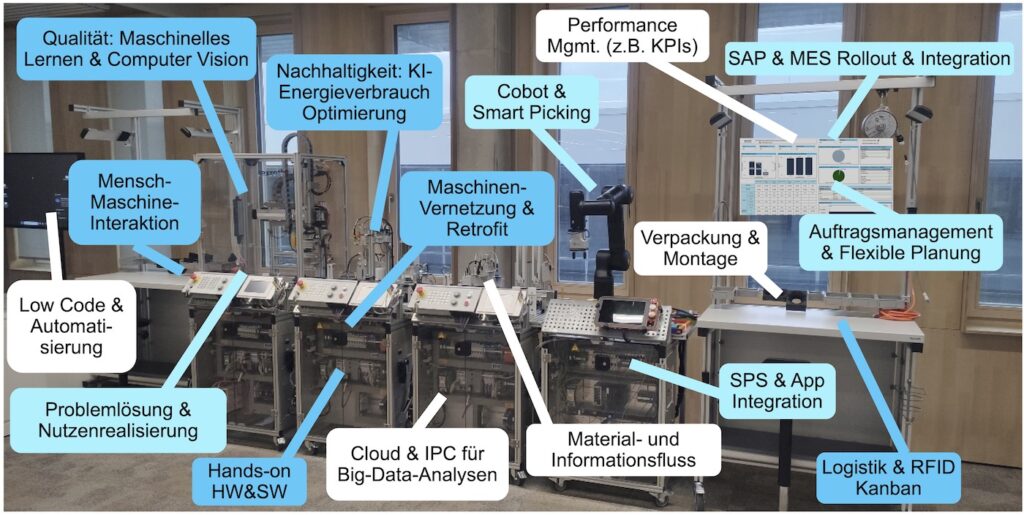
All of these aspects place essential demands on a modern learning factory. On the one hand, it must be easy to operate and on the other, it must be able to be quickly adapted to real learning objectives and application-related problems in industry thanks to its open and modular design. Figure 3 shows an open and modular learning factory that was developed for the development and implementation of application-oriented training with regard to I4.0. In contrast to previous learning factories, individual company processes and IT architectures can be easily and generically applied to it in order to carry out training measures for different target groups for the benefit-oriented implementation of I4.0.
Thanks to its open IT architecture, the learning factory enables the application and transferability of exercises and learning tasks. This is demonstrated by the listing of real problems from industrial companies, which enable an application and benefit reference. The simple expandability and interchangeability as well as an associated operator model analogous to real factories also help to constantly adapt to the reality of work, even if this can’t yet be estimated. This is particularly critical for the sustainable use of a learning factory, as a lack of adaptability inevitably leads to an expiration date for its use.
With the target-oriented, modular and open concept, learners can find their way more easily in the rapidly changing world of work, as they can verify results for themselves, making them easier to accept (deeper learning). Previous learning factories can’t be easily adapted to the learner’s working reality, which leads to low acceptance (simulation far removed from reality). The adaptability of a training course to the learner’s initial situation and real-life circumstances is a decisive factor for learning success, especially in the factory sector.
The comprehensibility of the current work task and the reference to it, which can be realistically reproduced in the learning factory presented, leads to learner acceptance. An open IT architecture is also needed for the learning factory to test company-specific processes, IT ecosystems and application scenarios of real use cases. This increases the benefits and the number of target groups that can be integrated. The high effectiveness of the modern, open and modular learning factory shown here has already been proven. For example, the rollout time for operational MES solutions in industrial value streams was reduced from six months to six weeks following the introduction of company-specific application training in the learning factory.
In summary, many new learning needs have already been identified in industry for the successful implementation of the digital transformation. On the other hand, there is a low willingness to learn, unsuitable formal learning opportunities and inflexible learning factories. The future skills required for the implementation of I4.0 can be tested and successfully transferred with the open, modern and modular learning factory shown.
However, the use of modern learning factories needs to be investigated in greater depth. It is necessary to identify which success factors actually contribute to the achievement of learning objectives and can be directly influenced by the learning factory. Furthermore, the interaction of other elements with the learning factory must be investigated (e.g. teaching quality concept, learning method, learning content).
Bibliography
[1] Dommermuth, M.: Entwicklung und Anwendung eines konsekutiven integralen Transformationskonzeptes für Werke von Industrieunternehmen mit variantenreicher Fertigung. Berlin 2021.[2] Lucks, K.: Praxishandbuch Industrie 4.0. Stuttgart 2017
[3] IG Metall: Handlungsempfehlungen der M+E Sozialpartner zu Aus- und Fortbildung für Industrie 4.0. URL: https://wap.igmetall.de/Basispapier%20Agiles%20Verfahren_Versand_17-03-28.pdf, Accessed: 13.6.2024.
[4] Spöttl, G.; Windelband, J.: The 4th Industrial Revolution: Its Impact on Vocational Skills. In: Journal of Education and Work 34 (2021), pp. 29-52.
[5] Neumer, J. et al: Beruflichkeit und Kollaboration in der digitalisierten Arbeitswelt. In: Working Paper Forschungsförderung 242 (2022), pp. 1-64.
[6] Burstedde, A.: Digitalisierung der Wirtschaft in Deutschland. Bundesministerium für Wirtschaft und Klimaschutz. Berlin 2022.
[7] Dietl, S.; Hennecke, M.: Ausbildung 4.0. Freiburg 2021.
[8] Dommermuth, M.; Laufer, J.; Herkulesaufgabe Digitale Transformation. In: Arbeits- Sozial- und Umweltmedizin 57 (2022), pp. 610-613.
[9] Haufe.de: Investitionen in Weiterbildung hoch, aber nicht immer sinnvoll. URL: www.haufe.de/personal/neues-lernen/weiterbildung-investitionen-oft-verschwendet_589614_491694.html, Accessed: 9.3.2024.
[10] Bitkom Research: Digitalisierung der Wirtschaft. Berlin 2023.
[11] Dommermuth, M.; Laufer, J.: Kognitive Werkerassistenzsysteme. In: GfA Frühjahrskongress A.8.2 (2022), pp. 1-8.
[12] Staufen AG: Unternehmen im Wandel URL: www.staufen.ag/wp-content/uploads/study_staufen_Unternehmen-im-wandel-2022_de_web-1.pdf, Accessed: 6.3.2024.
[13] Seim, C.; Walwei, U.: Wenn nicht Unvorhergesehenes passiert: Unser Arbeitsmarkt bleibt 2023 robust! In: Werkwandel 1 (2023), pp. 11-17.
[14] Stifterverband für die Deutsche Wissenschaft e. V.: Future Skills 2021. URL: www.stifterverband.org/download/file/fid/10547, Accessed: 25.2.2024.
[15] North, K.: Wissensorientierte Unternehmensführung. Wiesbaden 2021.
[16] InitiativeD21: D21-Digital-Index 2023/24 – Jährliches Lagebild zur Digitalen Gesellschaft URL: https://initiatived21.de/publikationen/d21-digital-index/2023-24, Accessed: 9.6.2024.
[17] Abele, E. et al: Learning Factories. Cham 2024.
[18] Wilbers, K.: Lernfabriken an beruflichen Schulen: Gewerblich-technische und kaufmännische Perspektiven. Erlangen 2021.
[19] Buehler, K.; Kohne, A.: Besser Lernen mit VR-/AR-Anwendungen. In: Virtual Reality und Augmented Reality in der Digitalen Produktion. Wiesbaden 2022.
Your downloads
You might also be interested in