A Learning Factory in Transition |
Innovatively meeting the demands of the modern labor market
| Journal | Industry 4.0 Science |
| Issue | Volume 40, Edition 4, Pages 63-68 |
| Bibliography | Share | Cite | Download |
Abstract
Keywords
Article
The Berlin University of Applied Sciences (HTW) aims to continuously adapt its training concepts to the current requirements of the labor market. The Lean Factory focuses on the “future skills” identified in the University Report 2020, in particular “agile working” and “problem-solving skills”. Both skills are considered crucial for young professionals in the report [1].
An empirical study from 2018, conducted by the Institute for Employment and Employability (IBE), shows that 69% of the 1036 employees surveyed expect a significant increase in the importance of agile organizational structures [2]. The Cassini study (2017) underlines that “design thinking” is mainly used in addition to the methods “Scrum” and “Kanban”, which are widely used in the media [3]. Agile approaches are usually used to solve complex problems [4]. This is particularly useful in dynamic market environments [5]. Almost the entire world of agile methods draws on the basic ideas of lean, such as the focus on processes and people, the introduction of improvement cycles and the pursuit of greater transparency and visualization [6, 4].
The complexity of lean is illustrated in the 4P model based on the book “The Toyota Way” (“Der Toyota Weg”). This model offers a structured approach to looking at the various dimensions of lean and their interdependence. The 4P model shows four interlinked levels that are generally applicable to companies. The basis is the “philosophy”, from which all of a company’s actions are derived: the behavior of the employees, the objectives and the way that objectives are pursued. Building on this is the “process”, i.e. the avoidance of waste through process fidelity.
The next level, “people and partners”, stands for mutual respect within the company and towards external partners, as well as good teamwork, not least characterized by the manager. The last level, “problem solving”, describes continuous improvement through constant reflection and a positive error culture. It emphasizes that the long-term feasibility of an individual lean principle can only be guaranteed if all relevant principles are considered in their entirety and interdependence. Lean is a holistic system and means much more than pure process optimization in production [6, 7].
The Lean Factory at the Berlin HTW adopts the holistic approach of the 4P model with the aim of providing students with a comprehensive introduction to the topic. The teaching’s requirements structure is derived from practice. In addition to lectures, the didactic elements of this approach include seminars, project work, case studies, business games and laboratory exercises in smaller groups. These various forms of teaching are characterized by more intensive supervision and increased interaction. They serve to deepen the acquired knowledge in concrete application scenarios [8]. The Lean Factory enables students to engage with the principles of lean management in a practical and well-founded manner and enables them to apply the knowledge they have acquired effectively in real professional contexts.
Origin of the learning factory: the assembly line
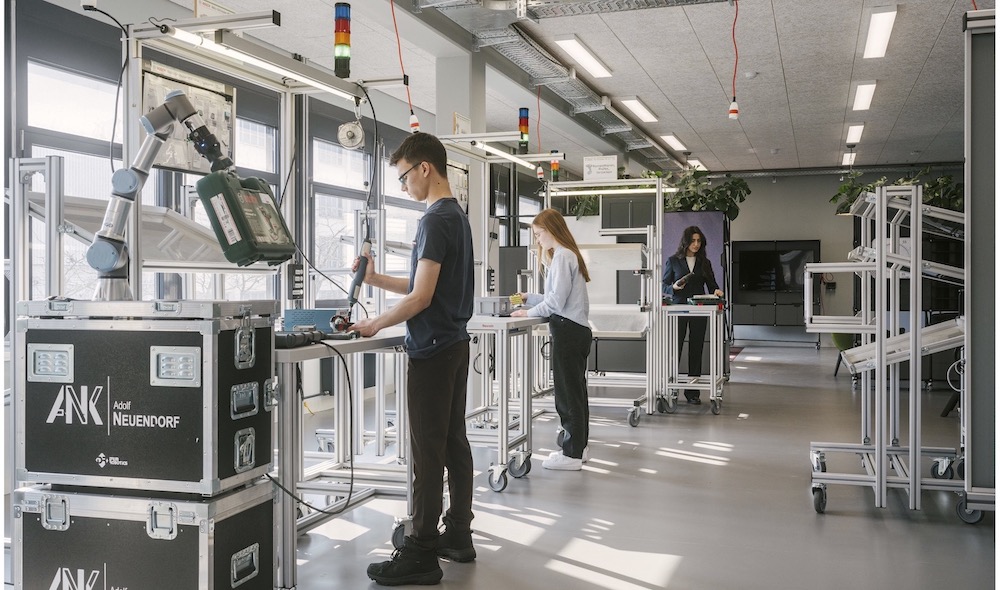
The Lean Factory is based on a practical assembly line as an integral part of the teaching concept. The assembly line was designed to implement the lean principles described and is made up of various elements, such as fully equipped workstations for assembly and quality inspection, a “Heijunka Board” for leveling production and supermarkets as a storage level within production. Assembly activities are carried out as part of simulation exercises and production is controlled decentrally using Kanban. Physical cards show the stock and order situation according to the pull principle. This enables the design of efficient
production in the customer cycle [9].
Development step 1: Digitalization of the assembly line
Building on the analog assembly line to teach the basics of lean production, the first stage of development involves fully integrating the workstations and materials with state-of-the-art information and communication technology. Monitors with touch screen functions provide the assembly stations with all the necessary process data and information in real time.
The basis for real-time monitoring of production is the networking of all value-adding instances with RFID transponders and readers. Each workpiece is fitted with a transponder and each workstation is equipped with a reader. The supermarkets are also equipped with sensors that enable electronic recording of stock levels. With the integration of these technologies, the entire material flow within the assembly line is digitally recorded. Throughput times, processing times per assembly station, storage times and stocks, as
well as defective rejects are recorded digitally in real time and without distortion.
The digital transformation forms the basis for the seamless implementation of the electronic Kanban system (e-Kanban). The physical cards previously used in the Kanban control loop are replaced by an IT system that displays inventory and consumption data in real time [9].
The possibilities for process optimization are expanded by the described integration of workstations and materials with information and communication technology. To give students a deeper insight into Industry 4.0, the Lean Factory provides a highly automated production system and a collaborative robot arm (cobot). PCB production is simulated on the highly automated production system. Modular tools and a simulation program on the production plant’s control computer allow any changes to be made to the automated processes.
The cobot is integrated into the existing assembly line. It is installed at an assembly station and can respond to various commands (e.g. assembling components or fixing screws). Commands are entered collaboratively by tapping it. Integrated sensors prevent injuries to fitters while working with the robot.
The expansion of the Lean Factory assembly line with digital applications, an automated production system and a robot enables students to experience the added value of Industry 4.0 and promotes awareness of human-machine interactions.
The first development step of the Lean Factory is aimed at optimizing the assembly line through digitalization. A further step expands the scope of the Lean Factory to include the field of design thinking. In addition to the KPI-based methods in production with a fixed process, a contrary approach is deliberately implemented.
Development step 2: Implementation of design thinking
Design thinking is a way of thinking that aims to find innovative solutions to problems. This approach focuses on the needs and requirements of users. To this end, it always takes the user’s perspective. Design thinking is generally applicable and opens up a wide range of possibilities for driving innovation and user orientation in various areas. One example of this is the development of products or services from the customer’s perspective in order to improve the user experience and strengthen customer loyalty. In process optimization, it enables the design of efficient and user-oriented processes [10]. It therefore
correlates with the lean concept described at the beginning.
The predominantly applied and purely analytical thinking for problem solving in companies is referred to as inductive or deductive reasoning [11]. Both logics are based on valid premises and real information [12]. In design thinking, however, abductive logic is also used [13]. Abduction is the process by which a hypothesis explains surprising or anomalous information [14]. It’s therefore sometimes equated with intuition [11]. In order to integrate intuition more strongly into the innovation process, design thinking
contains three core elements. These include the variable space, multidisciplinary teams and an iterative approach.
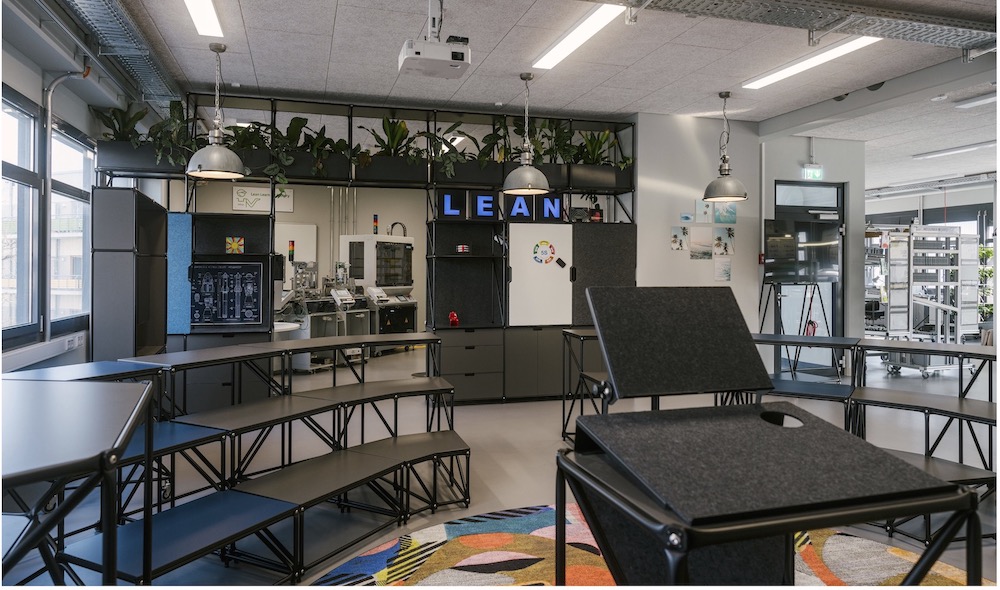
The Lean Factory provides the variable space. The furniture used from “System 180” [15] is modular and equipped with castors. All participants have the option of adapting the space to suit the situation, e.g. for more quiet or more exchange. Various materials are available to visualize ideas quickly and clearly. Stopwatches help separate the project phases in terms of time. Possible project phases are described in the following section. These phases are run through iteratively by multidisciplinary teams. Iteration is of crucial importance in order to discuss as many different views and opinions as possible and thus
determine the optimal solution for the user [10].
The Lean Factory in teaching
As a concrete example of the use of the lean factory in teaching, one of numerous simulation games is described below. All the development steps of the Lean Factory currentdescribed are incorporated into the simulation: the assembly line, digitization and the integration of design thinking. The aim of the simulation game described here is to supply irregular customer orders of a simple product with different variants according to the pull principle.
The literature shows different perspectives on the concept of a simulation game [16, 17]. As a rule, it is understood as a real system whose parameters can be changed by the player. This leads to a new system, which in turn is the starting point for new interventions [18]. In the example shown, it is the practical assembly line whose modular components can be variably arranged and used.
The actors are provided with the appropriate resources to assemble the product in different variants. It is crucial that the players play a dual role. On the one hand, they are part of the system and influence the process through their actions. On the other hand, they should observe the system to discuss their solutions in the workshops [17]. In this example, the students iteratively develop solutions during the simulation game in the specified project phases: “observe”, “understand”, “define point of view”, “ideate
and “prototype”.
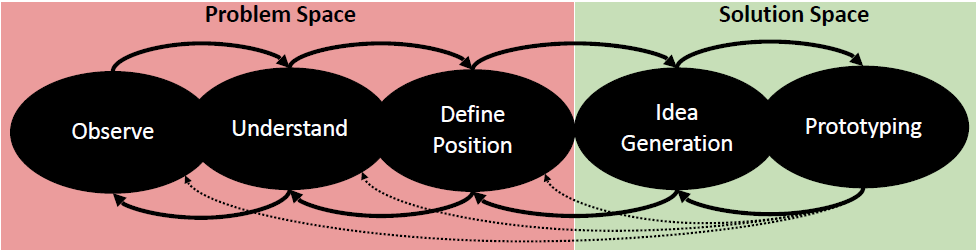
In the first round, the assembly of the product is played through with all parameters in the initial situation specified by the lecturers. The “observe” and “understand” project phases run in parallel. The networking of the assembly line carried out in the first development stage of the Lean Factory helps students to identify and analyze problems (e.g. bottlenecks, high stock levels, quality defects). The third phase, “define point of view”, has the primary goal of formulating a precise question for the subsequent idea generation phase. In the “ideate” phase, the aim is to generate a large number of ideas in a comparatively short
time.
The focus is on quantity and not quality when it comes to ideas that can contain or describe a solution. To
this end, multidisciplinary teams are assembled whose participants are assigned different roles beforehand and in which at least one member takes on the role of the user. The teams are distributed throughout the LeanFactory and use the variable space from the design thinking approach. The modular furnishings are moved, rooms are opened or closed. The groups use whiteboards, colored paper, modelling clay and Lego, among other things, to visualize and discuss their ideas. This is followed by the
“prototype” phase, in which the assembly line is rearranged and the new processes are discussed.
The new production prototype is then the starting point for the second round of the game. The students play four rounds. They then analyze the change in the previously defined KPIs and check whether production has been successfully optimized.
The design thinking process is divided into two overarching “spaces”. While the participants are in the problem space in the “observe”, “understand” and “define point of view” phases, they switch to the solution space in the “ideate” and “prototype” phases. Convergent and divergent thinking alternate in both “spaces”.
In the divergent thinking mode, an unconventional approach is taken with the generation of a variety of ideas, the collection of information, the inclusion of new perspectives and the willingness to take risks.
In the convergent thinking mode, on the other hand, the available information and ideas are analyzed in order to find answers to the problem using logic [19]. With each iteration step, the scope of options and ideas from divergent thinking becomes smaller and more detailed than in the previous iteration [20]. In this way, students arrive at realistic and feasible solutions.
Design thinking for lean production?
The Lean Factory at HTW Berlin has established itself as an innovative teaching and learning space that proactively addresses the challenges of the modern labor market. By combining an assembly line with the design thinking approach, the Lean Factory offers a space in which students can develop practical and interdisciplinary problem-solving skills. The implementation of Design Thinking in the Lean Factory is at an early stage. A research project is currentdescribedly being designed to investigate the actual influence of design thinking on creativity and problem-solving skills.
The project includes a study that uses experimental business games to investigate the comparison between design thinking and “traditional” methods of production optimization. It remains to be seen to what extent the implementation of design thinking influences the problem-solving skills of the test subjects and whether a design thinking proves to be a valuable addition to the production environment.
Bibliography
[1] Stifterverband für die Deutsche Wissenschaft e.V.: Hochschul-Bildungs-Report 2020. Für Morgen befähigen. Jahresbericht 2019. URL: www.hochschulbildungsreport2020.de/downloads, Accessed 21.02.2024.[2] Eilers, S.; Möckel, K. et al: HR-Report 2018. Schwerpunkt Agile Organisation auf dem Prüfstand. Eine empirische Studie des Instituts für Beschäftigung und Employability IBE im Auftrag von Hays. Weinheim 2018.
[3] Cassini Consulting: Personalmanagement in agilen Unternehmen. URL: cassini.cdn.prismic.io/cassini/60130fc3-499c-49b9-9ab0-9906bb2c0788_cassini_studie_agile_hr.pdf, Accessed 13.02.2024.
[4] Schön, E.-M.; Diebold, P. et al: Der Umgang mit Agilität in der Unternehmenskultur. Berlin Heidelberg 2023.
[5] Abrahamsson, P.; Salo, O. et al: Agile Software Development Methods. Finland 2002.
[6] Bertagnolli, F.: Lean Empowerment. Die konsequente Fortsetzung von Lean Leadership. Stuttgart 2023.
[7] Liker, J.; Meier, D.: Der Toyota Weg Praxisbuch, 8. Auflage. Munich 2018.
[8] Abawi, D.; Ahrens, V. et al: Das Studium des Wirtschaftsingenieurwesens. In: Fakultäten- und Fachbereichstag Wirtschaftsingenieurwesen e. V.; Verband Deutscher Wirtschaftsingenieure e. V. (Hrsg): Qualifikationsrahmen Wirtschaftsingenieurwesen. Stuttgart 2019.
[9] Dickmann, P.: Schlanker Materialfluss mit Lean Production, Kanban und Innovationen, 3. Auflage. Berlin Heidelberg 2015.
[10] Plattner, H.; Meinel, C. et al: Design Tinking. Innovationen lernen – Ideenwelten öffnen. Munich 2009.
[11] Blatt, M.; Sauvonnet, E.: Wo ist das Problem? Mit Design Thinking Innovationen entwickeln und umsetzen. München 2017.
[12] Fetchenhauer, D.: Psychologie, 1. Auflage. München 2012.
[13] Adler, I.; Lucena, B. et al: Design Thinking. Innovation im Unternehmen. Berlin 2014.
[14] Dew, N.: Abduction. A pre-condition for the intelligent design of strategy. In: Journal of Business Strategy 28 (2007) 4, S. 38-45.
[15] System 180 GmbH: Workshop Möbel. URL: www.system180.com/workshop/, Accessed 12.03.2024.
[16] Kriz, W.: Planspiel. In: Kühl, S.; Strodtholz, P. u. a. (Hrsg): Quantitative Methoden der Organisationsforschung. Wiesbaden 2005.
[17] Merz, W.: Volkswirtschaftliche Planspiele im Hochschulunterricht. Ludwigsburg Berlin 1993.
[18] Euler, D.: Didaktik des computerunterstützten Lernens. Praktische Gestaltung und theoretische Grundlagen, 1. Auflage. Nuremberg 1992.
[19] Freudenthaler-Mayrhofer, D.; Sposato, T.: Corporate Design Thinking. Wie Unternehmen ihre Innovationen erfolgreich gestalten. Wiesbaden 2017.
[20] Brown, T.: Change by Design. Wie Design Thinking Organisationen verändert und zu mehr Innovationen führt. Munich 2016.
[21] Hasso-Plattner-Institut (HPI): Was ist Design Thinking? URL: hpi-academy.de/design-thinking/was-ist-design-thinking/, Accessed 10.06.2024
You might also be interested in