
GAIA-X Maturity Model |
Assessing the future viability of cross-company data exchange
| Journal | Industry 4.0 Science |
| Issue | Volume 40, 2024, Edition 3, Pages 14-20 |
| Bibliography | Share | Cite | Download |
Abstract
Keywords
Article
Manufacturing companies are facing major challenges today. They have to meet the ever-increasing demands of their customer markets, while international competition and globalization are leading to ever faster processes and highly fluctuating product demand under high cost pressure. At the same time, innovation cycles are becoming shorter and production processes more complex. To counter these changes, companies are increasingly concentrating on their core competencies, reducing their vertical integration and forming cooperations and corresponding value creation networks [1].
The efficiency of these value creation networks depends largely on communication and the exchange of data, making it a central element. At the same time, the entire industrial value chain is undergoing fundamental changes due to factors such as the circular economy, Industry 4.0 and digitalization. This is leading to the creation of digital infrastructures that open up innovative use of data and thus present new opportunities for value creation. As a result, data is also gaining in importance as a strategic resource and can significantly increase productivity in the digital industry.
GAIA-X: An initiative for digital sovereignty in the EU
Data exchange within a company is still often a challenge, as the data is frequently stored in different systems and separated according to business processes. It becomes even more complex when data is exchanged between two companies. To improve this situation, in the fall of 2019 the European Union launched the GAIA-X project to create the next generation of data infrastructure for Europe and its companies [2]. The main goal of GAIA-X is to create a federated digital ecosystem that is open, transparent and secure [3].
In this ecosystem, data and services should follow common rules so that they can be created, combined and shared freely and securely. One key functionality is the provision of data sovereignty. This means that data owners are given control over their data and digital identities. This includes defining data usage restrictions that regulate who may perform which actions in which context with the data released by a data owner [4]. The aim is not to create a centralized cloud service, but to develop a federated information system that connects many providers and users of cloud services in a transparent environment in order to strengthen the European data economy as a whole.
GAIA-X Maturity Model: An instrument for determining digital status quo
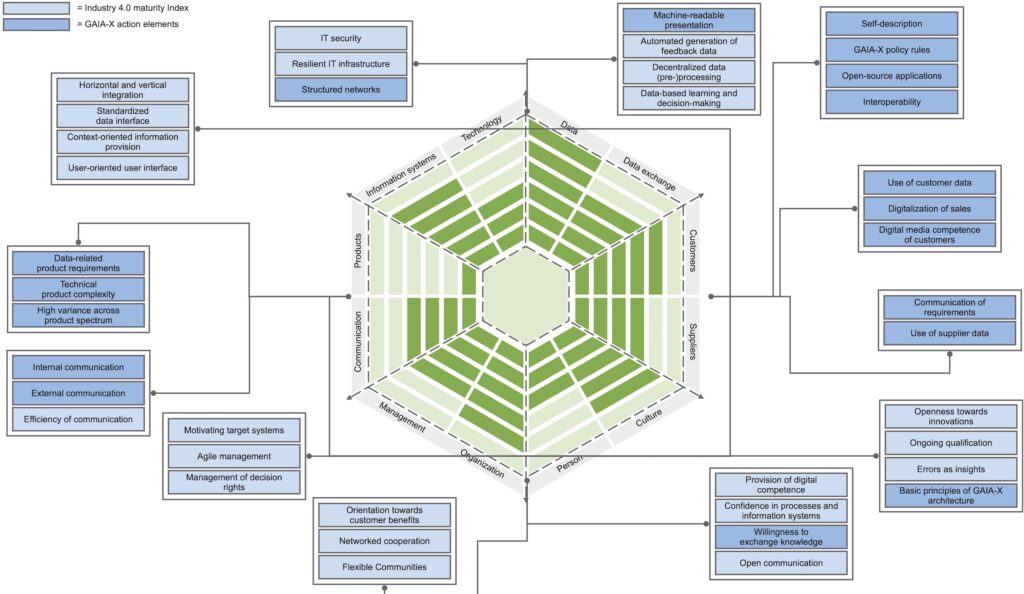
In order to enable companies to become full participants in the GAIA-X infrastructure and thus make cross-company data exchange and data processing more efficient, the GAIA-X maturity model acts as a tool for determining the digital status quo. It also serves to outline a development path for the successful implementation of GAIA-X. The basic components of the maturity model are shown in Figure 1. Overall, the model comprises six fields of action that encompass various aspects of an organization and ensure a holistic overview of progress.
These fields of action subdivide the area of analysis according to overarching criteria. By carefully selecting the fields of action, it can be ensured that all relevant facets of an organization are considered within the framework of the model objectives and that there is no one-sided view [5]. Each field of action is further subdivided into two guiding principles, which further specify the content-related delimitation of the area of investigation. The principles are in turn assigned to action elements that can be understood as levers with a high influence on the performance of the area of analysis. These action elements play an important role in the derivation and implementation of improvement measures, as they provide precise instructions for action.
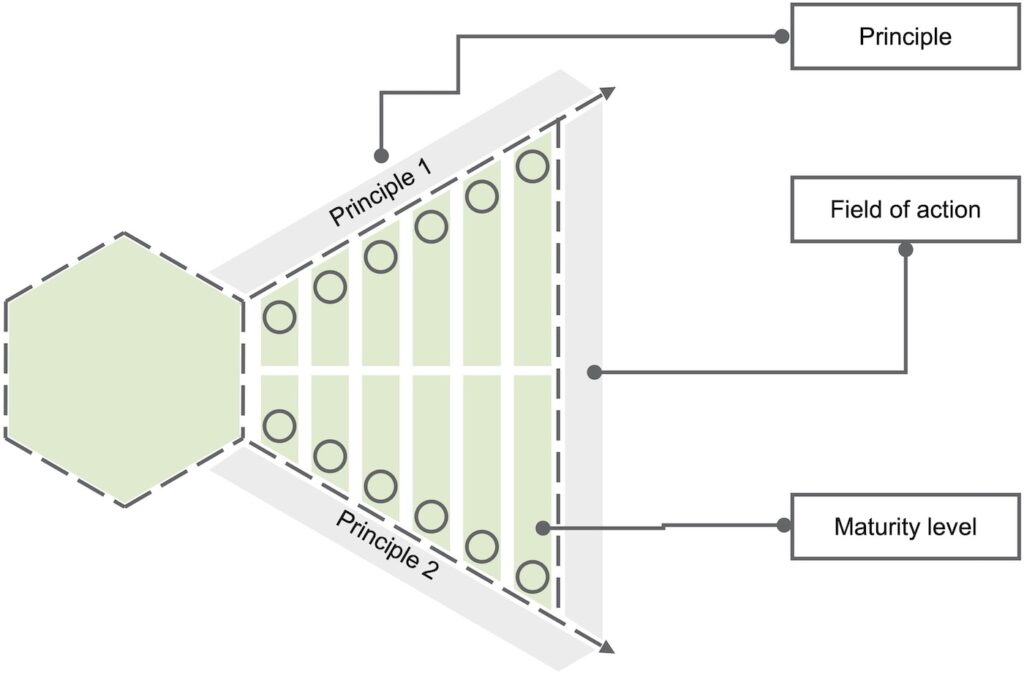
They are based on the maturity levels and form the basis for the transformation of manufacturing companies into agile organizations. The maturity levels are based on the assumption that the action elements can be at different stages of development. The more developed an action element is, the greater the benefit for the field of action or the company. A high level of maturity therefore corresponds to highly developed action elements.
The maturity model consists of six fields of action: Data and Data Exchange, Customers and Suppliers, People and Culture, Management and Organization, Communication and Products as well as Information Systems and Technology, all of which can be seen together with their associated action elements in the overview of the maturity model in Figure 2. As the declared aim of GAIA-X is to create a federated and secure data infrastructure in which interoperability between the participating organizations and the portability of data and services is guaranteed, the Data and Data Exchange field of action plays a central role. For this reason, this article will focus exclusively on this field of action. Nevertheless, the other fields of action are also important, as the digital transformation can only succeed if an organization is viewed holistically.
Data as a field of action: Data management for digital sovereignty
For the exemplary improvement of internal and external data exchange, the term “Data” must first be considered in more detail. Every company has a certain amount of knowledge that is converted into information, which in turn is converted into data that can be exchanged inside and outside the company [6]. Securing a dataset is crucial to maintaining its value. If a dataset becomes publicly accessible and even possibly obtainable free of charge, it does not lose its value, but the willingness of potential buyers to pay for it decreases significantly [7]. In order to exploit the economic potential of data, it must be protected from unauthorized access in order to preserve data sovereignty.
The basis for establishing data sovereignty and participating in a federated and secure data infrastructure is a machine-readable presentation of the data. More specifically, this means that data should be available in a standardized and structured format that can be easily interpreted and processed by computers and software applications. This enables seamless data exchange between different systems without the need for manual intervention or conversion.
In addition to the standardized and structured presentation of data, the automated generation of feedback data plays a central role. In the area of technical resources, the focus is on the further development of cyber-physical systems (CPS) [8]. These systems integrate mechatronic components with embedded systems such as sensors, actuators and information processing as well as a communication layer. Machines and systems are already equipped with a large number of sensors that mainly monitor technical processes and enable short-term interventions for control purposes. In addition to physical measurement, the localization of objects is crucial for monitoring business processes and generating feedback data. Aside from sensors and actuators, embedded systems constitute a further important component in cyber-physical systems. They act as a link between the communication layer and the electromechanical components (actuators).
Ever smaller and more cost-effective computing units are becoming possible thanks to improved computing power and a reduction in the size of transistors. This enables the decentralization of pre-processing computing operations and their coupling with technical resources. Time-critical calculations can be carried out faster, which favors the development of new applications by shortening signal propagation times.
Manufacturing companies are not only exposed to shorter lead times, but also to rapidly evolving innovation cycles. As a result, they must be able to react appropriately to changes in the business environment at ever shorter intervals. At the same time, it is crucial to quickly recognize emerging errors and identify their causes. A data-based understanding of the sources of errors is necessary in order to be able to react promptly. This requires continuous monitoring of the value creation processes, which is ensured by collecting suitable data and comparing the resulting digital image with the actual conditions and deriving suitable measures. Employees must have confidence in this database and be prepared to learn from it and base their decisions on it [8].
Data exchange: Foundations for effective collaboration
A central concern of GAIA-X is to improve the exchange of data between the individual participants. Compliance with the GAIA-X principles, which include self-description, is mandatory for participants. Self-description is a core element of the GAIA-X architecture and is essential for the smooth functioning of the network. It includes a description of each participant’s user profile and possibly their range of services in a standardized format. Participants are asked to provide information about their company, their data and their service offerings in the self-description, which can then be checked and verified by other network members. The self-description enables clear and trustworthy identification of the participants in a data room (and beyond). This creates trust and identity and facilitates decentralized interactions [3].
Another important point is compliance with the GAIA-X Policy Rules. The responsible GAIA-X committee has drafted a set of rules and general regulations that are intended to serve as the basis for GAIA-X and its associated processes. Participants must accept these rules and integrate them into their business processes.
One of the main activities necessary to realize the potential and minimize the risks of data exchange is the creation of open-source applications to implement the federated and secure data infrastructure [7]. Open-source applications based on open standards and protocols facilitate interoperability between different systems and services. This is crucial for realizing the vision of GAIA-X as an open and transparent data infrastructure. By using open-source software, different providers and solutions can be seamlessly integrated, eliminating dependence on proprietary technologies or closed systems.
Interoperability is considered to be one of the architectural principles of GAIA-X. It is defined as the ability of systems or entities to provide services to other systems or entities, to receive services from other systems or entities and to use these exchanged services to enable efficient joint operation [9]. In the context of GAIA-X, interoperability is understood as the seamless cooperation and efficient exchange of data and services between different actors. To achieve this, all GAIA-X participants must be able to interact with each other in a precisely defined and standardized manner.
Key elements of the GAIA-X Maturity Model: Evaluation of your own company
The GAIA-X maturity model is based on the Industry 4.0 Maturity Index designed by acatech and consists of both action elements that have been adopted from the Industry 4.0 Maturity Index as well as elements that have been developed specifically for GAIA-X. The added action elements are specifically aimed at expanding the scope of the acatech Industry 4.0 Maturity Index to include the implementation of GAIA-X and cross-company data exchange. Using the maturity matrix shown in Figure 3, the GAIA-X-specific action elements are specified in more detail based on the maturity levels of the Industry 4.0 Maturity Index. For each action element in the maturity matrix, it is specified which characteristics are available at each maturity level and which are not, thus defining clear requirements which companies must fulfill in order to reach the respective maturity level of the respective action element.
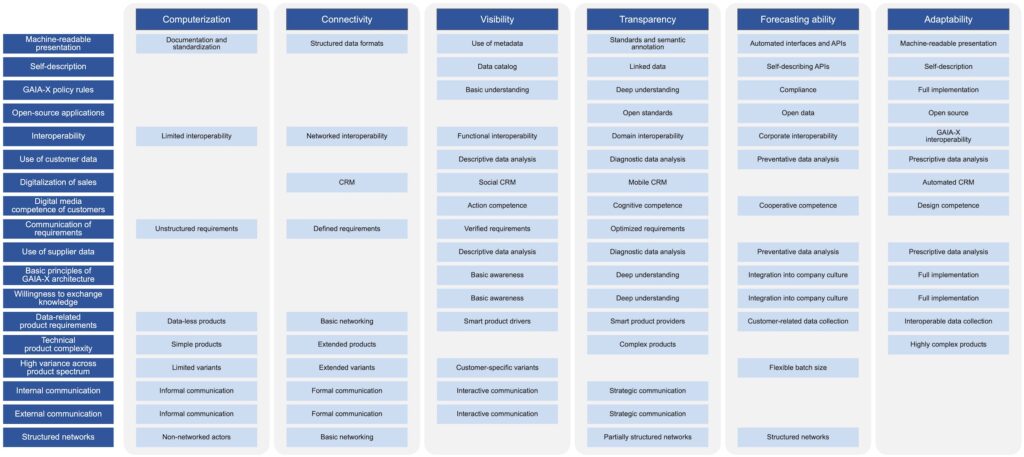
The model developed represents the first version of a holistic, maturity-based approach to evaluating a company’s ability to implement GAIA-X. It defines specific requirements for each maturity level through action elements that show a development path for companies to become fully-fledged GAIA-X participants. However, part of the task of future research could lie in the development of an application concept, e.g. in the form of questionnaires, or the development of a maturity model with maturity levels that have been developed specifically for GAIA-X.
This contribution was funded by the Federal Ministry of Education and Research under the grant no. 02J21D001.
Bibliography
[1] Spath, D.; Westkämper, E.; Bullinger, H.-J.; Warnecke, H.-J.: Neue Entwicklungen in der Unternehmensorganisation. Berlin 2017 .[2] Braud, A.; Fromentoux, G.; Radier, B.; Le Grand, O.: The Road to European Digital Sovereignty with Gaia-X and IDSA. In: IEEE Network 35 (2021) 2, pp. 4-5 .
[3] Gaia-X European Association for Data and Cloud AISBL (ed.): Gaia-X Federation Services (GXFS). Gaia-X Ecosvstem Kickstarter. White paper. Brussels 2021 .
[4] German Federal Ministry for Economic Affairs and Energy (BMWi) (ed.): GAIA-X: Policy Rules and Architecture of Standards. Berlin 2020 .
[5] Christiansen, S.-K.; Gausemeier, J.: Klassifikation von Reifegradmodellen. In: Zeitschrift für wirtschaftlichen Fabrikbetrieb 105 (2010) 4, pp. 344-49 .
[6] German Federal Ministry of Economic Affairs and Climate Action (BMWK) (ed.): Souveräner Datenaustausch als Enabler Künstlicher Intelligenz. Stand der Erkenntnisse aus der Industrie und Praxis. White paper. Berlin 2022 .
[7] Rusche, C.: Einführung in Gaia-X. Hintergrund, Ziele und Aufbau. Report. Cologne 2022 .
[8] Schuh, G.; Anderl, R.; Dumitrescu, R.; Krüg, A.; Hompel, M. t.: Industrie 4.0 Maturity Index. Die digitale Transformation von Unternehmen gestalten (Update 2020) Study. 2020 .
[9] Wunder, M.; Grosche, J.: Verteilte Führungsinformationssysteme. Berlin 2009.
You might also be interested in