
Machine Learning to Promote Sustainability |
Company analysis based on expert interviews
| Journal | Industry 4.0 Science |
| Issue | Volume 41, Edition 4, Pages 44-51 |
| Bibliography | Share | Cite | Download |
Abstract
Keywords
Article
Climate change is threatening both the Earth and its population, with a global warming of 1.5°C predicted to lead to extreme environmental conditions [1]. Without proactive measures, the needs of future generations will inevitably be jeopardized [2]. Digitalization measures are often presented as a potential tool to counter this development. Artificial intelligence, especially the subfield of machine learning, can improve sustainability efforts, for example by analyzing data and making decision forecasts [3]. Machine learning thereby has the potential to assist in reducing pollution, improving healthcare, and promoting equality. Nevertheless, the technology carries numerous risks due to potential miscalculations [4].
This study addresses the question: “How is machine learning used to promote environmental and social sustainability components in companies?” The interviews provide insight into strategies for introducing machine learning, outline use cases in companies and their impact on environmental and social sustainability, and propose existing opportunities and challenges related to the technology and its impact on sustainability.
Increased corporate responsibility for sustainability
In the Brundtland Report, the United Nations defines sustainability as the principle of meeting the needs of the present generation without compromising the ability of future generations to meet their own needs [5]. This definition was expanded in Agenda 21 to determine three (equally important) dimensions of sustainability: social, ecological, and economic [6].
To hold companies accountable for their environmental and social responsibility, the European Union adopted the Corporate Sustainability Reporting Directive (CSRD) [7] and the Corporate Sustainability Due Diligence Directive (CSDDD) [8]. As a result, companies are obliged to integrate ecological, social, and economic aspects into their corporate strategy and daily operations [9]. The aim of this study is to discuss how machine learning can contribute to this process.
Forms of artificial intelligence
Machine learning is a subfield of artificial intelligence (AI) in which computer agents can improve themselves based on data. With the goal of extracting information from a system, algorithms are used to recognize patterns, make predictions, and support decision-making processes [10].
In a supervised learning environment, algorithms are trained with labeled data and then validated with test data [11]. Regression (prediction of values through function approximation [12]) and classification (categorical assignment [13]) are based on supervised learning. Support vector machines and k-nearest neighbor algorithms [14] are suitable for both regression and classification. K-nearest neighbor is used in computer vision with the aim of analyzing and understanding visual scenes from the real world [15].
In an unsupervised learning environment, algorithms work with unlabeled data, often for clustering. A common method is K-means clustering [16]. Reinforcement learning is based on a reward-punishment principle for computer agents, which is often modeled using the Markov decision process (MDP) [17]. Deep learning uses neural networks to process large amounts of data with minimal preprocessing [16]. Neural networks are used, among other things, in natural language processing (NLP), which recognizes, understands, and generates human language [18]. Machine learning is often implemented as part of the CRISP-DM process, which provides a structured approach to data mining [19].
Description of the interview sample
The research results [20] are collected in ten exploratory qualitative expert interviews. The interviews are intended to close the research gap identified in a prior literature review. The experts are sustainability managers, AI project managers, machine learning developers, and executives from the automotive industry, the energy sector, the IT industry, and management consulting. The experts work in both small and medium-sized enterprises (SMEs) and large corporations and are all male. All interviews were recorded and transcribed. The qualitative content analysis is carried out using a deductive-inductive approach [21].
Leveraging machine learning to promote corporate sustainability
The interviews [20] show that implementing machine learning in companies is predominantly economically motivated. Nevertheless, the interview participants emphasize that ecology is part of their companies’ business plans and is integrated into corporate strategy. In any case, ecological improvements made via the use of machine learning often also drive economic potential (for example through resource savings). Only one expert cites the social driver of improving the working environment. Regulatory frameworks are also driving companies to implement machine learning use cases to meet requirements with less effort.
In SMEs, management initiates the introduction of machine learning by discussing possible solutions with machine learning providers. Experts report that employees in some SMEs do not have the necessary knowledge to assess the potential of machine learning in their field. In addition, time capacities are limited. Top-down initiatives are therefore predominant in SMEs. In larger companies, both top-down and bottom-up initiatives can be observed. According to experts, bottom-up initiatives require a promoter who drives action by forming networks between motivated employees.
The experts agree that the introduction of machine learning use cases to promote sustainability can be optimized through a mature machine learning strategy. However, the companies using machine learning often lack such comprehensive strategies. As a rule, machine learning solution providers carry out a proof-of-concept and implement a prototype solution within the company, which represents a step on from a pure feasibility study toward practical implementation. This process, based on information from the experts surveyed, is shown in Figure 1.
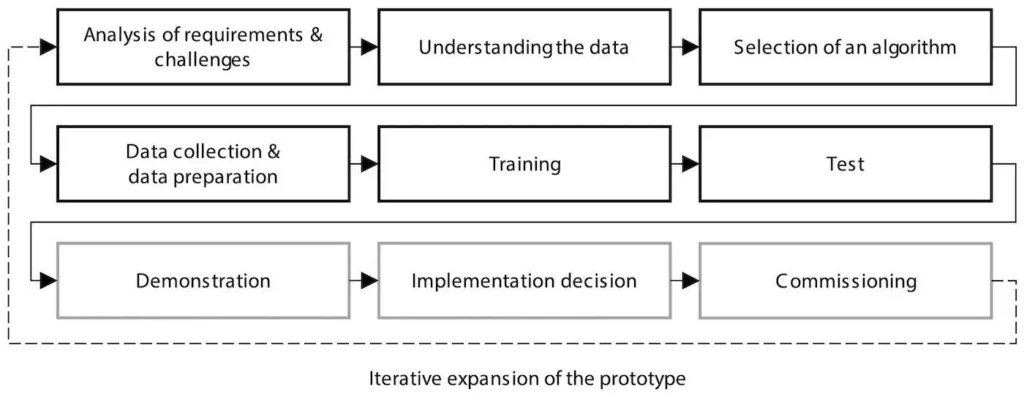
In the first step of the process, the existing challenges to be addressed with machine learning are analyzed and the requirements defined. Understanding the data is an important step before selecting an algorithm. This step is followed by data collection and data preparation. Prototypes are usually trained with a public data set to avoid data leaks. After successful testing, the prototype is integrated into the customer’s system. Its functionality is demonstrated in real time with safety buffers. The customer’s management makes the implementation decision depending on functionality, costs, trust, and the current market situation. After commissioning, the prototype is expanded in iterative steps.
Relevant use cases
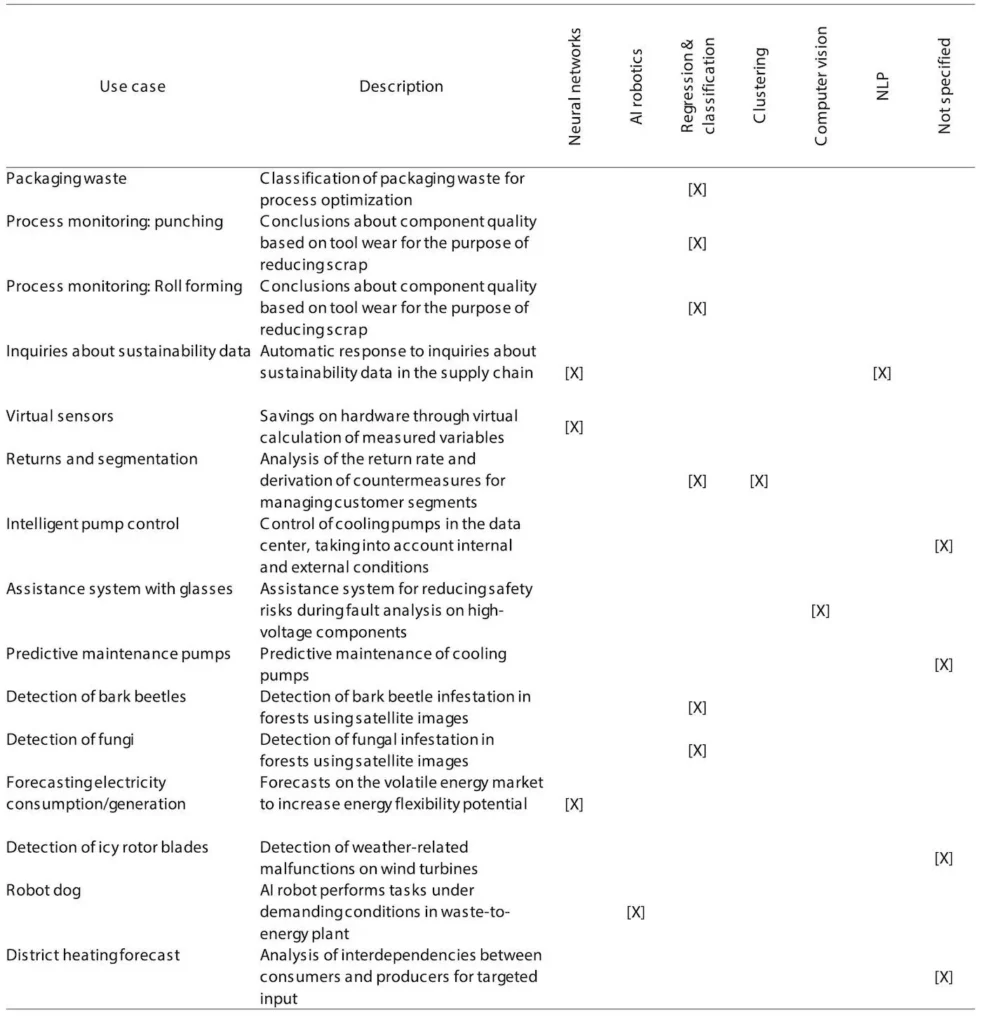
The experts [20] describe 15 machine learning use cases that contribute to corporate sustainability. One specific use case focuses on predicting electricity consumption and generation. In this case, a neural network-based application by an energy supplier ensures the electricity supply to private households. The use of machine learning is particularly important here in view of the fluctuating generation from renewable energy sources. Other use cases include detecting pest infestations in forests, controlling cooling pumps, and automatically processing requests for sustainability data in supply chains.
The use cases described are based on supervised, unsupervised, and reinforcement learning, with supervised learning being the most prominent. Some experts were unable to provide details on algorithms. The most common methods in the context of sustainability are classification and regression. An overview of all use cases with their corresponding machine learning methods is shown in Figure 2.
Impact of machine learning use cases on sustainability
The expert survey [20] outlines largely positive effects of machine learning on corporate sustainability. However, most experts find these difficult to quantify. The use cases examined reduce material consumption by reducing packaging material, waste material, and the need for replacement parts. In addition, electricity consumption can be reduced by up to 30%, which reduces greenhouse gas emissions. Two use cases promote biodiversity by protecting the ecosystem. In the social dimension, employee safety and motivation increase in the use cases. Overall, however, ecological effects outweigh social effects.
That said, machine learning also negatively impacts sustainability, as algorithms run on hardware made from precious metals and require electrical energy. Some experts emphasize the high-power consumption for training, while others claim that the energy consumed in training and operating the algorithm is negligible. Negative effects on a social dimension were not mentioned in the interviews. According to experts, meaningful metrics that go beyond greenhouse gas emissions are needed to quantify the positive effects of artificial intelligence on sustainability.
Opportunities and challenges in the use of machine learning
The experts surveyed [20] observe that most staff trust machine learning technology. Only older employees can sometimes approach it with skepticism, which is reinforced by the lack of transparency in the model results and questionable data security. Without financial support programs, proof-of-concepts often exceed the available funds. Only rarely is it investigated how existing data could be used profitably, which is often due to poor communication within the organization. This results in an unstructured database with poor data quality.
AI as a Service offers hope for a more efficient implementation, especially for companies with limited expertise and capacity. Centralizing computing power in data centers and optimizing algorithms could also potentially reduce energy consumption in the future. Machine learning could potentially inform interactions between different sustainability dimensions, thereby supporting the selection of suitable sustainability measures.
Findings and critical assessment
Literature often describes the IT department as the primary driver behind the introduction of machine learning [22], although, according to expert interviews, it is usually management that takes on this role, at least in SMEs. The literature also shows that machine learning strategies should involve all employees, which is rarely the case, despite the positive impact it has on implementation [23].
Both the literature and the interviews agree that a mature machine learning strategy has a particularly strong influence on successful implementation. Such a strategy contributes to transparency and communication, thereby reducing internal resistance. The experts surveyed outline a practice-oriented, iterative development process reminiscent of CRISP-DM [19]. In the literature, such process descriptions tend to omit decision-making on machine learning-based sustainability measures.
Use cases from literature come from the fields of energy, water, biodiversity, transportation, smart cities, health, and climate change. Internal company use cases are poorly documented, presumably for reasons of confidentiality. Internal company and scientific use cases overlap in the categories of energy and biodiversity but in hardly any other categories—possibly due to the focus of the interviews on economically driven organizations.
Supervised learning dominates in both practice and literature [24], while unsupervised or reinforcement learning has hardly been used to date. This may be because the results of unsupervised and reinforcement learning are less transparent than those of supervised learning, which is in line with the skepticism expressed by employees regarding the model results [20]. Consequently, further efforts are needed to harness both forms of machine learning in promoting sustainability.
Classification, regression, neural networks, computer vision, and NLP are methods that are frequently used in both literature and practice. These methods appear to be particularly relevant in the context of sustainability. However, some experts were unable to provide technical details, so a more technology-focused sample could provide further insight.
The literature emphasizes both positive (for example emission reduction and health promotion) and negative effects of machine learning (for example energy-intensive training and discrimination due to biased data). The literature calls for energy-efficient hardware and less computationally intensive models. This optimization of hardware and software is intended to reduce greenhouse gas emissions [25]. In the interviews, the focus is clearly on positive ecological impacts, especially emission reduction, while social potential remains largely untapped. As a first step, organizations could investigate using machine learning to improve working conditions.
When compared to the literature, the experts surveyed classify the negative ecological effects of training as less drastic, despite some disagreement. This can be explained by the varying degrees of complexity of the models used. Many of the models identified can be trained on standard hardware, which is why some assume a lower energy intensity. However, there are other models that require a higher computing capacity [20].
The literature sees quantifying the impact of machine learning on sustainability as a challenge [3] due to a lack of defined goals [26]. The experts surveyed see the challenge in the lack of suitable metrics. The development of suitable metrics therefore represents a further area for research.
Expert interviews and literature identify similar challenges: mistrust among older employees, data protection concerns, financial constraints, lack of knowledge, and a high degree of individualization [20, 27]. In addition, there are structural challenges such as a lack of overarching machine learning strategies and silo-like organizational structures. The resulting communication problems between IT and specialist departments make implementation difficult due to misunderstandings regarding the objectives and feasibility of machine learning use. These structural challenges often result in pilot projects without long-term scaling prospects.
Surveys show that 71% of companies in the manufacturing sector are already implementing initiatives to develop skills and mitigate concerns [28]. However, to have a lasting impact, these initiatives need to be strategically embedded in comprehensive transformation processes. Service models could reduce technical implementation barriers in the future if a clearly defined strategy with measurable goals is defined.
The importance of long-term, strategic integration
The results of the study show that, in practice, the potential of machine learning for promoting sustainability has not yet been realized, despite a strong will to do so. Companies should initiate machine learning to promote sustainability in a targeted manner, develop comprehensive machine learning strategies, foster skill acquisition, and address the problems with measurability surrounding the impact of machine learning on sustainability. Where existing capacity bottlenecks exist, companies should begin by raising employee awareness of sustainability and machine learning.
In line with CRISP-DM, further steps should include defining goals through specialist departments, reviewing and structuring the data pool together with IT, and identifying possible use cases [19]. The opportunity to use machine learning specifically for a holistic sustainability transformation is within reach if the technological, organizational, and cultural prerequisites are developed in the long term. Short-term implementation of machine learning to promote sustainability is usually not successful without strategic integration.
The authors would like to thank the Hessian Ministry of Science and Research, Arts and Culture for its financial support of the research project „LOEWE-Transfer-Professur“ (funding code: LOEWE/4TP/519/05/02.002(0002)/108).
Bibliography
[1] Badr, A.; El-Shazly, H.: Climate change and biodiversity loss: Interconnected Challenges and Priority measures. In: Catrina: The International Journal of Environmental Sciences 29 (2024) 1, pp. 69-78.[2] Masson-Delmotte, V.; Pörtner, H.; et al.: Häufig gestellte Fragen und Antworten: 1,5 °C Globale Erwärmung. Geneva 2018.
[3] Nishant, R.; Kennedy, M.; Corbett, J.: Artificial intelligence for sustainability: Challenges, opportunities, and a research agenda. In: International Journal of Information Management 53 (2020).
[4] European Commission: Mitteilung der Kommission an das Europäische Parlament, den Rat, den Europäischen Wirtschafts- und Sozialausschuss und den Ausschuss der Regionen: Förderung eines europäischen Konzepts für künstliche Intelligenz. Brussels, April 21, 2021.
[5] United Nations: Report of the World Commission on Environment and Development: Our Common Future. 1987.
[6] United Nations: Agenda 21. Rio de Janeiro, June 1, 1992.
[7] Ozen, O.; Nagel, L.; et al.: Addressing scope 3 categories for carbon accounting through a use-case at a scientific institute with a real production line. In: GCSM. Ho Chi Minh City 2024.
[8] European Commission: Richtlinie des Europäischen Parlaments und des Rates über die Sorgfaltspflichten von Unternehmen im Hinblick auf Nachhaltigkeit und zur Änderung der Richtlinie (EU) 2019/1937. Brussels, February 23, 2022.
[9] OECD: Corporate Sustainability. URL: https://www.oecd.org/en/topics/corporate-sustainability.html#:~:text=Corporate%20sustainability%20entails%20integrating%20environmental,long%2Dterm%20risks%20and%20opportunities, accessed 29.04.2025.
[10] Manning, C.: Artificial Intelligence Definitions. Stanford 2020.
[11] Buxmann, P.; Schmidt, H.: Grundlagen der Künstlichen Intelligenz und des Maschinellen Lernens. In: Buxmann, P.; Schmidt, H. (eds.): Künstliche Intelligenz: Mit Algorithmen zum wirtschaftlichen Erfolg (2019), pp. 3-17.
[12] Alpaydin, E.: Maschinelles Lernen. Berlin Boston 2019.
[13] Murphy, K.: Machine learning: A probabilistic perspective. Cambridge 2012.
[14] Anwar, A.; Ghany, K.; et al.: Human Ear Recognition Using Geometrical Features Extraction. In: Procedia Computer Science 65 (2015), pp. 529-537.
[15] Klette, R.: Concise Computer Vision: An Introduction into Theory and Algorithms. London 2014.
[16] Brynjolfsson, E.; McAfee, A.: The Business of Artificial Intelligence. URL: https://hbr.org/2017/07/the-business-of-artificial-intelligence, accessed 28.04.2025.
[17] Sutton, R.; Barto, A.: Reinforcement learning: An introduction, Cambridge London 2020.
[18] Kurdi, M.: Natural language processing and computational linguistics: Speech, Morphology and Syntax. London New York 2016.
[19] Shearer, C.: The CRISP-DM model: the new blueprint for data mining. In: Journal of Data Warehousing 5 (2000) 4, pp. 13-22.
[20] Bode, N.: Interview Transcripts: Driving Corporate Sustainability Through Artificial Intelligence. URL: https://doi.org/10.48328/tudatalib-1486, accessed 02.05.2025.
[21] Schreier, M.: Varianten qualitativer Inhaltsanalyse: Ein Wegweiser im Dickicht der Begrifflichkeiten. In: Forum: Qualitative Sozialforschung 15 (2014), pp. 27-50.
[22] Geretshuber, D.; Reese, H.: Künstliche Intelligenz in Unternehmen: Eine Befragung von 500 Entscheidern deutscher Unternehmen zum Status quo – mit Bewertungen und Handlungsoptionen von PwC. 2019.
[23] Cisco. Cisco-Umfrage: 42 Prozent der deutschen Firmen nutzen bereits KI. URL: https://news-blogs.cisco.com/emea/de/2023/10/19/cisco-umfrage-42-prozent-der-deutschen-firmen-nutzen-bereits-ki/, accessed 02.05.2025.
[24] Kar, A.; Choudhary, S.; et al.: How can artificial intelligence impact sustainability: A systematic literature review. In: Journal of Cleaner Production 376 (2022).
[25] Bolte, L.; Vandemeulebroucke, T.; et al.: From an Ethics of Carefulness to an Ethics of Desirability: Going Beyond Current Ethics Approaches to Sustainable AI. In: Sustainability 14 (2022) 4472.
[26] Crawford, K.; Whittaker, M.: The AI Now Report: The Social and Economic Implications of Artificial Intelligence Technologies in the Near Term. 2016.
[27] Rammer, C.: Herausforderungen beim Einsatz von Künstlicher Intelligenz: Ergebnisse einer Befragung von jungen und mittelständischen Unternehmen in Deutschland. Berlin 2021.
[28] Lane, M.; Williams, M.; Broecke, S.: The impact of AI on the workplace: Main findings from the OECD AI surveys of employers and workers. In: OECD Social, Employment and Migration Working Papers, No. 288. Paris 2023.
Your downloads
Potentials: Resource Efficiency
Solutions: Process Management
You might also be interested in