
Platform Business |
Increasing sustainability with digital business models

| Journal | Industry 4.0 Science |
| Issue | Volume 40, 2024, Edition 2, Pages 80-86 |
| Bibliography | Share | Cite | Download |
Abstract
Keywords
Article
The digital platforms developing in the context of Industry 4.0 enable a new type of value creation that is significantly more scalable. They are moving away from the traditional “pipeline” business model, which is essentially successful by optimizing its value chains, and towards the “network” business model, generating positive network effects by optimizing interactions between participants. Digital platforms have ushered in an era in which individuals and companies alike can create and capture value in unprecedented ways. Their importance should not be underestimated: The combined value of the two largest global platform companies, Apple and Microsoft, alone exceeded Germany’s entire gross domestic product in 2023.
Platforms and business models based on them have been around for years. However, the rapid development of information technology in recent years has substantially reduced the need for physical assets and infrastructure to create value. Digitalization enables platform participants to interact in extremely efficient ways. This lowers the barriers to accessing tangible and intangible goods, which in turn opens up opportunities to develop instruments that improve the sustainability of platform outcomes. This is where our considerations regarding the design of sustainable platforms come in.
Platforms that promote a more efficient use of existing resources are an exemplary scenario for this. Platforms such as TooGoodToGo [1] (reduction of food surplus), Cyrkle [2] (recycling of industrial waste) or Patch [3] (networking in the carbon credits market) represent successful examples. Through their transaction elements, these platforms not only optimize the use of resources, but also contribute to the reduction of waste and negative environmental impacts.
Furthermore, platforms can help to overcome barriers to innovation, especially in less developed markets. They provide a digital infrastructure that makes it possible to create new services and trade various goods. This access to digital resources promotes the development of creative solutions and supports the emergence of innovative services, even in regions with limited resources.
Digital platforms can be designed in a variety of ways to create a unique and sustainable value proposition. Decisions about governance mechanisms, such as levels of access and openness, pricing and competitive strategies, among others, influence the degree to which platforms can generate network effects and create value beyond their financial objectives.
We propose an innovative approach that can serve as a guiding compass for platform owners and operators. This approach enables decision-makers to identify key design decisions for platforms and set parameters that not only minimize negative consequences but also actively contribute to sustainability in the three dimensions of economic, environmental and social goals.
The digital platform business
Platforms are market intermediaries between two or more parties with a digital and modular architecture.
Platforms mediate transactions between two or more groups of actors [4]. Their key role is to facilitate interactions between users, whereby the value that the individual user derives from the platform increases with the total number of users on the platform [5]. These network effects are central to the value proposition of platforms and at the same time determine the competitive position of established platforms that have reached a critical mass of users and interaction intensity.
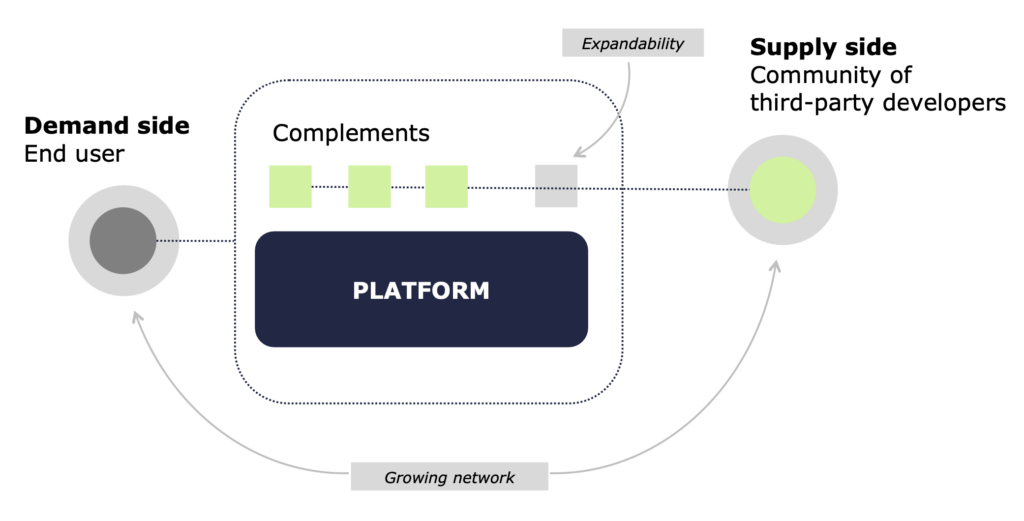
The underlying digital infrastructure of platforms enables specific social or environmental challenges to be tackled in a targeted manner [6]. By utilizing network effects and connectivity, achieving high scalability and facilitating the storage and exchange of data, digital platforms play a crucial role in overcoming barriers to sustainable development.
These barriers include difficulties in accessing resources, sharing information and mobilizing collective action. One such example is TooGoodToGo [7], a surplus food marketplace that enables users to easily discover unsold food, thereby reducing food waste and improving access to information. The company achieves direct network effects by encouraging stores and restaurants to offer their surplus food at a reduced price, which is highly attractive to consumers. In this way, it contributes to the overall goal of sustainable development by promoting a more accessible and environmentally conscious approach to consumer choices.
Platforms can be configured in a variety of ways to create a distinct value proposition that meets the needs of different stakeholders. However, their extensibility (the ability of innovators to develop new modules) and their expanding network (driven by network effects) also cause negative unintended consequences [8,9]. For example, platforms are criticized from a privacy perspective due to their inherent transaction monitoring. Their transactional and networking focus and the associated distance from traditional organizational structures opens the scope for questionable working practices and poor conditions for employees or subcontractors.
The shift away from more linear value creation processes towards multiple network-oriented flows of goods can be accompanied by increasing negative effects on the ecological environment, complicating attempts to attribute these according to the “polluter pays” principle. Last but not least, the value mechanisms based on network effects promote concentrated developments and even monopolistic structures with negative economic and social consequences.
Can digital platforms be designed in such a way that negative impacts are reduced or mitigated? The responsible design and implementation of business models is increasingly becoming the subject of research and policy. For example, the Responsible Research and Innovation (RRI) framework of the European Commission for Science and Technology encourages innovation for environmental or social benefits [10]. In scientific research, RRI is being developed as a design strategy that orients the innovation process towards achieving socially desirable goals [11].
For digital platforms, this means that the business model needs to be iterated throughout its lifecycle to ensure that it contributes to achieving environmental, social and economic benefits. Particularly in the early stages of platform development, owners may prioritize certain intermediate goals, such as achieving critical mass, occasionally prioritizing these over generating significant positive impact. As the platform develops and begins to have an impact, it becomes essential to adapt business model strategies to mitigate negative consequences and strengthen the contribution to sustainability.
The existing literature offers insights here that can inform decisions made by platform owners and operators and guide them towards optimizing platform value across all dimensions [12,13].
The sustainable platform business model
The business model comprises the creation, delivery and capture of value [14]. Success is determined by the functionality of these models. For platforms, success is determined in particular by the value created through the optimization of external interactions between participants. This optimization, which targets the number and quality of interactions, leads to more complementary modules (complements) and more participants on each side (achieved through network effects).
In order to design a sustainable digital platform, platform owners have various mechanisms at their disposal. These form the value propositions and include specific parameters that help to achieve sustainable growth by taking a stakeholder-centric approach.

Platform owners with an interest in sustainable development should ensure that complementary innovations on their platform are as non-harmful as possible or, better yet, make a positive contribution to sustainability. To achieve this, access control, trust systems and digital interfaces serve as instruments for regulating openness and access to the platform. Platform providers can, for example, set conditions for access to the platform or selectively exclude participants. Trust systems, which are based on user, platform or third-party ratings, are used to ensure quality in the sustainability dimensions across the entire platform.
In addition, access to applications is provided through digital interfaces or boundary resources. In the case of marketplaces, this could include setting conditions for registration, implementing a rating system and providing specific APIs for module development.
In this regard, legal frameworks such as the EU Digital Services Act (DSA)[15] play a central role in promoting responsible behavior by digital platforms. These regulations set out guidelines and obligations for online intermediaries and emphasize user safety, fundamental rights and a fair online environment. When designing sustainable platforms, compliance with such regulations becomes an integral aspect and influences decisions regarding access control, trust systems and digital interfaces. By incorporating these regulatory considerations, platform providers can improve their ability to responsibly regulate openness, access and subscriber behavior.
The iterative implementation of access control and trust mechanisms requires adjustments as the platform evolves and fosters complementary innovations. The effectiveness and applicability of each measure depends on its specific context and requires a reflective process to assess whether they achieve the platform owner’s desired value creation, delivery and capture outcomes. However, despite their contribution to mitigating undesirable participant behavior, these mechanisms fall short of fully encompassing the platform’s external and internal stakeholder relationships.
Sustainability through stakeholder-centric value creation
Platform operators must therefore take a stakeholder-centric approach that considers both internal and external stakeholders in the value creation and impact of the platform. Typically, platforms are designed to optimize value for their demand and supply sides. However, this economically based focus often ignores the environmental aspect or the directly and indirectly affected groups in the social context. In addition, network effects of digital platforms increase the complexity of predicting unintended negative consequences, as it is not immediately foreseeable how and why users will join and interact.
A stakeholder-centric perspective in platform design allows operators and owners to identify stakeholders early on and design offerings in a way that maximizes the value created for all or at least maintains the status quo by avoiding harm. The central question of how to develop a technology that benefits platform participants while also having a positive impact on society and the environment must be at the heart of the creation of a sustainable value proposition. Empirical studies suggest that platforms based on public-private partnerships may be more effective in creating sustainable value beyond profit maximization [16, 17].
An important aspect of stakeholder assessment for digital platforms is that it must be designed as a process of reflection and responsiveness. As the platform grows and its network effects are utilized, its scope for action also expands. A responsible and, above all, regular analysis of those affected by the platform’s activities is therefore necessary. This can be followed by a sustainability-oriented response and adaptation of the platform’s business model.
Assessing value capture across three dimensions
Transforming perceived benefits into social, environmental and economic value requires platform owners to think strategically about pricing, monetization and revenue streams.
For all platforms, it is crucial to establish sustainable financing mechanisms for smooth operations. This of course also applies to platforms that primarily aim to have a positive social or environmental impact. One approach is to emphasize the tangible environmental and social benefits for end users and thus justify payment fees that exceed the marginal cost of accessing the platform. Another viable strategy is to introduce membership fees that offer the benefit of recurring revenue. Membership fees, together with the expansion of platforms due to strong network effects, enable relatively low (perceived) fees for participants, while covering additional costs incurred by the sustainability goal of the platform.
In order to promote broad acceptance in society, a strategic mix of subsidization on the one hand and monetization on the other is proving to be extremely effective and should be considered. This can also ensure that the platform remains inclusive, i.e. accessible to a more diverse user base.
In addition, platform owners can implement pricing mechanisms that can better promote social inclusion and sustainability. For example, differentiated pricing and freemium pricing models can be used to set different prices for different income groups. This article supports platform providers in developing a strategy that steers their innovation process towards sustainability. In doing so, we focus on digital platforms that primarily create value through network effects. To ensure sustainability in social and environmental dimensions, a perspective that goes beyond organizational boundaries is required.
The “winner-take-all” nature of platform businesses generally makes it difficult to focus on sustainability at an early stage due to the dominance of network effects. However, this does not rule out the possibility that the fundamental orientation of the business model is geared towards achieving a positive sustainability effect or that this will move to the forefront of platform development through downstream adjustments to the business model mechanisms once critical mass is reached. We recommend an iterative and reactive design of the business model with the involvement of all stakeholders. In addition, platform owners are encouraged to use mechanisms such as effective governance, prioritization of sustainable design patterns, involvement of multiple stakeholders and use of technical interfaces.
If platform owners use the proposed framework to shape the business model element of their platforms, prospects for sustainable value creation will open up within all three key sustainability dimensions.
Bibliography
[1] TooGoodToGo. URL: www.toogoodtogo.com/de, Abrufdatum 25.02.2024.[2] Cyrkle. URL: cyrkl.com/en/marketplace, Abrufdatum 25.02.2024.
[3] Patch. URL: www.patch.io, Abrufdatum 25.02.2024.
[4] Eisenmann, T.; Parker, G.; Van Alstyne, M.: Strategies for Two-Sided Markets. In: Harvard Business Review 2006.
[5] Evans, D. S.; Schmalensee, R.: The New Economics of Multisided Platforms. In: Harvard Business Review 2016.
[6] Ciulli, F.; Kolk, A.; Boe-Lillegraven, S.: Circularity Brokers: Digital Platform Organizations and Waste Recovery in Food Supply Chains. In: Journal of Business Ethics 167 (2020), S. 299-331.
[7] Too Good To Go: Sustainability Report. 2022.
[8] Zuboff, S.: Big Other: Surveillance Capitalism and the Prospects of an Information Civilization. In: Journal of Information Technology 30 (2015), S. 75-89.
[9] Bonina, C.; Koskinen, K.; Eaton, B.; Gawer, A.: Digital Platforms for Development: Foundations and Research Agenda. In: Information Systems Journal 31 (2021), S. 869-902.
[10] Sutcliffe, H.: A Report on Responsible Research and Innovation. 2011.
[11] Von Schomberg, R.: A Vision of Responsible Research and Innovation. In: Responsible innovation: Managing the responsible emergence of science and innovation in society 2013, S. 51-74.
[12] George, G.; Bock, A. J.: The Business Model Book: Design, Build and Adapt Business Ideas That Drive Business Growth. London 2017.
[13] Lüdeke-Freund, F.; Carroux, S.; Alexandre Joyce; Massa, L.; Breuer, H.: The Sustainable Business Model Pattern Taxonomy – 45 Patterns to Support Sustainability-Oriented Business Model Innovation. In: Sustainable Production and Consumption 15 (2018), S. 145-162.
[14] Teece, D. J.: Business Models, Business Strategy and Innovation. Long Range Planning 43 (2010), S. 172-194. DOI: 10.1016/j.lrp.2009.07.003.
[15] European Comission. Digital Services Act (DSA). 2024.
[16] Lüdeke-Freund, F.; Breuer, H.; Massa, L. Sustainable Business Model Design: 45 Patterns. Berlin 2022.
[17] Van Ziegert, S.; Dowling, M.; Khan, V.; Melhem, S.; Glotzbach, S.: Policy Paper for Development in the Age of Digital Platforms. GIZ, The World Bank, Münchner Kreis. 2021.
You might also be interested in