
Open Source as Enabler for Smart Data Ecosystems |
How collaboration shapes sovereignty and interoperability across industrial applications

| Journal | Industry 4.0 Science |
| Issue | Volume 42, 2026, Edition 4, Pages 6-13 |
| Open Access | https://doi.org/10.30844/I4SE.26.4.1 |
| Bibliography | Share | Cite | Download |
Abstract
Keywords
Article
Data ecosystems enable data orchestration as essential input for artificial intelligence (AI) and are crucial for addressing regulatory requirements, such as the Digital Product Passport [1]. The core of data ecosystems lies in the collaboration of various actors around shared digital data objects for the purpose of adding value [2]. The vision of many data ecosystems, particularly in deliberate initiatives in Europe, is not only to capture value from data but to realize sovereign data-handling practices. Data sovereignty, which involves self-determination and control over data assets, forms the first step toward achieving digital sovereignty in both political and economic spheres [3]. Current global political turmoil, dependencies on large technology providers and their platforms and economic recession continue to drive action toward a sovereign data economy.
Supported by the European Union’s (EU) data strategy [4], numerous developments have been initiated to ensure the required interoperability between different actors and technologies to make sovereign data ecosystems reality. These include the development of data spaces as well as basic enabling technologies and standards.
To enable a wide range of AI and data applications, the focus is not on individual solutions or standards but rather on strategic enablers. For example, the Eclipse Dataspace Protocol (DSP) orchestrates data sharing in ecosystems and fosters technical interoperability with a particular focus on semantic interoperability [5]. Prominent examples in the industrial domain include Catena-X for automotive supply chains [6] and Manufacturing-X for cross-sectoral production networks [7]. Such OSS-based data space technologies enable use cases such as digital product passports, predictive maintenance, and interoperable digital twins across company boundaries [8, 9].
There are various maturity stages of interoperability in data ecosystems, the highest of which is cross-domain, flexible data sharing where data can be (re)used in different contexts, across disciplines, and with consistent and automated workflows [10]. Many interoperability standards stem from private consortia, not backed by a formal standard-setting organization [11]. In manufacturing, this includes standards like OPC UA for machine communication [12] or the Asset Administration Shell for standardized digital twins—both increasingly implemented throughout OSS communities [13].
Yet, interoperability is a major challenge for business ecosystems and technology research often overlooks the complex conditions that impact its success or failure [14]. Collaborative standards for complex enabling technologies are required to ensure full interoperability across multiple industries and ecosystems. In this context, open-source software (OSS) is becoming increasingly prominent. Not only are standards for data ecosystems being developed in close collaboration with OSS communities [e.g., 15], but OSS is also seen as a means to digital sovereignty in itself [16, 17]. Further, OSS is already anchored in most digital solutions and constitutes a significant part of the digital ecosystem [18] and economically important technologies [19]. Following the EU’s open source strategy for 2020-2023, further steps will be taken in 2026 towards a strategic approach and an operational framework to address OSS and EU technological sovereignty, security, and competitiveness [20]. The role of OSS for digital sovereignty is additionally mentioned in the coalition agreement of the German federal government [21].
Despite the critical role of OSS, much remains unknown about how its sustainable development as an enabler of sovereign data ecosystems can be effectively supported. There are no silver bullets or shortcuts on the path to digital sovereignty, so it is important to take a critical look at OSS and examine the risks or possible side effects, for example, cybersecurity risks [22, 23] or open-washing-strategies [24], especially when it comes to open source artificial intelligence (OS-AI). Additionally, the economic sustainability of OSS-enabling technologies is not guaranteed. Research suggests that underinvestment in enabling technologies is almost certain [11]. This is apparent in the prominent vulnerabilities of critical open-source infrastructure components, which are affected by underproduction and underinvestment despite their intense usage [25].
Capturing value in the digital economy requires a solid understanding of the dynamics of platforms and ecosystems as it is profoundly different to non-digital contexts [11]. Thus, this article sheds light on the role of OSS for sovereign and smart data ecosystems by providing a review as a foundation for further research, i.e., in-depth case studies of data management technologies. This review establishes a baseline for future research as well as policy and strategy implications.
Sovereign data ecosystems via purposeful open-source software
The term OSS reflects different historical movements. Free and open-source software (FOSS) describes any computer program released under a license that grants users rights to run the program for any purpose, whether to study it, to modify it, or to redistribute it in original or modified form. It is often referred to as OSS due to the pivotal role of the Open Source Initiative [26]. While initial FOSS communities consisted of individual users, many contemporary contributions are sponsored by companies so that today’s (F)OSS community also encompasses corporate user-developers and producer-developers [19]. Also, strategic consortia emerge as collaborations between organizations under a (F)OSS framework [27].
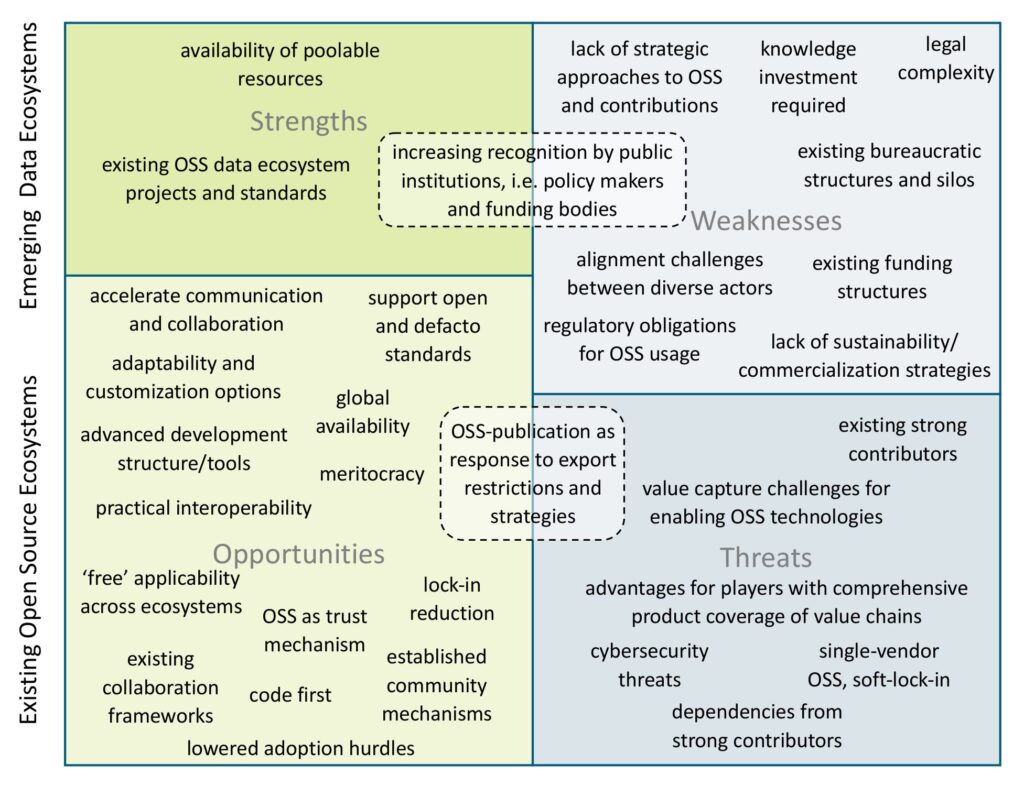
The following subsections serve as an introduction to this topic in the form of a narrative and summarizing review [28] and outline the helpful and harmful aspects of OSS from the perspective of (European) organizational alliances aiming to create enabling technologies for data ecosystems. They are clustered according to strengths, weaknesses, opportunities, and threats (SWOT).
Strengths of open-source software as an enabler for data ecosystems
The contemporary OSS landscape and emerging data ecosystems exhibit some complementary characteristics. The strength of the data ecosystem landscape lies in the availability of data resources and development capacity among actors who share common interests. Collaborations in OSS projects are one method of bringing these resources together [29]. As there is already a growing landscape of data ecosystem technologies and emerging standards, such as for data-sharing protocols or trust mechanisms [e.g., 30], alliances have already been formed and a learning curve navigated. The growing recognition among policymakers and funding bodies of the importance of OSS for digital sovereignty is another strong positive factor.
Opportunities of open-source software as an enabler for data ecosystems
These strengths complement the opportunities offered by the OSS ecosystem: OSS enables independent technology design, verification, and substitution, which helps avoid vendor lock-in and increases interoperability by combining FOSS with open standards [17]. Further, OSS lowers barriers for adoption and customization and fosters trust by enabling insight into the source code and development paths.
In addition, OSS offers the possibility of accelerated collaboration via a “code first” mindset. Speed is a key factor for emerging data ecosystems as it determines how quickly an ecosystem becomes useful for participants and which rules are set first and by whom. Timely implementation and standardization prevent fragmentation, build trust and momentum, and serve the short innovation cycles for enabling technologies.
OSS projects follow the principle of meritocracy, ensuring that loyal contributors are recognized and valued. Professionalized development structures, tools, and market players support organizations in their OSS activities. In addition, OSS offers established mechanisms for managing communities and coordinating collaboration on source code, as well as available governance frameworks that address aspects ranging from legal issues to conflict resolution.
The resulting OSS code can be freely applied. Its applicability across ecosystems and its global availability offer decisive advantages, particularly for industrial applications, as they enable data ecosystems to be supported across different regions and jurisdictions, for example to connect international production sites, synchronize supply chain data, or operate interoperable digital twins across multiple suppliers.
Threats of digital sovereignty and the establishment of data ecosystems
However, there are also characteristics that may leave OSS opportunities unexploited or even hold negative consequences. The OSS approach does present some threats for data ecosystems, including cybersecurity risks that may arise due to the openness of the source code, even though OSS can offer other significant security advantages over proprietary systems.
Furthermore, even in OSS, knowledge asymmetries can cause lock-in situations and dependencies on single actors [31]. The meritocratic principle can favor large players with significant development capacities. Many large technology providers and platform operators are also active as OSS contributors and hold expertise in the commercialization of OSS components as well as a strong position in the communities.
From an economic perspective, developing and marketing enabling technologies is particularly challenging. They tend to produce large spill-overs, which may be positive for the emergence of data ecosystems but also hinder innovation and lead to underinvestment by private enterprises [11]. Regulatory measures or distinct support may complement this investment gap. Some research focuses on the strong role of China in the OSS ecosystem and emphasizes how OSS serves as a calculated response to Western export controls and reduced dependencies on foreign technologies, coupled with the rapid rate of innovation and integration within the global technology ecosystem [32].
Weaknesses of digital sovereignty and the establishment of data ecosystems
Some of these threats hinder the development of data ecosystems by exploiting inherent weaknesses. Many companies act purely as users of OSS and have no strategic perspective, contributing rarely and often unsustainably [33]. In addition, the use of OSS products involves legal complexities that particularly deter smaller companies as they would first need to invest in knowledge around OSS mechanisms.
The use of OSS is increasingly accompanied by regulations designed to ensure safe use but which impose obligations on companies and have a restrictive effect. Existing funding structures and bureaucratic processes also appear to be an obstacle to the rapid development of data ecosystems, leading to silos. The data ecosystem landscape is decentralized and fragmented, and aligning the various stakeholders is challenging, often leading to delays and preventing shared benefits. OSS can be a way forward, providing an effective framework to drive the evolution and maturation of data ecosystems and their enabling technologies.
Figure 1 provides an overview of all aforementioned aspects. The SWOT perspective traditionally depicts company internal and external factors. In our presentation, the internal factors correspond to the characteristics of emerging industrial data ecosystems, whereas the external factors refer to the distinctive features of the existing open-source ecosystem.
Next research steps
The explorative SWOT presents a snapshot and outlines the next steps for interdisciplinary research efforts. The key next step involves detailed systematic reviews and an empirical examination of (OSS) projects that target the enablement of data ecosystems. Examples of such projects include those directly dedicated to data sharing in trusted ecosystems [e.g., 9] as well as other platform approaches. An initial exploration of the status quo reveals that challenges and opportunities are largely shaped by actual practice and the nature of long-term implementation. Therefore, projects at different stages of maturity or life cycle phases should be analyzed to gain deeper insight into the underlying concepts and dynamics. The evolutionary pathways and various patterns of development and distribution, as well as the resulting requirements, should also be examined in greater detail.
Furthermore, there is a need to analyze the accompanying legal conditions. In the context of open-source data ecosystem technologies, this includes not only data regulation—such as the Data Act or Data Governance Act—but also the Cyber Resilience Act and future measures that may accompany the EU’s open-source strategy for ecosystems [20, 34].
Summary and outlook
Standards for digital technologies are not only about compatibility and benchmarks of final products but also development paths [11]. Some researchers suggest that developing countries in particular are experiencing the economic and social impacts of OSS and OSAI, as license fees for proprietary solutions inhibit usage even more than in industrialized nations [31].
Researchers need to better investigate the economic effects and dependencies arising from OSS as well as options for the effective design and marketing of basic technologies in the long term, especially in the context of increasing political relevance. Regulators must identify how the market for enabling technologies can be effectively supported, especially since spillover effects are vital for ecosystem emergence. Companies should generally promote OSS management that includes contributions or support of developer communities and the creation of infrastructures for this purpose.
This contribution was made possible thanks to the project “Platform-based interorganizational networks for data spaces and data ecosystems” PlatioNX (02J24A000), funded by the Federal Ministry of Research, Technology and Space (BMFTR) as part of the funding measure “Dynamics of digitally networked value creation systems (DynaVer)”.
This is an original article. The German translation can be accessed via DOI: 10.30844/I4SD.26.4.1
Bibliography
[1] European Commission: Advancing transparency and sustainability: How to leverage open data for clearer product insights and improved environmental practices. URL: https://data.europa.eu/en/news-events/news/eus-digital-product-passport-advancing-transparency-and-sustainability, accessed 15.06.2026.[2] Möller, F. et al.: Data ecosystems in IS research: The road so far, where we are now, and the road ahead. In: Electronic Markets 35 (2025). DOI: https://doi.org/10.1007/s12525-025-00860-1.
[3] Hellmeier, M.; von Scherenberg, F.: A Delimitation of Data Sovereignty from Digital and Technological Sovereignty. In: European Conference on Information Systems Research Paper, ECIS (2023). URL: https://aisel.aisnet.org/ecis2023_rp/306.
[4] European Commission: European data strategy: Making the EU a role model for a society empowered by data. URL: https://commission.europa.eu/strategy-and-policy/priorities-2019-2024/europe-fit-digital-age/european-data-strategy_en, accessed 15.06.2026.
[5] Turkmayali, A.; Gras, N.: Making the Dataspace Protocol an international standard: Version 1.0. IDSA Statement (2024). URL: https://internationaldataspaces.org/offers/dataspace-protocol-overview, accessed 15.06.2026.
[6] Catena-X: Catena-X. Your Automotive Network. URL: https://catena-x.net/, accessed 15.06.2026.
[7] Factory-X: Manufacturing-X. URL: https://factory-x.org/de/manufacturing-x/, accessed 15.06.2026.
[8] Eclipse Tractus-X: Eclipse Tractus-X KIT. URL: https://eclipse-tractusx.github.io/Kits, accessed 15.06.2026.
[9] Eclipse Dataspace: Projects. URL: https://dataspace.eclipse.org/projects/, accessed 15.06.2026.
[10] Stegemann, L.: Interoperability Maturity Model: Orchestrator Tool for Platform Ecosystems. In: Beverungen, D.; Lehrer, C.; Trier, M. (Eds.): Transforming the Digitally Sustainable Enterprise. Lecture Notes in Information Systems and Organisation. Switzerland 2025, pp. 609–626.
[11] Teece, D. J.: Profiting from innovation in the digital economy: Enabling technologies, standards, and licensing models in the wireless world. In: Research Policy 47 (2018) 8, pp. 1367–1387. DOI: https://doi.org/10.1016/j.respol.2017.01.015.
[12] Braun, R.; Mendoza, F.: Geräteintegration für OPC UA angeschlossene Feldgeräte. In: atp magazin 63 (2021). DOI: https://doi.org/10.17560/atp.v63i11-12.2567.
[13] Jacobides, M. G.; Cennamo, C.; Gawer, A.: Towards a theory of ecosystems. In: Strategic Management Journal 39 (2018) 8, pp. 2255–2276. DOI: https://doi.org/10.1002/smj.2904.
[14] Hodapp, D.; Hanelt, A.: Interoperability in the era of digital innovation: An information systems research agenda. In: Journal of Information Technology 37 (2022) 4, pp. 407–427. DOI: https://doi.org/10.1177/02683962211064304.
[15] Eclipse Foundation: Eclipse Foundation Establishes Category A Liaison With ISO/IEC JTC 1/SC 38 for Cloud Computing and Distributed Platforms. URL: https://newsroom.eclipse.org/news/announcements/eclipse-foundation-establishes-category-liaison-isoiec-jtc-1sc-38-cloud, accessed 15.06.2026.
[16] Bechara, J.; Lechner, U.: Digital Sovereignty and Open-Source Software – A Discussion Paper. In: Phillipson, F.; Eichler, G.; Erfurth, C.; Fahrnberger, G. (Eds.): Innovations for Community Services. Communications in Computer and Information Science. Switzerland 2024, pp. 397–407. DOI: https://doi.org/10.1007/978-3-031-60433-1_22.
[17] Ganten, P.; Seyffarth, M.; Kuhlmann, N.: Successful Digital Transformation in Economy and Industry Requires Open Source. In: Schmuntzsch, U.; Shajek, A.; Hartmann, E. A. (Eds.): New Digital Work II. Switzerland 2025, pp. 17–31. DOI: https://doi.org/10.1007/978-3-031-69994-8_2.
[18] Hoffmann, M.; Nagle, F.; Zhou, Y.: The Value of Open Source Software. Harvard Business School Strategy Unit Working Paper No. 24-038, 2024. DOI: https://doi.org/10.2139/ssrn.4693148.
[19] Brunswicker, S.; Haefliger, S.: Is there collaboration in open collaboration? The role of producers and corporate users in Open Source software development. In: Technovation 148 (2025). DOI: https://doi.org/10.1016/j.technovation.2025.103325.
[20] European Commission: Call for evidence: European Open Digital Ecosystems. URL: https://ec.europa.eu/info/law/better-regulation/have-your-say/initiatives/16213-European-Open-Digital-Ecosystems_en, accessed 15.06.2026.
[21] CDU; CSU; SPD: Koalitionsvertrag zwischen CDU, CSU und SPD: 21. Legislaturperiode (2025). URL: https://www.bundesregierung.de/breg-de/aktuelles/koalitionsvertrag-2025-2340970, accessed 15.06.2026.
[22] Cybersecurity and Infrastructure Security Agency (CISA); Federal Bureau of Investigation (FBI); National Security Agency (NSA); U.S. Department of the Treasury: Improving Security of Open Source Software in Operational Technology and Industrial Control Systems (2023). URL: https://www.cisa.gov/sites/default/files/2023-10/Fact_Sheet_Improving_OSS_in_OT_ICS_508c.pdf, accessed 15.06.2026.
[23] Cox, R.: Fifty Years of Open Source Software Supply Chain Security. In: Queue 23 (2025) 1, pp. 84–107. DOI: https://doi.org/10.1145/3722542.
[24] Liesenfeld, A.; Dingemanse, M.: Rethinking open source generative AI: open washing and the EU AI Act. In: ACM Conference on Fairness, Accountability, and Transparency 2024, pp. 1774–1787. DOI: https://doi.org/10.1145/3630106.3659005.
[25] Champion, K.; Hill, B. M.: Underproduction analysis of open source software. In: Empirical Software Engineering 30 (2025) 6. DOI: https://doi.org/10.1007/s10664-025-10703-4.
[26] Fortunato, L.; Galassi, M.: The case for free and open source software in research and scholarship. In: Philosophical Transactions of the Royal Society A: Mathematical, Physical, and Engineering Sciences 379 (2021). DOI: https://doi.org/10.1098/rsta.2020.0079.
[27] Liu, M.; Hansen, S.; Tu, Q.: Sustaining collaborative software development through strategic consortium. In: The Journal of Strategic Information Systems 30 (2021) 3. DOI: https://doi.org/10.1016/j.jsis.2021.101671.
[28] Paré, G.; Trudel, M.-C.; Jaana, M.; Kitsiou, S.: Synthesizing information systems knowledge: A typology of literature reviews. In: Information & Management 52 (2015) 2, pp. 183–199. DOI: https://doi.org/10.1016/j.im.2014.08.008.
[29] Forschungsbeirat der Plattform Industrie 4.0: Open Source als Innovationstreiber für Industrie 4.0. 2022. URL: https://www.acatech.de/publikation/open-source-i40-innovationstreiber/, accessed 15.06.2026.
[30] Eclipse Foundation: Eclipse Dataspace Working Group: Projects. URL: https://dataspace.eclipse.org/projects/, accessed 15.06.2026.
[31] Kshetri, N.: Economics of Open Source Software and AI Models. In: Computer 58 (2025) 1, pp. 134–141. DOI: https://doi.org/10.1109/MC.2024.3488974.
[32] Korte, K.: Open-Source Leadership: What’s Really at Stake. In: Forbes, 07.08.2025. URL: https://www.forbes.com/councils/forbestechcouncil/2025/08/07/open-source-leadership-whats-really-at-stake/, accessed 15.06.2026.
[33] Bitkom e.V.: Open Source Monitor 2025. 2025. URL: https://www.bitkom.org/Open-Source-Monitor-2025, accessed 15.06.2026.
[34] European Commission: Cyber Resilience Act (CRA). 2024. URL: https://digital-strategy.ec.europa.eu/en/policies/cyber-resilience-act, accessed 15.06.2026.
Your downloads
You might also be interested in