
From Private Law to Private Ordering |
Rule-making through industrial digital platforms
| Journal | Industry 4.0 Science |
| Issue | Volume 42, 2026, Edition 4, Pages 98-105 |
| Open Access | https://doi.org/10.30844/I4SD.26.4.11 |
| Bibliography | Share | Cite | Download |
Abstract
Keywords
Article
What are industrial digital platforms?
Although little researched to date, industrial digital platforms—such as the Bosch IoT Suite, XOM Materials, the SAP Business Network, and the Siemens Insights Hub [1-3] —are considered crucial for the future of our economy. Industrial digital platforms are defined as commercial, long-term offerings for companies in the manufacturing sector, which typically operate in complex, industry-specific markets. These platforms process information on behalf of a business user or facilitate interactions with other business users or with the platform operator itself [2]. Although industrial digital platforms are hence always B2B, not every B2B platform is also an industrial digital platform [3]. They are considered key to a successful digital economy and can contribute to a significant increase in efficiency in value creation [1, 2, 4].
Distinction from commercial-social digital platforms
Commercial B2C sales platforms, such as Amazon, and social networks, such as Instagram, are much better known to the public than industrial digital platforms.
Current platform regulation is tailored to precisely these types of digital platforms, which are categorized as commercial-social.
Industrial digital platforms differ from them in three respects: First, industrial digital platforms operate within the industrial sector and are explicitly geared toward B2B interactions.
Second, they are mostly services designed to foster long-term relationships with business partners.
Third, and arguably the most challenging from a legal perspective, the success of these business models requires a special foundation of trust and, consequently, effective protection of trade secrets [2].
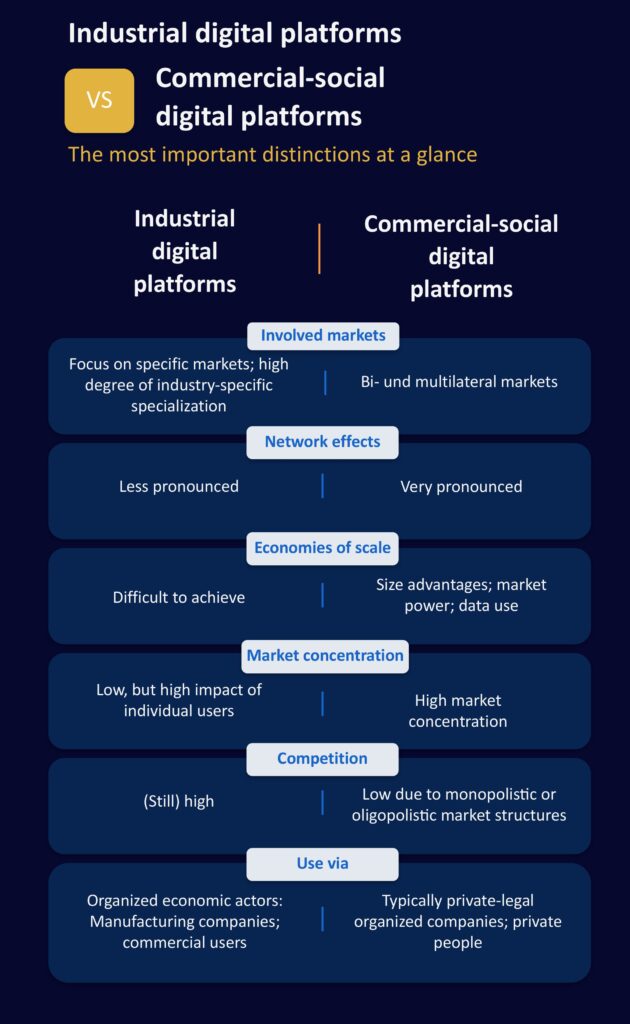
These factors lead to differences in economic characteristics (Fig. 1) and in legal classification.
As illustrated in Figure 1, industrial digital platforms serve specific markets and exhibit a high degree of industry-specific specialization [5].
In contrast, commercial-social digital platforms operate in bilateral or multilateral markets [6, 7]. These different orientations affect the user base. In the case of industrial digital platforms, the user base consists solely of commercial users and completely excludes private individuals [8, 9]. Furthermore, due to their specialization and complexity, they reach far fewer users than commercial-social digital platforms [3].
For these reasons, network effects are less pronounced and economies of scale are more difficult to achieve [2, 10]. A distinction must also be made with regard to market concentration. Industrial digital platforms are characterized by comparatively low levels of market concentration; competition among platforms offering a similar range of services is therefore (still) high [1, 9, 10].
Typology of industrial digital platforms
Different types of industrial digital platforms can be distinguished (Fig. 2), though classifications are not rigid and must adapt to the market’s dynamic evolution [3, 11, 12]. It is already apparent that the boundaries between platform types are becoming increasingly blurred, with one platform type in particular gaining prominence [3]. Nevertheless, the nature of the value-creating interaction continues to provide a suitable basis for a fundamental typology [13].
As shown in Figure 2, industrial digital platforms can be divided into transaction-centric and data-centric platforms [1, 13].
The former category includes platforms that orchestrate interactions between supply and demand for goods and services among industrial companies [14].
In a narrower sense, these are industrial online marketplaces and manufacturing platforms, as well as supply chain management and logistics platforms [1].
Data-centric industrial platforms, on the other hand, are IT infrastructure offerings. They are geared toward the creation, structuring, analysis, and evaluation of data and data streams and are designed to ensure the effective exchange of data [13].
They thus encompass industrial infrastructure platforms, data marketplaces, and production platforms [4, 13].
Particular consideration should be given to the latter, as their focus on the digital development of products and services goes beyond the defining characteristic of data-centric industrial platforms, namely the optimization of industrial process [3].
Instead, they leverage the intelligent, digital interconnection of all components in the Internet of Things—which is why they are also referred to as Industrial Internet of Things (IIoT) platforms [1]. These platforms draw on the most efficient elements of other platform types while continuously optimizing processes in line with technological progress [3]. This combination takes digital value creation to a new level [3, 15].
Despite their benefits, the complexity of IIoT platforms gives rise to a multitude of legal issues. In addition to issues relating to ownership, usage rights, trade secrets, data protection, and liability law, the question of the applicable law must be clarified [3].
Legal framework
Consumer- and communication-oriented digital platforms in the B2C sector have experienced exorbitant growth in recent years, as a result of which they have come under intense regulatory scrutiny.
In contrast, the young and still highly fragmented market for industrial digital platforms has so far received little attention in legislation, politics, or academia.
From a legal perspective, industrial online platforms have not yet been adequately addressed.
This feeds uncertainty regarding the extent to which existing regulations – such as those created primarily for commercial-social digital platforms—apply [2].
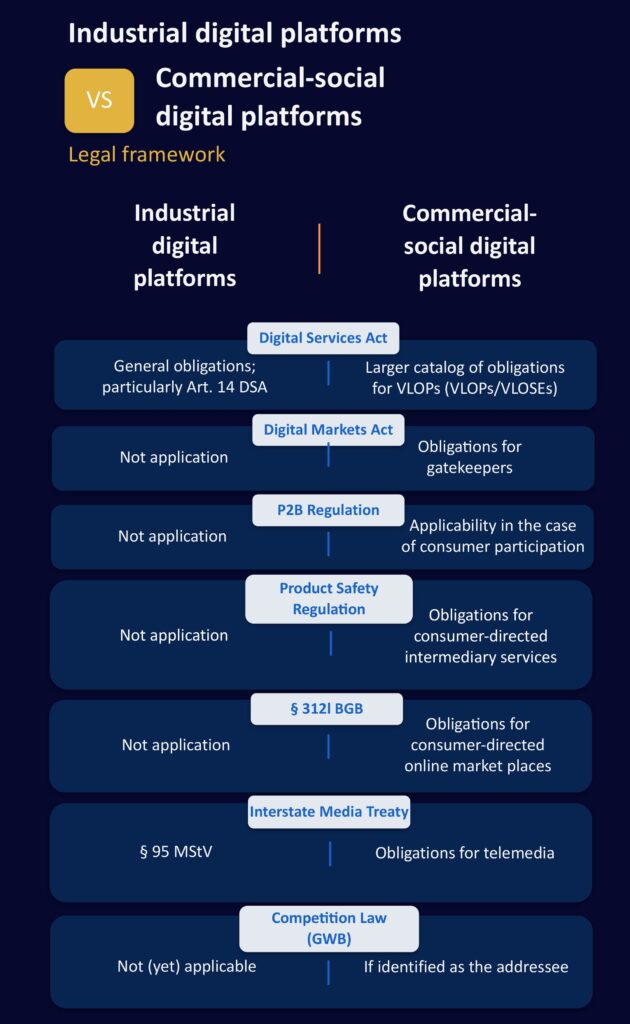
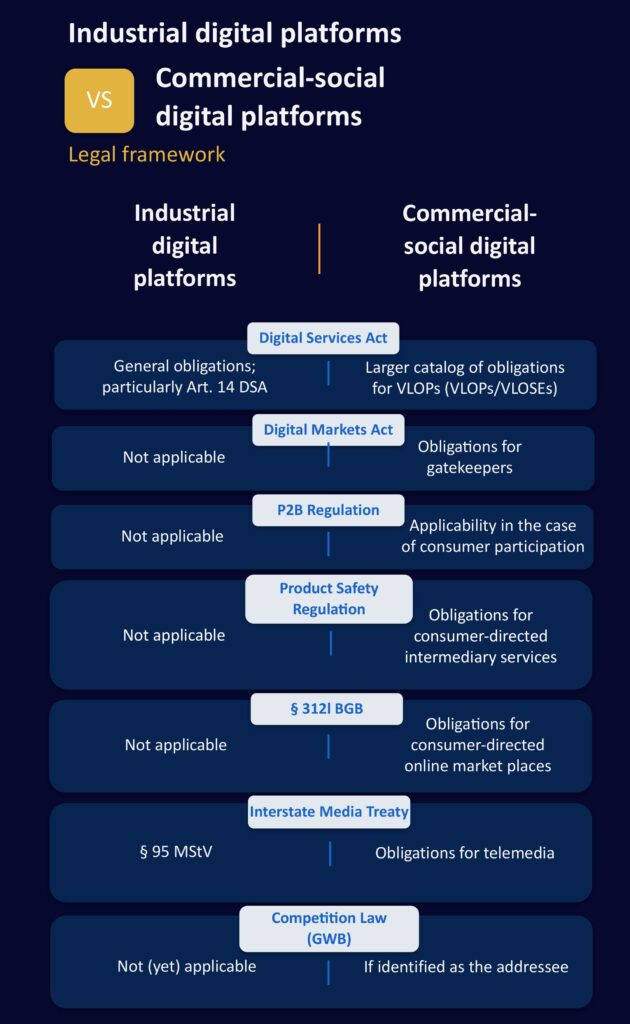
Typical regulatory frameworks tailored to digital platforms include the Digital Services Act (DSA), the Digital Markets Act (DMA), the Platform-to-Business Regulation (P2B-VO), the Product Safety Regulation (ProdSVO), Section 312l of the German Civil Code (BGB), the Interstate Media Treaty (MStV), and the German Act against Restraints of Competition (GWB) (Fig. 3) [3].
However, Figure 3 clearly shows that the majority of these regulations do not apply to industrial digital platforms.
Individual regulatory frameworks
The DSA aims to create a safe, predictable, and trustworthy digital environment through harmonized regulations. It also seeks to promote innovation, protect fundamental rights, and safeguard the digital single market. The primary objective is to prevent the dissemination of illegal content, including products, services, and activities [16]. The regulation addresses intermediary services such as digital platforms. Consequently, industrial digital platforms generally fall within the scope of the DSA. However, the strict obligations apply only to very large digital platforms (so-called VLOPs) with at least 45 million monthly active users. Industrial digital platforms typically do not reach this threshold due to their limited user bases [2, 3].
Furthermore, many key provisions are primarily aimed at consumers, meaning that industrial digital platforms are subject only to the general provisions of the DSA [17]. Of particular note is Article 14, which could be relevant to the drafting of the general terms and conditions (GTC) of industrial digital platforms. Otherwise, it can be assumed that the DSA will have little impact on these platforms.
The DMA aims to ensure competitive and fair markets in the digital sector. Obligations apply exclusively to so-called “gatekeepers”, which serve as gateways to end users and meet the same thresholds as those laid down in the DSA. For the reasons stated above, the regulation does not apply to industrial digital platforms [2, 3, 18].
The P2B Regulation, the ProdSVO, and Section 312l of the German Civil Code (BGB) all exclude industrial digital platforms due to their lack of consumer relevance [2, 3].
The MStV covers telemedia. As such, industrial digital platforms could qualify as media intermediaries. This requires a potential relevance for the formation of public opinion, which is questionable for this type of digital platform. Even if such relevance were assumed, a reach of one million monthly users would first have to be achieved. Given their specialization in goods and services, the obligations of industrial digital platforms are likely restricted primarily to the duty to provide documentation to state media authorities upon request. The authorities can conclude from these documents that the regulations for media intermediaries do not apply to the platform [19].
If the goal is to prevent anti-competitive effects and risks to competition within the digital economy, industrial digital platforms may be considered as addressable parties, provided they are designated by the Federal Cartel Office as undertakings of paramount cross-market significance for competition pursuant to Section 19a of the GWB. This requires that they operate to a significant extent in digital markets. To assess this, a case-by-case analysis is conducted, focusing on characteristics such as network effects, data access, or innovation-driven competitive pressure [20].
At this point, the distinction between the various types of industrial digital platforms becomes particularly relevant. While the primary activity of transaction-centric industrial platforms usually takes place in the manufacturing sector, data-centric industrial platforms focus on digital business models. If a cross-market activity in the sense of a digital ecosystem is affirmed, it is especially IIoT platforms that could meet this set of criteria.
Although this may not yet be the case, given ongoing digitalization, a development typical of large digital corporations cannot be ruled out in the future [3]. The regulation of large corporations largely took place only after they had attained monopoly positions and exerted an almost unchecked influence on competition. Against this backdrop, it seems imperative to incorporate regulatory frameworks for industrial digital platforms already in the early stages of development, to ensure a high degree of legal certainty, and to design them in such a way that they can withstand future dynamics at the same time.
Regulation of industrial digital platforms
Industrial digital platforms exhibit significant structural differences compared to commercial-social digital platforms. Due to their design, they are often not covered—or only covered to a limited extent—by the regulatory regimes typical of such platforms. The legal analysis shows that they are essentially only subject to the general due diligence obligations of the DSA, the duty to provide documentation under the MStV, and, prospectively, the GWB.
This, in turn, implies that general contract law is the primary legal framework applicable to industrial digital platforms. The legal framework is largely shaped by the terms and conditions set by the platform operators, meaning that they effectively establish private law. It is worth questioning whether this can meet the requirements of legal certainty and fair competition [3].
General terms and conditions
Through their platform architecture and their general terms and conditions (GTC), industrial digital platforms, in a sense, establish “private law” [3, 21]. GTC are pre-formulated contractual terms applicable to a large number of contracts that one contracting party (the user) imposes on the other contracting party upon conclusion of a contract. If the contractual terms have been negotiated in detail between the parties, they do not constitute GTC, as the relevant clauses have then been transformed into what is known as a so-called individual agreement [22, 23].
Due to their universal nature, GTCs do not distinguish between contracts entered into by consumers and those entered into by businesses, meaning they apply equally to customer-to-customer (C2C), business-to-customer (B2C), and business-to-business (B2B) contracts [22-24]. The standards developed by the Federal Court of Justice (BGH) are relevant for understanding GTC and their enormous practical significance [22, 23, 25–27].
Content review
Where GTC are in place, the clauses must generally withstand a so-called content review. If an unreasonable disadvantage to the contracting party is found to be contrary to the principles of good faith, a clause in the GTC is invalid [24]. Before outlining the standards and scope of this review mechanism below, its function should be explained.
The use of GTC eliminates the need to renegotiate individual, standardized contract provisions and thus helps reduce transaction costs [23, 29]. Moreover, content review significantly diminishes the practical need for legal counsel [22, 29]. Given that transactions between businesses in Germany are overwhelmingly small in volume, the disproportion between transaction costs and contract value is therefore particularly important [22, 23]. In the absence of a specific regulation in the GTC, for instance, the general provisions of the German Civil Code (BGB) apply. In contrast, other legal systems in which such default provisions do not exist face an increased administrative burden of reviewing the contractual clauses at issue. Consequently, no comparable reduction in transaction costs can be found, for example, in the Anglo-American or English legal spheres [22].
However, the unilateral imposition of these terms—which deviate from dispositive law, typically results in the counterparty being exposed to a situational disadvantage [23, 28]. Specifically, the use of GTC is often accompanied by the user strengthening their legal position relative to the counterparty due to existing information asymmetries [23, 29]. This circumstance of situational inequality is addressed both by the criterion of reasonableness and by the protection of the counterparty against the inclusion of surprising clauses.
Consequently, a bifunctional mechanism can be identified, aimed at balancing bargaining power on the one hand and reducing transaction costs on the other hand [22].
Impact of Digital Services Act Article 14 on platform terms and conditions
Finally, it remains to be examined whether the contractual review standards of the aforementioned Article 14 of the DSA have an impact on the national review of GTC. The provision establishes transparency and due diligence obligations for the GTC of digital intermediary services, which in principle also cover industrial digital platforms [3, 29, 30]. In this process, “the freedom of contract of the providers of intermediary services shall fundamentally be respected” [31].
According to the correct, albeit controversial, view, Article 14(4) DSA nevertheless establishes a so-called “indirect effect” of fundamental rights within this scope of private autonomy [32-39]. Platform providers must therefore implement, in particular, procedural rules to protect the fundamental rights of the affected contracting parties [35].
The indirect effect may arise in the drafting of non-transparent provisions regarding the restriction of user-generated content, as well as in their enforcement through content moderation—for example, concerning the review of the incorporation of terms [30, 32, 34]. In this regard, courts and regulatory authorities may refer to a “moderation of content moderation” as the standard of review [40].
In light of the accelerated full harmonization, it is even be assumed that if the platform GTC contain provisions on usage restrictions and must therefore satisfy the criteria of Article 14(4) DSA, the latter supersedes national content review [30, 40, 41]. Consequently, the relevant clauses would be assessed solely against the standards of the DSA. Other clauses may continue to be subject to national standards, resulting in a “split content review” [30].
The relevance of industrial digital platforms for legal governance
It is clear that industrial digital platforms differ significantly from commercial-social digital platforms. This applies not only to their structure but, in particular, to the legal framework in which they are embedded. The instrument of GTC—whether at the national or European level—grants them leeway in shaping their terms.
However, the exercise of contractual autonomy in this manner can lead to imbalances in bargaining power. This is because it allows these platforms to determine market access, market conduct, and interactions within the platform market. Precisely because providers of industrial digital platforms often act as contracting parties themselves, undesirable power dynamics may arise. This development is particularly likely in the case of data-centeric IIoT platforms. The statutory requirement of content review provides a remedy. However, the tensions between this protective function on the one hand and contractual autonomy on the other hand are unmistakable.
Furthermore, the impact of the EU provision under Article 14 DSA, particularly Paragraph 4, on national standards of review must be emphasized. There is clearly a shift in the balance of power toward a private level of rule-making [42]. This phenomenon must be accompanied by legal certainty, transparency, and reliability. Only then will it be able to provide stability for competition and be able to optimize value creation within our national economy.
This article was funded by the Federal Ministry of Research, Technology and Space as part of the funding initiative “Dynamics of Digitally Networked Value Creation Systems (DynaVer)” within the specialized program “The Future of Value Creation.”
The original German version of this article can be accessed via DOI: 10.30844/I4SD.26.4.11
Bibliography
[1] Koenen, T.; Heckler, pp.: Deutsche digitale B2B-Plattformen. Handbuch des Bundesverbands der Deutschen Industrie e.V. Berlin 2021. URL: www.bdi.eu/publikation/news/Deutsche-digitale-B2B-Plattformen, accessed 06.01.2026.[2] Romeike, P. C.: Der Begriff der „industriellen Online-Plattformen“ im Recht. In: Recht Digital 5 (2025) 6, pp. 313-319.
[3] Romeike, P. C.: Typisierung und Rechtsrahmen industrieller Online-Plattformen. In: Recht Digital 5 (2025) 10, pp. 521-530.
[4] Obermaier, R.: Handbuch Industrie 4.0 und Digitale Transformation: Betriebswirtschaftliche, technische und rechtliche Herausforderungen. Wiesbaden 2019, pp. 397-417. DOI: https://doi.org/10.1007/978-3-658-24576-4
[5] Beverungen, D.; Dumitrescu, R.; Kühn, A.; Plass, C.: Digitale Plattformen im industriellen Mittelstand: Strategien, Methoden, Umsetzungsbeispiele. Berlin 2024, pp. 13-23. DOI: https://doi.org/10.1007/978-3-662-68116-9
[6] Paal, B. P.; Kieß, F.: Digitale Plattformen im DSA-E, DMA-E und § 19a GWB. In: Zeitschrift für Digitalisierung und Recht 2 (2022) 1, pp. 1-34.
[7] Kumkar, L. K.: Online-Märkte und Wettbewerbsrecht: Implikationen der Platform Revolution für das EU-Vertriebskanalrecht. Baden-Baden 2017.
[8] Schallmo, D. R. A.; Kundisch, D.; Lang, K.; Hasler, D.: Digitale Plattformen und Ökosysteme im B2B-Bereich: Fallstudien, Ansätze, Technologien und Tools. Wiesbaden 2024, pp. 1-23. DOI: https://doi.org/10.1007/978-3-658-43130-3
[9] Haucap, J.; Kehder, C.; Loebert, I.: B2B-Plattformen: Potenziale, Hemmnisse und Handlungsoptionen am Beispiel von Nordrhein-Westfalen. Baden-Baden 2021. DOI: https://doi.org/10.5771/9783748925750
[10] Falck, O.; Koenen, J.: Industrielle Digitalwirtschaft – B2B-Plattformen. Studie im Auftrag des Bundesverbands der Deutschen Industrie e.V. Berlin 2020. URL: https://bdi.eu/publikation/news/Industrielle-Digitalwirtschaft-B2B-Plattformen, accessed 18.01.2026.
[11] Schneider, H.-H., in: Bunte, H.-J.: Kartellrecht Kommentar. Bd. 2, 14th edition, München 2022, Sonderb. I Digitalwirtschaft.
[12] ten Hompel, M.; Henke, M.; Otto, B.: Silicon Economy: Wie digitale Plattformen industrielle Wertschöpfungsnetzwerke global verändern. Berlin 2022, pp. 55-74. DOI: https://doi.org/10.1007/978-3-662-63956-6
[13] Hoffmann, M.; Schröder, C.; Pasing, P.: DIGITALE B2B-PLATTFORMEN: Status quo und Perspektiven der Industrie in Deutschland. Studie im Auftrag der Friedrich-Ebert-Stiftung. In: WISO DISKURS (2021) 1.
[14] Dolata, U.: Industrieplattformen als Markt-, Produktions- und Innovationsflächen. Feldvermessungen und theoretisch-konzeptionelle Überlegungen. In: Berliner Journal für Soziologie 34 (2024) 2, pp. 171-196. DOI: https://doi.org/10.1007/s11609-024-00526-3
[15] Srnicek, N.: Plattform-Kapitalismus, 2nd edition. Hamburg 2020.
[16] Erwägungsgrund 12 Satz 1 DSA.
[17] Erwägungsgründe 13, 72 DSA.
[18] Erwägungsgründe 6 Satz 1, 31 Satz 5 DMA.
[19] Dörr, D., in: Cole, M. D.; Oster, J.; Wagner, E. E.: Medienstaatsvertrag Jugendmedienschutz-Staatsvertrag Kommentar. 104. Aktualisierung, Heidelberg 2025, §§ 2, 91, 95.
[20] Lorenz, pp. in: Berg, W.; Mäsch, G.: Deutsches und Europäisches Kartellrecht Kommentar. 5th edition, München 2025, GWB § 19a.
[21] Schweitzer, H.: Digitale Plattformen als private Gesetzgeber: Ein Perspektivwechsel für die europäische „Plattform-Regulierung“. In: Zeitschrift für Europäisches Privatrecht 27 (2019) 1, pp. 1-11.
[22] Leuschner, L.: Die Bifunktionalität der AGB-Kontrolle als Schlüssel zur Neuausrichtung der §§ 305 ff. BGB im unternehmerischen Rechtsverkehr. In: Zeitschrift für Wirtschaftsrecht 46 (2025) 41, pp. 2467-2477.
[23] Leuschner, L.: AGB-Recht im unternehmerischen Rechtsverkehr: Kommentar zu den §§ 305-310 BGB mit Klauselteil, Erläuterungen zur Rechtswahl und Länderberichten. 2nd edition, München 2021, pp. 1-112.
[24] Pfeiffer, T.: AGB-Recht. Recht der Allgemeinen Geschäftsbedingungen. 8th edition, München 2026, pp. 1-28, pp. 258-383.
[25] BGH, Urt. v. 17.02.2010 – VIII ZR 67/09.
[26] BGH, Urt. v. 23.06.2005 – VII ZR 277/04.
[27] BGH, Urt. v. 20.01.2016 – VII ZR 26/15.
[28] Mast, T.: AGB-Recht als Regulierungsrecht. In: Juristen Zeitung 78 (2023) 7, pp. 287-296. DOI: https://doi.org/10.1628/jz-2023-0096
[29] Stoffels, M.: AGB-Recht. 5th edition, München 2024, pp. 30-33.
[30] Hofmann, F.; Raue, B.: Digital Service Act. Gesetz über digitale Dienste. Baden-Baden 2023, pp. 246-276.
[31] Erwägungsgrund 45 Satz 1 DSA.
[32] Spindler, G.; Gerdemann, pp.: Das Gesetz über digitale Dienste (Digital Service Act) (Teil 1). Grundlegende Strukturen und Regelungen für Vermittlungsdienste und Host-Provider. In: Gewerblicher Rechtsschutz und Urheberrecht 125 (2023) 1-2, pp. 3-11.
[33] Raue, B.; Heesen, H.: Der Digital Services Act. In: Neue Juristische Wochenschrift 75 (2022) 49, pp. 3537-3543.
[34] Seckelmann, M.; Mast, T.; Kettemann, M. C.; Dreyer, pp.; Schulz, W., in: Mast, T.; Kettemann, M. C.; Dreyer, pp.; Schulz, W.: DSA, DMA. Digital Services Act, Digital Markets Act Kommentar. München 2024, pp. 261-284.
[35] Vgl. dazu BGH, Urt. v. 29.07.2021 – III ZR 179/20.
[36] Spindler, G.: Löschung und Sperrung von Inhalten aufgrund von Teilnahmebedingungen sozialer Netzwerke. Eine Untersuchung der zivil- und verfassungsrechtlichen Grundlagen. In: Computer und Recht 35 (2019) 4, pp. 238-247.
[37] BVerfG, Beschl. v. 18.07.2015 – 1 BvQ 25/15.
[38] BVerfG, Urt. v. 22.02.2011 – 1 BvR 699/06.
[39] Vgl. dazu BGH, Urt. v. 29.07.2021 – III ZR 179/20.
[40] Billing, T.; Vetter, pp.: Vorgaben des EU-Digitalrechts für die Gestaltung von AGB. Analyse wichtiger Digitalrechtsakte für die AGB-Praxis. In: Multimedia und Recht 28 (2025) 11, pp. 849-857.
[41] Erwägungsgrund 9 DSA.
[42] Feld, L. P.; Haucap, J.; Krieger, T.: Wie politische und wirtschaftliche Macht ineinandergreifen. In: Frankfurter Allgemeine Zeitung (2025). URL: https://www.faz.net/aktuell/wirtschaft/wirtschaftswissen/feld-haucap-krieger-wie-macht-und-wirtschaft-verflochten-sind-accg-110762515.html
Your downloads
You might also be interested in