AI-Driven Organization as a New Work Paradigm |
Implications for individual and organizational change

| Journal | Industry 4.0 Science |
| Issue | Volume 42, 2026, Edition 5, Pages 94-100 |
| Open Access | https://doi.org/10.30844/I4SE.26.5.11 |
| Bibliography | Share | Cite | Download |
Abstract
Keywords
Article
The AI organization: Definition and requirements
The advent of agent-based artificial intelligence (AI) in the workplace marks a paradigm shift: AI is evolving from a passive tool designed to support human activities—that is, an object of work organization—into a functional subject or organizational actor within defined domains that performs tasks autonomously [1, 2]. The focus of human work is shifting from AI-supported tasks within a process toward the active orchestration of AI-supported process chains, management, and exception handling [3, 4].
The effect of this transformation on work organization and competence development is still unclear. This paper addresses this gap by developing a concept of the AI organization as an analytical framework for the systematic integration of AI into work processes. Based on this framework, it derives a digital enablement model that is being evaluated at the Fraunhofer Institute for Industrial Engineering IAO through a multi-stage AI upskilling program.
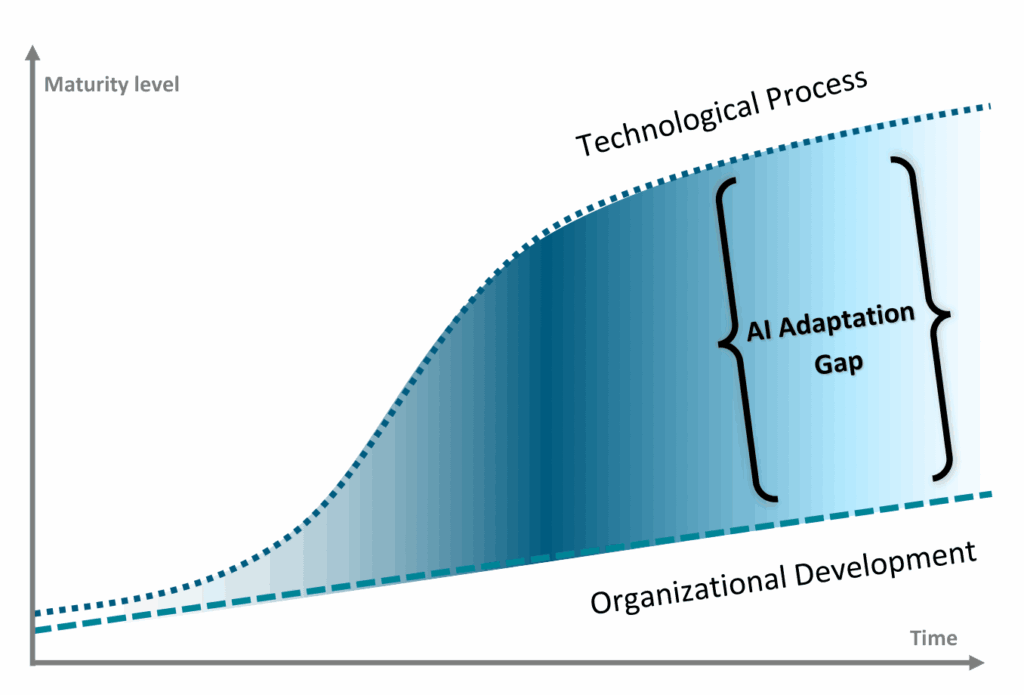
While AI tools are developing rapidly today, the organization’s roles, processes, governance, and competencies often fail to keep pace—resulting in a growing adoption gap, known as the AI Adoption Gap (Figure 1).
Jarrahi et al. [5] emphasize that neither full automation nor absolute human control yields optimal results in complex knowledge domains. Instead, hybrid intelligence approaches aim for a complementary division of tasks between humans and AI.
Ideally, this requires a systematic co-configuration of defined role contracts, in which the division of roles between human and AI actors is dynamically configured throughout the different stages of the work process [2]. AI acts autonomously within defined domains with humans intervening where contextual knowledge, moral judgment, or strategic judgment are required. Dell’Acqua et al. [6] illustrate this distinction using the concept of the “jagged frontier”—an irregular line between tasks that AI handles excellently and those at which it fails, even when both task types appear to be similarly complex, underscoring the need to reallocate existing tasks. Based on this, this paper adopts the following working definition:
An AI organization is a work organization in which AI systems with their own capacity for action are designed as regular organizational elements and are thus an autonomous part of the organization’s collective and adaptive capacity. Humans retain final normative and strategic responsibility.
Digital enablement as an empowerment strategy
Productivity effects and shifts in tasks resulting from the use of AI are already visible today. For example, Schmidt et al. [7] show that the benefits of using Microsoft Copilot are highly context-dependent, indicating high efficiency when used for structured text tasks, low efficiency when used for learning or networking activities, although evaluations converge over time. The key development is the qualitative shift in tasks: through interaction with AI, human work shifts from operational, step-by-step execution—i.e., ”task execution” (e.g., information gathering, summarization, and text creation)—through control (setting the framework for AI) toward responsible decision-making regarding the use of AI-generated outputs, which can be understood as ”task stewardship” [8, 9].
In this process, AI takes on specific functional roles such as structuring or pattern recognition [5, 10]. This suggests that training employees for an AI-driven organization must include context-sensitive use of AI as well as a cultural shift. Upskilling therefore requires not only learning to use new tools, but above all a shift in skills and mindset, as well as the ability to continuously adapta. At the same time, the latent risk of deskilling must be prevented.
Previous research has addressed various facets of human-AI interaction but converges on three central requirements for competency development:
- Dell’Acqua et al. [6] and Schmidt et al. [7] show that AI tools generate productivity benefits only when employees understand their operating principles and use them appropriately in context. This underscores the need for sound AI tool proficiency: employees require a foundational technical understanding of agentic and generative AI systems and their integration into existing work environments. This includes confident operation, an understanding of key operating principles, and basic prompting skills.
- The concept of the “jagged frontier”[6] illustrates that blindly delegating tasks to AI leads to quality losses. employees must therefore be able to specifically identify tasks suitable for AI, deconstruct processes in granular detail, and consciously design the division of labor between humans and AI. This requires methodological and process expertise, including the ability to design AI-supported process chains, specify roles and permissions, and iteratively optimize workflows. Human value creation consequently shifts from step-by-step execution toward the design and orchestration of hybrid processes.
- Lee et al. [8] and Simkute et al. [9] show that the use of generative AI reduces the cognitive effort required and promotes systematic substitution effects. Counteracting this tendency requires the ability to critically examine AI outputs for factual accuracy, bias, and normative compatibility—that is, critical judgment and accountability as a core mindset. When AI is embedded in an organization as an agent with implicit assumptions and potential biases, the need for context-sensitive evaluation and normative control increases. In addition, the scope of action and permissible decisions that agents are authorized to make must be defined. Employees thus assume “task stewardship”, meaning that they remain responsible for deciding where and how AI is deployed and where human judgment remains irreplaceable [5].
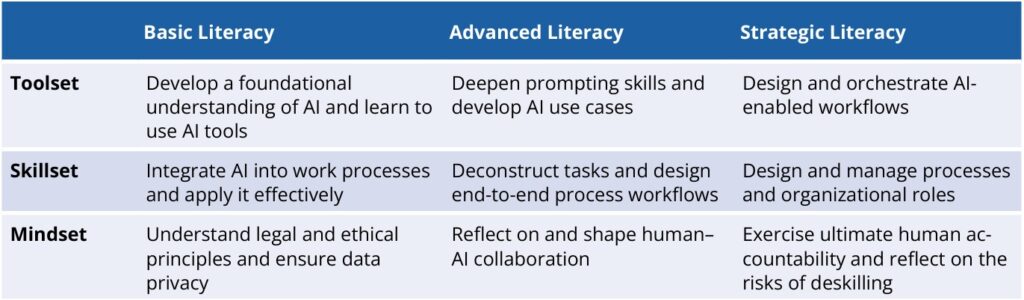
These three dimensions form the basis of the Digital Enablement Model (Figure 2). It operationalizes the three pillars of competence described above for workforce development in the AI organization and follows the empirically derived logic that effective upskilling must include not only a toolset but, above all, a skillset and mindset.
The model distinguishes between three progressive levels of competence: Basic Literacy targets employees with little or no AI experience. It establishes the foundation for tool proficiency and an initial understanding of responsibility by providing legal and ethical guidelines for AI implementation. Employees are empowered to integrate AI into their own work processes.
Advanced Literacy targets employees with basic or advanced AI proficiency. This level deepens tool proficiency and addresses methodological and process competence. Employees learn to consciously divide tasks between humans and AI, design process chains, and establish iterative improvement cycles.
Strategic Literacy targets employees with extensive AI experience and promotes their methodological and process competence as well as their critical judgment and accountability. It empowers employees to shape AI use at both the process and organizational levels.
The Digital Enablement Model aims to strengthen cognitive agency in working with agentic AI: AI should be deployed as an organizational actor without eroding human judgment, willingness to take responsibility, and methodological design capabilities. Reflective tasks are crucial for maintaining and developing these competencies.
The digital enablement model was translated into an AI upskilling program at the Fraunhofer Institute for Industrial Engineering IAO. The program builds on a pilot project and addresses the practical requirements of an AI-driven organization. The AI upskilling program targets over 500 employees working in research or administration. Approximately 40 employees participated in the pilot project. The AI upskilling program was designed as a work and learning project (WLP).
Work and Learning Projects (WLP) represent an established format of work-integrated continuing education in which real world work tasks are transformed into learning tasks and addressed through structured learning steps [11,12]. Learning thus does not take place separatlyly from value creation but rather within the work process itself, enabling the targeted use of diverse prior knowledge, as participants select tasks based on their skill level and job profile [12, 13]. Peer-to-peer learning and the joint reflection on challenges, edge cases, and deviations serve as central mechanisms for developing complex, context-sensitive competencies [14]. Against the backdrop of the paradigm shift toward AI-driven organization outlined above, WLPs thus function as organizational living laboratories.
In the pilot project, learners independently select real-world work tasks, process them according to a standardized, AI-supported learning process, and document the prompts they develop in a shared library. Peer-to-peer learning sessions facilitate colleagues to exchange experiences about challenges, edge cases, and best practices in the context of task stewardship. Initial findings suggest that the approach is particularly effective in productively leveraging heterogeneous prior knowledge, promoting context-specific learning, and strengthening the transferability of acquired competencies across different domains [15].
Building on the experiences gained in the pilot project, the AI upskilling program is deliberately not designed as a rigid, mandatory track. Employees enter at the competency level that corresponds to their individual level of knowledge: the more relevant experience they have with AI tools and with designing human-AI processes, the higher their entry point. The required self-assessment of individual competencies fosters the ability to reflect and exercise critical judgment. This differentiated approach considers the diverse starting points of the workforce and supports tailored development across the three pillars: toolset, skillset, and mindset.
To acquire basic AI skills, the Basic Literacy level offers a module designed to build a general understanding of AI, as well as a module introducing Microsoft Copilot and FhGenie, an internal LLM platform of the Fraunhofer Society. Binding usage and data privacy guidelines are reinforced throughout all sessions. At the Advanced Literacy level, the program supplements so-called Promptathons with a module on the systematic identification and development of cross-process use cases.
While the free selection of tasks in the pilot project promoted exploratory learning processes , the expanded program provides a structured methodology that enables employees to systematically identify AI-suitable tasks within their area of work along the jagged frontier and integrate them into process workflows. This supports the deliberate configuration of roles in the context of hybrid intelligence.
AI masterclasses are offered to employees at the Strategic Literacy level. These classes develop competencies for designing more complex workflows and structuring tasks at the process level. Participants learn to design agentic AI systems as regular organizational elements (roles, routines, information flows, rules) while consciously assuming ultimate normative and strategic responsibility. In addition, specific leadership modules address the unique role of managers within the AI organization. Topics include raising awareness of systemic risks such as deskilling, enabling managers to foster AI competencies within their teams, and developing strategic process and role architectures based on hybrid intelligence.
In addition, an institutionalized AI community is being established as a structured forum for continuous exchange of experience, the presentation of new use cases, and targeted knowledge transfer through internal multipliers. Advanced community members are responsible for maintaining the prompt library: they add new prompts and provide feedback in terms of application areas and quality criteria. This measure ensures the quality of shared resources and establishes a sustainable internal knowledge structure.
The impact of the program is evaluated continuously at three levels: output and reach (completed modules, templates created, prompts maintained), outcome (time savings, usage rates, perceived self-efficacy, and changes in usage patterns), and impact (demonstrable process improvements and quality gains in pilot areas). Following completion of each program module, anonymized short surveys are conducted.
In addition, a company-wide online survey is conducted halfway through the overall program to assess the usability and transferability of the content and to gather more detailed feedback on components that are still missing. The survey also includes an assessment of relevant tools and technology trends in the field of AI. The AI upskilling program is currently being piloted, and evaluation results are not yet available. Impact measures such as productivity effects and transferability are assessed using standardized scales that capture individual experiences and are systematically analyzed across all respondents.
Next steps toward an AI Organization
In this paper, we derived a Digital Enablement Model comprising three competency dimensions based on theoretical considerations of the AI organization and translated it into a three-level upskilling program that is currently being piloted as a Work and Learning Project at the Fraunhofer Institute for Industrial Engineering IAO. This represents both a strength and a limitation of the approach: the model currently draws on experience from a single research organization with a highly qualified workforce, and its transferability to other types of organizations has yet to be examined. In addition, the evidence gathered so far is based primarily on qualitative observations; systematic evaluation of the program’s impact remains outstanding.
The next step is to implement and empirically validate the Digital Enablement Model in additional organizations and establish connections with existing frameworks such as DigComp 2.2. For practitioners, the paper demonstrates that effective AI upskilling must address tool proficiency, process design competence, and critical judgment equally and must do so within the work process rather than separately from it.
From the traditional perspective, AI is a digital assistant: an intelligent helper that takes over specific tasks—more cheaply, quickly, and consistently. Yet the organization itself essentially remains unchanged. Overcoming the AI adoption gap requires new structures, processes, and competencies. Tasks, responsibilities, and decision-making authority are distributed between humans and machines. The AI organization, by contrast, is not understood as a collection of individuals but as a hybrid sociotechnical system in which humans and AI are intertwined: AI is no longer an object within the organization but becomes part of the organization itself—a subject rather than a tool. Tasks and processes must therefore be decomposed at a granular level and reallocated between humans and AI.
Bibliography
[1] Bankins, S.; Ocampo, A. C. u. a.: A multilevel review of artificial intelligence in organizations: Implications for organizational behavior research and practice. In: Journal of Organizational Behavior Bd. 45 (2024), Nr. 2, S. 159–182.[2] Hölzle, K.; Haner, U.: Human-Centered AI-Paired Work Systems – Integrating GenAI and the human factor in work system theory. In: Industry 4.0 Science Bd. 2025 (2025), Nr. 5.
[3] Mallon, D.; Duda, J. u. a.: AI and the future of human decision-making. In: Deloitte Development LLC. (Hrsg.): 2026 Global Human Capital Trends: From tensions to tipping points: Choosing the human advantage, Deloitte Insights, 2026.
[4] World Economic Forum: AI at Work: From Productivity Hacks to Organizational Transformation, C&T Industry Strategy Officers Community (Community paper), 2026.
[5] Jarrahi, M. H.; Askay, D. u. a.: Artificial intelligence and knowledge management: A partnership between human and AI. In: Business Horizons Bd. 66 (2023), Nr. 1, S. 87–99.
[6] Dell’Acqua, F.; McFowland, E. u. a.: Navigating the Jagged Technological Frontier: Field Experimental Evidence of the Effects of Artificial Intelligence on Knowledge Worker Productivity and Quality. In: Organization Science Bd. 37 (2026), Nr. 2, S. 403–423.
[7] Schmidt, C. F.; Petzolt, S. u. a.: Generative KI in der Wissensarbeit: Wahrnehmung, Nutzen und Akzeptanz von Microsoft 365 Copilot. In: Zeitschrift für Arbeitswissenschaft (2026) (Online First).
[8] Lee, H.; Sarkar, A. u. a.: The Impact of Generative AI on Critical Thinking: Self-Reported Reductions in Cognitive Effort and Confidence Effects From a Survey of Knowledge Workers. In: Proceedings of the 2025 CHI Conference on Human Factors in Computing Systems. Yokohama Japan : ACM, 2025.
[9] Simkute, A.; Tankelevitch, L. u. a.: Ironies of Generative AI: Understanding and Mitigating Productivity Loss in Human-AI Interaction. In: International Journal of Human–Computer Interaction (2024), S. 1–22.
[10] Brynjolfsson, E.; Li, D. u. a.: Generative AI at Work. In: The Quarterly Journal of Economics Bd. 140 (2025), Nr. 2, S. 889–942.
[11] Schröder, T.: Arbeits- und Lernaufgaben für die Weiterbildung. Bielefeld 2009.
[12] Binder, M.; Hofmann, J.: Neue Arbeitsformen – neue Weiterbildungsformen. In: Dick, P.-M.; Zitzelsberger, R. u. a.: (Hrsg.): weiterbilden#weiterdenken: Strukturwandel in der Metall- und Elektroindustrie durch berufliche Weiterbildung gestalten. Bd. 60. Bielefeld 2021, S. 97–118.
[13] Bauer, W.; Koring, C. u. a.: Weiterbildungsprofile und Arbeits- und Lernprojekte: Ergebnisse aus dem Projekt “Weiterbildung im Prozess der Arbeit” (WAP). Institut Technik und Bildung (ITB) Bremen 2007.
[14] Struck, P.: Peer Learning in der beruflichen Ausbildung. Bielefeld 2023.
[15] Kuhn, L.; Schmidt, C. F. u. a.: AI Upskilling promoting Peer-to-Peer Learning using Self-Selected Real-Work Use Cases. In: AHFE International Conference Istanbul 2026. Manuskript zur Veröffentlichung eingereicht.
Your downloads
You might also be interested in