
Fire Department Action Patterns for IT Support? |

| Journal | Industry 4.0 Science |
| Issue | Volume 39, 2023, Edition 1, Pages 59-63 |
| Open Access | https://doi.org/10.30844/I4SE.23.1.59 |
| Bibliography | Share | Cite | Download |
Abstract
Keywords
Article
The aim of a maintenance organization is to ensure long-term, efficient and disturbance-free operation throughout the entire lifespan of the ERP system [1]. Maintenance organization includes the processes of IT service management, training, project management as well as internal communications and documentation. The focus here is on the service processes involved in ERP operation, such as those mapped in the ITIL process model (IT Infrastructure Library), and the processes for employee training on IT issues. Training in this sense includes all activities that serve to maintain, expand and adapt professional knowledge, skills and abilities [2].
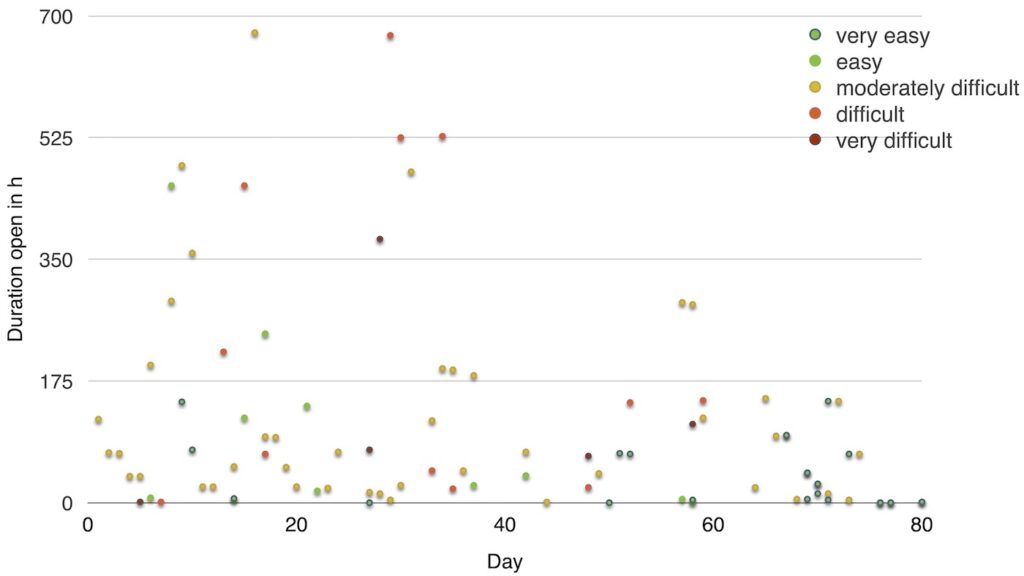
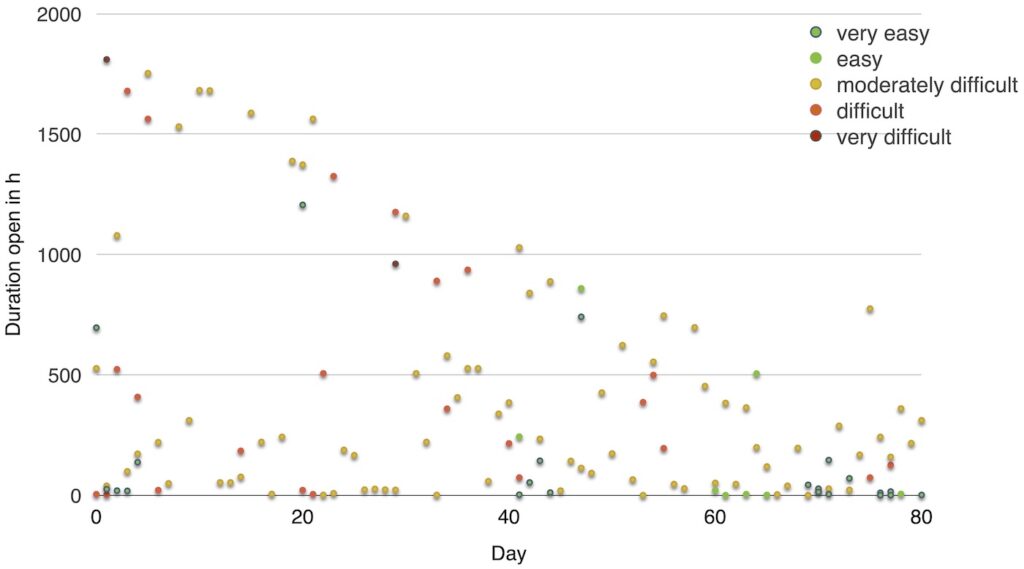
Negative consequences of non-optimal maintenance organization can include unforeseen support costs and time spent manually compensating for inadequate data quality. Maintenance organization deals with unforeseen incidents whose volume and severity cannot be predicted in advance. Figure 1 shows the distribution of incidents across five different difficulty levels over an 80-day period in the organization examined in the scope of this article.
Patterns of action in emergency organizations
An emergency organization is an organization whose purpose is to provide aid in urgent situations to maintain or restore the regular lifestyle of a given person or community [3]. The service provided by emergency organizations and the troubleshooting undertaken in the IT area are similar, both in terms of the urgency of action and objective as well as in terms of structure and prevailing framework conditions (see Fig. 2).

The core competence of emergency organizations (such as rescue, fire brigade, police, technical relief organizations or military) is – in a figurative sense – the elimination of “disturbances” through operations of various kinds.
These organizations have specific structural properties in place in order to successfully manage their operations and patterns of action. Structural characteristics of emergency response organizations include, for example, an operational organization pattern that differs based on type of damage, the presence of self-similar structural elements and a clearly defined allocation of roles that ensures that tasks are carried out as smoothly as possible, even when the personnel composition of a response team changes.
Action patterns are procedures that are applied at different organizational levels to achieve a specific goal [5]. These include, for example: situational investigation methods, specific management procedures and the development or orchestration of predefined, often event-specific standards (e.g. a one-room fire is handled differently than a major fire) [6].
The action patterns shown in Figure 3 were recommended for testing in an IT context.

For this purpose, a workshop was held with those responsible for the maintenance organization and an expert for emergency organizations. Our experiment was designed to examine whether transferring the action patterns used by emergency organizations to the context of an IT maintenance organization makes sense and enables improvements within the latter.
These patterns of action can be explained as follows: Standards can help emergency services prepare for and carry out a specific type of operation by providing workforce guidance (e.g. guidelines for dividing tasks at the operation site, documents or checklists, standardized terminology, description of the tasks handled by a specific role). Emergency organizations anticipate the expected resource requirements for certain types of operations in advance. These are determined by the alert keyword and the emergency location.
There are detailed plans for certain places and objects that enable the emergency services to quickly orientate themselves at the scene and thus shorten the time required to investigate the location. Among other things, these detailed plans may show the individual levels of a building, list sources of danger and predefine appropriate buffer zones for resources.
Material and human resources are transferred into ready-to-use, modular and combinable units in order to improve the ability to react when damage occurs. The emergency services undergo training in which they are provided with basic and role-specific knowledge.
In simulations or large-scale exercises, emergency services practice the application of the operational standards at regular intervals – sometimes on a mandatory basis.
In a short training course, the employees of the IT maintenance organization were made familiar with the general operating patterns followed by emergency service organizations. The time between receipt and closing of the ticket was used as an evaluation parameter for the experiment. This data was relatively easy to collect because a ticket management system was in place. The tickets were divided into five levels of difficulty, ranging from very simple to solve to extremely difficult.
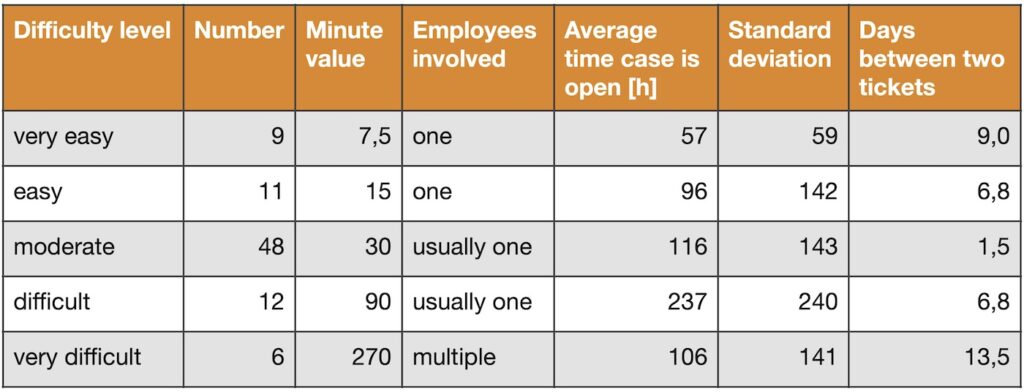
The classification is based on an assessment of the tickets made by the employees of the IT maintenance organization. In order to make the workload of the maintenance organization during this time comparable for the experiment, the levels of difficulty were assigned minute values, resulting in an overall workload value of 4,372.5 minutes in the first evaluation period. The opening times for tickets vary depending on the difficulty of the incident. The individual categories are not thus comparable with each other.
On the one hand, this is because serious and very serious incidents only occur very rarely, and on the other hand, it is due to the way tickets are assigned to team members. Tickets also arrive at random times and are thus not subject to any semblance of regularity.
This also makes it very difficult to ensure consistent staff utilization in the IT support organization.
Applying emergency action patterns to the IT support field
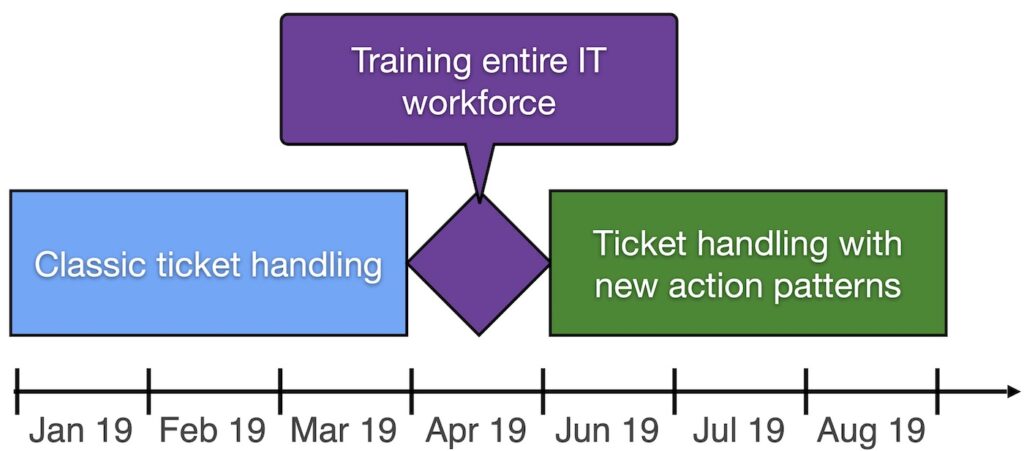
This experiment examined whether training IT employees in the action patterns of emergency organizations had a positive impact on IT support work. The time period of the experiment is shown in Figure 6. In the post-training phase of the experiment, a workload value of 5,295 minutes was recorded, which constitutes an increase of approximately 21% compared to the pre-training phase.
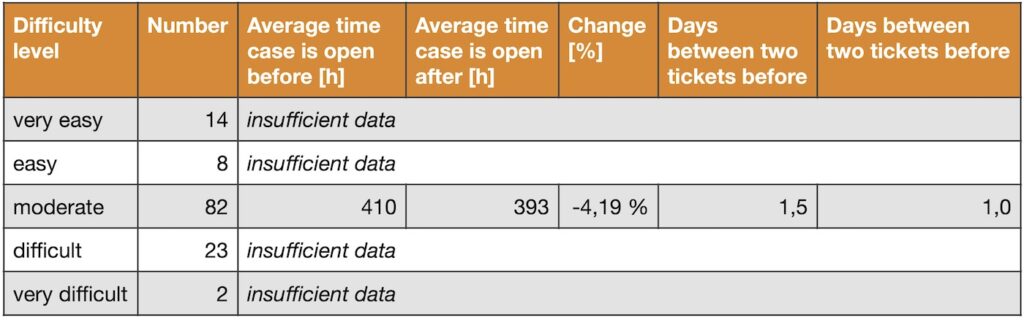
In most of the categories considered, not enough data accrued during the respective study periods to be able to make statistically relevant statements about changes to the time a ticket was open. However, clear differences can be seen in the “moderately difficult” category.
Despite an approximately 20% higher ticket workload, by applying the action patterns of emergency organizations, a noticeable reduction in time open for tickets of moderate difficulty was achieved. In the authors’ opinion, the incorporation of certain patterns of action employed by emergency organizations is certainly justified for IT maintenance organizations.
The action patterns used in the experiment were subjected to an evaluation by IT support employees.
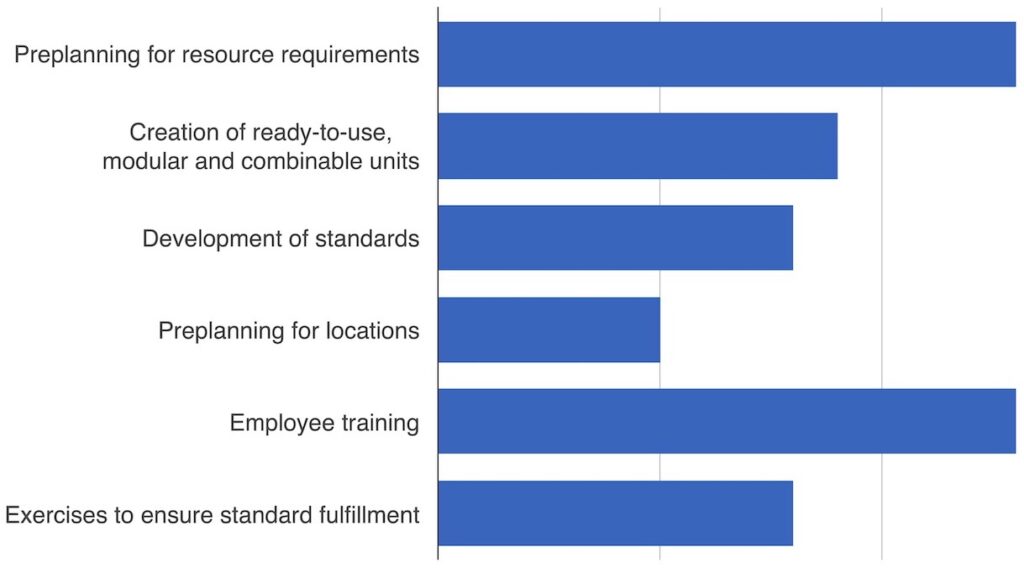
Two of the six action patterns suggested for use in IT support were viewed as particularly suitable (see Fig. 8). In addition to the unsurprising support for staff training, the advance planning of resource requirements was of particular value, as was the creation of ready-to-use, modular and combinable units. Some of the more specific patterns of action, such as pre-planning for locations, were deemed less useful by IT support staff.
Evaluation of the approach
In order to avoid excessive intervention in the already heavily stressful working atmosphere of the IT maintenance organization, no more intensive intervention beyond the training was carried out during the two-phase investigation. This leaves questions unanswered, e.g. such as which action patterns are used in which specific cases. Nevertheless, it seems extremely useful to familiarize IT maintenance organizations with the patterns of action employed by emergency organizations. To ensure that these patterns of action are indeed applicable, an appropriate method kit that describes suitable patterns of action and their possible applications should be developed. However, further experiments are necessary to make this a reality.
Bibliography
[1] Gronau, N.: Enterprise Resource Planning. Architektur, Funktionen und Management von ERP-Systemen. 3rd Edition. Munich 2014.[2] Becker, M.: Personalentwicklung. Bildung, Förderung und Organisationsentwicklung in Theorie und Praxis. 4th Edition. Stuttgart 2005.
[3] Bruderer, H.; Organisation für Notfallsysteme: Leitfaden zum Aufbau von ausserberuflichen Hilfsorganisationen. Zurich 1979. [4] Kern, E.-M.; Hartung, Th.; Zielorientiertes Risikomanagement bei Einsatzorganisationen, in: W. Kersten, J. Wittmann (ed), Kompetenz, Interdisziplinarität und Komplexität in der Betriebswirtschaftslehre. Wiesbaden 2013.
[5] Seidel, S.: Toward a theory of managing creativity-intensive processes: a creative industries study. Information Systems and E-Business Management (2011) 9: 407. DOI: doi.org/10.1007/s10257-009-0123-7.
[6] Röser, T.; Kern, E.-M. (2019): Management von Einsatzprozessen: Flexibilität durch Standardisierung. In: Zeitschrift Führung + Organisation, ZfO Vol. 88 (2019) Issue 1, pp. 47-53
Your downloads
You might also be interested in