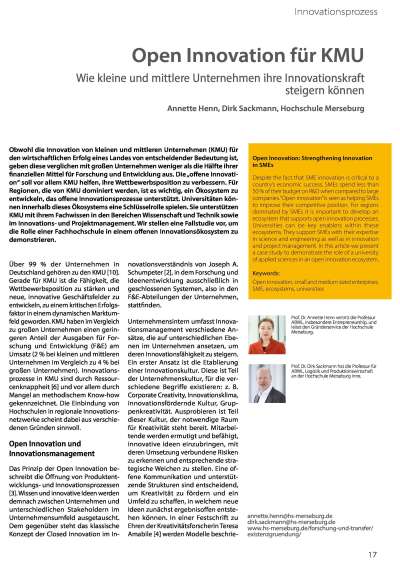
Open Innovation

Strengthening Innovation in SMEs

JournalIndustrie 4.0 Management
Issue Volume 39, 2023, Edition 6, Pages 17-21
Bibliography Share Cite Download

Abstract

Despite the fact that SME innovation is critical to a country’s economic success, SMEs spend less than 50 % of their budget on R&D when compared to large companies. “Open innovation”is seen as helping SMEs to improve their competitive position. For regions dominated by SMEs it is important to develop an ecosystem that supports open innovation processes. Universities can be key enablers within these ecosystems. They support SMEs with their expertise in science and engineering as well as in innovation and project management. In this article we present a case study to demonstrate the role of a university of applied sciences in an open innovation ecosystem.

Keywords

Access limited

You are currently not logged in / not yet registered.

To read the content in full, you must have an appropriate subscription. Alternatively, you can also obtain access by paying a one-off fee.

Subscription included Purchase
without 29,00 €
Digital 27,55 €
Expert 26,10 €
Professional 0,00 €

Read for once 29,00 €

All prices include 7% VAT

After purchasing access rights, you will automatically be redirected back to this page.


Potentials: Innovation

You might also be interested in

Industry 4.0—Progress and Digitalization in Limbo

Industry 4.0—Progress and Digitalization in Limbo

Status of sustainable transformation and digitalization in production engineering
Christian Donhauser ORCID Icon, Daniel Riepl
Digitalization projects help users represent complex processes more simply and efficiently. However, there are many obstacles to implementation. Reluctance to implement these projects is palpable. This affects, among others, employers and employees, who may fall behind economically by waiting or avoiding change. These observations can be traced back to an overarching research question: What barriers and systemic challenges hinder sustainable transformation within the context of Industry 4.0, particularly when considering human labor in production engineering? What questions are the affected stakeholders asking? The primary goal of this long-term research project is to define these questions decisively and in detail in order to develop a conceptual foundation that integrates research, teaching, and technological development and thus combines the potential of digital technologies with the experiential and practical knowledge of production workers.
Industry 4.0 Science | Volume 42 | 2026 | Edition 3 | Pages 56-60
Serious Gaming and the Energy Transition

Serious Gaming and the Energy Transition

Collaborative knowledge generation and interactive understanding of complex interrelationships
Janine Gondolf ORCID Icon, Gert Mehlmann, Jörn Hartung, Bernd Schweinshaut, Anne Bauer
Conveying the complexity and multifaceted nature of the energy transition to a broad audience is a challenge. This article demonstrates how interactive serious games on a multitouch table can help make connections tangible and comprehensible. The games and the table were used in various conversational contexts. These are presented here in three case vignettes based on participant observation of the different applications, as well as situated and shared reflection. The vignettes demonstrate how interaction can trigger epistemic processes, enable shifts in perspective, and foster collective thinking, all of which are necessary for shaping the future of society as a whole.
Industry 4.0 Science | Volume 42 | 2026 | Edition 2 | Pages 62-69
Industrial Transformation via a Machining Learning Factory

Industrial Transformation via a Machining Learning Factory

A learning module to foster competencies for a sustainability-driven transformation
Oskay Ozen ORCID Icon, Victoria Breidling ORCID Icon, Stefan Seyfried ORCID Icon, Matthias Weigold
Sustainability-enhancing transformation processes are necessary in all sectors if we are to remain within planetary boundaries. This also applies to the industrial sector as a significant emitter of greenhouse gases. Employees need new competencies to master this complex task of industrial transformation. These range from CO2 equivalents accounting to the development and evaluation of transformation scenarios, including technical measures. The learning module developed here addresses these competency requirements and uses the example of the ETA factory to show how a competency-oriented learning module for industrial transformation can be structured. It essentially comprises four phases: data collection and CO2 equivalents accounting, cause analysis, development of measures and evaluation of measures.
Industry 4.0 Science | Volume 42 | Edition 2 | Pages 38-47 | DOI 10.30844/I4SE.26.2.38
Data Quality and Domain Expertise for Resilient AI Deployment

Data Quality and Domain Expertise for Resilient AI Deployment

Integrating anomaly and label error detection in industry
Pavlos Rath-Manakidis, Henry Huick, Erdi Ünal, Björn Krämer ORCID Icon, Laurenz Wiskott ORCID Icon
AI implementation transforms work and worker-technology relationships in industrial quality control. This paper explores how approaches to data quality and model transparency support ethical AI deployment, fostering worker agency, trust, and sustainable work design in automatic surface inspection systems (ASIS). Recurring problems like data inefficiency, variable model confidence, and limited AI expertise point to key challenges of human-centered AI: user trust, agency and responsible data management. A solution co-developed with an ASIS supplier demonstrates that the challenges extend beyond the purely technical, underscoring the value of AI design that augments human capabilities. Technical solutions such as anomaly, label error, and domain drift detection are proposed to enhance data quality and model reliability. The insights emphasize the following generalizable strategies for resilient AI integration: understanding user-reported problems through a human-AI interaction lens, ...
Industry 4.0 Science | Volume 42 | Edition 1 | Pages 128-135 | DOI 10.30844/I4SE.26.1.120
Digital Competence Lab (DCL) for Speech Therapy

Digital Competence Lab (DCL) for Speech Therapy

Designing a learning platform to advance digital skills
Anika Thurmann ORCID Icon, Antonia Weirich ORCID Icon, Kerstin Bilda, Fiona Dörr ORCID Icon, Lars Tönges ORCID Icon
The digital transformation of healthcare results in lasting changes in speech therapy. Smart technologies and artificial intelligence (AI) are creating new opportunities to ensure therapy quality, address care bottlenecks, and actively involve patients in exercise processes. At the same time, these developments are expanding the role of speech therapists, who increasingly use digital systems as supportive tools in addition to their core therapeutic tasks. Based on a feasibility study of the AI-supported application ISi-Speech-Sprechen in a real-world setting of complex Parkinson's therapy (PKT), this article outlines the key challenges associated with implementing smart technologies.
Industry 4.0 Science | Volume 42 | 2026 | Edition 1 | Pages 110-118 | DOI 10.30844/I4SE.26.1.102
AI Skills for Responsible Use

AI Skills for Responsible Use

Realistic learning environments, critical thinking, and role design in teams
Valentin Langholf ORCID Icon, Niklas Obermann ORCID Icon, Uta Wilkens ORCID Icon, Marco Kuhnke, Michael Prüfer
Artificial intelligence (AI) is changing the world of work. But how can work teams learn to use AI support in a way that delivers speed advantages and ensures consistently high quality? One possible approach is to test it in a workplace-like simulation. Trying it out under realistic conditions shows the role that critical thinking plays.
Industry 4.0 Science | Volume 42 | Edition 1 | Pages 100-107 | DOI 10.30844/I4SE.26.1.92