Hybrid Decision Support in Product Creation |
Improving performance with data science and artificial intelligence
 , Jens Pottebaum
, Peter Nyhuis
, Rainer Stark
, Klaus-Dieter Thoben
, Petra Wiederkehr
, Jens Pottebaum
, Peter Nyhuis
, Rainer Stark
, Klaus-Dieter Thoben
, Petra Wiederkehr
| Journal | Industry 4.0 Science |
| Issue | Volume 41, Edition 1, Pages 18-25 |
| Open Access | https://doi.org/10.30844/I4SE.25.1.18 |
| Share | Cite | Download |
Abstract
Keywords
Article
Many requirements for technical products only become apparent at a later stage of product life: during product use, decommissioning or material recirculation. Nevertheless, it remains important to already anticipate and consider upstream and downstream resource consumption as well as the quantities of available recycled material in the product creation phase.
New concepts are required to deal with rapidly changing extreme data in the engineering of both product and production system. One must also sufficiently prepare for future data requirements: What data do we need today, what do we need tomorrow? What information do we need to aggregate into what new knowledge for future development processes?
Product creation shapes the circular economy
Those who work in product engineering see themselves as problem solvers [1]. They bear overall responsibility and are therefore key players in shaping a circular economy [2]. If companies want to become climate-neutral in the future, specialists in product engineering must consciously influence the life cycle complexity [3] in their own company in both upstream and downstream processes [4, 5].
Knowledge and expertise are crucial for a product to become an innovation [6]. Heuristics, methods and simulations based on data, information and models form the foundation for this [7]. However, the efficiency of product creation is limited to the processing of modeled product and process data.
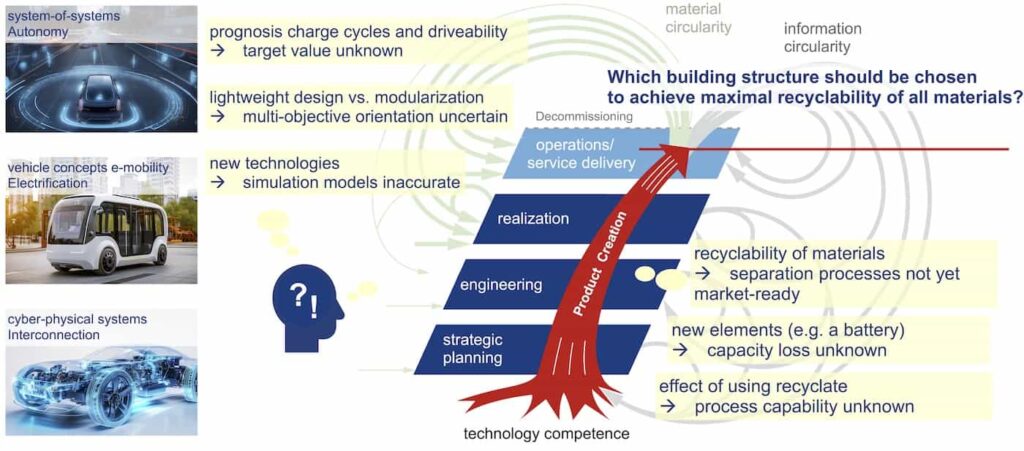
A passenger car, for example, can be understood as a cyber-physical system that can be built on an electrified vehicle concept and that interacts with other elements in road traffic in the sense of a System-of-Systems (Figure 1). A product structure must be defined for this car considering the entire product life—shown in Figure 1 using the generic Product Life Cycle (gPLC, see [8]). This is crucial for the subsequent recirculation of materials, see [9].
The replacement of battery elements, for example, is only possible if disassembly is already provided for in the engineering phase. Accordingly, the product structure must already be designed with the aim of sustainability and recyclability and in the context of the overall system, in which interdisciplinary dependencies exist [10].
Performance limits in decision-making
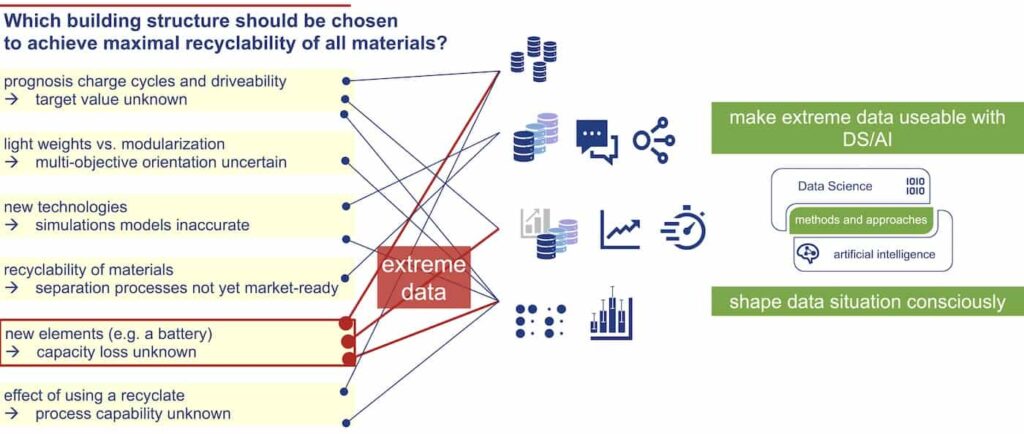
The decision-making situation is visualized in Figure 1 by six aspects of complexity that exemplify the limits of today’s performance capabilities:
- The product structure must contain the battery system. The required installation space depends on the target maximum capacity. The target value is unknown, realistic charging cycles and future driving behavior can only be estimated by experts.
- Lightweight design reduces energy consumption while modularization facilitates disassembly and reuse. Energy efficiency can therefore be contradictory to resource efficiency. While lightweight design requires integrated structures that are optimized for individual cases, modularization can only be achieved through standardized structural elements that are never optimal in individual cases. Multi-objective optimization requires compromises.
- New manufacturing technologies are researched and developed to market readiness in parallel with the development of passenger cars. While the repair of defective battery cells may not yet be efficient, the corresponding technology is being continuously developed. Thus, simulation models are not yet mature enough to apply Design-for-Maintenance to batteries.
- The vision of sustainable products is the complete recyclability of the materials used, a change from “consumption” to pure “use”. In the product structure, parts are combined to form assemblies and products. Composite materials enable lightweight design solutions. However, the recovery of the materials requires predictive technologies that are not yet ready for the market (in regard to separation processes).
- Car manufacturers currently tend to guarantee a battery capacity of 70 % after eight years of operation or 160,000 km. Safety factors compensate for a lack of knowledge, as the loss of capacity in relation to new battery materials (lithium, replacement of cobalt, zinc-air technology, etc.) cannot yet be validated for the lifespan of the product.
- If recycled materials are added in plastics production, for example, unpredictable mixing ratios of grains of different ages arise over time. Research into the effects on process capability in production requires extremely complex experimental studies.
These aspects are examples of the limits of performance caused by increasing lifecycle-related complexity in terms of material and information circularity [3, 8]. Concepts such as the “Update Factory” [11] address this challenge. Information circularity for the circular economy must be consciously designed to incorporate learning from the product life as well as the increasing desire for digital business models [8]. Performance is determined by the availability of product-related information, for instance from maintenance history, recycling processes, digital twins, production processes and engineering iterations [8].
In the “Update Factory”, for example, information from condition monitoring is required for the selection of treatment measures. The classic engineering approach of systematically securing such information and consolidating it in heuristics and simulation models (see, for instance, [1, 12]) does not satisfy the dynamics and necessary adaptability of future products. Accordingly, it limits the efficiency of the entire product creation, from concept development to production implementation.
The potential of data science and artificial intelligence
To overcome the limits attributed to decision-making performance in product creation, the quality of decisions must be increased while demands on time and resources remain the same. Data Science (DS) and artificial intelligence (AI) offer potential for overcoming these limits. Established calculation methods in product engineering, such as finite element analysis or fluid dynamics simulations, combine mechanical domain knowledge with the fundamentals of mathematics.
DS processes and methods combine the skills of computer science and mathematics (especially stochastics) with the specialist knowledge of the respective domains (see left in Figure 2, based on [13]).
DS forms the basis for methods such as machine learning or reasoning with ontologies. Such processes can be used to provide machines with (artificial) intelligence. According to the European Commission’s Expert Council [14], AI “refers to systems that display intelligent behaviour by analysing their environment and taking actions – with some degree of autonomy – to achieve specific goals“.
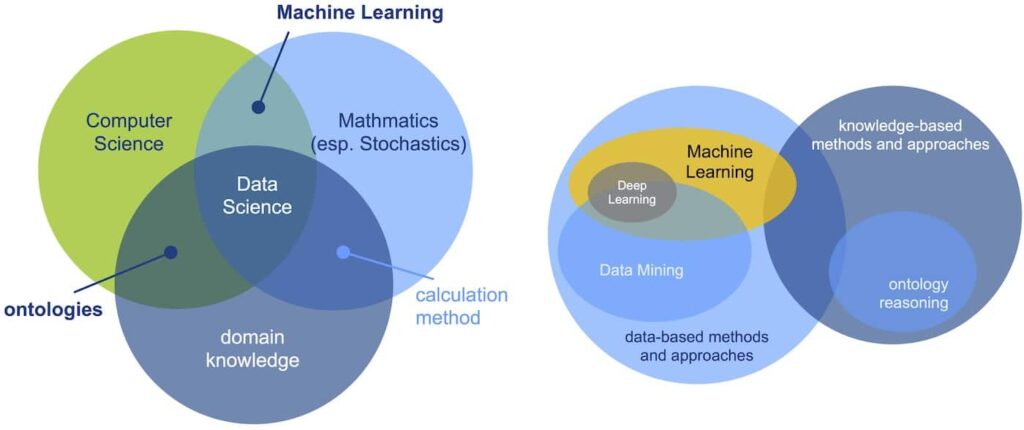
DS/AI can be divided into data-based approaches and knowledge-based approaches [15] (right in Figure 2). The crucial factor for decision support is not the categorization into DS and AI but the arising capabilities for engineers in product creation. The focus is on processes and methods that represent a fundamentally new approach compared to established approaches in product creation. The aim is to support humans in their cognitive processes in the sense of weak AI but not to map cognitive processes as an alternative to human intelligence in the sense of strong intelligence (cf. hybrid intelligence [16]).
Opportunity and challenge: extreme data
The main requirement regarding data and information is to support the handling of extreme data (see [17]). Extreme data is understood here as data within which various characteristics interact simultaneously. Large volume, high speed and great variety, for example, often only become “extreme” when data is scattered and shows different extreme deviations in values. In many cases, this data can even contradict previously established approaches in product creation: Using machine-generated information in the decision-making process, which, according to previous scientific consensus, requires verified and validated information (Figure 3). The focus here is not on general decision support systems [18] but on the domain-specific challenges in product creation.
Product engineering relies on heuristics, methods, models and simulations that have been researched and developed according to established standards (see above). Based on this, data must be condensed into information and knowledge along the Knowledge Pyramid before it is integrated into decisions.
This compression can be understood as the “qualification” of data [19]. Unlike machine learning, sorting, calculation, optimization and evaluation processes are based on this understanding. Guidelines and standards are the result of such qualification, which in this case takes place through consensus building among specialist personnel and which engineers can refer to in their actions.
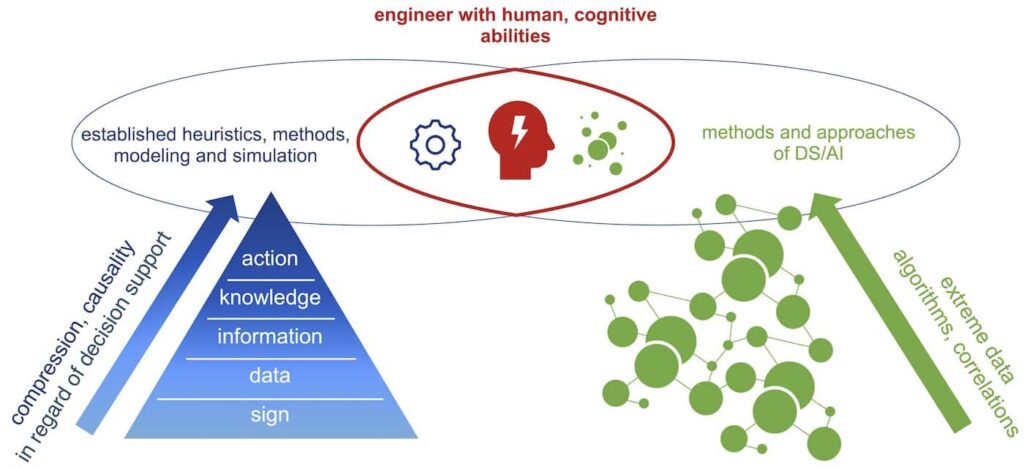
To be able to follow machine-generated decision support, a clear association of responsibility and liability issues in the interaction between humans and AI systems is required. When deciding which technical concept and which specific technical realization is to be pursued, various influencing elements are to be equally combined in the future: mathematical interpretation based on formulas, technical simulation and heuristic rules on one side, and data availability on usage situations in operational mode, as well as additional recorded conditions such as weather, environmental influences, measured vibrations etc. on the other side.
The aviation industry provides an example: Aircraft turbines contain turbine blades that wear out during operation and require regular maintenance. During operation, it was recognized that wear is significantly higher on flight routes over India than in other airspaces (see, for instance, [20]). It is the responsibility of product creation to make decisions on adjusted maintenance intervals, a flight ban over India or design changes to the components based on such observations – and thus to help decide on the safety of the aircraft passengers.
New approach: Hybrid Decision Support
Hybrid Decision Support describes the synergetic combination of previously used methods, heuristics, models and simulations on the one hand and DS and AI processes and methods on the other. In order to responsibly deploy this type of Hybrid Decision Support in product creation, individual key activities and their dependencies must be highlighted. These include understanding a problem or innovation potential and designing and validating against requirements and customer needs. On the one hand, engineers must be supported in narrowing down solution spaces and thus optimally focusing engineering activities. On the other hand, they should be empowered to creatively develop and implement new solutions. Six promising approaches for increasing the quality of results in product creation can be identified:
- Mastering the complexity of requirements [21],
- the integration of usage-related information [22],
- the generation and explainability of solution spaces [23],
- continuous virtual process validation [24],
- the efficient interaction of people and information technology, and
- the partial automation of activities [25, 26].
An increase in the quality of decision-making must always go hand in hand with an improvement in the predictability of product properties and production conditions (see [27]). This applies in particular to the examples of Design-for-Circularity and Design-for-Sustainability. These must be understood as characteristics of both the product and the process. The consistent shift away from the consumption of resources towards the long-lasting use of products requires continuous learning with a perspective on the production, use and decommissioning of products.
Extreme data must be made usable for specific issues in product creation using DS/AI. For example, the capacity loss of batteries (example in Figure 4) can be estimated more and more reliably as the service life of the first products on the market increases. However, data from extremely numerous and globally distributed systems (vehicles) must be taken into account, the quality of which depends heavily on the environmental conditions, storage and possibly usage behavior.
Aiming for change in product creation
Circular economy and sustainability are becoming increasingly important to society as the key to overcoming the complex challenges of climate change. The prerequisite for this is increasing capabilities for the engineering of circular products. At the same time, clear trends can be identified as to which basic algorithms, technologies and the DS/AI processes and methods based on them will reach a sufficient level of maturity in the foreseeable future.
In order to develop circular products, the efficiency of product creation must be increased by incorporating additional digital capabilities. This requires a fundamental change in product creation. A basic understanding of reliability and impact must be created so that engineering is always able to act in accordance with applicable rules and specifications. From 2024, the DFG Priority Programme 2443 will lay the foundations to enable engineers of product and associated production system to use DS/AI processes and methods to design circular products.
This article was written by the program committee “DFG Priority Programme 2443 – Hybrid Decision Support in Product Creation”.
Your downloads
Potentials: Management Resource Efficiency
Solutions: Product Development
You might also be interested in