Circular Economy Enabled by Digitization |
Digital networking in the procurement of manufacturing companies

| Journal | Industry 4.0 Science |
| Issue | Volume 41, 2025, Edition 1, Pages 26-33 |
| Open Access | https://doi.org/10.30844/I4SE.25.1.26 |
| Bibliography | Share | Cite | Download |
Abstract
Keywords
Article
Global warming is one of the greatest challenges of the 21st century. Its impact manifests itself in extreme weather events and rising temperatures, which pose immense threats for both ecological systems and human civilization [1]. The increasing extraction and use of raw materials are closely linked to these climatic changes. Since 2017, the global economy has extracted and used almost more material than in the entire 20th century.
In figures, that is over 500 billion tons [2]. The demand for resources to secure the standard of living of an expanding world population results in excessive material extraction and increased pressure on ecosystems [3]. Against the backdrop of these threats, the United Nations warn of a possible comprehensive collapse and emphasize the need for a sustainable use of resources [4].
Circular economy as one solution to global warming
In view of intensifying environmental and economic challenges, political bodies such as the United Nations Environment Assembly (UNEA) and the Group of Seven (G7) are focusing on circular economy and sustainable supply chains [5]. Procurement plays a key role in the implementation of circular economy strategies for manufacturing companies [6, 7]. The use of digitally networked platforms can improve the transparency and traceability of materials and products along the entire value chain [8].
The optimization of supply chains in the context of sustainability through procurement not only leads to a reduction in CO₂ emissions but also enables companies to make their production processes more sustainable and resource-efficient [9]. This study investigates digitalization as a catalyst for circular economy practices in the procurement of manufacturing companies.
Twin transformation in procurement
Companies moving towards digitalization goes hand in hand with the growing pressure to achieve sustainability goals [10]. Great opportunities arise once the digital transformation and the sustainability transformation are synergistically linked. This integration, also known as “twin transformation”, can increase the potential of both transformation processes by using their respective strengths to promote each other [10]. Thus, despite initially conflicting requirements, digitalization and sustainability goals can be effectively combined, which can lead to many competitive advantages [10].
A starting point for realizing this synergy is reflected in the implementation of circular economy principles in procurement. The procurement process—considering the entire life cycle of goods and services—offers the most positive ecological, social and economic effects [11]. There are numerous definitions of the term circular economy in literature, as the article “Conceptualizing the Circular Economy (Revisited): An Analysis of 221 Definitions” illustrates [12].
Circular economy is defined, among other things, as an economy in which the value of products, materials and resources is maximized over their entire life cycle with the aim of minimizing waste. In contrast to linear economy, which is rooted in a linear production and consumption model, circular economy is based on closing material cycles [5]. The ideal vision of circular economy rests upon the idea that no waste is generated in the conventional sense [13]. To look at the circular economy in detail, it is necessary to explain Lehmacher and Bödecker’s so-called 11R strategy [14]. Figure 1 shows a schematic representation of these 11R principles, including descriptions and examples.
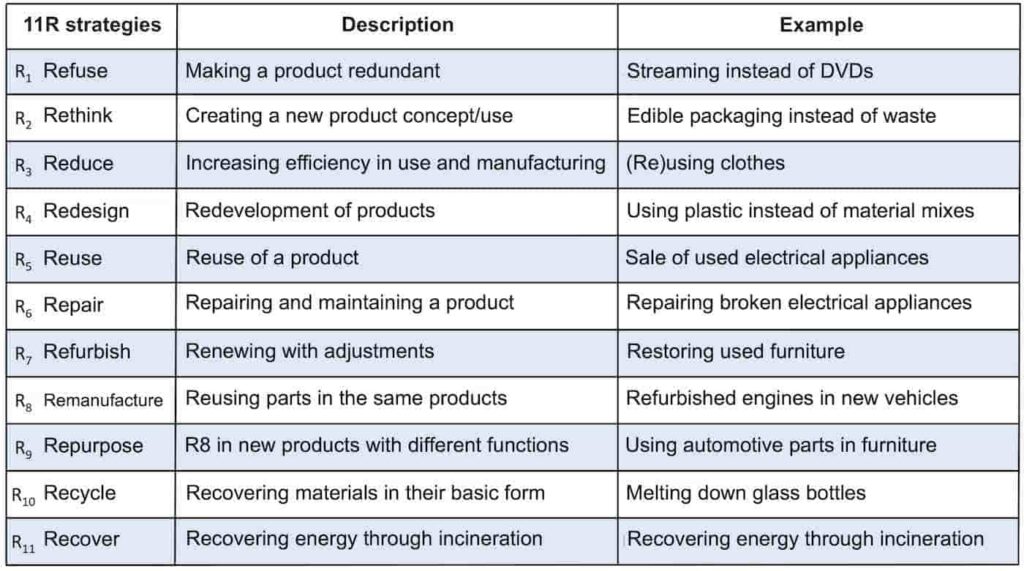
The fundamental aim of all 11R strategies is to maintain or increase the economic value of a product for each usage cycle. The higher up the strategies are shown in Figure 1, the sooner they close the material cycle again and the fewer CO₂ emissions generated [15]. In industry, the implementation of circular economy strategies in procurement is becoming increasingly relevant, especially in highly interconnected sectors such as the automotive industry [17]. Fusing digitalization and circular economy creates new opportunities for the transparent and efficient design of material flows.
Introduction of the interview partners and applied research methodology
In the course of this study, eight experts from five leading global companies in German industry were selected to conduct expert interviews. The selection of the companies was based on their position in the global automotive and aviation industries, the diversity of their supply chains and their active participation in innovation projects in the field of digital networking and circular economy. The following companies were interviewed as part of this study:
- Company 1: Leading manufacturer in the aerospace and defense industry with over 100,000 employees worldwide.
- Company 2: Automotive supplier with a global network of production facilities and research centers, a diversified customer base and tens of thousands of employees.
- Company 3: OEM in the automotive industry with over 100,000 employees worldwide that manufactures vehicles for the private and commercial sectors and offers mobility services.
- Company 4: Globally active industrial company with a focus on the automotive industry and well over 100,000 employees internationally.
- Company 5: Specialist in drive and chassis technology in the automotive and industrial technology sector, with over 100,000 employees.
When putting together this group of experts from the respective companies, care was taken to include representatives from different areas of procurement in order to ensure a more comprehensive perspective on the results. Managers and experts from the fields of procurement, supply chain management, sustainability and after-sales management were selected. For reasons of data protection, the participating companies and interview partners were anonymized.
The use of semi-structured guided interviews allowed adequate consideration of the complexity of the object of investigation and ensured a flexible approach [18]. This way of structuring by means of guidelines ensures that each expert is confronted with the same thematic blocks and core questions during the interview, which guarantees a sound basis for comparison for the evaluation [19]. At the same time, this interview form allows flexibility, facilitating the mention of relevant points during the interview that contribute to in-depth answers.
For example, it is possible to actively formulate detailed questions on interesting topics to obtain even more in-depth information [19]. The interview guide was deliberately designed as a flexible one to allow both the central research question to be answered and other relevant research topics to be identified.
The interview guide can be handed out on request. All interviews were conducted on site at the respective companies or digitally between May and July 2024. All interviews were recorded and carefully transcribed to enable a detailed, category-led, qualitative content analysis. The qualitative text analysis software MAXQDA, an interactive and structured software solution for qualitative data analysis (QDA) [20], was used to support the analysis.
State-of-the-art circular economy in networked procurement
The evaluation of the surveys has provided in-depth insights into the potential of the networked circular economy in procurement. In line with the dominant transfer character of this publication, the results have been divided into the following six main categories:
Motivation and incentives
According to the interviewees, the main economic motivations for implementing circular economy are long-term cost reduction through material reuse and ensuring material availability. Simultaneously, ecological factors are gaining importance, particularly the conservation of natural resources and the reduction of CO₂ emissions.
These goals are increasingly being anchored in companies’ strategic planning processes. Social incentives are the result of growing pressure from consumers and legal requirements. Companies have not yet focused their efforts on inspiring new applicants or existing staff. Although economic factors continue to dominate, sustainability criteria are becoming more prominent when selecting suppliers.
Best practices and experiences
The principles of circular economy are yet to be fully implemented by the participating companies. Nevertheless, the R strategies of recycling, reuse and remanufacturing are becoming increasingly important. Recycling already takes place through the separation of production waste by type. The implementation of these principles is proving to be particularly challenging in the aviation industry due to strict safety regulations. There is significant potential for the use of recycled materials, especially for non-safety-relevant components.
CO₂ footprint
According to the interviews, CO₂ footprint plays a central role in procurement. Detailed CO₂ data is of crucial importance for the awarding of contracts. In the automotive industry, for instance, the carbon footprint is expected to become as important as price and quality in the future. Circular economy approaches, and especially recycling and reuse, are seen as key strategies for reducing CO₂ emissions. The use of sustainable energy sources such as green electricity was also mentioned.
Opportunities and potential
The main opportunities and potential of circular economy were identified as increasing the resilience and security of supply chains. In view of global disruptions, such as the Covid-19 pandemic, as well as material shortages and geopolitical conflicts, circular economy creates the possibility of greater localization and less dependence on critical suppliers. The digital product passport was named as one of the more efficient uses of resources. According to participants, it promotes transparency along the supply chain and could improve the traceability of materials through technologies such as blockchain.
Obstacles and challenges
The implementation of circular economy strategies was associated with a variety of internal and external challenges. Internal challenges included the cost of adapting processes, the complexity of integration into existing processes, staff training and the necessary investment in research and development. External challenges relate mainly to SMEs, which, potentially, do not have the necessary resources to meet the requirements of circular economy. In addition, the complexity of global supply chains makes seamless implementation difficult. The limited availability of recycling materials was cited as a further problem. Finally, there is a tension between the development of environmentally friendly products and the associated, often higher production costs. Regulatory hurdles were also mentioned.
Cooperation and partnerships
The experts emphasize the need for a collaborative approach in the automotive industry to address key challenges such as standardization and efficient data exchange along the entire value chain. In this context, platforms such as Catena-X are of crucial importance as they ensure transparency and traceability, which is essential for the implementation of a circular economy [21]. In addition, multilateral data exchange contributes to the achievement of sustainability goals through the precise recording and tracking of CO₂ emissions along the supply chain.
Practical circular economy applications in the companies surveyed
In a mutual discussion, the following two circular economy applications – some of which have already been implemented at the companies surveyed – were rated as particularly interesting and promising:
Dismantling-as-a-Service
This concept aims to dismantle products (such as vehicles) systematically to ensure optimal reuse of the materials. While conventional car recycling companies focus primarily on the sale of used spare parts and therefore only make a limited contribution to circular economy, specialized companies that are in direct contact with manufacturers and focus on the systematic dismantling of their products are expected to gain importance in the future. It is also predicted that changes to the legal framework, for example in the form of the “European Sustainability Reporting Standards”, will accelerate the implementation of circular economy processes.
Deposit system
When purchasing a product, the customer pays a deposit that is refunded when the defective component is returned, to ensure the recycling of old parts. This means that defective components are removed from the market and subjected to systematic testing to evaluate their circular economy potential. Components that can still be reconditioned are repaired as part of a defined reconditioning process and reintroduced to the market. The customer does not receive the original component back but a refurbished replacement product. The reconditioned component is passed on to another customer once the repair is complete.
The idea is to contribute to an efficient circulation of resources and extend the service life of the products. Setting an appropriate price for the take-back system is a major challenge. Furthermore, the business model requires efficient warehousing and the continuous availability of replacement products to ensure rapid repair processes. The system is already being used in logistics and for packaging materials.
Future circular economy potential in manufacturing companies
In conclusion, the implementation of circular economy practices can be an attractive approach to extending product life cycle and reducing raw material consumption and CO₂ emissions in the manufacturing industry. This study suggests that circular economy principles have been sufficiently researched in theory but are still under-utilized in practice. Companies are well advised to individually analyze the potential of circular economy practices in relevant areas to maximize their specific benefits. In view of the legislation that has been passed or is pending, as well as rapid technological advances, it is crucial to develop a strategy for twin transformation.
Kempten University of Applied Sciences provides long-term and sustainable support to interested companies. Staff at the university are currently working on specific guidelines to help small and medium-sized manufacturing companies identify and successfully implement circular economy potential in a targeted manner. These guidelines are a key component of ongoing projects at Kempten University of Applied Sciences and are intended to help strengthen the innovative capacity and competitive strength of companies in the long term.
This article was created as part of the collaboration between the aforementioned industrial companies and Kempten University of Applied Sciences. One operational focus was the final thesis by Mr. David Pfister on the topic of “Opportunities and challenges of the digitally networked circular economy in the procurement of manufacturing companies”. Our special thanks go to the companies mentioned and the experts interviewed for their active support and commitment.
Bibliography
[1] Bethke, M.:Der ökologische Kontext: Der Klimawandel und die planetaren Grenzen (des Wachstums). In: Martin Bethke (ed.): Nachhaltiges Wirtschaften als Erfolgsfaktor. Herausforderungen, Strategien und Best Practices für ein zukunftsfähiges Unternehmen. Wiesbaden 2023, pp. 3-12. DOI: 10.1007/978-3-658-42321-6_2.[2] Circle Economy Foundation (ed.) (2024): The Circularity Gap Report 2024: A circular economy to live within the safe limits of the planet. URL: https://circulareconomy.europa.eu/platform/sites/default/files/2024-01/65ae7d516defe92cc1988a47_CGR%20Global%202024%20-%20Executive%20Summary.pdf, accessed 25.10.2024.
[3] Faßbender, S.; Mattissek, A.: Resources. In: Eva Nöthen and Verena Schreiber (ed.): Transformative geographische Bildung. Schlüsselprobleme, Theoriezugänge, Forschungsweisen, Vermittlungspraktiken . Berlin, Heidelberg 2023, pp. 69-75. DOI: 10.1007/978-3-662-66482-7_11.
[4] United Nations Office for Disaster Risk Reduction (ed.) (2022): Global assessment report on disaster risk reduction. Geneva, Switzerland. URL: https://www.undrr.org/gar/gar2022-our-world-risk-gar, accessed 25.10.2024.
[5] United Nations Environment Program; International Resource Panel (2024): Global Resources Outlook 2024 – Bend the trend. Pathways to a Liveable Planet as Resource Use Spikes. URL: https://wedocs.unep.org/20.500.11822/44901, accessed 25.10.2024.
[6] Migliore, M.; Talamo, C.; Paganin, G.: Circular Economy and Sustainable Procurement: The Role of the Attestation of Conformity. In: Marco Migliore, Cinzia Talamo and Giancarlo Paganin (eds.): Strategies for Circular Economy and Cross-sectoral Exchanges for Sustainable Building Products. Preventing and Recycling Waste. 1st ed. Cham 2020, pp. 159-173. DOI: 10.1007/978-3-030-30318-1_6.
[7] Helmold, M.; Treu, J.; Fritz, J.; Hummel, F.: Kreislaufwirtschaft als Modell der Zukunft. In: Marc Helmold, Johannes Treu, Jürgen Fritz and Florian Hummel (ed.): ESG, CSR und SDG als langfristiger Wettbewerbsvorteil. Nachhaltigkeit durch innovative Konzepte, Methoden und Tools. Wiesbaden 2024, pp. 297-322. DOI: 10.1007/978-3-658-44579-9_14.
[8] Ebinger, F.; Omondi, B.: Transparenz und Digitalisierung in nachhaltigen Wertschöpfungsketten In: Alexandra Hildebrandt and Werner Landhäußer (ed.): CSR und Digitalisierung. Der digitale Wandel als Chance und Herausforderung für Wirtschaft und Gesellschaft 2nd edition. Berlin 2021, pp. 347-362. DOI: 10.1007/978-3-662-61836-3_22.
[9] Lozano-Oviedo, J.; Cortés, C. E.; Rey, P. A.: Sustainable closed-loop supply chains and their optimization models: a review of the literature. In: Clean Techn Environ Policy 26 (4) (2024), pp. 999-1023. DOI: 10.1007/s10098-023-02730-w.
[10] Kreutzer, R. T.: Ausgestaltung einer Kreislaufwirtschaft. . In: Ralf T. Kreutzer (ed.): Kreislaufwirtschaft. Wie Projektplanung und Umsetzung gelingen . 1st ed. 2023. Wiesbaden 2023, pp. 23-58. DOI: 10.1007/978-3-658-43105-1_3.
[11] Beckmann, H.: Nachhaltigkeit in der Beschaffung. In: Holger Beckmann (ed.): Grundkurs Beschaffungsmanagement. Wiesbaden 2023, pp. 319-332. DOI: 10.1007/978-3-658-39125-6_24.
[12] Kirchherr, J.; Yang, N. N.; Schulze-Spüntrup, F.; Heerink, M. J.; Hartley, K.: Conceptualizing the Circular Economy (Revisited): An Analysis of 221 Definitions (2023). In: Resources, Conservation and Recycling 194, p. 107001. DOI: 10.1016/j.resconrec.2023.107001.
[13] Meyer, C.: “Transforming our world”. Discourses on the future for the implementation of the UN Agenda 2030. Bielefeld 2022. DOI: 10.14361/9783839455579.
[14] Lehmacher, W.; Bödecker, J.: Circular Economy.Industrielle Revolution: Der Weg zu mehr Nachhaltigkeit durch Kreislaufwirtschaft. Wiesbaden 2023, DOI: 10.1007/978-3-658-41311-8_2.
[15] Potting, J.; Hekkert, M.; Worrell, E.; Hanemaaijer, A.: Circular economy: Measuring innovation in the product chain. The Hague 2017. URL: https://www.pbl.nl/uploads/default/downloads/pbl-2016-circular-economy-measuring-innovation-in-product-chains-2544.pdf, accessed 25.10.2024.
[16] Pamminger, R.; Glaser, S.; Wimmer, W.: Modeling of different circular end-of-use scenarios for smartphones (2021). In: Int J Life Cycle Assess 26 (3), pp. 470-482. DOI: 10.1007/s11367-021-01869-2.
[17] Kozuch, A.; Deimling, C. von; Eßig, M.: Circular Supply Management: Beitrag der Beschaffung zu wirksamer Nachhaltigkeit in Lieferketten. In: Roy Fritzsche (ed.): Logistik in Wissenschaft und Praxis. Von der Datenanalyse zur Gestaltung komplexer Logistikprozesse: Festschrift für Rainer Lasch zum 60. Geburtstag. Unter Mitarbeit von Rainer Lasch, Otto Opitz and Günter Bamberg. Wiesbaden 2021, pp. 305-327. DOI: 10.1007/978-3-658-33480-2_13.
[18] Mey, G.; Mruck, K. (ed.): Handbuch qualitative Forschung in der Psychologie. 1st edition. Wiesbaden 2010. DOI: 10.1007/978-3-531-92052-8.
[19] Helfferich, C.: Leitfaden- und Experteninterviews. In: Nina Baur and Jörg Blasius (ed.): Handbuch Methoden der empirischen Sozialforschung. [2nd, completely revised and expanded edition]. Wiesbaden 2019, pp. 875-892. DOI: 10.1007/978-3-658-37985-8_55.
[20] Rädiker, S.; Kuckartz, U.: Analyse qualitativer Daten mit MAXQDA. Text, Audio und Video. Wiesbaden 2019. DOI: 10.1007/978-3-658-22095-2.
[21] Catena-X Automotive Network e.V. (ed.) (n.d.): Anwendungsfall Kreislaufwirtschaft. URL: https://catena-x.net/fileadmin/user_upload/03_Angebote/Portal/One_Pager_CX_Circular_Economy.pdf, accessed 25.10.2024.
Your downloads
Potentials: Strategy
Solutions: Procurement
You might also be interested in