
AI-Assisted Work Planning |
Extracting expert knowledge from historical data for streamlined efficiency and error mitigation

| Journal | Industry 4.0 Science |
| Issue | Volume 40, 2024, Edition 5, Pages 74-80 |
| Open Access | https://doi.org/10.30844/I4SE.24.5.74 |
| Bibliography | Share | Cite | Download |
Abstract
Keywords
Article
The increasing globalization of markets and the resulting competitive pressure necessitates the most efficient use of resources for manufacturing companies to sustain themselves in the long term [1]. Market and legal pressures for more sustainable products and operations exacerbate this development. As a prominent example, the automotive industry faces disruptive changes resulting from the change to battery electric vehicles.
Particularly in high-wage locations like Germany [2], where labor costs significantly impact overall expenses, the efficiency of resource utilization becomes even more crucial. Furthermore, manual tasks continue to constitute a significant portion of value creation in manufacturing companies and contribute a high proportion of incurred costs, thus requiring detailed planning of predominantly manual work contents [3]. Against the backdrop of digital and ecological transformations, new obstacles emerge that require a holistic approach, especially in terms of complying with evolving legal and market requirements and integrating sustainable practices from the beginning of the product lifecycle.
To address these challenges, manufacturing entities employ different tools, such as systems of predetermined times, to analyze and describe manual processes [4]. Such systems allow planners to describe work processes as a sequence of standardized actions for which execution times can be assigned based on standard performance. This allows for prospective process planning and identifying improvements. Among these systems, MTM (Methods-Time Measurement) stands out as a particularly popular system within Germany and many other industrial states [5]. The use of MTM for a detailed examination requires expertise and considerable effort, which many companies may not adequately cover [6, 7].
This article presents a novel concept for an AI-based assistance system for work plan creation. It firstly covers, in brief, the conventional process for work plan creation and identify possible application for an assistance system. Then it describes the AI assistance system as an approach when developing such systems, followed by a closer look at the challenge of defining quality metrics to collect training data and evaluate the final model. Finally, it presents the initial results developing these quality metrics.
Current situation
Work planning currently relies heavily on manual processes, where process planners devise plans based on product specifications, historical plans for similar items, and methodologies like Methods-Time Measurement (MTM), as shown in Figure 1. This approach, grounded in individual planners’ past experiences, is susceptible to errors, especially in dynamic planning environments.
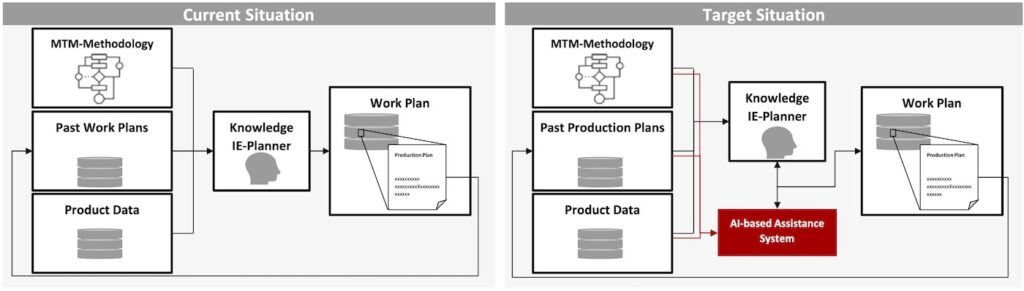
The quality of these plans often hinges on the individual experience of planners, leading to variability and potential deterioration when integrating disparate solutions from past projects. This variability can manifest in different planners analyzing and describing identical processes in slightly diverse manners, thereby increasing the risk of errors when combining parts of these plans. Furthermore, reliance on historical plans may inadvertently incorporate outdated regulatory or operational guidelines, necessitating thorough verification of the final plan to ensure its current relevance and accuracy[8].
Leveraging artificial intelligence and machine learning for work planning emerges as a promising solution [9–11], allowing machines to find novel solutions to complex problems by learning from example datasets imitating human learning. In recent years, large language models (LLMs) [12] have emerged as powerful tools that show promising results especially when applied to new and unseen tasks [13].
Overview of the AI assistance system for work plan generation
The proposed AI-assistance system comprises the three main components “plausibility check”, “causal analysis”, and generative “solution suggestion” as shown in Figure 2.
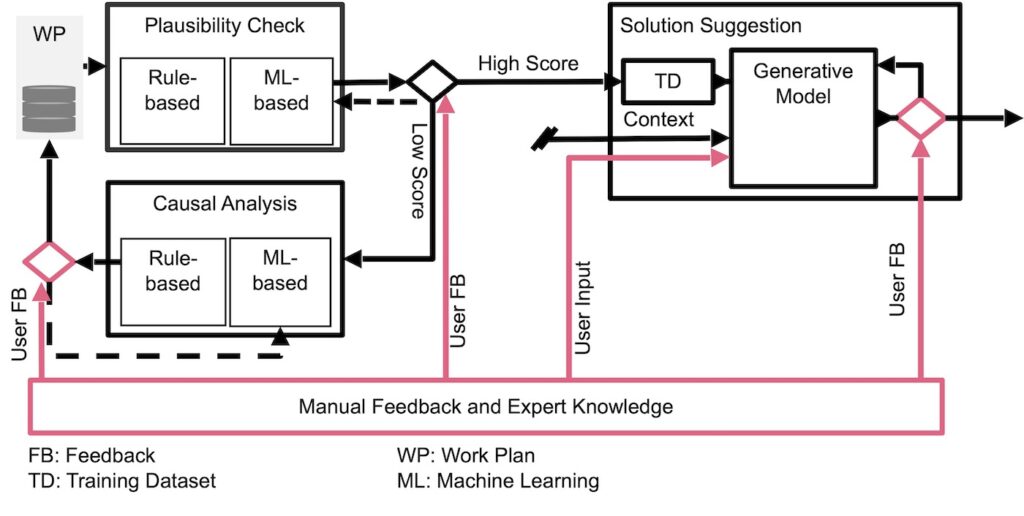
The “plausibility check” component uses a combination of rule-based and machine learning-based methods to identify errors in work plans. This combination provides a comprehensive approach to plausibility checking: rule-based checks ensure adherence to explicit guidelines, while machine learning-based analysis captures implicit knowledge. “Causal analysis” facilitates an understanding of the root causes.
To do so, the system provides explanations and suggestions for corrective actions, enabling planners to address issues and prevent recurrence. In addition, planners can identify and flag incorrectly identified errors, which improves future error detection. “Solution suggestion” streamlines the process of identifying similar historical products and corresponding work plans. It actively assists planners by generating process descriptions and analysis suggestions based on user input and context information.
The combination of the “plausibility check” and “causal analysis” components ensures high quality input data for training the assistance system. The rules contained in the rule-based model are easily understood by domain experts and can be altered quickly when requirements change. More nuanced plan qualities can be added to the machine-learning model iteratively by integrating expert feedback during operation.
The generative AI assistance model is trained using data that’s been vetted and refined, leading to a generative model capable of producing high-quality work plans that aren’t merely innovative but also grounded in the practical realities of work planning. By integrating the insights and standards derived from the plausibility check, the generative model becomes capable of handling the complexities of work planning.
By ensuring data quality, setting standards for plan quality, and enabling flexible plan adjustments, the system can significantly enhance the efficiency and effectiveness of work planning processes. This advanced approach to work planning promises to streamline operations, reduce errors, and harness the full potential of historical data and expert knowledge in creating optimal work plans.
Developing quality metrics for work plans
As machine learning models are trained on examples, a high-quality training dataset is required to ensure correct model predictions. This dataset must contain a high volume of well-written work plans that match quality requirements. To ensure the quality of the work plans contained in the training dataset and to facilitate training and evaluation of an assistance system for work plan generation, there need to be performance metrics for resulting plans. Such quantitative quality metrics are vital for ensuring data quality, ensuring that generated plans are useful and allowing flexible adjustments.
Historical work plans, while available, lack consistent quality measures and frequently undergo edits during both planning and production phases. In the absence of quantitative labeled datasets, the development of a generative model for MTM analyses and process descriptions presents unique challenges [14]. As the quality of training data directly influences the robustness and generalization capabilities of AI models, inaccurate or unreliable data can introduce noise into the training process, hindering the model’s ability to learn meaningful patterns and make accurate predictions, thereby compromising its effectiveness in real-world applications [15].
Quantitative quality measures are critical not only for selecting training data but also for evaluating the performance of AI models trained on this data [16]. Without reliable metrics, it becomes difficult to gauge the effectiveness hindering their adoption in practical settings. Ensuring high quality of the generated plans involves establishing a set of criteria or plausibility checks that can assess the adequacy and feasibility of the plans generated by the model.
To achieve a quantitative quality metric for work plans, this article proposes a dual plausibility-checking tool consisting of a rule based stage as well as a complementary neural network model. Rule-based evaluation utilizes established MTM standards, company policies, and other fixed rules to ensure that generated plans meet explicit minimum requirements. Similarly, a neural network (NN) model is employed to capture and apply more nuanced, implicit knowledge that may not be codified in explicit rules.
The size and quality of the training dataset for the plausibility check system is enhanced, by augmenting it with a root cause analysis tool, which also incorporates both rule-based and neural network components. This tool complements error detection by pinpointing potential reasons behind identified errors and suggesting actionable improvements. It enriches the analysis by integrating additional data types, like product information, offering a more holistic understanding of each case. The interplay between the plausibility checks and root cause analysis is dynamic and iterative, ensuring continuous enhancement of the training data. This synergistic approach ensures the system not only identifies and corrects errors more efficiently but also allows users to give feedback to improve both models.
Building on the integration of plausibility checks and root cause analysis, a methodical approach to developing a high-quality training dataset and model training is established. This process leverages iterative labeling, enriched by continuous feedback by expert planners, ensuring that the training data undergoes perpetual refinement, drawing on insights from direct user input. Active learning, in particular, sharpens the focus of labeling efforts on the most critical data points, streamlining the use of resources.
Experimental evaluation of quantitative quality measure
An empirical assessment of a rule-based plausibility score was conducted using data from a German automotive: OEM. This evaluation involved the compilation of relevant rule sets by reviewing various sources, including MTM-UAS training materials, company-specific guidelines and standards for work plan creation. Insights were also garnered through discussions with planning experts. The rule set includes approximately 20 rules of different levels of abstraction, organized into four categories.
The first category, “General Process Description”,ensures the process is described with sufficient reliability. The second, “MTM Rule Set Application”,focuses on the correct application of the MTM system (e.g. use of the correct MTM modular system, analysis of the first distance range for a pick up and place action following body movement). Rules in the third category “Application of Standard Time Values” verify that preference is given to internal standard time values when applicable. The last category, “Work Plan Structure” ,encompasses rules concerning adherence to a standardized schema for free-text descriptions.
A prototype of the rule-based plausibility checking tool, based on the defined ruleset and covering a subset of these rules, was developed. To not affect the production environment and allow fast development cycles, a standalone Python application based on the Dash library was developed and deployed in a separate analysis environment. XML-Data was used to import data from the proprietary Manufacturing Execution System into the tool. This tool was then applied in a case study focusing on the installation process of the center console across various workstations for eleven vehicle models in five factories. The rule-based model automatically identified discrepancies, which were subsequently manually reviewed for validation.
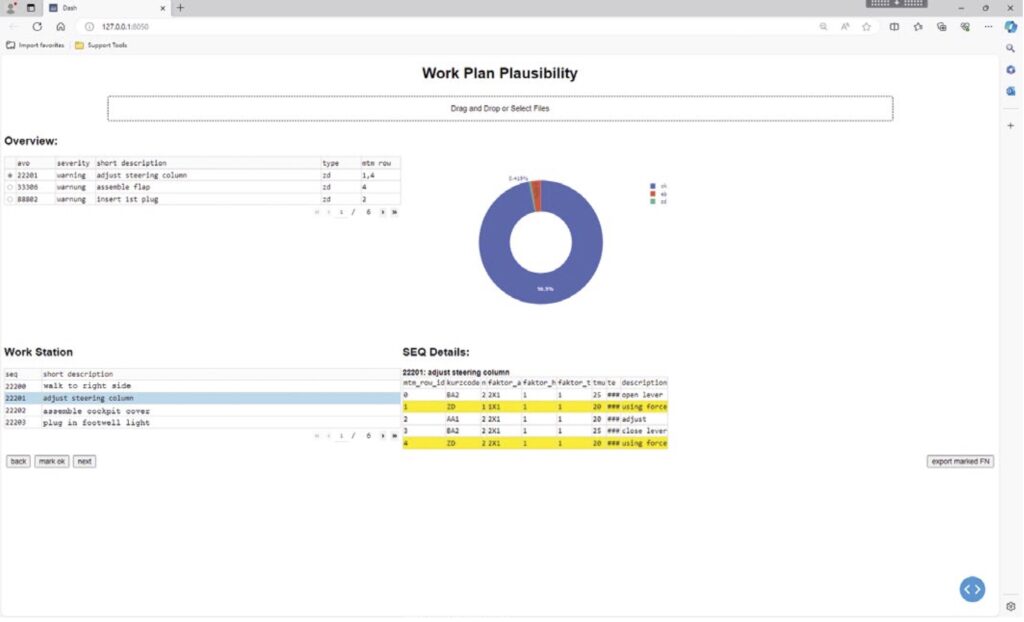
Figure 3 shows a visual depiction of the prototype tool. The tool facilitates the uploading of work plans, followed by an automated execution of the rule-based assessment. The interface displays a summary table at the top of the page, listing potential rule infringements, while an adjacent pie chart visualizes the distribution. Users can examine specific issues by selecting an entry from the summary table, which reveals a detailed breakdown of the violation in question.
The lower section of the interface then provides a comprehensive view of the MTM analysis, alongside textual descriptions of the focal process and its related procedures, offering a holistic understanding of the context. Finally, the user is able to give feedback to the tool by rejecting the identified violation with the click of a corresponding button below the detailed view.
The evaluation highlighted the need for rules to be finely tuned and sensitive to accurately identify relevant violations within the work plans. However, this sensitivity often led to a high number of false positives, where the system flagged issues that weren’t actual violations, thus requiring further manual review to confirm their relevance. After manual review, roughly one third of the automatically identified issues were rejected.
Summary and future perspectives
It became evident that while rules serve as a fundamental baseline for assessing work plans, they can only provide a rough estimate of the plan’s quality. The complex interrelations inherent in work processes cannot be fully encapsulated by these rules. This limitation is particularly noticeable in scenarios that demand a nuanced understanding of the workflow and the tasks involved.
An illustrative example of this complexity is the application of seemingly straightforward rules, such as analyzing the distance range after a body movement. Testing such rules proved challenging, as work plans often describe real processes in an abstract manner and may not always follow a chronological order. Consequently, reliance on heuristics becomes necessary to interpret the plans accurately, further emphasizing the intricate nature of translating real-world processes into structured, rule-based assessments.
Looking ahead, the convergence of AI and work planning holds immense potential for addressing complex challenges. While rule-based evaluation provides a solid foundation, the expansion of machine learning capabilities will enable organizations to navigate intricate relationships and leverage additional data sources effectively. By embracing this multifaceted approach, organizations can not only optimize their operational processes but also move towards sustainable and resilient business practices in the face of future uncertainties.
In conclusion, AI-assisted work planning comprising of “plausibility check”, “causal analysis” and “solution suggestion” represents a transformative approach to address contemporary challenges. By harnessing the power of AI to extract expert knowledge from historical data, organizations can streamline efficiency, mitigate errors, and adapt swiftly to changing circumstances. As businesses navigate an increasingly complex and dynamic landscape, integrating AI into work planning processes is not just a competitive advantage, it’s a strategic imperative for building sustainable and agile operations in the digital age.
Bibliography
[1] Abele, E.: Zukunft der Produktion. Herausforderungen, Forschungsfelder, Chancen. München 2011.[2] Statista: Durchschnittseinkommen in Europa. URL: https://de.statista.com/statistik/daten/studie/183571/umfrage/bruttomonatsverdienst-in-der-eu, Accessed 04.19.2022.
[3] Scholer, M.: Wandlungsfähige und angepasste Automation in der Automobilmontage mittels durchgängigem modularem Engineering. Am Beispiel der Mensch-Roboter-Kooperation in der Unterbodenmontage. 2018.
[4] Shell, R. L.: Arbeitsmessung: Prinzipien und Praxis 1986.
[5] MTM Association e.V.: MTM-UAS Lehrgangsunterlage. Hamburg 2019.
[6] Deuse, J.; Busch, F.: Zeitwirtschaft in der Montage. In: Lotter, B.; Wiendahl, H.-P. (ed): Montage in der industriellen Produktion. Ein Handbuch für die Praxis mit 18 Tabellen. Berlin, Heidelberg 2012.
[7] Finsterbusch, T.; Petz, A.; Faber, M.; Härtel, J.; Kuhlang, P.; Schlick, C. M.: A Comparative Empirical Evaluation of the Accuracy of the Novel Process Language MTM-Human Work Design. In: Advances in Ergonomics of Manufacturing: Managing the Enterprise of the Future 490 (2016), pp. 147-155.
[8] Russell, S.; Norvig, P.: Artificial Intelligence, Global Edition: A Modern Approach. London 2021.
[9] Deuse, J.; Stankiewicz, L.; Zwinkau, R.; Weichert, F.: Automatic Generation of Methods-Time Measurement Analyses for Assembly Tasks from Motion Capture Data Using Convolutional Neuronal Networks – A Proof of Concept. In: Nunes, I. L. (ed): Advances in Human Factors and Systems Interaction. Proceedings of the AHFE 2019 International Conference on Human Factors and Systems Interaction, July 24-28, 2019, Washington D.C., USA. 2020.
[10] Albrecht Borsdorf; Fabian Nöhring; Peter Kuhlang: Automatisierte Erstellung von MTM-Analysen: Ergebnisse einer Machbarkeitsstudie zur KI-gestützten, textbasierten Datenauswertung. In: Zeitschrift für wirtschaftlichen Fabrikbetrieb 117 (2022) 10, pp. 651-654.
[11] Jansing, S.; Moehle, R.; Brockmann, B.; Deuse, J.: Die hybride Analyse als Multiplikator im Bereich der Bewegungsökonomie durch maschinelle Lernverfahren und regelbasiertes Wissen. In: Human Factors and Simulation 83 (2023).
[12] Vaswani, A.; Shazeer, N.; Parmar, N.; Uszkoreit, J.; Jones, L.; Gomez, A. N.; Kaiser, Ł.; Polosukhin, I.: Attention is All you Need. In: Advances in Neural Information Processing Systems 30 (2017).
[13] Brown, T.; Mann, B.; Ryder, N.; Subbiah, M.; Kaplan, J. D.; Dhariwal, P.; Neelakantan, A.; Shyam, P.; Sastry, G.; Askell, A.; Agarwal, S.; Herbert-Voss, A.; Krueger, G.; Henighan, T.; Child, R., Ramesh, A.; Ziegler, D.; Wu, J.; Winter, C.; Hesse, C.; Chen, M.; Sigler, E.; Litwin, M.; Gray, S.; Chess, B.; Clark, J.; Berner, C.; McCandlish, S.; Radford, A.; Sutskever, I.; Amodei, D.: Language Models are Few-Shot Learners. In: Advances in Neural Information Processing Systems 33 (2020), pp. 1877-901.
[14] Erohin, O.; Schallow, J.; Deuse, J.; Klinkenberg, R.: Application of data mining to predict assembly time in early phases of product emergence: 43rd International Conference on Computers and Industrial Engineering (CIE) 2013.
[15] Schulte, L.; Killich, N.; Deuse, J.; Meierhofer, F.: Autonome Qualitätsprüfung 4.0. Reduzierung von Pseudofehlern in der Leiterplattenfertigung durch die Integration von Maschinellem Lernen. In: Industrie 4.0 Management 37 (2021) 6, pp. 52-56.
[16] Deuse, J.; Schmitt, J.: Industrial Data Science – Nutzen künstlicher Intelligenz für die Produktion. In: KANBrief (2019) 4, pp. 12.
Your downloads
Potentials: Management
Solutions: Production Planning
You might also be interested in