Cognitive Assistance Systems in Intralogistics |
User studies with augmented reality and an AI chatbot

| Journal | Industry 4.0 Science |
| Issue | Volume 40, 2024, Edition 5, Pages 67-72 |
| Open Access | https://doi.org/10.30844/I4SE.24.5.66 |
| Bibliography | Share | Cite | Download |
Abstract
Keywords
Article
Assistance systems make a significant contribution to improving the execution and control of work tasks, shortening learning phases and increasing flexibility in work processes [1]. They can be divided into physical and cognitive systems. Physical systems – such as exoskeletons – relieve the physical burden on humans. Cognitive systems aim to reduce cognitive loads and are becoming increasingly important in the context of digitized industry (Industry 5.0) with a focus on human-centered, resilient, and sustainable production [2]. User acceptance plays an important role in the context of human-centricity. According to the Technology Acceptance Model, the perceived usefulness and ease of use of the systems are crucial [3].
In intralogistics, which includes internal logistics processes such as incoming goods inspection, picking and packing [4], cognitive assistance systems are already being used in various areas. They aim to reduce error rates and increase understanding of changes in processes by providing relevant information [5]. The intuitive and ergonomic use of the systems plays a key role. Possible technologies that can be used here include augmented reality (AR) or AI chatbots.
AR offers the possibility to integrate virtual information into the real world to present an enhanced image of reality to the user [6]. Several research studies underline the potential of using AR-based assistance systems [7, 8] and the resulting optimization of work processes through support functions in intralogistics [9]. There is a wide range of possible applications for AR-based assistance systems, such as the targeted and context-dependent display of virtual information and the visual inspection of results using image-based recognition methods.
As an interface between humans and IT systems, AI chatbots can support logistics processes with simple queries or processing steps. Applications are diverse, ranging from simple information retrieval to product availability queries [10]. AI chatbots can be used to provide employees with a permanent virtual assistant, allowing them to complete tasks efficiently without the help of additional people [11].
Augmented reality and AI chatbots in cognitive assistance systems
AR plays an important role in intralogistics by optimizing work processes and reducing error rates through the mobile provision of information. In particular, AR implementations support incoming goods by capturing and verifying product information and in picking and packing by displaying relevant information such as storage locations and packing samples [7].
To date, AR applications mainly use static, text-based overlays and do not focus on the interaction between the user and the real environment [13]. Therefore, part of AR’s potential remains untapped. In this respect, interaction and user experience could be further improved [6]. The acceptance of such assistance systems depends largely on the design of the user interfaces and the appropriate choice of hardware. However, findings from laboratory tests still need to be validated in real working environments [8, 12]. New developments, such as the “ARpack” assistance system, also offer innovative approaches to make packing work steps more intuitive. Here, physical products inside a package are displayed as holograms using data glasses reducing the need for text-based instructions, and thus avoiding potential language barriers. This is intended to promote intuitive understanding of the information [14].
Artificial intelligence enables machines to perform human-like activities by emulating human characteristics such as memory, learning ability, and development processes [15]. AI technology provides advanced solutions for existing applications and promotes automation, particularly in areas of planning, decision-making and classification. In addition, AI enables more efficient management, development and analysis processes for large amounts of data, as well as the simulation and control of complex technical systems [16].
AI chatbots, IT systems with text or speech-based interfaces, facilitate communication between humans and machines. They are characterized by using natural language in a user interface, a so-called Conversational User Interface (CUI), which enables a dialog. If this interaction is realized via text messages, the CUI is referred to as a chatbot [17]. The introduction of ChatGPT at the end of 2022 in particular sparked global interest in AI chatbots [18]. In logistics, AI can provide support by delivering information and checking availability, and can serve as a virtual assistant to help employees complete tasks more effectively [11].
User studies using augmented reality and AI chatbots to assist intralogistics work processes
The potential and challenges of AR assistance systems and AI chatbots in intralogistics require further research to make them more usable in practice. In this context of intralogistics processes, the usability of these technologies is a success factor. The research question of this work is therefore:
What is the usability of AR support or support via an AI chatbot when carrying out intralogistics processes (picking and packing)?
The research question is investigated methodically in several steps. First, a working environment is set up that replicates the real conditions of intralogistics in order to create a contextualized framework for carrying out the processes. Within this framework, a prototype assistance system will be developed to support employees in their tasks. The assistance system is used as a click prototype. This is followed by an evaluative user study. Participants carry out the work processes of picking and packing with the help of the assistance system. The collected data is then evaluated to assess usability. One user study was conducted for AR and one for AI chatbots. The aim of this work is therefore to examine the usability of AR assistance systems and AI chatbots in the given context of intralogistics, thus covering a broad field of technology.
User study 1: Augmented reality
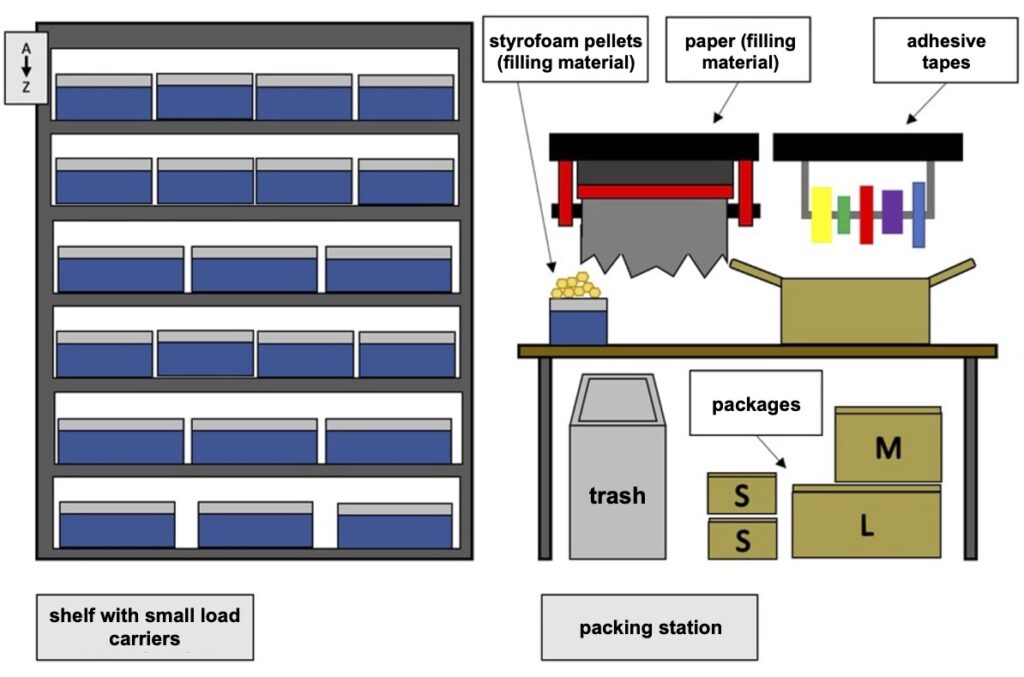
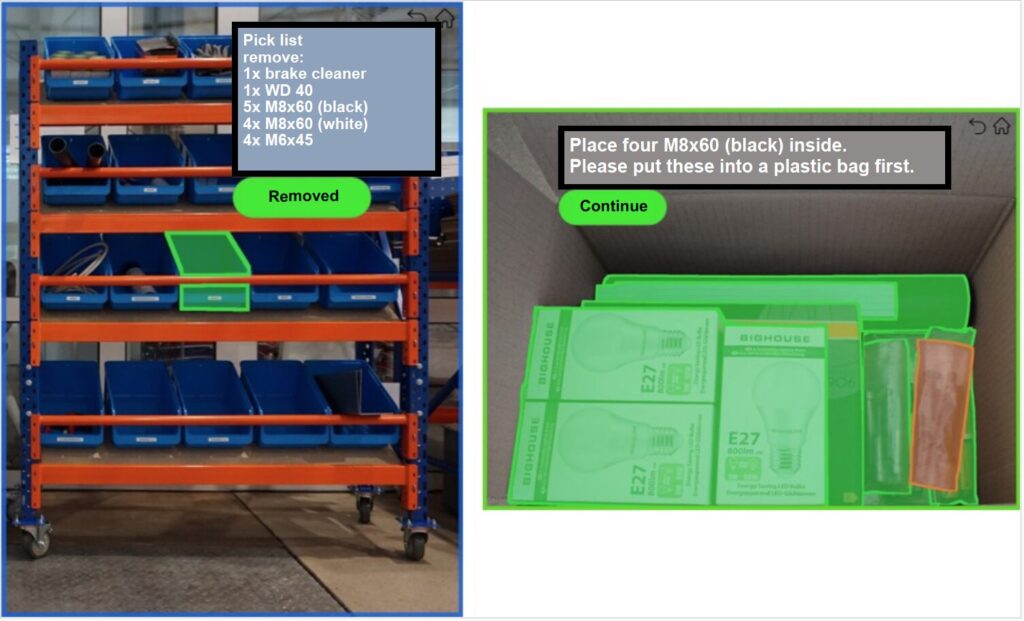
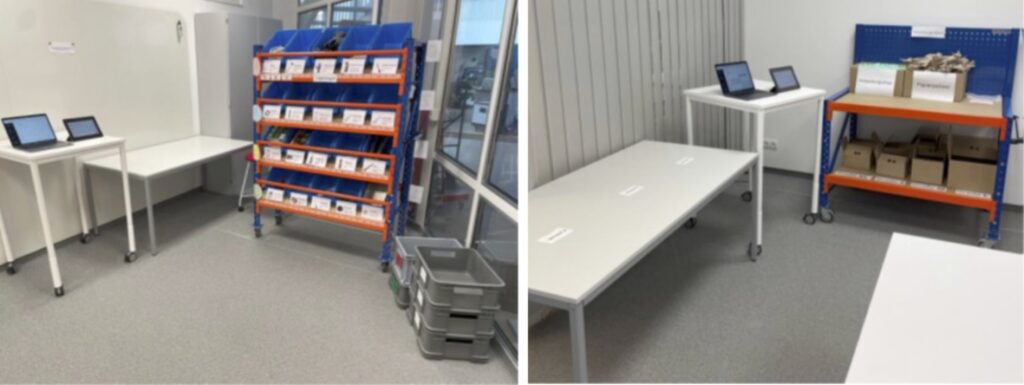
Working environment/scenario: The picking process environment consists of a shelving system equipped with several labeled small load carriers. They contain the intended picking objects, such as screws, light bulbs and batteries. The participants receive information about the objects and quantities to be picked using the tablet-based assistance system. It also supports the picking of objects and verification of correct picking (see Figure 2). For the packing process, the test environment includes boxes of various sizes, packing material and objects to be packaged. As the various objects require individual packing patterns during the process to prevent possible damage, the assistance system (also tablet-based) helps with positioning using appropriate packing material. Figure 1 outlines the corresponding workstations.
Assistance system: During picking, the items to be picked and their quantities are highlighted and displayed in a structured manner by the assistance system to minimize picking errors. During the packing process, the system specifies the sequence and position for packing the items and indicates which packing material should be used for safe transportation. Color highlighting makes it easier to identify the correct compartments, objects, and filling materials. Figure 2 shows exemplary views of the assistance system used.
User study: A total of 20 people took part in the user study. One half went through an easy, the other through a difficult version of the picking and packing tasks. The difficulty was determined by the number of various objects to be picked or packed. For the packing process, packing materials used also varied.
Results: The participants in the “simple tasks” group rated the assistance system with an average usability score of 82 (standard deviation: 11.7); using the System Usability Scale questionnaire [19]. The average usability score was 91.50 for the “difficult task” group (standard deviation: 5.5). This puts the scores in the excellent usability range (>80) [20].
User study 2: AI chatbot assistance
Working environment/scenario: The structure of the working environment largely corresponds to the structure for user study 1. The workstations are shown in Figure 3. As in user study 1, the participants go through the picking and packing process using the assistance system, consisting of an AI chatbot (text input) and visual process guidance.
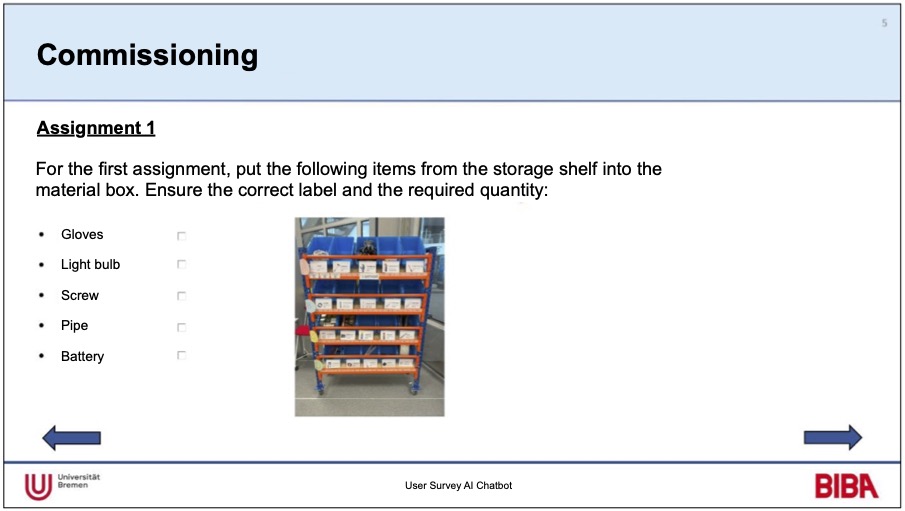
Assistance system: The AI chatbot was created using Botsonic. This software is based on ChatGPT-3 and provides it with various content generation functions. By training the AI chatbot with its own documents, Botsonic thus enables the creation of AI chatbots with personalized responses. The AI chatbot can therefore provide specific answers for this user study according to the intralogistics tasks to be processed.
The process guidance was created as a click prototype and is shown as an example in Figure 4. The user can navigate between the individual work steps using the interactive blue arrow buttons and use the tick function to mark actions as completed. The ‘Botsonic’ symbol at the end of the sentence indicates that in this step, communication with the AI chatbot makes sense. The purple markings help you formulate suitable questions.
User study: A total of 15 people took part in the user study. The user study consisted of an introductory presentation, the actual study and a survey in the form of three questionnaires. The participants went through both processes (picking and packing) one after the other. To complete the tasks, which were the same for everyone, they had to repeatedly ask the AI chatbot questions to obtain relevant information about completing the task, such as selecting a suitable picking box or requesting packing instructions.
Results: The participants rated the assistance system’s usability score at 90.8 (standard deviation: 5.4); using the System Usability Scale questionnaire [19]. This puts the usability score in the excellent usability range (>80) [20].
Discussion and outlook
In an empirical user study, the usability of Augmented Reality (AR) to support intralogistics processes was analyzed. The usability scores indicate that the use of AR led to efficient guidance for the test subjects. This was particularly useful in order picking when selecting similar objects, such as screws, by reducing the need to manually distinguish between different types. In the packing process, AR technology also proved beneficial by providing precise guidance on packing patterns and the selection of appropriate packing materials. However, problems were identified with the spatial orientation and handling of the tablet in relation to the object being viewed, which is a limiting factor of the AR application. Using static images instead of a dynamic camera image due to the use of a click prototype proved to be a hindrance, as users initially required additional effort to spatially assign the virtual information.
Regarding the use of an AI chatbot, a second empirical user study also found a high level of user-friendliness, which is reflected in a good usability score. The comments made during and after the implementation underlined the added value of using AI chatbots.
Overall, both technologies appear to improve processes in various areas of intralogistics. The studies carried out provide initial indications of potential and challenges. Subsequent research should functionally implement the prototype assistance systems. Further user studies would be desirable in the context of real intralogistics processes in companies.
Bibliography
[1] Niehaus, J.: Mobile Assistenzsysteme für Industrie 4.0: Gestaltungsoptionen zwischen Autonomie und Kontrolle, FGW-Impuls Digitalisierung von Arbeit, Forschungsinstitut für gesellschaftliche Weiterentwicklung e.V. (FGW) 2017. URL: https://www.ssoar.info/ssoar/bitstream/handle/document/68013/ssoar-2017- niehaus-Mobile_Assistenzsysteme_fur_Industrie_40.pdf, Abrufdatum 11.03.2024.[2] Breque, M.; De Nul, L.; and Petridis, A.: Industry 5.0: Towards a sustainable, human centric and resilient European industry. Publications Office of the European Union. 2021.
[3] Davis, F. D.: A technology acceptance model for empirically testing new end-user information systems: Theory and results. Boston, MA 1985.
[4] Arnold, D.; Isermann, H.; Kuhn, A.; Tempelmeier, H.; Furmans, K.: Handbuch Logistik. Berlin Heidelberg 2008.
[5] Mättig, B.; Kretschmer, V.: Einsatz digitaler Assistenzsysteme in der Logistik 4.0, In: Handbuch Industrie 4.0: Automatisierung, Produktion, Logistik und Informatik. Berlin 2020.
[6] Mehler-Bicher, A.; Steiger, L.: Augmented Reality. Theorie und Praxis, 2. Edition. Oldenbourg Berlin 2014.
[7] Wang, W.; Wang, F.; Song, W.; Su, S.: Application of Augmented Reality (AR) Technologies in Inhouse Logistics. In: E3S Web Conf. 145 (2020) 1.
[8] Kim, S.; Nussbaum, M.; Gabbard, J.: Influences of augmented reality head-worn display type and user interface design on performance and usability in simulated warehouse order picking. In: Applied Ergonomics 74 (2019), pp. 186-193.
[9] Reif, R.; Günthner, W.: Pick-by-vision: augmented reality supported order picking. The Visual Computer 25 (2009) 5-7, pp. 461-467.
[10] Straßer, T.; Axmann, B.: Analyse und Bewertung von KI-Anwendungen in der Logistik 2021. URL: https://doi.org/10.2195/LJ_NOTREV_STRASSER_DE_202108_01, accessed: 11.03.2024.
[11] Stölzle, W. u. a.: Impulse für Investitionsentscheidungen in die Digitalisierung – Erfolgsgeschichten und aktuelle Herausforderungen 2018. URL: https://www.alexan- dria.unisg.ch/server/api/core/bitstreams/ba01125c-5050-4f56-9775-5ab3ed278e3c/content, accessed: 12.02.2024.
[12] Quandt, M.; Stern, H.; Kreutz, M.; Freitag, M.: Bedarfsgerechter Einsatz intelligenter AR-basierter Assistenzsysteme in der Intralogistik, wt online (2024).
[13] Marks, A.: Wirtschaftliche Mitarbeiterqualifizierung durch lernorientierte Montagesystemgestaltung. Aachen 2019.
[14] Mättig, B.: ARPack – Fraunhofer IML, Fraunhofer-Institut für Materialfluss und Logistik IML. URL: https://www.iml.fraunhofer.de/de/abteilungen/b1/ verpackungs_und_handelslo gistik/innovationen/arpack.html, accessed: 12.03.2024.
[15] Felden, C.: Künstliche Intelligenz. 2021. URL: https://www.oldenbourg.de:8080/wi-en- zyklopaedie/lexikon/technologien-methoden/KI-undSoftcomputing/Kunstliche-Intelligenz, accessed: 23.02.2024.
[16] Görz, G.; Schneeberger, J.; Schmid, U.: Handbuch der Künstlichen Intelligenz (5. Edition). München 2024.
[17] Bruns, B.; Kowald, C.: Praxisleitfaden Chatbots Conversation Design für eine bessere User Experience. Wiesbaden 2023.
[18] Hüsch, A.; Distelrath, D.; Hüsch, T.: Einsatzmöglichkeiten von GPT in Finance, Compliance und Audit: Vorteile, Herausforderungen, Praxisbeispiele. Wiesbaden 2023.
[19] Brooke, J.: SUS: A quick and dirty usability scale. Usability Eval. In: Ind. 189 (1995).
[20] Lewis, J. R.; Sauro, J.: The Factor Structure of the System Usability Scale. In: Kurosu, M. (ed): Human Centered Design. HCD 2009. Lecture Notes in Computer Science, Vol. 5619. Berlin Heidelberg 2009.
Your downloads
Potentials: Strategy
Solutions: Process Management
You might also be interested in