Technologie: Virtual Reality

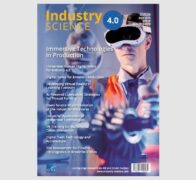
I4S 3/2026: Immersive Technologies in Production

I4S 3/2026: Immersive Technologies in Production

VR, AR, MR, XR: Catalysts for the next industrial revolution?
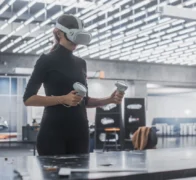
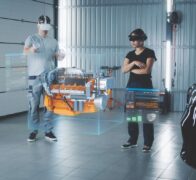
Immersive technologies are fundamentally transforming manufacturing. VR, AR, MR, and XR merge physical and digital worlds into interactive work environments. In Industry 4.0, they enable more intuitive access to planning, production, maintenance, and training. This issue of Industry 4.0 Science shows how immersive technologies are becoming a central building block of resilient, flexible, and innovative production systems.
Digital Factory Planning for Startups

Digital Factory Planning for Startups

A simulation-based production structure design
Herwig Winkler ORCID Icon, Tobias Isau
With the increasing complexity of production and logistics systems, traditional factory planning approaches are reaching their limits. In this context, digital factory planning offers a promising solution for enabling well-informed decisions, particularly during the early planning phases. For startups, the optimal planning of a production facility is challenging, as they often operate with limited financial and infrastructural resources. This paper presents a methodological approach to digital factory planning that utilizes VR simulation for the layout planning of a factory hall for a young company in the solar industry. The proposed approach demonstrates how simulations can support the design of flexible production structures, particularly in startup environments.
Industry 4.0 Science | Volume 42 | 2026 | Edition 3 | Pages 68-75
Developing Virtual Reality in Learning Contexts

Developing Virtual Reality in Learning Contexts

Navigating efficiency, content relevance and scalability
Stella Kanatouri ORCID Icon, Oliver Sosna ORCID Icon, Alexander Kulik, Sina C. Truckenbrodt ORCID Icon, Friederike Klan ORCID Icon, Christian Erfurth ORCID Icon
While virtual reality can facilitate hands-on learning, its development faces barriers, including high costs and time demands and scalability challenges. This article presents two case studies that illustrate strategies for overcoming such barriers when training the next generation of skilled workers in environmental technologies. By examining approaches for streamlining development and increasing content relevance and scalability, we highlight lessons learned for future practice. We conclude by envisioning a future in which educational institutions can flexibly and cost-effectively prototype virtual reality in learning contexts, ensuring alignment with curricular goals and learners’ needs.
Industry 4.0 Science | Volume 42 | Edition 3 | Pages 26-34 | DOI 10.30844/I4SE.26.3.3
Immersive Human Digital Twins for Industry 4.0

Immersive Human Digital Twins for Industry 4.0

Supporting adaptive human-centric production by integrating cognitive and physical states
Tajbeed A. Chowdhury ORCID Icon, Eric Wagner ORCID Icon, Paul Motzki ORCID Icon, Martina Lehser ORCID Icon
The rapid advancement of immersive technologies has created new opportunities to transform human-machine collaboration in industry. This paper presents an immersive platform with a digital twin that combines both physical and cognitive characteristics of human dynamics. By integrating multimodal sensing, human biomechanics, and cognitive state into digital twin technology, the proposed system enhances operational safety and ensures better ergonomics. The main argument is that human digital twins are not only desirable but essential for next-generation industrial systems. We discuss the limitations of existing human modeling approaches, outline the conceptual foundations of human digital twins, and demonstrate their industrial relevance across safety, productivity, ergonomics and sustainability.
Industry 4.0 Science | Volume 42 | 2026 | Edition 3 | Pages 6-13 | DOI 10.30844/I4SE.26.3.1
Industrial Application of Immersive Technologies

Industrial Application of Immersive Technologies

Exploring XR solutions for training, instruction, design review, and assembly planning
Andreas Straube ORCID Icon, Faikar Zakky Haidar ORCID Icon, Matheus Lenzi dos Santos ORCID Icon, Kussai AI Jairoud ORCID Icon, Eduardo Koscianski ORCID Icon
In recent years, the decreasing cost and improved usability of immersive hardware and software have made extended reality (XR) increasingly attractive for industrial applications. Stand-alone systems with inside-out tracking and camera-based pass-through enable accessible mixed reality (MR) solutions. At the same time, emerging no-code software platforms allow engineers to create XR environments without programming expertise, broadening adoption across production settings. This paper explores key industrial application areas of immersive technologies through selected commercially available XR software solutions for product and process training, spatial instructions and guides, collaborative design review, and assembly and production planning.
Industry 4.0 Science | Volume 42 | 2026 | Edition 3 | Pages 38-47 | DOI 10.30844/I4SE.26.3.4
I4S 3/2025: Digital Twin

I4S 3/2025: Digital Twin

Innovative concepts for manufacturing, logistics, and learning environments
In the connected world, digital twins open up completely new possibilities: they virtually replicate physical systems, processes, or products. However, key challenges remain, including the collection of current product data. This issue of Industry 4.0 Science covers a wide range of topics, from the basic concept of the digital twin to its benefits in procurement and its use in supply chain management.
Virtual Exhibition as a Digital Twin

Virtual Exhibition as a Digital Twin

A framework for decision-making for virtual representations
Isger Glauninger ORCID Icon, Markus Schürmann, Matthias Mühl, Christian van Husen ORCID Icon
Transforming formats such as showrooms, laboratories or exhibitions into a virtual presence offers both opportunities and challenges. Particularly with cyber-physical systems (CPS), which rely heavily on user interaction, extensive adaptations must be made in order to maintain their purpose and function virtually. As part of this research project, digital solutions from different technologies and fields of application were transferred to a virtual exhibition. On this basis, the influence of the digital transformation on the interactivity and emulation of the solutions was analyzed. This article presents a framework that supports practitioners in the implementation of virtual representations.
Industry 4.0 Science | Volume 41 | Edition 3 | Pages 110-116
Training in the Industrial Metaverse

Training in the Industrial Metaverse

Buzzword or opportunity?
Leon Schellhammer ORCID Icon, Lucas Waag, Mert Cumert, Dieter Uckelmann ORCID Icon
Metaverse-based training programs offer a realistic and risk-free learning environment that is particularly valuable in industrial contexts, e.g. in immersive training and the simulation of workflows. Challenges remain in the areas of data protection, technological acceptance and integration into existing systems. Using a carefully crafted questionnaire, four expert interviews were conducted to investigate whether the metaverse can innovate training programs effectively and lastingly. Its standardized format yields comparable, reliable data while allowing for an accurate evaluation of the results.
Industry 4.0 Science | Volume 41 | 2025 | Edition 2 | Pages 102-108
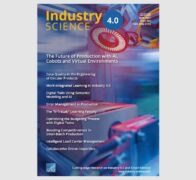
I4S 2/2025: The Future of Production with AI, Cobots and Virtual Worlds

I4S 2/2025: The Future of Production with AI, Cobots and Virtual Worlds

Technology needs innovative, value-adding business models
Artificial intelligence, collaborative robotics, and virtual worlds, such as the metaverse, are fueling visions for new forms of industrial value creation. However, innovation alone is not enough—given that these technologies only develop their full potential through intelligent business models. How can companies efficiently integrate AI-supported automation, cobots and digital twins into their processes?
Potentials and Application of the Industrial Metaverse

Potentials and Application of the Industrial Metaverse

Convergence from simulation to reality
Oliver Petrovic, Yannick Dassen, Christian Brecher
This paper deals with the concept of the Industrial Metaverse and its potential impact on the manufacturing industry. First, the possibilities of the Industrial Metaverse are explained in general and then possible resulting functionalities for production technology along the life cycle are presented. For the two topics "Synthetic Data Generation" and "Virtual Qualification" the implications of the Industrial Metaverse are considered more concretely.
Industrie 4.0 Management | Volume 39 | 2023 | Edition 5 | Pages 27-32 | DOI 10.30844/IM_23-5_27-32
1 2 3