Technologie: Virtual Reality

Knowledge Based Validation of Virtual Products

Knowledge Based Validation of Virtual Products

Christoph Schäfer, Axel Friedewald, Hermann Lödding ORCID Icon
Technologies such as Digital Mock Up (DMU) or Virtual Reality (VR) help to expose and fix design errors at an early stage in the product development process. Nevertheless the discovery of these potential problems is still a common obstacle. The approach introduced within this paper improves the existing virtual product validation method by using the company’s existing knowledge of former projects. The DMU-Cockpit integrates the usually spread experience of known errors in one tool by modelling a relation between classified components and sources of error in a matrix. This allows the automatic selection of potential sources of error for a chosen part and derives the most valuable validation tasks of the knowledge base.
Industrie Management | Volume 28 | 2012 | Edition 3 | Pages 61-64
Efficient Creation of Truck Assembly Processes with Virtual and Mixed Reality

Efficient Creation of Truck Assembly Processes with Virtual and Mixed Reality

Franz Obermair, Valeska Nassiri, Johann Reitzenberger
Flexible and quick adaption to changes in design and technical requirements or order quantity is a key factor in the commercial vehicles sector. Due to higher wage costs, European production sites need also efficient and well organized assembly processes. This paper details the implementation of a Virtual Reality System. Using Virtual and Mixed Reality Systems assembly processes can be optimized for production at a very early stage in the design process.
Industrie Management | Volume 28 | 2012 | Edition 2 | Pages 38-41
Matching Virtual and Real Supply Chain Objects

Matching Virtual and Real Supply Chain Objects

An Approach to Match Research Environments in Logistics
Michael Lawo, Tobias Warden, Dieter Uckelmann ORCID Icon, Dirk Werthmann
To evaluate research approaches in logistics, tests are indispensable. For enhanced research in logistics worldwide well established labs could take a major role to shorten development cycles. However, often remote access to necessary resources in the different labs is not possible. In this context a new opportunity for a technology driven access to supply chain labs could be established to increase the availability and user friendliness as well as the utilization rate of existing infrastructures. In the present article the remote access through a web based interface is introduced. The system has been developed within a two year student project in collaboration with the computer science and production engineering department at the University of Bremen.
Industrie Management | Volume 28 | 2012 | Edition 1 | Pages 45-48
Use of Virtual Reality Technology for Engineering Education at Universities

Use of Virtual Reality Technology for Engineering Education at Universities

Reimund Neugebauer, Andreas Hirsch, Franziska Pürzel, Radek Knoflicek, Tomas Novotny
Within the last few years there was a growing trend at universities to establish so called Virtual Reality laboratories as special work places. This trend follows the need for better visualisation, both of research findings and of teaching content. The use of Virtual Reality systems for educational purposes at universities improves the imparting of complex issues and therefore enables a faster and more purposeful expert education. The visualisation of the relevant teaching content, using the virtual-interactive environment in combination with practical training, will help to improve the training results [1]. This paper outlines the potentials of the Virtual Reality technology for the university education.
Industrie Management | Volume 26 | 2010 | Edition 6 | Pages 49-52
Sound Design and Machine Acoustics in Virtual Reality

Sound Design and Machine Acoustics in Virtual Reality

Christian Weber, Günter Höhne, Stephan Husung, Klaus Augsburg, Sebastian Gramstat
Virtual Engineering is an important tool to verify and optimise products in early design phases. For the development of innovative complex technical systems the applied models should comprehend the most important product properties. Up to now there are deficits in modelling and evaluating the acoustic behaviour of technical products although this is important in areas with rigid ergonomic and comfort requirements, e.g. in the consumer goods and automobile industries. In order to overcome these deficits, at the Ilmenau University of Technology a flexible audiovisual stereoscopic projection system (FASP) has been constructed. Consequently, investigations of the sound effects of machine components, machines, cars and other products as well as psycho-acoustic assessments of designed products in a virtual environment can be realized.
Industrie Management | Volume 26 | 2010 | Edition 2 | Pages 57-60
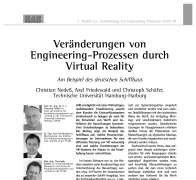
Impact of Virtual Reality Techchnology on Engineering Processes

Impact of Virtual Reality Techchnology on Engineering Processes

Christian Nedeß, Axel Friedewald, Christoph Schäfer
Competence in building more innovative ships will help the German Maritime Industry guaranteeing its existence under competitive conditions in respect to Asia. The realistic visualisation with Virtual Reality (VR) enables the demonstration of the shipyard’s design competence to the customer in an early stage as well as the discussion of design decisions and their implications between ship yard and supplier. Using the example of shipbuilding, the article shows which changes in the business processes of a company are essential for an efficient use of VR and which add-ons are necessary for a user-oriented ease of operation.
Industrie Management | Volume 25 | 2009 | Edition 2 | Pages 43-46
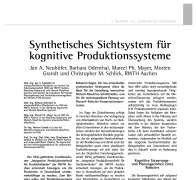
Development of a Synthetic Visual System for Cognitive Production Systems

Development of a Synthetic Visual System for Cognitive Production Systems

Jan A. Neuhöfer, Barbara Odenthal, Marcel Ph. Mayer, Morten Grandt, Christopher M. Schlick
The Cluster of Excellence “Integrative Production Technology for High-Wage Countries”, funded by the German Research Foundation, at the RWTH Aachen University develops solutions to improve the competitiveness of production in Germany. In the future, production systems should be capable of independently adapting to new conditions as a result of the development of cognitive controls, e.g., for robot-aided assembly processes. The tasks of humans will thereby focus primarily on system monitoring and direct cooperation with robots. A system developed at the IAW serves as the foundation for the design of AR-based user interfaces for computer-supported planning of human-robot cooperation processes.
Industrie Management | Volume 24 | 2008 | Edition 4 | Pages 33-36
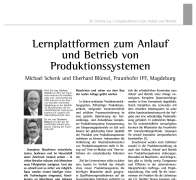
Learning Platform for Production Ramp-up and Operation

Learning Platform for Production Ramp-up and Operation

Michael Schenk, Eberhard Blümel
Developing and testing and operating complex machinery and repairing it under time pressure if it breaks down - individuals in many professions have to learn new skills. Moreover, they have to do so as quickly and as thoroughly as possible. Virtual technologies are supporting learning more and more frequently. Operations and procedures on machinery and plants are already taught in individual lessons on the virtual model. They can be repeated as often as desired without the space or time constraints of real machinery and without endangering either operator or plants through incorrect behaviour and can be practiced before a real machine or plant has been constructed.
Industrie Management | Volume 23 | 2007 | Edition 3 | Pages 23-26
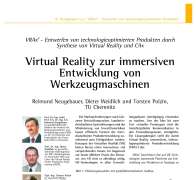
Virtual Reality with Parallel Kinematics

Virtual Reality with Parallel Kinematics

Development and testing of machine tools
Reimund Neugebauer, Dieter Weidlich, Torsten Polzin
Virtual Reality methods will open new ways for generating a virtual machine tool in the near future. Based on the experience gained in the development of prototypes, a virtual development platform for machine tools with parallel kinematics is striven for. Based on such a complex engineering solution, the assessment of, for example, the redundancy and size of the workspace as well as collision aspects and the avoidance of both singularities and certain mechanical characteristics of the construction will be fundamentally simplified. This, in turn, will ensure shorter iteration cycles in the development of an optimal machine structure and forms the basis for test operations within the virtual production process. The development process for machine tools with parallel kinematics will thus no longer be of a linear nature, but will be defined as an overall process in the form of concurrent engineering.
Industrie Management | Volume 21 | 2005 | Edition 2 | Pages 19-22
Distributed Design Reviews with Immersive VR Technologies

Distributed Design Reviews with Immersive VR Technologies

Frank-Lothar Krause, Hendrik Gärtner, Helmut Jansen, Dirk Langenberg, Ralph Schultz
Today manufacturers of complex investment goods concentrate on their core business and retrieve additional services from external subcontractors. Many design reviews are necessary to coordinate such cooperation. They cause high expense for manpower and for travel. In the research project “Digital Product Development with Virtually Cooperating Teams using Optical Networks” a new conference system will be realised, which utilizes Virtual Reality (VR). This paper describes the requirements and the process flow of future distributed design reviews as well as the method of solution which is prototypical realized in the project ProViT.
Industrie Management | Volume 19 | 2003 | Edition 5 | Pages 25-28
1 2 3