Services

The Utopia of European Cybersecurity Certifications

The Utopia of European Cybersecurity Certifications

Alexander Lawall ORCID Icon, Jesus Luna Garcia
Interoperable automation can benefit cybersecurity certification processes that result from the EU Cybersecurity Act (e.g. EUCS) so that they represent less overhead for the stakeholders involved. The development of key standardization efforts involving relevant stakeholders (e.g. regulators) is needed to fully realize these benefits. EU projects like H2020 MEDINA, HEU COBALT and communities such as EUROSCAL are well on the way to achieving this goal. However, more practical experience is needed to make continuous certification with automation a reality.
Industry 4.0 Science | Volume 40 | 2024 | Edition 2 | Pages 48-55
Artificial Intelligence in ERP Systems

Artificial Intelligence in ERP Systems

Development potential and benchmarking
Marcus Grum ORCID Icon, Nicolas Korjahn
The use of artificial intelligence (AI) is becoming more important for a variety of industries, which is why enterprise resource planning (ERP) systems also offer many possible uses of AI. Due to their newly acquired, AI-based adaptability and learning abilities, modern AI-integrated ERP systems are able to develop competencies, plan processes, make forecasts and interact intelligently with humans. It is not uncommon for such systems to initiate major structural changes for companies and to open up new markets and design areas [1]. In order to measure the progress of an ERP system in terms of AI, the Center for Enterprise Research (CER) has developed an AI maturity model. Building on this model, a tool for evaluating AI integration in an ERP system should be able to showcase potential for development and enable market comparison.
Industry 4.0 Science | Volume 39 | 2023 | Edition 1 | Pages 100-105 | DOI 10.30844/I4SE.23.1.100
Digitally Networked Business Models

Digitally Networked Business Models

Structured Benefit and Effort Estimation for Digital and Hybrid Business Model Innovation
Sebastian Beiner, Steffen Kinkel ORCID Icon, Dennis Richter
An essential component of digital value creation is the innovation of digitally networked business models. By networking different actors and service bundles, new customer value can be created. However, this networking leads to increased complexity, which makes it difficult for tradition- al industrial companies in particular to exploit these opportunities in a meaningful way. For this reason, a system is presented that reduces com- plexity through modelling and makes it possible to compare the effort and benefits of business model ideas at an early stage.
Industrie 4.0 Management | Volume 38 | 2022 | Edition 4 | Pages 28-32
“Get Back to the Point or I Can‘t Help You”

“Get Back to the Point or I Can‘t Help You”

Structuring of Customer Contacts in Technical Service
Jörg Abel, Peter Ittermann, Tobias Wienzek
The market for technical services is currently undergoing a transformation that is having an impact on the business models and structures of companies in this market. This change also has consequences for the specialists at technical service providers: In addition to new technical knowledge, they have to communicate more with customers and partners in particular. These interactions are not always free of conflict and can become stressful for employees. The article shows examples of how technical service companies can improve the interaction situation of their employees with organizational measures.
Industrie 4.0 Management | Volume 38 | 2022 | Edition 2 | Pages 41-44
Feasibility Analysis of Hybrid Value Creation − An Approach for Analysing the Feasibility of Hybrid Value Creation Business Models in the Context of SMEs

Feasibility Analysis of Hybrid Value Creation − An Approach for Analysing the Feasibility of Hybrid Value Creation Business Models in the Context of SMEs

Ein Ansatz für die Analyse der Machbarkeit von Geschäfts-modellen hybrider Wertschöpfung im Kontext von KMU
Christian Köhler, Tobias Mahl
The diffusion of networked, intelligent products and production goods within the framework of Industry 4.0 is not only changing production, but is also causing the emergence of new forms of value creation and new types of business models that offer products and services in an integrated manner. This trend is called hybrid value creation and aims to offer customers holistic and individual solutions. The development of such business models requires a multi-criterial feasibility study. This paper deals with the specifics of the feasibility study of hybrid value creation business models.
Industrie 4.0 Management | Volume 37 | 2021 | Edition 5 | Pages 16-20 | DOI 10.30844/I40M_21-5_S16-20
Smart Service Lifecycle Management

Smart Service Lifecycle Management

Rahmenkonzept und Anwendungsfall
Mike Freitag, Stefan Wiesner
The growing amount of available data due to the digitalization of value creation is accelerating the transformation of manufacturing industries into providers of customer-oriented services. Smart services, currently the most highly developed level of data-based digital services to complement physical products for specific customer expectations, are an example of this. However, the analysis of expert interviews as well as of use cases from business practice shows that the knowledge of how such smart services can be developed is still rudimentary. This article presents a framework for Smart Service Lifecycle Management that supports the systematic development of Smart Services, taking into account business models and the value network. The framework concept will be implemented and validated based on an application example from the textile industry.
Industrie 4.0 Management | Volume 35 | 2019 | Edition 5 | Pages 35-39 | DOI 10.30844/I40M_19-5_S35-39
Customer Involvement in the Development of Services

Customer Involvement in the Development of Services

Ziel- und risikoadäquates Methodenportfolio zur Einbindung von Kunden in die Gestaltung von Dienstleistungen
Claas Christian Wuttke, Sarah Gärtner, Theodor Ackbarow
Clearly defined objectives and a systematic risk assessment are the prerequisite for efficient customer integration. Here we show that the core to achieve this is: (i) a workshop-based process for planning and integration of customers into the development of services and (ii) a structured data base of customer integration methods. Out of this database an individual set of methods - depending on the task and the context - can be composed.
Industrie 4.0 Management | Volume 32 | 2016 | Edition 1 | Pages 19-24
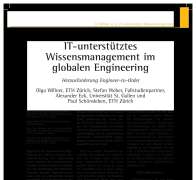
IT-Supported Knowledge Management in Global Engineering

IT-Supported Knowledge Management in Global Engineering

Herausforderung Engineer-to-Order
Olga Willner, Stefan Weber, Alexander Eck, Paul Schönsleben
As a consequence of globalized markets product development and engineering functions increasingly work in globally distributed teams. To overcome challenges of global engineering processes, leading companies employ IT applications for storing knowledge centrally and accessing it locally. Typical IT applications however are not sufficient for engineer-to-order products, i.e. products that are engineered and built to the particular specifications of a customer. This paper explores on the example of a large elevator manufacturer how knowledge-intensive tasks can be coordinated and executed globally, efficiently combining the distinct capabilities of distributed engineering sites.
Industrie Management | Volume 30 | 2014 | Edition 4 | Pages 49-52
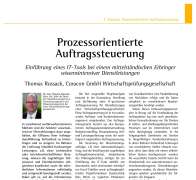
Process-Oriented Job Control

Process-Oriented Job Control

Implementation of an IT tool in a medium-sized professional service firm
Thomas Russack
In increasingly competitive markets professional service firms are highly recommended to continuously scrutinize and improve the efficiency of their job execution. Providing content-related high quality services, such as technical or business consulting, the respective sub-processes as well as each single activity have to be coordinated effectively and required information needs to be provided completely and in time. Thereby, requirements of an operation at different sites have to be considered, both at the customer’s and the company’s own premises, concerning various areas and locations. This article is an abstract of the problem, the solution and the project-related findings based on a practical example.
Industrie Management | Volume 29 | 2013 | Edition 4 | Pages 61-65
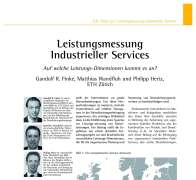
Performance Measurement of Industrial Services

Performance Measurement of Industrial Services

Which Dimensions Really Matter?
Gandolf R. Finke, Matthias Wandfluh, Philipp Hertz
Due to increased global competition as well as decreasing product margins industrial services are becoming increasingly important also in manufacturing companies. In parallel, the complexity of the service networks necessary to perform the different services continuously rises, leading to major challenges for these companies. In order to meet these challenges, companies rely on improved transparency. An important tool to achieve this is the introduction of KPIs to measure the performance of industrial services. In this paper we present results of an ongoing research project and describe the essential performance dimensions that must be considered for the planning and control of industrial service networks.
Industrie Management | Volume 29 | 2013 | Edition 1 | Pages 19-23
1 2 3 5