Autor: Paul Schönsleben

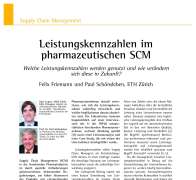
Key Performance Indicators within Pharmaceutical SCM

Key Performance Indicators within Pharmaceutical SCM

Welche Leistungskennzahlen werden genutzt und wie verändern sich diese in Zukunft?
Felix Friemann, Paul Schönsleben
Supply chain management (SCM) within the researching pharmaceutical industry is characterized by specific requirements: Especially regulations, a high value of the products with corresponding requirements on (anti counterfeit -) security and long cycle times characterize this industry. This article shows which key performance indicators supply chain managers at the biggest researching pharmaceutical companies use currently, how they change in the future and which implications can be derived from that. The findings mainly base on an interview series with 11 of the global TOP20 highest-grossing, researching pharmaceutical companies (ranking according to [1]) as well as a literature analysis and a single case study conducted at one of the companies.
Industrie Management | Volume 30 | 2014 | Edition 6 | Pages 30-34
IT-Supported Knowledge Management in Global Engineering

IT-Supported Knowledge Management in Global Engineering

Herausforderung Engineer-to-Order
Olga Willner, Stefan Weber, Alexander Eck, Paul Schönsleben
As a consequence of globalized markets product development and engineering functions increasingly work in globally distributed teams. To overcome challenges of global engineering processes, leading companies employ IT applications for storing knowledge centrally and accessing it locally. Typical IT applications however are not sufficient for engineer-to-order products, i.e. products that are engineered and built to the particular specifications of a customer. This paper explores on the example of a large elevator manufacturer how knowledge-intensive tasks can be coordinated and executed globally, efficiently combining the distinct capabilities of distributed engineering sites.
Industrie Management | Volume 30 | 2014 | Edition 4 | Pages 49-52
Energy Efficiency as Decision Criterion for the Purchase of Machine Tools

Energy Efficiency as Decision Criterion for the Purchase of Machine Tools

Energieeffizienz als Entscheidungskriterium beim Erwerb von Produktionsanlagen in der Automobilindustrie
Olga Willner, Manuel Rippel, Paul Schönsleben, Thomas Heck
Over the last two decades, themes such as resource scarcity, environmental pollution and rising commodity prices have gained increasing importance in the design of automotive industry production processes. As a result, the pressure on car manufacturers to plan their production facilities according to energy efficiency criteria is constantly rising. At present, machine tool suppliers still provide insufficient data to support purchasing decisions based on energy efficiency aspects. A case study conducted with Daimler AG explores a car manufacturer’s specific information requirements with respect to energy efficiency. Furthermore, an approach for the integration of energy data in the product data sheets of machine tool suppliers is presented.
Industrie Management | Volume 28 | 2012 | Edition 5 | Pages 33-36
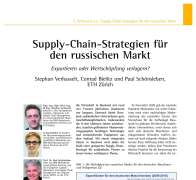
Supply Chain Strategies for the Russian Market

Supply Chain Strategies for the Russian Market

Export Goods or Outsource Production?
Stephan Verhasselt, Conrad Bielitz, Paul Schönsleben
Within the BRIC states the Russian economy seems to be a latecomer. Especially in comparison to China’s economy, which has grown with rates up to eleven percent during the last years, the Russian economy develops more slowly. However, Russia’s economy still offers good opportunities to foreign countries. In particular large public funded investment projects for modernising Russia’s infrastructure will require foreign technology and corresponding machines within the next years. With an increase in demand, the choice of a suitable supply chain strategy becomes more and more important for foreign companies participating in the Russian market.
Industrie Management | Volume 28 | 2012 | Edition 2 | Pages 23-28
Energy Management in Production

Energy Management in Production

Approaches for Monitoring and Controlling Energy Efficiency
Katharina Bunse, Matthias Vodicka, Paul Schönsleben
Current political developments regarding the withdrawal from nuclear energy will probably result in an additional increase in energy costs over the next few years. This increases the relevance of reducing energy consumption in production for industrial enterprises. Thus, in addition to quality, cost, delivery reliability and flexibility, energy efficiency is integrated as an additional performance criterion in the decisions of production managers. An important instrument to increase energy efficiency in production processes is the implementation of energy management. This paper presents the advantages of an integrated energy management and outlines the main tasks and methods. IT solutions are presented that assist companies in configuring and controlling production processes to become more energy efficient.
Industrie Management | Volume 27 | 2011 | Edition 6 | Pages 53-56
Economic and Ecologic Challenges in SCM

Economic and Ecologic Challenges in SCM

Approaches towards Efficient Recovery of Waste Materials
Matthias Vodicka, Katharina Bunse, Paul Schönsleben
Over the last decades, the cement industries achieved significant efficiency enhancements in their production processes. The so-called “co-processing”, the use of waste as a source of energy and raw material, was found to be both ecologically and economically beneficial. Cement plants can partially replace all fossil fuels by alternative ones and thus achieve significant reduction of cost and carbon footprint. Yet, in this context special challenges regarding supply chain management emerge. While respecting goals like quality, cost and delivery reliability, changing conditions need to be considered. Examples may be new regulations and the question of waste availability at nearby located industries as well as the desire to engage in long-term supply relationships. This article shows the relevant interrelations and presents approaches in order to contribute to a more efficient development of these supply chain relationships.
Industrie Management | Volume 27 | 2011 | Edition 6 | Pages 25-28
The Role of Industrial Services in Manufacturing

The Role of Industrial Services in Manufacturing

Lessons learned from the economic crisis
Fabrice Seite, Ruben Jönke, Paul Schönsleben
For many companies from the investment goods industry industrial services have evolved from a necessary prerequisite for selling a core product to a very important source of turnover and profit. But what role do industrial services play for the providing company during an economical crisis? To answer this question, the authors conducted interviews with six Swiss companies from machining and plant industry. The results of the research especially highlight the unique economic potential of industrial services. Companies may use the highlighted potential by adapting their service offering according to their customer’s economic situation.
Industrie Management | Volume 26 | 2010 | Edition 6 | Pages 57-61
Concept for an Organizational Structure for Lean Production

Concept for an Organizational Structure for Lean Production

Ansätze für eine angepasste Aufbauorganisation unter Anwendung von Lean-Grundsätzen
Katharina Bunse, Mario Schmuziger, Paul Schönsleben
„Lean Production“ is a known as successful production concept increasing productivity of a company in the long-term. Implementing lean principles in production can be challenging for the organizational structure of a company. Insufficient holistic process models, missing interface definitions and inflexible management structures can be major limitations. This article analyses - with the example of a Swiss production site of a company in the medical engineering sector - the challenges for the organization associated with the implementation of lean principles in operations. Requirements for an adapted organizational structure are highlighted and alternative organizational structures outlined. Advantages and disadvantages of these alternatives are presented and a solution for the case-study example developed. Companies in a similar environment can get suggestions for the adaption of their own organizational structure when implementing lean management principles in their production.
Industrie Management | Volume 26 | 2010 | Edition 2 | Pages 53-56
Strategic Power Factors in Buyer Supplier Relationships

Strategic Power Factors in Buyer Supplier Relationships

Josef Oehmen, Paul Schönsleben, Max von Bredow, Philipp Gruber, Gunther Reinhart
The increasing globalization gives western companies great new opportunities. Especially China gained increasing importance as a sourcing market in the last years. Despite these opportunities, a retreat of many companies from China could be witnessed recently. Among other factors, this is due to the fact that western companies cannot exert enough influence on the performance and price of their suppliers. This article presents tools and processes to successfully face this challenge and improve the own position of power as a customer.
Industrie Management | Volume 25 | 2009 | Edition 4 | Pages 29-33
Performance-Based Product-Service-System Contracts

Performance-Based Product-Service-System Contracts

Methodology for their development
Ingo Lange, Paul Schönsleben, Raphael Kunz
The past years have displayed a tremendous trend in which traditional manufacturing companies have become professional service providers by offering beneficial product-service bundles with a strong focus on customer needs. Driven by the outsourcing phenomenon, service providers are becoming an integrated part of the customers’ value chain processes. This service paradigm shift requires an increased joint service initiative between service providers and their customers. Measuring the performance and value created by industrial services, such as maintenance and packaging, is crucial to maintain ongoing and new collaborative service business relationships. Based on a case study with Bosch Packaging Services as a globally operating service provider, the article presents a generalized methodology for the development of performance-based service contracts integrating service processes, performance indicators and risk analysis as the basis for product-service business relationships.
Industrie Management | Volume 24 | 2008 | Edition 5 | Pages 17-20
1 2