Services

Success Factors for Professional Service Management in Manufacturing Enterprises

Success Factors for Professional Service Management in Manufacturing Enterprises

Thomas Friedli, Heiko Gebauer
This article reports how product manufacturers can benefit from an extended service business. After a short introduction, we explain the transition line from product manufacturers into service providers and describe the challenges inherent in the transition process. Then, we focus on identifying the success factors that need to be considered when creating a professional service management in the context of a manufacturing firm, and triggers to navigate the transition.
Industrie Management | Volume 19 | 2003 | Edition 5 | Pages 74-77
Operate Instead of Sale

Operate Instead of Sale

Perspectives of new, company spanning business models in plant engineering
Gunter Lay, Horst Meier, Jürgen J. Schramm, Arndt Werding
Business relation between customer and supplier is less characterized by purchase of investment goods. In terms of specific use tasks the functional utility of investment goods becomes of higher weight shortly. Within the new business relationship supplier becomes full-service-supplier and cus-tomer becomes user, as flexibility and availability are increasing. The definition contracting model used in plant engineering and construction describes the change from purchasing and property to acquisition by use. Due to the fact that it is a complex term, realizable types and physical forms of contracting models are presented below. Based on this, first experiences with contracting models are presented, future significance of contracting models is calculated, possible short-ages are identified as well as the need to act which hinder an implementation of contracting models yet.
Industrie Management | Volume 19 | 2003 | Edition 4 | Pages 9-13
The Extension of the Product Term

The Extension of the Product Term

Concept and Examples
Klaus-Dieter Thoben ORCID Icon, Jens Eschenbächer
The majority of manufacturing enterprises is currently trying to become more competitive in the preparation of customer-centric and innovative products. The focus of manufacturing paradigm is changing from a mainly sales-driven business towards a provider of utility or benefit to the customer. Consequently, the traditional product definition must be extended. Based on the description of the concept of extended products, this paper discusses approaches to extend the classical product definition and the resulting requirements. Additionally, the role of collaboration in enterprise networks will be discussed. Some practical examples are mentioned.
Industrie Management | Volume 19 | 2003 | Edition 4 | Pages 48-51
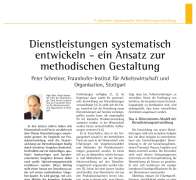
Systematic Development of Services A Methodical Approach

Systematic Development of Services A Methodical Approach

ein Ansatz zur methodischen Gestaltung
Peter Schreiner
In recent years, services increasingly became a subject in research as well as in practice. In comparison with product development new service development often is dominated by intuitive action. Therefore there is a huge potential for optimizing the development procedure in terms of a determination, quality and customer focus. This article introduces an approach for service development that is based on a methodical approach. It is shown, how the complex task of service development can be simplified.
Industrie Management | Volume 19 | 2003 | Edition 4 | Pages 75-77
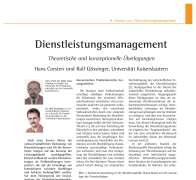
Service Management – Theoretical and Conceptual Considerations

Service Management - Theoretical and Conceptual Considerations

Theoretische und konzeptionelle Überlegungen
Hans Corsten, Ralf Gössinger
This article aims at pointing out both theoretical starting points and a conceptual framework for the management of services. The theoretical considerations take up the concept of the bundles of values and the interpretation of services as solutions to customers’ problems. On the conceptual level, a structuring of the complex ma- nagement problem is proposed. This makes it possible to identify relevant action fields and to subject to a differentiated analysis.
Industrie Management | Volume 19 | 2003 | Edition 4 | Pages 23-27
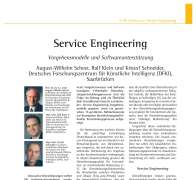
Service Engineering – Procedure Models and ICT-Support

Service Engineering - Procedure Models and ICT-Support

August-Wilhelm Scheer, Ralf Klein, Kristof Schneider
Innovative services increasingly represent a critical factor for industrial enterprises to differ from competitors. While the industrial engineering was optimized over decades, services generally are designed unsystematically. This results inefficient planning and failures in meeting the needs of the customer. The article gives an overview on basic forms of existing service engineering procedure models and describes a generic, ICT-supported framework for the service-specific design of development processes.
Industrie Management | Volume 19 | 2003 | Edition 4 | Pages 15-18
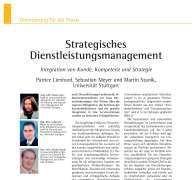
Strategic Service Management – Integration of Customer, Competences and Strategy

Strategic Service Management - Integration of Customer, Competences and Strategy

Integration von Kunde, Kompetenz und Strategie
Patrice Lienhard, Sebastian Meyer, Martin Stanik
Service companies and service offering industrial enterprises face new challenges. These include the increasing substitution of similar goods and services from one enterprise with those of another, dynamic resources and the emancipation of the customer caused by the change from a seller’s to a buyer’s market. Knowledge about their own abilities, the customer’s needs, as well as their integration into a service strategy become critical success factors of an enterprise.
Industrie Management | Volume 19 | 2003 | Edition 4 | Pages 36-39
Improving Knowledge Transfer, Strengthening Service Competence

Improving Knowledge Transfer, Strengthening Service Competence

Learning History
Patrice Lienhard, Marc Opitz
Knowledge as strategic resource becomes even more important now than in the past, because of the turbulent change experienced by a company and its operating environment. Therefore, innovative service companies attempt to bundle the existing knowledge in the company and to use it optimal. Through the accumulation of know-ledge, competencies arise which the competitor has difficulties imitating and which create a competitive advantage. The learning history method can now help to recover implicit knowledge in the company, to improve processes and to strengthen the service competence.
Industrie Management | Volume 19 | 2003 | Edition 3 | Pages 67-70
Barriers for Product Configuration Tools in Automation Industry

Barriers for Product Configuration Tools in Automation Industry

An Empirical Survey
Marc Szydlowski, Ines Greve-Ecker, Matthias Trier
CRM manages customer interactions in marketing, sales and service. Based on an empirical survey the barriers for product configuration software to support the sales process in the automation industry are presented. In this industry, CRM systems are currently primarily employed for the optimization of after-sales services.
Industrie Management | Volume 19 | 2003 | Edition 1 | Pages 25-28
1 4 5