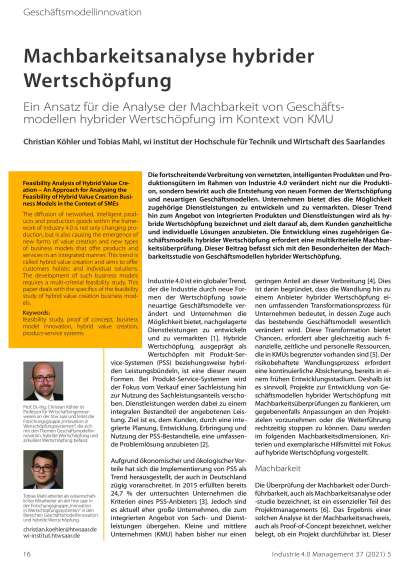
Feasibility Analysis of Hybrid Value Creation − An Approach for Analysing the Feasibility of Hybrid Value Creation Business Models in the Context of SMEs

Ein Ansatz für die Analyse der Machbarkeit von Geschäfts-modellen hybrider Wertschöpfung im Kontext von KMU

JournalIndustrie 4.0 Management
Issue Volume 37, 2021, Edition 5, Pages 16-20
Open Accesshttps://doi.org/10.30844/I40M_21-5_S16-20
Bibliography Share Cite Download

Abstract

The diffusion of networked, intelligent products and production goods within the framework of Industry 4.0 is not only changing production, but is also causing the emergence of new forms of value creation and new types of business models that offer products and services in an integrated manner. This trend is called hybrid value creation and aims to offer customers holistic and individual solutions. The development of such business models requires a multi-criterial feasibility study. This paper deals with the specifics of the feasibility study of hybrid value creation business models.

Keywords


Bibliography

[1] Kagermann, H.; Wahlster, W.; Helbig, J.: Umsetzungsempfehlungen für das Zukunftsprojekt Industrie 4.0. Deutschlands Zukunft als Produktionsstandort sichern. Abschlussbericht des Arbeitskreises Industrie 4.0. 1 Band. Frankfurt/Main: Plattform Industrie 4.0 / Forschungsunion Wirtschaft – Wissenschaft. 2013, URL: www.bmbf.de/files/Umsetzungsempfehlungen_Industrie4_0.pdf, Abrufdatum 11.05.2021.
[2] Meier, H.; Uhlmann, E.: Produktverständnis im Wandel. In: Meier, H.; Uhlmann, E. (Hrsg): Industrielle Produkt-Service Systeme: Entwicklung, Betrieb, Management (2017), S. 1-16.
[3] Bahrke, M.; Kempermann, H.: Hybride Geschäftsmodelle als Lösungsanbieter zum Erfolg: Eine vbw Studie, erstellt vom Institut der deutschen Wirt- schaft Consult GmbH. München 2015.
[4] Biege, S.; Schröter, M; Gan- denberger, C.; Buschak, D.; Weißfloch, U.; Schlummer, M.; Jäger, A.; Merk, S.: Chancen für die nachhaltige Entwicklung durch neue hybride Wertschöpfungskonzepte. Stuttgart 2013.
[5] Lins, D.; Arnold, D.; Mahl, T.; Köhler, C.; Kuhlenkötter, B.; Prinz, C.: Phasenmodell zur Überwindung von Implementierungsbarrieren bei der Entwicklung hybrider Geschäftsmodelle; 67. Kongress der Gesellschaft für Arbeitswissenschaft (GfA), 03.-05. März 2021, Bochum. Bochum 2021.
[6] DIN Deutsches Institut für Normung.: DIN-Taschenbuch 472: Projektmanagement: Netzplantechnik und Projektmanagementsysteme, 1. Auflage. Berlin 2009.
[7] Rat für Forschung und Technologieentwicklung: Empfehlung zu einer optimierten Proof-of-Concept-Unterstützung im Wissenstransfer. URL: www.rat-fte.at/files/rat-fte-pdf/einzelempfehlungen/2013/131203_Empfehlung_Proof%20of%20 Concept.pdf, Abrufdatum 11.05.2021.
[8] Felkai, R.; Biederwieden, A.: Projektmanagement für technische Projekte: Ein Leitfaden für Studium und Beruf, 3. Auflage. Wiesbaden 2015.
[9] Wirtz, B. W.; Thomas, M.-J.: Design und Entwicklung der Business Model-Innovation. In: Schallmo, D. R. A. (Hrsg): Kompendium Geschäftsmodell-Innovation: Grundlagen, aktuelle Ansätze und Fallbeispiele zur erfolgreichen Geschäftsmodellinnovation. Wiesbaden 2014.
[10] Kuster, J.; Bachmann, C.; Huber, E.; Hubmann, M.; Lippmann, R.; Schneider, E.; Schneider, P.; Witschi, U.; Wüst, R.: Handbuch Projektmanagement: Agil-Klassisch-Hybrid, 4. Auflage. Berlin 2019.
[11] Andelfinger, V. P.: Geschäftsmodelle – das magische Dreieck aus Machbarkeit, Erwünschtheit und wirtschaftlicher Tragfähigkeit und die Schieflage in aktuellen eHealth- und AALProjekten. In: Andelfinger, V., P.; Hänisch, T. (Hrsg): Wie Smartphones, Apps und Wearables die Gesundheitsversorgung verändern werden. Wiesbaden 2016.
[12] Berry, G.; Shabana, K., M.: Adding a strategic lens to feasibility analysis. In: New England Journal of Entrepreneurship, Vol. 23 (2020) 2, S. 67-78
[13] Harwardt, M.: Management der digitalen Transformation: Eine praxisorientierte Einführung, Wiesbaden 2019
[14] Pastoors, S; Scholz, U.: Phase 7: Ideen umsetzen und Markteinführung vorbereiten. In: Scholz, U.; Pastoors, S.; Becker, J. H. u.a.: Praxishandbuch Nachhaltige Produktentwicklung: Ein Leitfaden mit Tipps zur Entwicklung und Vermarktung nachhaltiger Produkte. Berlin 2018.

Your downloads


Potentials: Services

You might also be interested in

MAKI—A Digital Assistant for Practice-Based Learning

MAKI—A Digital Assistant for Practice-Based Learning

Why every factory is a learning factory
Olaf Resch ORCID Icon
With the help of digital assistants, academic teaching is possible in any factory. In order to achieve the best learning effects, however, the interests of all stakeholders must be taken into account. The factory wishes to deploy its employees quickly and productively, the learners desire a positive learning experience, and the educators want to illustrate abstract concepts in a meaningful and practical way. The only way to combine all of these perspectives is via a well-thought-out educational concept and highly functioning technology.
Industry 4.0 Science | Volume 42 | 2026 | Edition 2 | Pages 70-77
Serious Gaming and the Energy Transition

Serious Gaming and the Energy Transition

Collaborative knowledge generation and interactive understanding of complex interrelationships
Janine Gondolf ORCID Icon, Gert Mehlmann, Jörn Hartung, Bernd Schweinshaut, Anne Bauer
Conveying the complexity and multifaceted nature of the energy transition to a broad audience is a challenge. This article demonstrates how interactive serious games on a multitouch table can help make connections tangible and comprehensible. The games and the table were used in various conversational contexts. These are presented here in three case vignettes based on participant observation of the different applications, as well as situated and shared reflection. The vignettes demonstrate how interaction can trigger epistemic processes, enable shifts in perspective, and foster collective thinking, all of which are necessary for shaping the future of society as a whole.
Industry 4.0 Science | Volume 42 | 2026 | Edition 2 | Pages 62-69
Industrial Transformation via a Machining Learning Factory

Industrial Transformation via a Machining Learning Factory

A learning module to foster competencies for a sustainability-driven transformation
Oskay Ozen ORCID Icon, Victoria Breidling ORCID Icon, Stefan Seyfried ORCID Icon, Matthias Weigold
Sustainability-enhancing transformation processes are necessary in all sectors if we are to remain within planetary boundaries. This also applies to the industrial sector as a significant emitter of greenhouse gases. Employees need new competencies to master this complex task of industrial transformation. These range from CO2 equivalents accounting to the development and evaluation of transformation scenarios, including technical measures. The learning module developed here addresses these competency requirements and uses the example of the ETA factory to show how a competency-oriented learning module for industrial transformation can be structured. It essentially comprises four phases: data collection and CO2 equivalents accounting, cause analysis, development of measures and evaluation of measures.
Industry 4.0 Science | Volume 42 | Edition 2 | Pages 38-47 | DOI 10.30844/I4SE.26.2.38
Building the Future Workforce Today

Building the Future Workforce Today

Trendiation as a strategic framework for employee qualification and training
Jürgen Fritz, Sebastian Busse, Ingo Dieckmann, Torsten Laub
As Industry 4.0 and artificial intelligence reshape organizational capabilities, traditional training systems struggle to keep pace with evolving skill requirements. This paper introduces Trendiation—a structured methodology for translating emerging trends into actionable strategies—as a systematic approach to this challenge. Through a workshop-based application examining Edutainment, Human-Centered Design, and Workforce Transformation, we demonstrate how organizations can move from abstract trend identification to concrete qualification requirements and prioritized training initiatives. The method produces a traceable artifact chain spanning trend framing, capability-gap assessment, and implementation roadmaps. Participant evaluations indicate high perceived clarity and practical utility. By bridging foresight analysis with participatory design, Trendiation enables organizations to proactively cultivate adaptive capabilities and build learning cultures aligned with future work ...
Industry 4.0 Science | Volume 42 | 2026 | Edition 2 | Pages 22-29 | DOI 10.30844/I4SE.26.2.22
Data Quality and Domain Expertise for Resilient AI Deployment

Data Quality and Domain Expertise for Resilient AI Deployment

Integrating anomaly and label error detection in industry
Pavlos Rath-Manakidis, Henry Huick, Erdi Ünal, Björn Krämer ORCID Icon, Laurenz Wiskott ORCID Icon
AI implementation transforms work and worker-technology relationships in industrial quality control. This paper explores how approaches to data quality and model transparency support ethical AI deployment, fostering worker agency, trust, and sustainable work design in automatic surface inspection systems (ASIS). Recurring problems like data inefficiency, variable model confidence, and limited AI expertise point to key challenges of human-centered AI: user trust, agency and responsible data management. A solution co-developed with an ASIS supplier demonstrates that the challenges extend beyond the purely technical, underscoring the value of AI design that augments human capabilities. Technical solutions such as anomaly, label error, and domain drift detection are proposed to enhance data quality and model reliability. The insights emphasize the following generalizable strategies for resilient AI integration: understanding user-reported problems through a human-AI interaction lens, ...
Industry 4.0 Science | Volume 42 | Edition 1 | Pages 128-135 | DOI 10.30844/I4SE.26.1.120
Operationalizing Ethical AI with tachAId

Operationalizing Ethical AI with tachAId

Validating an interactive advisory tool in two manufacturing use cases
Pavlos Rath-Manakidis, Henry Huick, Björn Krämer ORCID Icon, Laurenz Wiskott ORCID Icon
Integrating artificial intelligence (AI) into workplace processes promises significant efficiency gains, yet organizations face numerous ethical challenges that stakeholders are often initially unaware of—from opacity in decision-making to algorithmic bias and premature automation risks. This paper presents the design and validation of tachAId, an interactive advisory tool aimed at embedding human-centered ethical considerations into the development of AI solutions. It reports on a validation study conducted across two distinct industrial AI applications with varying AI maturity. tachAId successfully directs attention to critical ethical considerations across the AI solution lifecycle that might be overlooked in technically-focused development. However, the findings also reveal a central tension: while effective in raising awareness, the tool’s non-linear design creates significant usability challenges, indicating a user preference for more structured, linear guidance, especially ...
Industry 4.0 Science | Volume 42 | 2026 | Edition 1 | Pages 50-59 | DOI 10.30844/I4SE.26.1.48