Sustainability

Ecological Aspects Logistics

Ecological Aspects Logistics

Bernd Scholz-Reiter ORCID Icon, Felix Böse, Uwe Hinrichs, Christian Toonen
Against the backdrop of increasing importance of ecological aspects within all company functions, logistics has to be repositioned to comply with upcoming ecological challenges. This article introduces the concept of ecologistics and its measures within all fields of corporate logistics. As an example distribution logistics is detailed in its effort to consider ecological relevant aspects within the planning and control and the configuration of logistical structures.
Industrie Management | Volume 23 | 2007 | Edition 5 | Pages 15-18
Activity-Based Costing in Logistic Areas

Activity-Based Costing in Logistic Areas

Prozessorientierung erhöht Kostentransparenz
Jochen Deuse ORCID Icon, Christian Goldscheid, Yvonne Finke
A crucial criterion for the competitiveness of logistic areas (besides the efficency of logistic processes) is cost transparency, i. e. the cost allocation to performed logistic services. Since logistic processes unlike production processes do not generate material goods but services, it is very common to find cost structures where traditional cost accounting systems lead to distortion of costs. Activity-based costing facilitates process-oriented cost calculation and cost allocation to service processes.
Industrie Management | Volume 23 | 2007 | Edition 5 | Pages 35-38
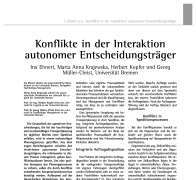
Conflicts Among Decision Makers in the Freight Forwarding Company

Conflicts Among Decision Makers in the Freight Forwarding Company

Ina Ehnert, Marta Anna Krajewska, Herbert Kopfer, Georg Müller-Christ
An integrated operational transportation planning within a freight forwarding company demands a multilevel planning process involving several stages of decision makers. Interactions among the involved autonomous workers generate conflicts. The barriers created by such conflicts should be removed in order to generate a positive emergence of the planning processes. On the basis of theoretical frames for conflict management the possibilities of coping with the conflicts arising in the freight forwarding company are introduced.
Industrie Management | Volume 23 | 2007 | Edition 4 | Pages 31-33
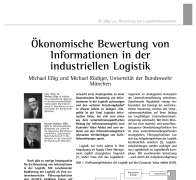
Economic Evaluation of Information in Industrial Logistics

Economic Evaluation of Information in Industrial Logistics

Challenges and first thoughts about value orientation in information logistics
Michael Eßig, Michael Rüdiger
Up to now there are few approaches to an evaluation of information in logistics. However, with the increasing establishment of logistics as a corporate leadership function and a visible increase of the focus on company spanning control of supplier-buyer relationships as part of Supply Chain Management, we also see an increase in the need for an evaluation of information. This article attempts to give first thoughts about an economic evaluation of information in logistics and also attempts to substantiate the need for continued research in this subject area. The presented approach is the Total Logistics Information Value which consist of the company specific contributions of information logistics to the Economic Value Added on the one hand, and the information logistically relevant value added by the suppliers on the other hand.
Industrie Management | Volume 23 | 2007 | Edition 4 | Pages 45-48
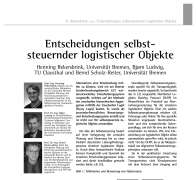
Decisions of Autonomously Controlled Logistic Objects

Decisions of Autonomously Controlled Logistic Objects

Henning Rekersbrink, Bjørn Ludwig, Bernd Scholz-Reiter ORCID Icon
Autonomously controlled transportation processes require decision making of logistic objects regarding routing alternatives. In this contribution a multicriterial evaluation assessment procedure is introduced basing on the fuzzy hierarchical aggregation, adapted and further developed at the CRC 637 “Autonomous Control of Logistic Processes” at Bremen University. The main design focus was user-friendliness within autonomous control and other fields of application. The example of use is a hierarchical structure of the subcriteria characterising the routing alternatives of an autonomous package. It is shown that the procedure can consider unprecise and fuzzy formulated knowledge directly in the model, while parameter adjusting was reduced to a minimum. Different weightings and compensation effects of subcriteria are depicted. The contribution shows the evaluation on a two-subcriteria basis and the possibilities of multicriterial evaluation as well. The evaluation of hard and soft ...
Industrie Management | Volume 23 | 2007 | Edition 4 | Pages 25-30
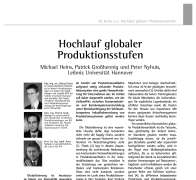
Ramp-up of Global Production Stages

Ramp-up of Global Production Stages

Michael Heins, Patrick Großhennig, Peter Nyhuis ORCID Icon
Today globalization is a common challenge companies have to cope with. Cost aspects are still playing an essential role in this context. To ensure a long-term profitability, companies also have to consider non-monetary factors like core-competences. Besides globalization the increasing rate of ramp-ups caused by decreasing product life-cycles is a big challenge for companies. This article will introduce approaches to deal with the conflict of objectives between cost-reduction, safe-guarding of core-competences and ramp-up of production systems.
Industrie Management | Volume 23 | 2007 | Edition 3 | Pages 55-58
Intellectual Capital: Your Future Assets

Intellectual Capital: Your Future Assets

Reporting and Development of Intangible Assets
Katja Pook
Corporate success depends increasingly on immaterial assets. These are hard to assess, evaluate and shape. Only a few companies manage them systematically. Intellectual Capital Reporting provides a framework and opens the way for sustainable management of intangible assets.
Industrie Management | Volume 22 | 2006 | Edition 6 | Pages 45-46
Cooperation in Reverse Logistic Networks

Cooperation in Reverse Logistic Networks

Grit Walther, Thomas Spengler
New legal regulations require subsequent organisational and structural changes within the field of recycling complex discarded products (electronic scrap, end-of-life vehicles). Horizontal networks of small and medium sized companies are regarded to be especially suited for the resulting tasks. However, analyses of existing networks show a high diversity of company and network types. Therefore, empirical studies were carried out with the goal of determining characteristics, targets, and measures of existing recycling networks.
Industrie Management | Volume 22 | 2006 | Edition 3 | Pages 49-52
Cooperating Routing Protocols for Autonomous Controlled Transport Processes

Cooperating Routing Protocols for Autonomous Controlled Transport Processes

Bernd Scholz-Reiter ORCID Icon, Henning Rekersbrink, Michael Freitag ORCID Icon
For the implementation of autonomous control of transport processes it is tried to transfer well known and approved routing protocols from data communication to transport problems. Here structural differences between data and transportation networks prevent a direct transfer of the protocols, so that several different, particularly adapted protocols with different targets must cooperate in transportation networks. In the following a concept for autonomous controlled transport networks, called “Distributed Logistics Routing Protocol”, is introduced, developed at the CRC 637 “Autonomous Control of Logistic Processes” in Bremen.
Industrie Management | Volume 22 | 2006 | Edition 3 | Pages 7-10
Medium-Sized Businesses and Cooperations

Medium-Sized Businesses and Cooperations

Success by Systematical Outsourcing
Jens Gericke
Many companies have difficulties managing the recent situation of competition. Some companies achieve only small cost savings through the use of rationalization strategies. Network cooperations, however, offer many possibilities to successfully take advantage of efficiency increasing synergy effects. All participating companies can concentrate harder on their core business and achieve other features in cooperation with partner companies. This development concerns major enterprises as well as medium-sized businesses. While Outsourcing can be seen as a routine job for major enterprises, it poses problems for medium-sized businesses. These companies are lacking the necessary experience as well as tools to evaluate Outsourcing. This contribution points out the problems, that are related to Outsourcing in medium-sized businesses and demonstrates solutions.
Industrie Management | Volume 22 | 2006 | Edition 3 | Pages 45-48
1 15 16 17 18